When our customer approached us with a concept for a Medical Aesthetic Device Cart Enclosure, the challenge was not simply building a housing. The real challenge was combining luxury aesthetics, structural strength, precision assembly, and manufacturability into one integrated product.
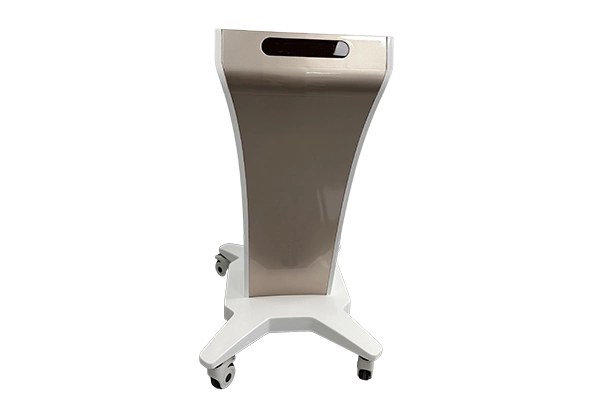
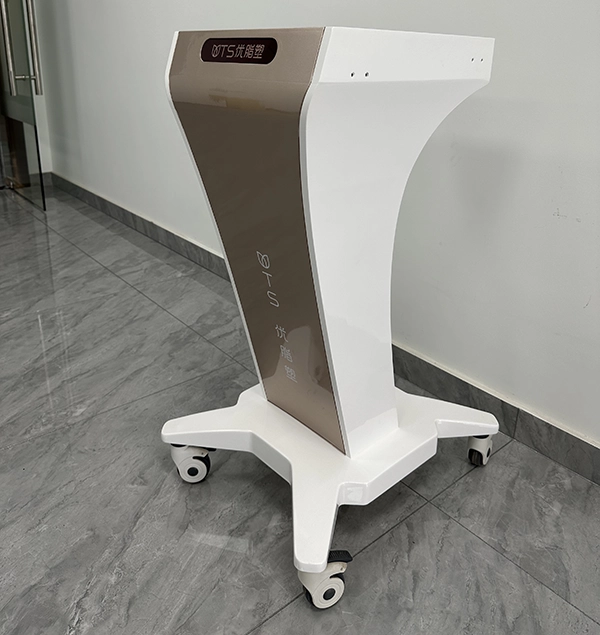
At Zhongrongda, our team was responsible for transforming the customer’s design into a production-ready enclosure measuring 51 cm long, 63 cm wide, and 110 cm high.
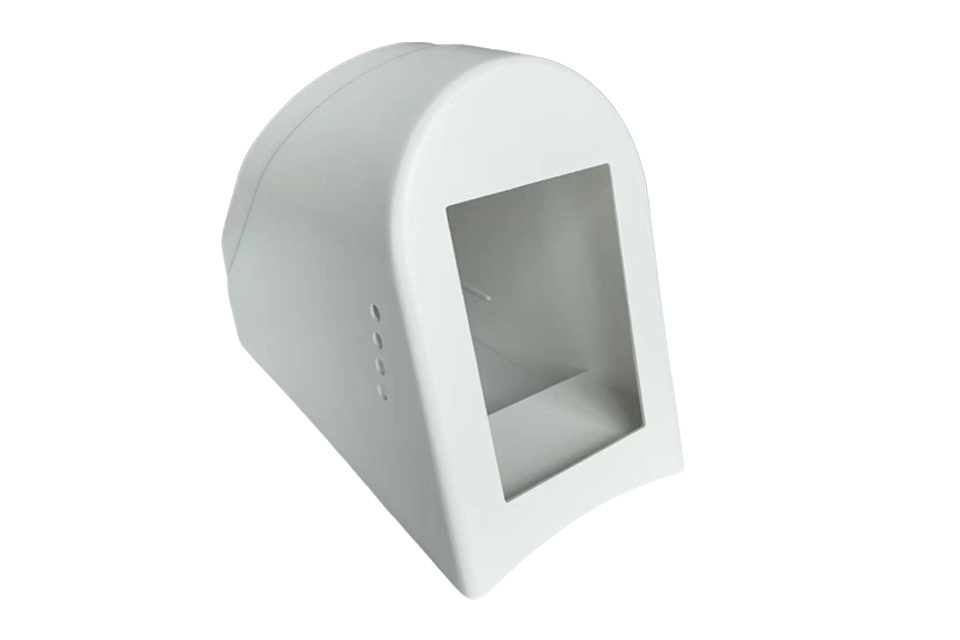
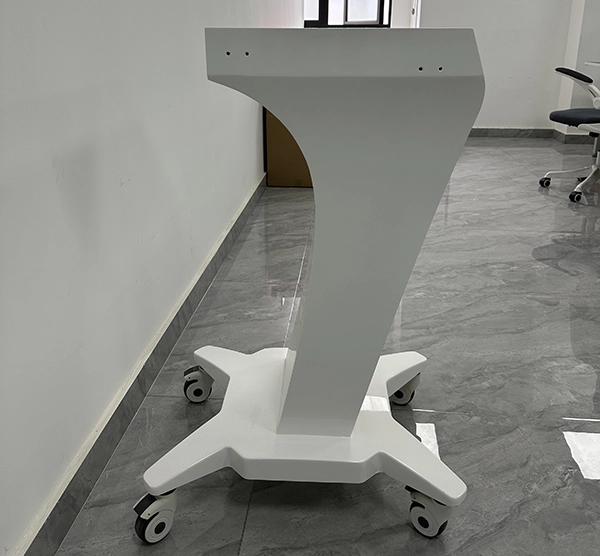
The enclosure featured a dramatic dual-curved waistline profile, a CNC-machined aluminum front panel, high-gloss piano paint surfaces, matte white powder-coated sections, and a heavy-duty mobile base capable of supporting sophisticated medical aesthetic equipment.
From the first prototype through final assembly, nearly every stage presented engineering challenges that required detailed process optimization.
Medical Aesthetic Device Cart Enclosure Design Requirements
The product consisted of:
- 6063-T5 aluminum alloy decorative front panel
- Reinforced cold-rolled steel structural frame
- ABS and sheet metal integrated base
- High-gloss piano paint exterior
- Matte white electrostatic powder coating
- Precision caster mounting structure
The customer required:
- Luxury aesthetic appearance
- Consistent curved surfaces
- Invisible assembly transitions
- Tight panel gaps
- High structural rigidity
- Easy internal equipment installation
These requirements immediately created several manufacturing risks.
Solving Dual-Curved Sheet Metal Forming Challenges
Precision Sheet Metal Forming for Custom Medical Device Enclosures
The most difficult feature of this Medical Aesthetic Device Cart Enclosure was the symmetrical dual-curved waist profile.
Although the shape appears simple, maintaining perfect symmetry between both sides is extremely difficult during sheet metal fabrication.
Potential defects included:
- Uneven curvature
- Twisting after bending
- Assembly misalignment
- Visible asymmetry
At Zhongrongda, our team first converted the customer’s design data into bend simulation models.
Before production tooling was finalized, we created validation samples through Rapid Prototyping to verify curve consistency and assembly behavior.
Multiple CNC bending programs were tested until both sides consistently met tolerance requirements.
This process significantly reduced dimensional deviation before welding.
Eliminating Distortion During Welding
Maintaining Surface Accuracy After Sheet Metal Assembly
After forming, the enclosure required extensive welding.
Traditional welding methods can introduce:
- Heat distortion
- Surface waviness
- Misaligned panels
- Post-processing difficulties
To prevent these issues, our team implemented controlled welding sequences and custom fixtures.
Every welded assembly was measured after each major operation.
The result was a stable enclosure structure capable of supporting heavy internal equipment while maintaining cosmetic appearance standards.
For customers developing new equipment platforms, this approach often shortens development cycles compared with redesigning problems later.
Achieving Piano Gloss Surface Quality
High Gloss Medical Device Enclosure Finishing Challenges
One of the customer’s most important requirements was the piano-gloss black finish.
High-gloss surfaces expose every imperfection.
Common defects include:
- Orange peel texture
- Dust particles
- Color inconsistency
- Sanding marks
- Surface waviness
Because the enclosure featured large curved surfaces, maintaining visual consistency became even more challenging.
At Zhongrongda, we implemented a multi-stage finishing process.
The workflow included:
- Surface preparation
- Primer coating
- Precision sanding
- Intermediate inspection
- Gloss coating
- Final polishing
Each stage was inspected before proceeding to the next operation.
The final finish delivered mirror-like reflections without visible texture variation.
Creating Seamless Aluminum Panel Integration
CNC Machining and Precision Assembly
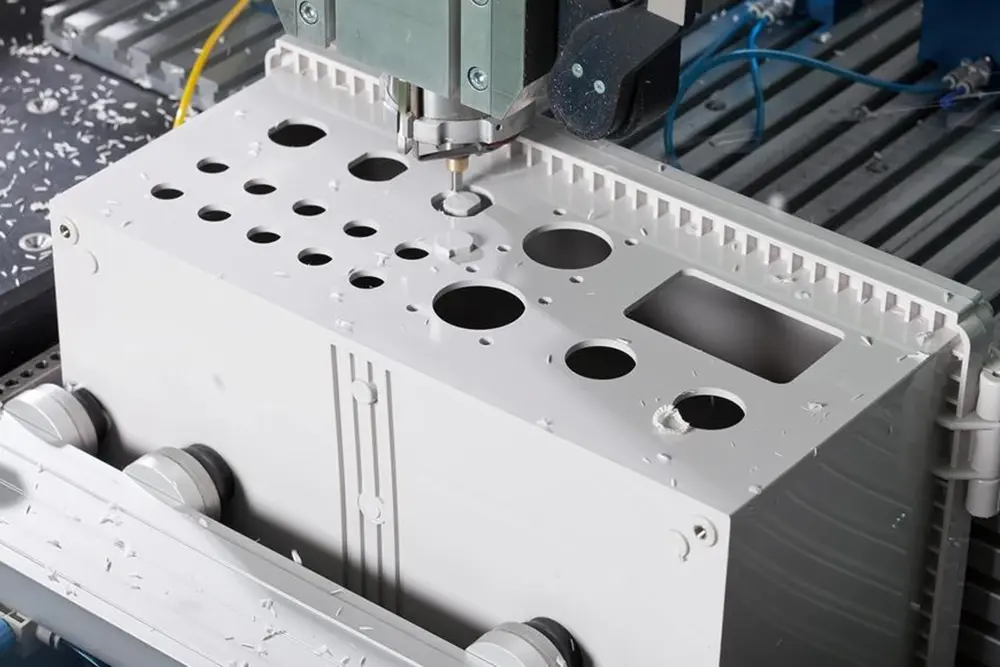
The front decorative panel was manufactured from aluminum alloy.
The component required:
- CNC precision machining
- Accurate logo positioning
- Window openings
- Tight assembly tolerances
Even small dimensional deviations would create visible gaps between the aluminum panel and the enclosure body.
Using our CNC Machining capability, we produced the panel with precise dimensional control and repeatable surface quality.
During assembly verification, our team repeatedly adjusted interface dimensions to achieve uniform panel gaps around the entire perimeter.
The final assembly delivered a premium appearance expected in high-end medical aesthetic equipment.
Preventing Surface Damage During Manufacturing
Protecting Piano Gloss Medical Device Enclosures
High-gloss painted surfaces are extremely vulnerable during production.
Potential damage sources included:
- Handling scratches
- Packaging abrasion
- Assembly contact marks
- Transportation impact
To solve this issue, we developed a staged protection strategy.
Protective films were applied immediately after inspection.
Dedicated transport fixtures prevented component contact.
Assembly personnel followed designated handling procedures.
As a result, surface quality remained stable from production through shipment.
Balancing Structural Strength and Luxury Appearance
Engineering the Internal Structure
A frequent challenge in Medical Device Enclosure projects is balancing appearance with functionality.
Customers often focus on external styling while internal equipment requires:
- Load-bearing support
- Cable routing
- Cooling considerations
- Service accessibility
At Zhongrongda, our engineering team optimized both structural and cosmetic requirements simultaneously.
The reinforced steel frame provided rigidity.
The outer shell maintained elegant proportions.
The base structure supported medical-grade caster systems while preserving the overall design language.
This balance is critical in modern Beauty Device Enclosures where appearance directly influences product positioning.
Why Early Prototyping Reduced Production Risks
Before committing to mass production, our team produced multiple functional samples.
Using Rapid Prototyping, we verified:
- Curve symmetry
- Assembly gaps
- Internal component fit
- Surface treatment compatibility
By identifying risks early, we reduced the likelihood of expensive tooling modifications later in the project.
For complex aesthetic equipment housings, prototype validation remains one of the most effective methods for controlling development risk.
Material Selection Considerations
The enclosure combined multiple materials:
- 6063-T5 aluminum alloy
- Cold rolled steel
- ABS engineering plastic
Each material was selected based on specific performance requirements.
For engineers evaluating material properties, the external reference ABS plastic properties and applications provides useful technical background regarding durability, impact resistance, and manufacturability.
Final Production Results
The completed Medical Aesthetic Device Cart Enclosure achieved:
- Consistent dual-curved geometry
- Uniform panel gaps
- Mirror-quality piano gloss finish
- High structural strength
- Reliable caster integration
- Stable production repeatability
Most importantly, the enclosure successfully combined premium aesthetics with practical engineering requirements.
4. FAQ
1. What is a Medical Aesthetic Device Cart Enclosure?
A Medical Aesthetic Device Cart Enclosure is a structural housing used to protect and support medical aesthetic equipment while providing mobility, appearance, and internal equipment integration.
2. Why is curved sheet metal fabrication difficult?
Curved sheet metal requires precise bending control. Small deviations can create asymmetry, assembly issues, and visible appearance defects.
3. Why use aluminum front panels?
Aluminum panels provide lightweight strength, precision machining capability, and premium appearance quality.
4. What causes defects in piano gloss finishes?
Common causes include dust contamination, poor sanding, uneven coating thickness, and inadequate curing control.
5. Why is prototyping important for medical device enclosures?
Prototyping helps identify structural, assembly, and cosmetic issues before production tooling is finalized.
6. What materials are commonly used in beauty device enclosures?
Aluminum alloy, cold rolled steel, ABS plastic, and engineering polymers are commonly used.
7. How are panel gaps controlled?
Panel gaps are controlled through CNC machining, fixture design, tolerance management, and assembly verification.
8. Why is surface protection critical during production?
High-gloss finishes are highly susceptible to scratches and require controlled handling procedures.
9. Can custom medical equipment housings support heavy equipment?
Yes. Properly engineered steel frame structures provide high load-bearing capacity while maintaining cosmetic appearance.
10. What services does Zhongrongda provide for enclosure projects?
Zhongrongda supports prototyping, CNC machining, sheet metal fabrication, assembly validation, and production manufacturing.
{ “@context”:”https://schema.org”, “@type”:”Article”, “headline”:”Custom Medical Aesthetic Device Cart Enclosure Manufacturing”, “author”:{ “@type”:”Organization”, “name”:”Zhongrongda” }, “publisher”:{ “@type”:”Organization”, “name”:”Zhongrongda” }, “datePublished”:”2026-06-03″, “articleSection”:”Medical Device Enclosure Manufacturing”, “keywords”:”Medical Aesthetic Device Cart Enclosure, Medical Device Enclosure, Beauty Device Enclosures”, “contactPoint”:{ “@type”:”ContactPoint”, “telephone”:”+86 13972955806″, “email”:”info@zrdmfg.com” } }CTA
Need a Custom Medical Aesthetic Device Cart Enclosure?
If your project involves complex curved sheet metal fabrication, CNC-machined aluminum panels, piano gloss finishing, or precision medical equipment housing assembly, our team at Zhongrongda can help evaluate manufacturability before production begins.
Email: info@zrdmfg.com
Phone: +86 13972955806
Contact us today to discuss your next custom enclosure project.