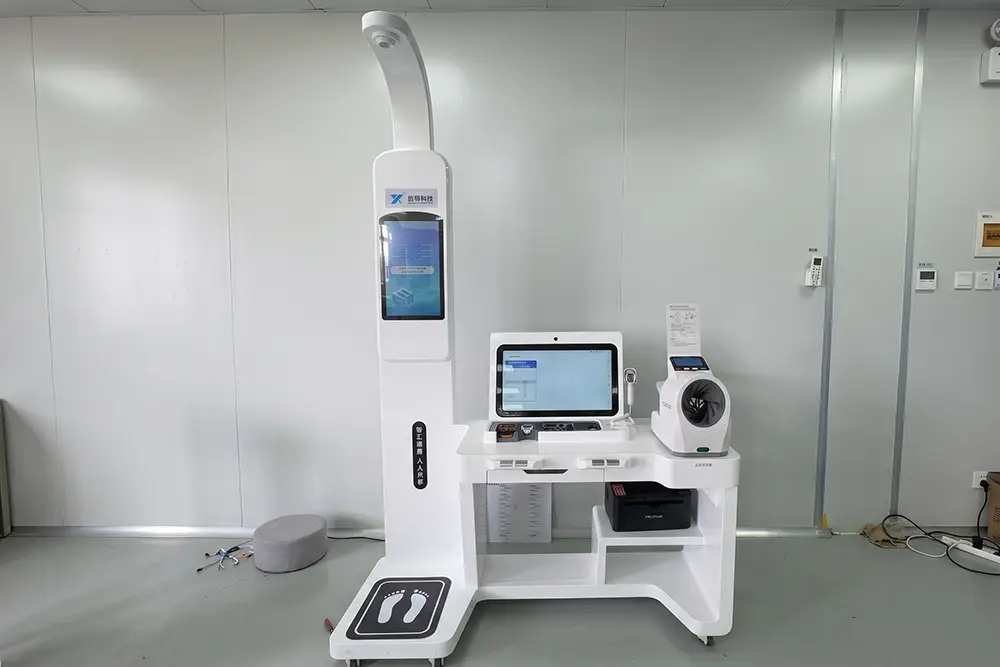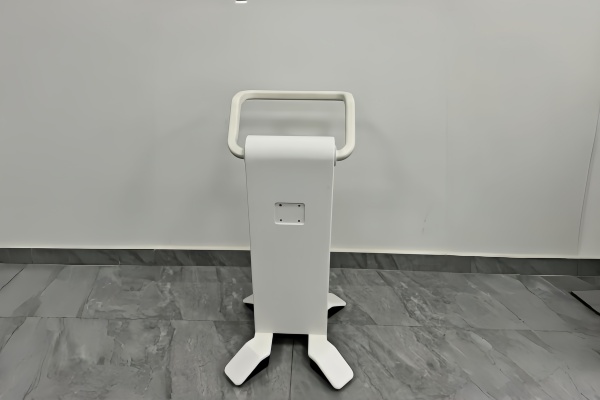
Executing precision manufacturing for a Vertical Medical Equipment Support Cart requires an uncompromising approach to structural mechanics and surface finishing. At Zhongrongda, our engineering team recently finalized the fabrication process for a high-end, armrest-style support cart designed for medical and beauty equipment.
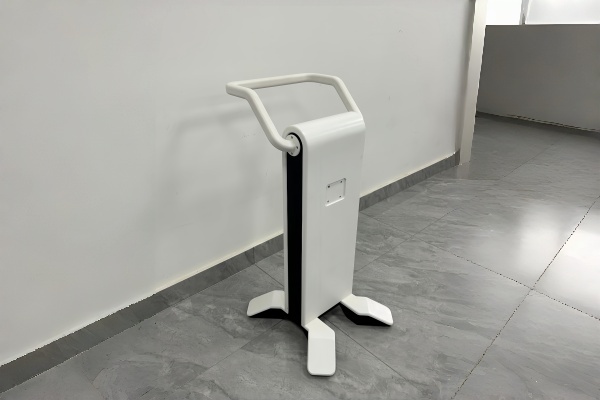
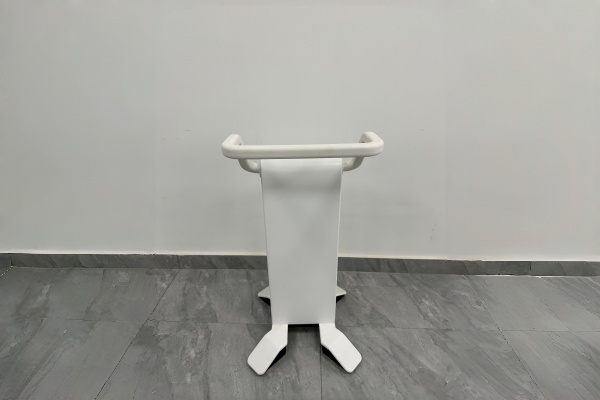
This specific project required us to balance strict lightweight design principles with exceptional load-bearing strength. The final physical dimensions of this unit are precisely calibrated at 42cm in length, 42cm in width, and 84cm in height. You can observe the streamlined minimalist exterior and the seamless integration of these components in the reference file named IMG_4169.jpg.
Balancing a tall, slender vertical profile with a heavy top-mounted payload introduces severe deformation risks during the sheet metal forming process. Below, our team details the specific structural bottlenecks encountered during this project and the exact manufacturing processes we implemented to resolve them.
Overcoming Deformation in Medical Cart Sheet Metal Bending
The primary structural foundation of this 84cm tall cart utilizes 6063-T5 aluminum alloy sheet metal paired with thickened cold-rolled steel. This combination ensures the chassis is lightweight yet rigid enough to support heavy clinical instruments.
The core engineering problem arises from the design of the main vertical plate. Forming a long, continuous curved plate creates significant internal stress within the metal.
During standard press brake operations, large flat surfaces are highly susceptible to warping, twisting, and springback, which compromises the entire vertical alignment of the chassis.
Implementing CNC Angle Compensation for Flatness
To eliminate longitudinal warping, our team bypassed standard manual bending. We deployed advanced CNC press brakes equipped with laser-guided angle measurement systems.
Before processing the 6063-T5 aluminum, our engineers calculated the exact springback coefficient specific to the curved geometry. We programmed custom angle compensations into the CNC controller to apply varied, micro-adjusted pressure.
- This process neutralizes the uneven stress caused by the long vertical span.
- It ensures the large flat surfaces remain completely planar without concavity.
- It guarantees strict perpendicularity across the entire 84cm height of the cart.
During the structural joining phase, standard TIG welding introduces excessive heat zones that distort the pre-bent panels. Our engineers utilized continuous fiber laser welding, locking the chassis into heavy, custom-machined heat-sinking fixtures.
This laser welding process creates deep penetration with a minimal heat-affected zone, resulting in a perfectly straight chassis. If your current fabrication partner struggles with panel distortion on large assemblies, our engineering team can audit your CAD models to optimize the flat patterns for laser welding.
U-Shape Aluminum Armrest Welding and Integration
The upper section of the cart features a prominent, integrated aluminum alloy tube armrest. This component serves as both a primary touchpoint for the user and a critical aesthetic element.
The primary manufacturing challenge is bending a large U-shape aluminum tube symmetrically without causing the inner radius to wrinkle or the outer radius to crack.
Furthermore, welding this tubular armrest to the flat sheet metal chassis without leaving visible weld beads or burn marks requires immense precision.
Seamless Integration and Multi-Stage Grinding
To achieve a flawless curve, our team utilized rotary draw tube bending machines equipped with internal mandrels. The mandrel supports the inside of the aluminum tube during the bending process, completely preventing structural collapse and surface wrinkling.
To join the armrest to the main body, we engineered a specific interlocking joint during the Rapid Prototyping phase. This allows the tube to key directly into the sheet metal chassis.
- We utilized pulsed laser welding to fuse the tube to the chassis without overheating the joint.
- Following the welding phase, our technicians executed a multi-stage mechanical grinding protocol.
- We used progressively finer abrasives to blend the weld bead entirely into the surrounding metal.
This creates a continuous, unibody structure with perfectly smooth, rounded corners and absolutely no sharp burrs. This level of seamless integration is a strict requirement for all our Beauty Device Enclosures, ensuring user safety and a premium tactile experience.
Precision Assembly for Beauty Device Support Cart Chassis
The foundation of the cart relies on a three-pronged bottom support system. This base must distribute the weight of the overhead medical equipment evenly to prevent tipping during transit.
The engineering difficulty lies in maintaining exact symmetrical angles across all three sheet metal legs. A deviation of even one degree during the bending or welding phase will cause the cart to wobble, rendering it entirely unsuitable for clinical use.
Verifying Symmetrical Load Distribution
We utilized precision laser cutting to generate the flat patterns for the base, ensuring an initial dimensional tolerance of ±0.05mm.
During the bending of the three-pronged base, we utilized dedicated checking fixtures to verify the angle of each leg before final welding.
To complete the base, we integrated custom anti-slip, wear-resistant base pads. When sourcing materials for these load-bearing contact points, we closely analyzed specific ABS plastic properties and applications to select a polymer blend that offers high friction without degrading under heavy lateral loads.
This meticulous approach to the base construction guarantees a highly stable, uniform platform that easily passes strict medical tip-testing standards.
CNC Machining Mounting Holes for Precision Instruments
The central vertical plate features specific installation points designed to hard-mount precision medical interfaces. The primary problem is cutting perfectly aligned holes through the thick sheet metal without introducing burrs or structural stretching.
Standard punch pressing causes the metal around the hole to deform, which misaligns the threaded inserts and compromises the mounting security of the expensive medical equipment.
Guaranteeing Positional Tolerance
To guarantee absolute hole accuracy, we performed all functional cutouts after the laser welding phase was complete.
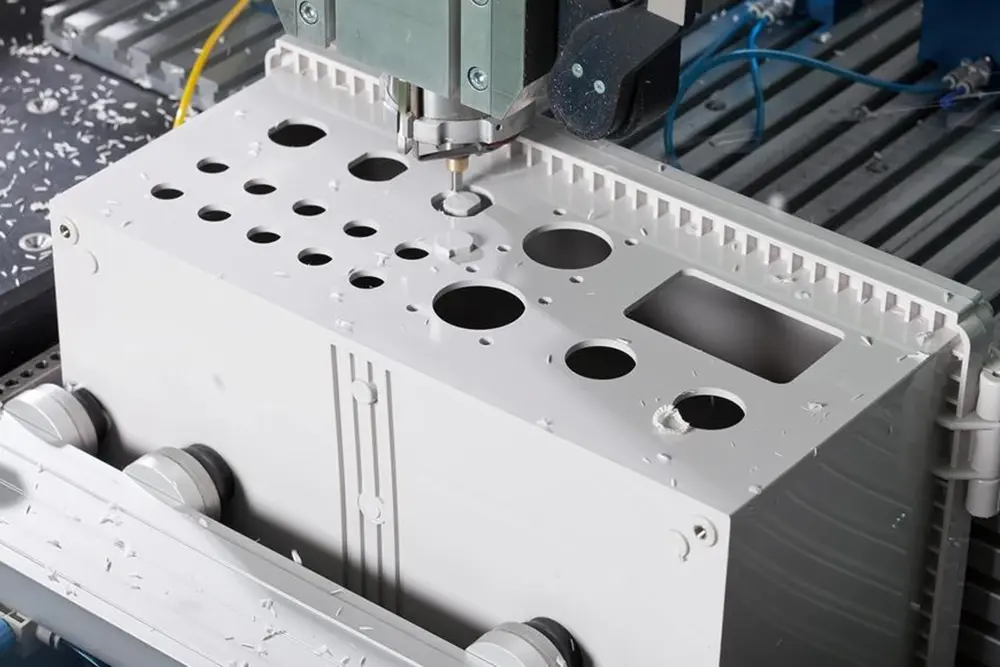
We clamped the fully welded vertical chassis into a 5-axis CNC mill. This allowed us to execute the CNC Machining of the mounting holes from a perfectly registered zero-point.
- We utilized specialized end mills to plunge and interpolate the exact hole diameters.
- This specific process ensures strict coaxiality and positional tolerance across the mounting pattern.
- The resulting cutouts are perfectly perpendicular to the face of the sheet metal.
By machining these holes post-assembly, we eliminate all tolerance stacking issues. This guarantees that your medical instruments will bolt onto the cart flawlessly during final assembly. This exact tolerance matching is a standard baseline for every Medical Device Enclosure we manufacture at Zhongrongda.
Perfecting Matte White Electrostatic Powder Coating
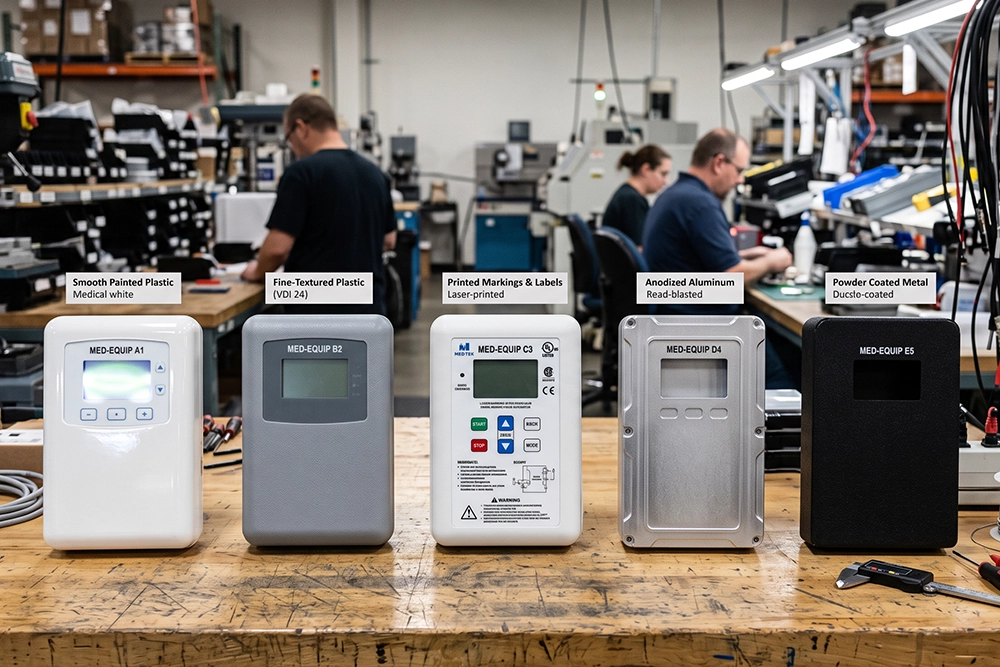
A high-end clinical environment demands an exterior finish that communicates sterility while remaining highly durable. We specified an eco-friendly, matte white electrostatic powder coating for the entire chassis.
Applying matte finishes to large, flat vertical surfaces is highly difficult. The coating is susceptible to visible dust particles, inconsistent thickness, and color shifting if the baking process is uneven.
Controlling the Curing Environment
The primary problem is maintaining an even film thickness across the asymmetrical 84cm height.
Our team implemented a strict chemical degreasing and phosphating process prior to the coating application to ensure perfect adhesion. Inside our climate-controlled electrostatic spray booths, we optimized the spray gun voltage and powder flow rate.
- This ensures the powder distributes uniformly across the large aluminum surfaces.
- We utilized a stepped infrared baking process to cure the powder coating.
- This controlled thermal ramp prevents the matte finish from developing glossy spots or color deviations.
The resulting surface is a flawless, medical-grade texture. It is highly resistant to chemical stains, offers excellent antibacterial properties, and withstands the rigorous cleaning protocols required in hospital environments.
Frequently Asked Questions (FAQs)
Q1: What materials are best for a Vertical Medical Equipment Support Cart?
At Zhongrongda, we utilize a combination of 6063-T5 aluminum alloy sheet metal and thickened cold-rolled steel. This hybrid approach ensures the main vertical chassis remains lightweight while providing the necessary structural rigidity for heavy equipment.
Q2: How do you prevent the large vertical sheet metal plate from warping?
We avoid standard manual bending. We use advanced CNC press brakes with laser angle compensation to manage material springback. We also utilize continuous fiber laser welding with heat-sinking fixtures to eliminate thermal distortion.
Q3: How do you bend the U-shape aluminum armrest without wrinkling?
Our team uses rotary draw tube bending machines equipped with internal mandrels. The mandrel supports the inner diameter of the aluminum tube during the bend, preventing the metal from collapsing, wrinkling, or cracking.
Q4: How do you achieve a seamless joint between the armrest and the chassis?
We engineer interlocking joints and use pulsed laser welding to fuse the components without overheating. We then execute a multi-stage mechanical grinding process to blend the weld bead completely into the surrounding metal, eliminating all visible seams.
Q5: How do you ensure the three-pronged base does not wobble?
We maintain strict ±0.05mm tolerances during laser cutting and use dedicated checking fixtures during the CNC bending of the base legs. This guarantees symmetrical angles and exact load distribution across the bottom support.
Q6: What are the exact physical dimensions of this medical support cart?
The specific dimensions for this integrated vertical support cart chassis are strictly manufactured to 42cm in length, 42cm in width, and 84cm in height.
Q7: Why do you use CNC machining for the equipment mounting holes?
Standard punching stretches the metal and reduces positional accuracy. We perform 5-axis CNC machining on the fully welded chassis to ensure the mounting holes have strict coaxiality, perpendicularity, and absolute positional tolerance.
Q8: What type of surface finish is applied to the support cart?
We apply an eco-friendly, matte white electrostatic powder coating. This specific finish provides a premium medical-grade texture that is highly resistant to stains, antibacterial, and easy to clean with clinical sterilizers.
Q9: How do you prevent particles or color differences in the matte powder coating?
We operate climate-controlled electrostatic spray booths to maintain a clean environment. By optimizing the spray voltage and using a stepped infrared baking process, we ensure a uniform film thickness without color shifting or glossy spots.
Q10: Are the anti-slip base pads durable enough for medical environments?
Yes. We engineer the bottom support using specific high-friction polymer blends that resist degrading under heavy lateral loads. This ensures the cart remains firmly planted during equipment operation and transport.
Contact Zhongrongda
Are dimensional inaccuracies or warped sheet metal components delaying your clinical equipment rollout? Our engineering team specializes in solving complex bending deformations and executing seamless tube welding. Partner with Zhongrongda for precise, medical-grade manufacturing execution.
Email: info@zrdmfg.com
Phone: +86 13972955806