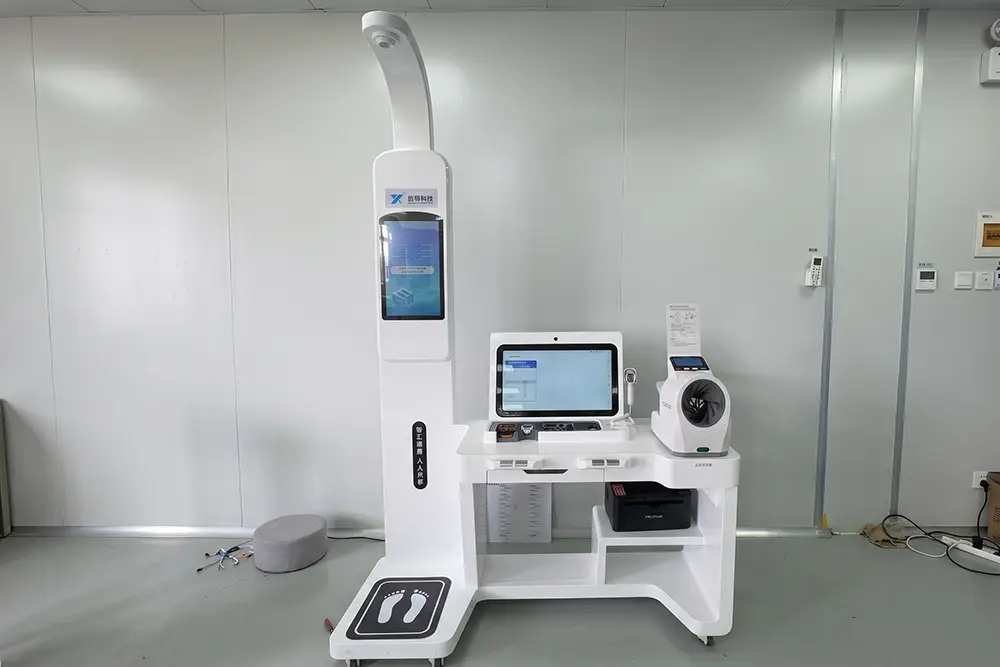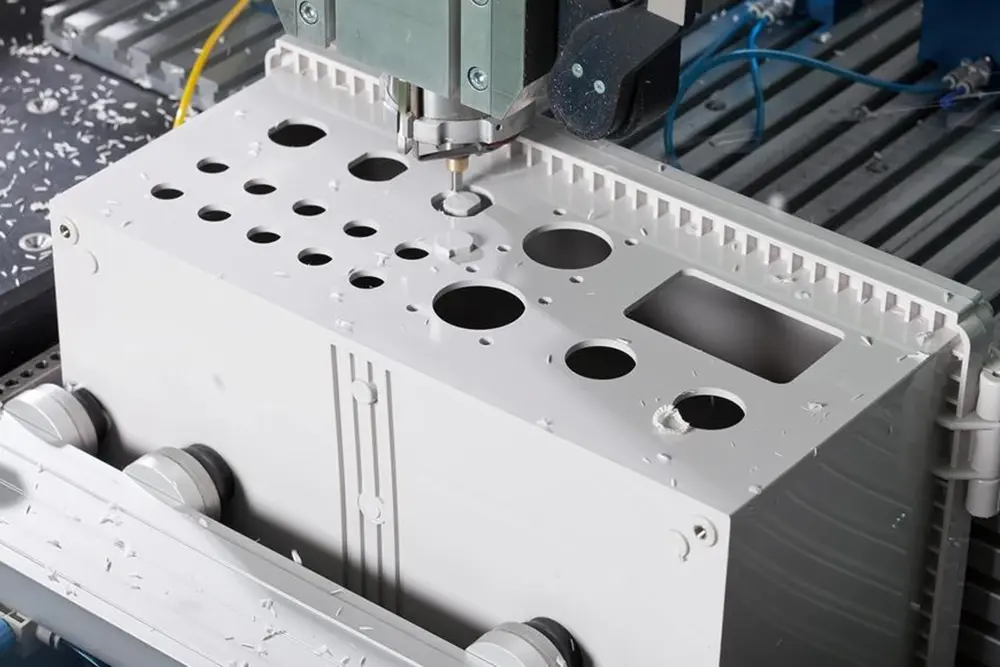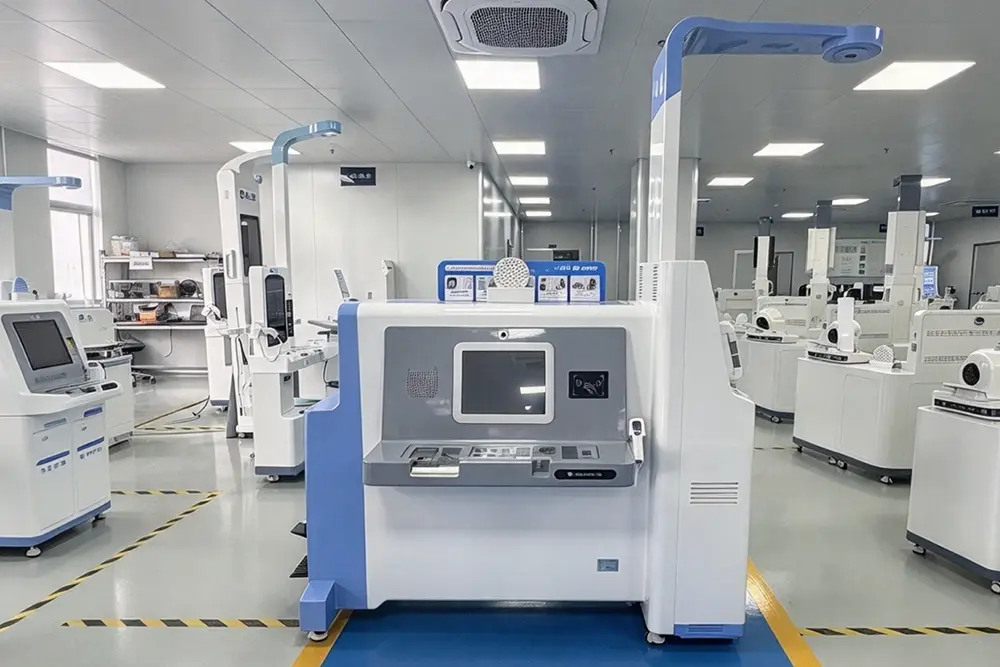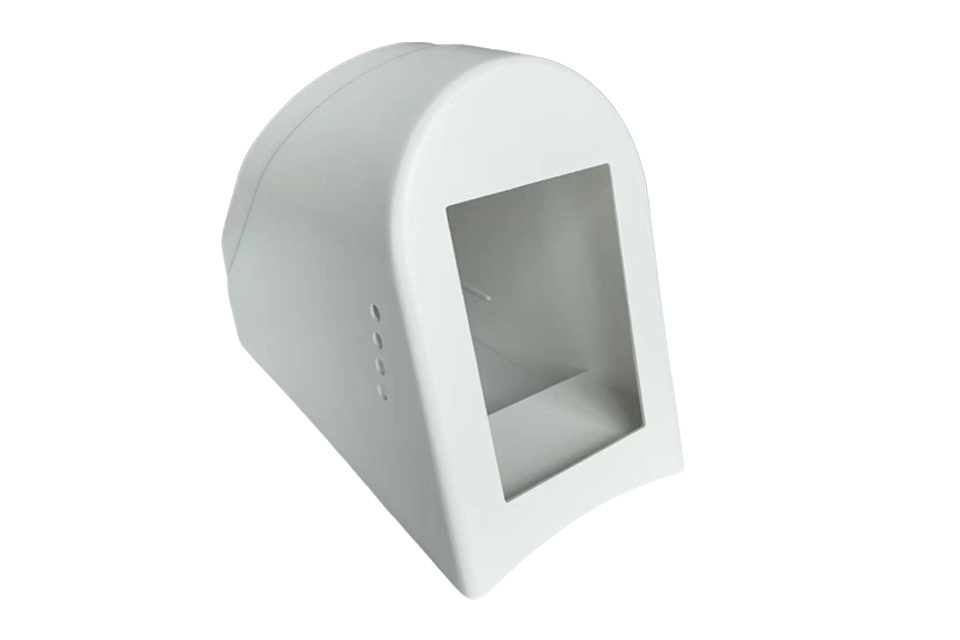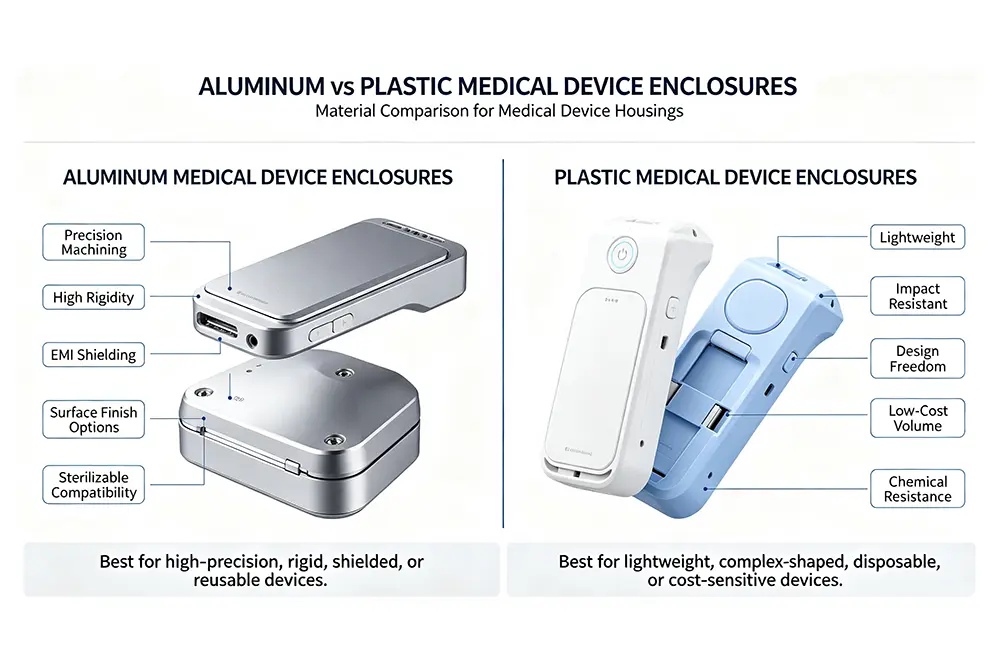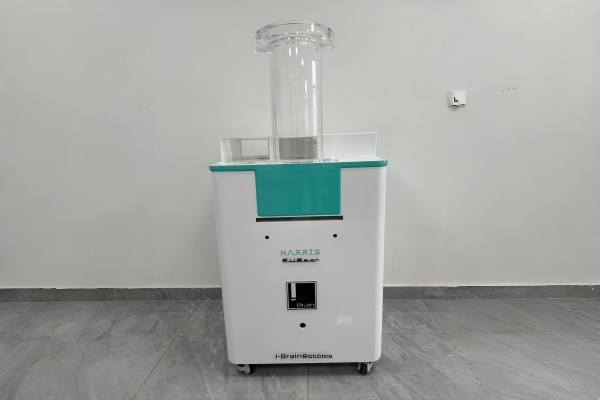
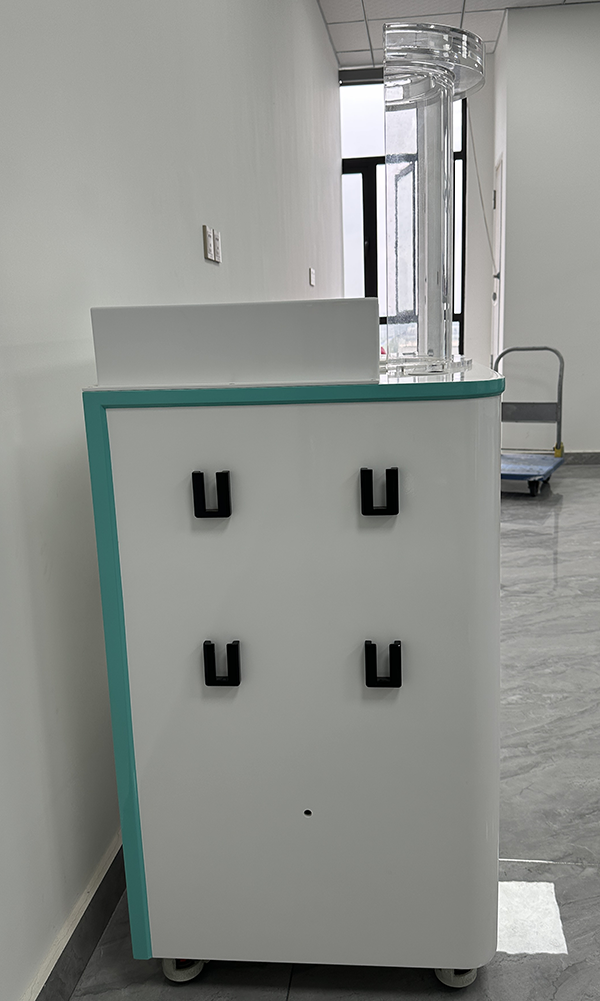
Successfully executing Medical Robot Enclosure Manufacturing requires strict adherence to tight tolerances and complex material integration. At Zhongrongda, our team recently engineered the I‑Brain Robotics Intelligent Medical Robot Integrated Equipment Chassis Cart.
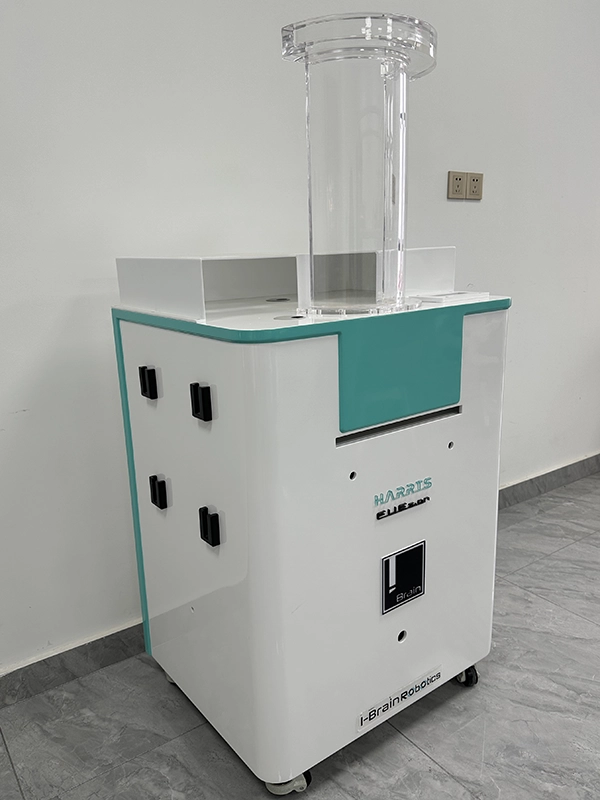
This specific project demanded a flawless combination of structural integrity and medical-grade aesthetics. The final physical dimensions of this unit stand at exactly 69cm in length, 58cm in width, and 147cm in height.
Balancing heavy load-bearing requirements with a refined, spotless exterior presents significant manufacturing hurdles. Below, our team details the specific engineering problems encountered during this project and the exact manufacturing processes we implemented to solve them.
Core Challenges in Medical Robot Enclosure Manufacturing
When engineering complex carts, material selection and structural planning dictate the manufacturing workflow. We selected 6063-T5 aluminum alloy sheet metal and thickened cold-rolled steel for the main chassis to ensure lightweight stability.
For the upper sections, we utilized high-transparency acrylic (PMMA) and ABS for the decorative boards. The primary engineering challenge was merging these vastly different materials without visible fasteners or uneven gaps.
If you are struggling with complex material integration, evaluating your current design with our engineers can eliminate assembly bottlenecks early.
Tackling PMMA Acrylic CNC Machining for the Top Column
The top transparent column requires a long cylinder integrated seamlessly with an irregular flange. Machining this as a single piece is a notoriously difficult process.
Standard lathe operations often introduce vibration, leading to micro-cracking in the PMMA material. To solve this, our team utilized simultaneous 5-axis CNC Machining to turn and mill the acrylic block without removing it from the fixture.
Maintaining continuous tool paths prevented stress accumulation in the PMMA. We programmed strict feed rate controls to manage heat generation, ensuring the acrylic remained tough and did not warp or crack under the cutting tool.
Post-machining, the acrylic required absolute transparency. We bypassed standard chemical dips and implemented a multi-stage mechanical polishing process.
Our technicians utilized progressively finer abrasive compounds to achieve a zero-scratch, burr-free finish. This labor-intensive step guarantees the high light transmission critical for the optical sensors housed within the I-Brain Robotics unit.
Sheet metal fabrication for medical equipment bases
The chassis base required exact squareness and immense structural rigidity. Utilizing thickened cold-rolled steel and 6063-T5 aluminum, we faced the problem of material distortion during the welding phase.
Our engineers deployed fiber laser cutting to ensure the initial flat patterns held tolerances within 0.05mm. Following the laser cutting, we utilized precision CNC press brakes to form the box-like structure.
To prevent the aluminum from warping under high heat, our team at Zhongrongda utilized pulsed TIG welding. We clamped the chassis into custom heat-sinking fixtures that pulled excess thermal energy away from the critical faces.
This seamless welding process resulted in a perfectly square, unibody box structure. This level of rigidity is a standard baseline for any Medical Device Enclosure we produce, ensuring the cart easily supports heavy internal robotic components.
Surface Treatment and Precision Assembly Protocols
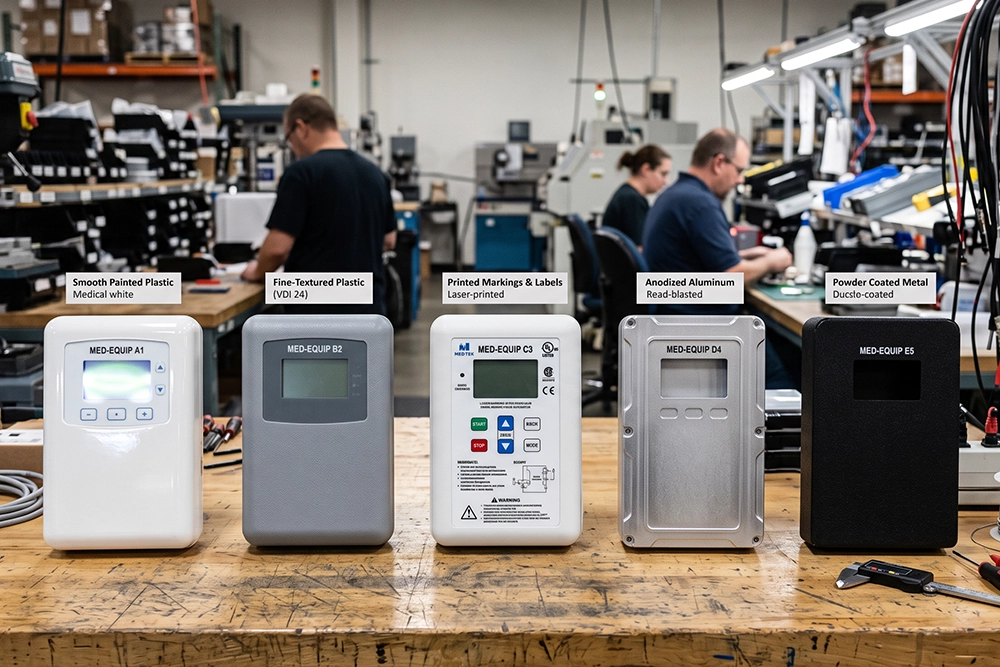
Once the raw components were fabricated, the focus shifted to achieving a medical-grade surface and executing a seamless final assembly. Medical environments require surfaces that resist stains and are easily sterilized.
We specified a high-gloss white electrostatic powder coating paired with a Tiffany blue decorative panel. However, applying high-gloss finishes to large, flat box-like structures introduces high defect risks.
Perfecting the High-gloss powder coating chassis
The primary problem with high-gloss powder coating on large flat sheet metal panels is the “orange peel” effect and inconsistent color matching.
To eliminate orange peel, our team strictly controlled the ambient humidity and temperature inside our spraying facility. We optimized the electrostatic charge voltage to ensure a perfectly uniform powder distribution across the 69cm by 58cm chassis base.
During the baking phase, we utilized a stepped temperature ramp. This allowed the powder to melt and flow completely flat before fully cross-linking and curing.
The resulting surface is highly reflective, visually flawless, and meets all medical-grade cleanability standards. We apply these same strict cosmetic defect controls to our Beauty Device Enclosures, where surface appearance is equally critical.
Medical equipment enclosure assembly and Tolerance Matching
The final, and perhaps most difficult, phase was the integration of the polished PMMA column, the painted sheet metal, the ABS decorative parts, and the branding nameplates.
Because we process different materials through different thermal and mechanical operations, maintaining matching tolerances is incredibly difficult. We addressed this early during the Rapid Prototyping stage by designing specific interlocking registration tabs on the sheet metal.
For the transparent decorative elements, we leveraged specific ABS plastic properties and applications to CNC mill snap-fit joints that compress slightly upon assembly. This ensured a tight seal against the sheet metal.
To attach the irregular PMMA flange to the square metal box, our team engineered a hidden silicone gasket system. We precision-punched the functional mounting holes and logo placements using a CNC turret press prior to painting.
During final assembly, custom alignment jigs compressed the acrylic and sheet metal together evenly. This process guarantees a uniform, seamless gap around the entire perimeter, avoiding any mechanical stress that could later crack the acrylic in the field.
Frequently Asked Questions (FAQs)
Q1: What materials are best for Medical Robot Enclosure Manufacturing?
At Zhongrongda, we utilize 6063-T5 aluminum alloy and cold-rolled steel for load-bearing bases. For optical or aesthetic upper sections, we use high-transparency PMMA (acrylic) and ABS due to their toughness and machinability.
Q2: How do you prevent PMMA from cracking during CNC machining?
We manage heat generation by calculating exact feed rates and spindle speeds during PMMA acrylic CNC machining. We also use continuous 5-axis tool paths and custom workholding to prevent vibration and material stress.
Q3: What makes sheet metal fabrication for medical equipment different from standard fabrication?
Medical carts require flawless, seamless welding to prevent bacterial ingress. We utilize heat-sinking fixtures and pulsed TIG welding to prevent warping, ensuring a perfectly square and sealed chassis.
Q4: How do you achieve a defect-free high-gloss powder coating chassis?
We control the electrostatic voltage and ambient environment to ensure uniform powder distribution. We also use a stepped baking process that allows the powder to flow completely flat, eliminating the “orange peel” effect.
Q5: How do you assemble PMMA and sheet metal without visible gaps?
Our team uses custom alignment jigs and hidden gasket systems during the medical equipment enclosure assembly. This ensures even compression and a uniform gap without applying stress to the acrylic flange.
Q6: What are the exact dimensions of the I-Brain Robotics cart enclosure?
The specific dimensions for this integrated equipment chassis cart are 69cm in length, 58cm in width, and 147cm in height.
Q7: Can you match custom brand colors in your surface treatments?
Yes. For this project, we successfully matched a specific Tiffany blue for the decorative panels, contrasting with the high-gloss white, ensuring precise color panel assembly without deviation.
Q8: How do you polish complex PMMA shapes like long cylinders?
We avoid chemical dips that degrade the material. Instead, our technicians use a labor-intensive, multi-stage mechanical step-polishing process with fine abrasives to achieve a highly transparent, scratch-free finish.
Q9: Why do you use laser cutting before CNC bending for medical carts?
Laser cutting allows us to maintain strict initial flat-pattern tolerances of 0.05mm. This extreme accuracy is required so that the subsequent CNC bending forms a perfectly aligned, square box for the chassis.
Q10: How do you handle multi-component tolerance matching?
We address tolerance stacking during the engineering phase by designing interlocking registration tabs and utilizing precision CNC equipment. This ensures the sheet metal, acrylic, and ABS parts fit seamlessly during final assembly.
Contact Zhongrongda
Are manufacturing bottlenecks delaying your medical device launch? Our engineering team is ready to solve your most complex material integration and precision machining challenges. Partner with Zhongrongda for reliable, medical-grade manufacturing.
Email: info@zrdmfg.com
Phone: +86 13972955806