Introduction
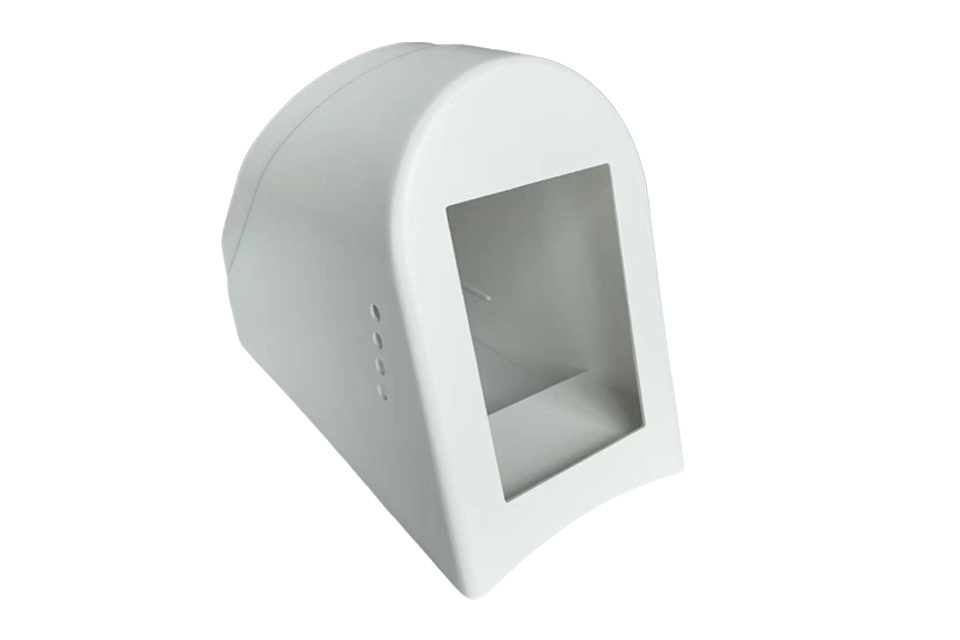
In this project, we engineered a custom ABS vacuum formed enclosure for a single-user desktop industrial device requiring high structural stability, ergonomic geometry, and multi-material integration. The end application demanded a compact yet rigid housing system with precise assembly interfaces for internal electronics, power modules, and mobility components.
The customer, an industrial equipment OEM, required a large-format enclosure (700 × 550 × 620 mm) that combined aesthetic smoothness with structural reinforcement. Traditional injection molding was not cost-effective for low-volume production, so our engineering team at Hubei Zhongrongda Intelligent Technology Co., Ltd. implemented a hybrid manufacturing strategy combining thick-sheet vacuum forming, CNC finishing, and internal sheet metal reinforcement.
The main challenge of this custom ABS vacuum formed enclosure was not only achieving stable dimensional accuracy with 8–15 mm ABS sheets, but also ensuring consistent assembly between plastic and metal structures under real-world mechanical load conditions.
1: Project Overview
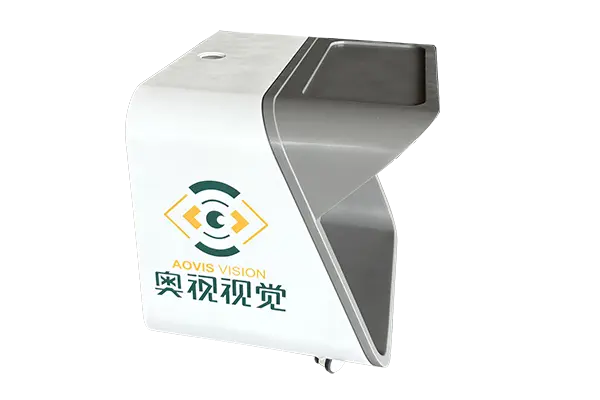
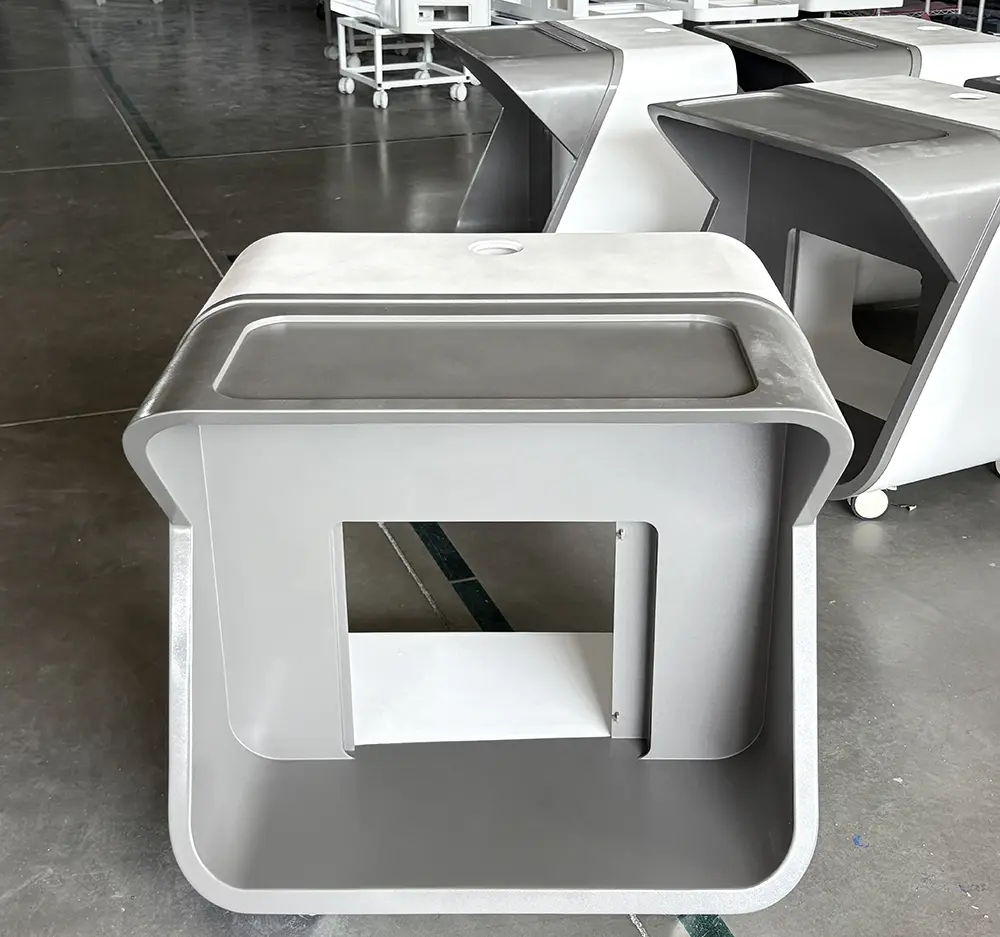
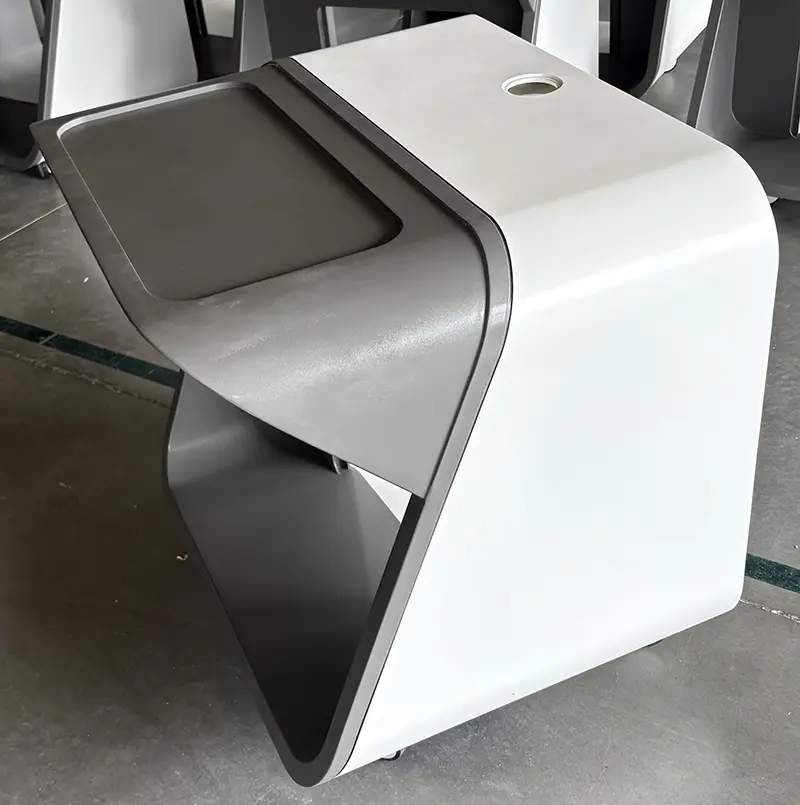
This project involves a large single-user desktop equipment housing system designed for industrial and laboratory use. The enclosure consists of two main structural modules:
- White primary shell: thick-sheet ABS vacuum formed structure with CNC trimming
- Grey functional panel: secondary vacuum formed ABS component with integrated geometry
Application Industry:
- Industrial desktop automation equipment
- Laboratory testing workstation system
- Compact control terminal enclosure
Key Engineering Requirements:
- Overall size stability: 700 × 550 × 620 mm
- High rigidity under load without full injection molding cost
- Smooth aesthetic surface suitable for industrial-grade product appearance
- Internal mounting capability for electronics, power modules, and mechanical supports
- Modular assembly between plastic shell and metal reinforcement frame
The enclosure is a typical case of low-volume, high-complexity industrial housing manufacturing, where structural reliability and manufacturing flexibility are both critical.
2: Engineering Challenges
1. Thick ABS Vacuum Forming Stability (8–15 mm Sheet)
The most critical challenge in this custom ABS vacuum formed enclosure was processing ultra-thick ABS sheets. Compared to standard 2–5 mm thermoforming, this project introduced multiple technical risks:
- Uneven thermal distribution during zone heating
ABS sheets required segmented heating control with ±5°C precision. Any deviation caused inconsistent material flow. - Surface defects such as wrinkling and corner collapse
Deep draw geometry caused stress concentration at rounded corners and cavity transitions. - Cooling shrinkage and structural warping
Large-format parts experienced uneven shrinkage after demolding, especially in long-span flat areas. - Edge tearing during demolding
Vertical wall areas with tight radii risked surface damage due to adhesion stress.
2.CNC Post-Processing Precision Issues
After vacuum forming, CNC machining was required for functional openings and interface surfaces. Key issues included:
- Raw vacuum-formed geometry variation affecting CNC fixture alignment
- ABS material sensitivity causing edge whitening and chipping during cutting
- Difficulty maintaining tolerance consistency across multiple hole patterns and slots
3. Sheet Metal Internal Reinforcement Integration
A cold-rolled steel internal frame was designed to reinforce structural rigidity. However, this introduced major assembly challenges:
- Tolerance conflict between plastic shell and metal frame
Both components accumulated manufacturing deviations, leading to misalignment. - Mounting hole misregistration
CNC holes in plastic and pre-punched metal holes were not perfectly concentric, causing assembly stress. - Sharp edge risk on metal parts
Burrs and sharp corners from bending processes risked damaging the inner ABS surface during assembly.
3: Manufacturing Process Breakdown
Step 1: Thick Sheet Vacuum Forming (Primary Structure)
We used 8–15 mm ABS sheets processed through a large-scale vacuum forming system:
- Multi-zone heating system with ±5°C control accuracy
- Controlled thermal softening to maintain uniform viscosity
- Deep vacuum draw forming for large-radius enclosure geometry
- Integrated corner rounding to reduce stress concentration
This step defined the fundamental geometry of the enclosure.
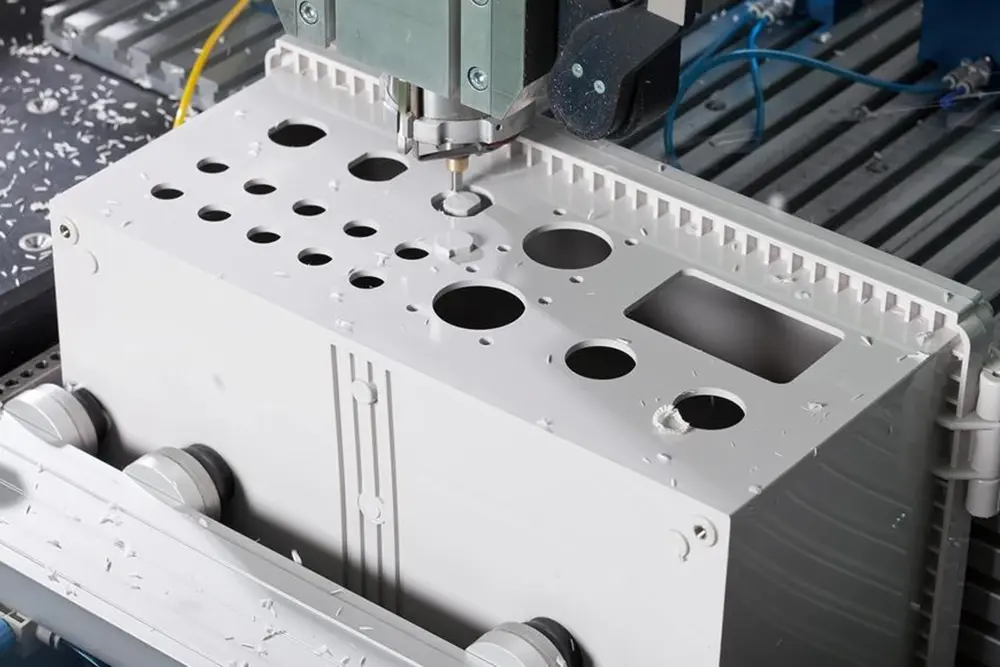
Step 2: CNC Precision Trimming and Machining
After forming, the rough shell underwent CNC machining:
- High-speed CNC trimming for perimeter edges
- Precision drilling for cable routing holes on top surfaces
- Internal cavity window cutting for module installation
- Edge finishing to remove thermal deformation artifacts
Due to material softness, cutting parameters were optimized to prevent surface whitening.
Step 3: Sheet Metal Reinforcement Fabrication
Internal support structure was manufactured using cold-rolled steel:
- Laser cutting for precise hole patterns
- CNC bending to form structural frame
- Riveting and assembly for load-bearing reinforcement
- Installation points designed for wheels, power supply, and internal partitions
This structure significantly improved mechanical rigidity of the plastic shell.
Step 4: Final Assembly and Surface Finishing
- Plastic and metal components were assembled using a hybrid fastening system
- Anti-scratch isolation layers were added at contact points
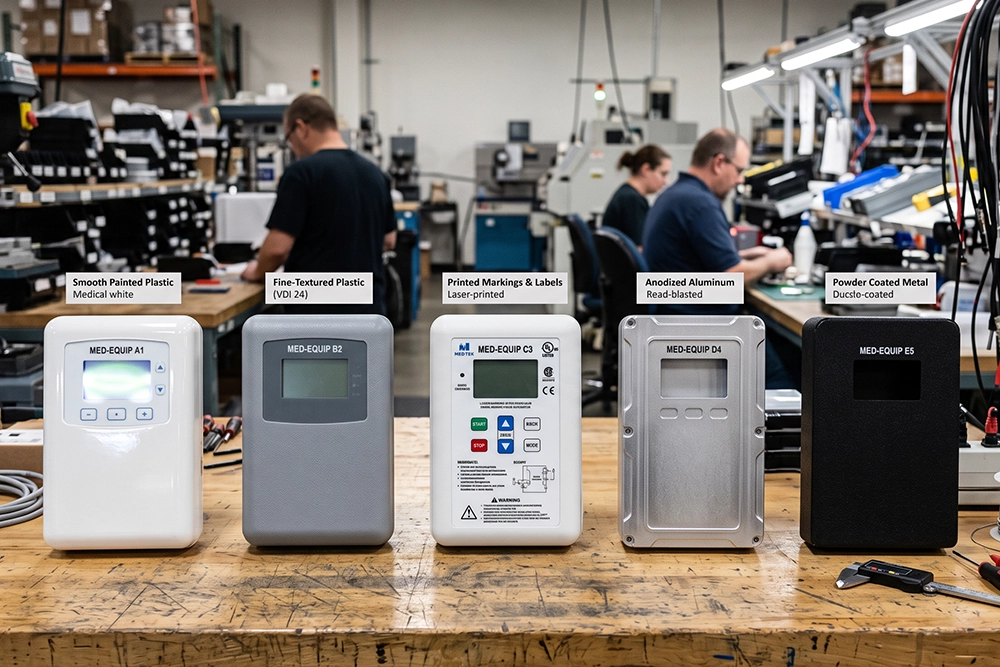
- Surface treated with dust-free matte white coating
- Grey ABS secondary panel was vacuum formed separately and assembled using snap-fit + adhesive bonding
For related manufacturing capabilities, see our CNC Machining and Rapid Prototyping solutions.
4: Material Selection & Reasoning
ABS Thick Sheet (8–15 mm)
ABS was selected due to:
- Excellent thermoforming performance for thick-sheet applications
- High impact resistance suitable for industrial equipment housing
- Good surface finishing compatibility with matte coatings
Cold-Rolled Steel Internal Frame
- Provides structural reinforcement for large-span plastic shell
- Improves load-bearing capacity for wheels and internal modules
- Ensures long-term dimensional stability
The hybrid ABS + steel structure is widely used in industrial enclosure engineering where pure plastic structures cannot meet rigidity requirements.
5: Precision & Quality Control
To ensure dimensional reliability of this custom ABS vacuum formed enclosure, we implemented multi-stage quality control:
Tolerance Control
- Vacuum forming dimensional deviation: ±1.2–2.0 mm
- CNC machining accuracy: ±0.1 mm
- Sheet metal frame tolerance: ±0.2 mm
Inspection Methods
- Full-size 3D measurement verification
- Assembly dry-fit testing before final coating
- Load-bearing simulation on internal reinforcement points
QC Equipment
- Coordinate Measuring Machine (CMM)
- Digital height gauge
- Precision calipers and micrometers
- Optical contour inspection system
These inspections ensured consistent assembly between plastic and metal systems.
6: Final Result & Performance
The final enclosure achieved:
- Stable structural integrity under multi-point load conditions
- Smooth ergonomic surface with no visible vacuum forming defects
- Reliable assembly between plastic shell and metal frame
- Fully functional mounting system for internal electronic modules
Performance validation confirmed:
- No visible warping after 72-hour thermal stability test
- No structural cracking under simulated transport vibration
- Consistent alignment across repeated assembly cycles
This project demonstrates the feasibility of combining thick-sheet vacuum forming with precision CNC finishing for complex industrial enclosures.
7: Application Industry Impact
This solution is widely applicable across multiple industries requiring compact but rigid enclosure systems:
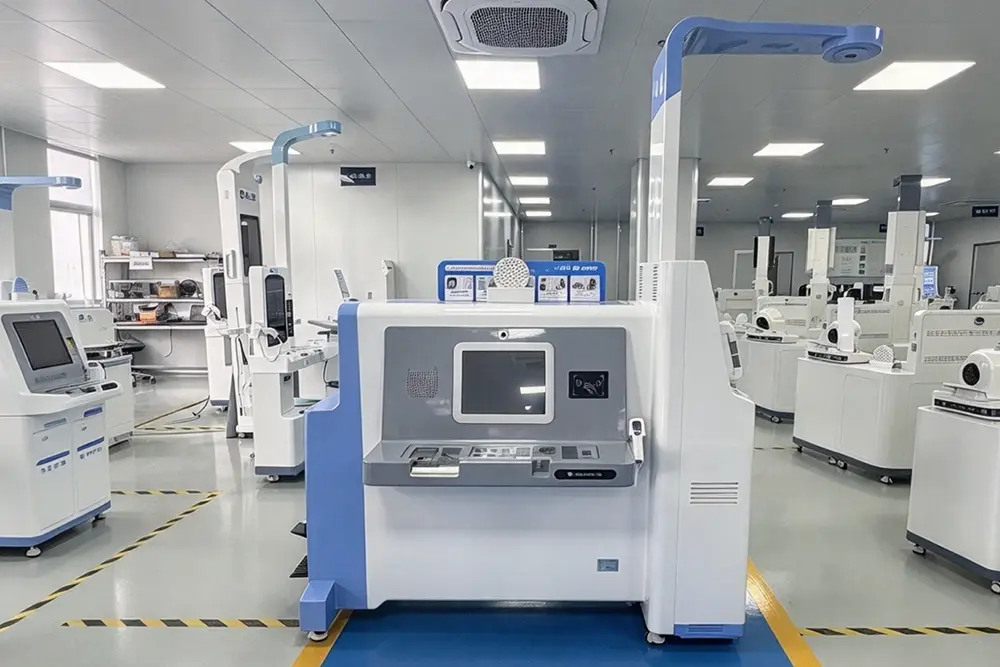
Medical Device Enclosure
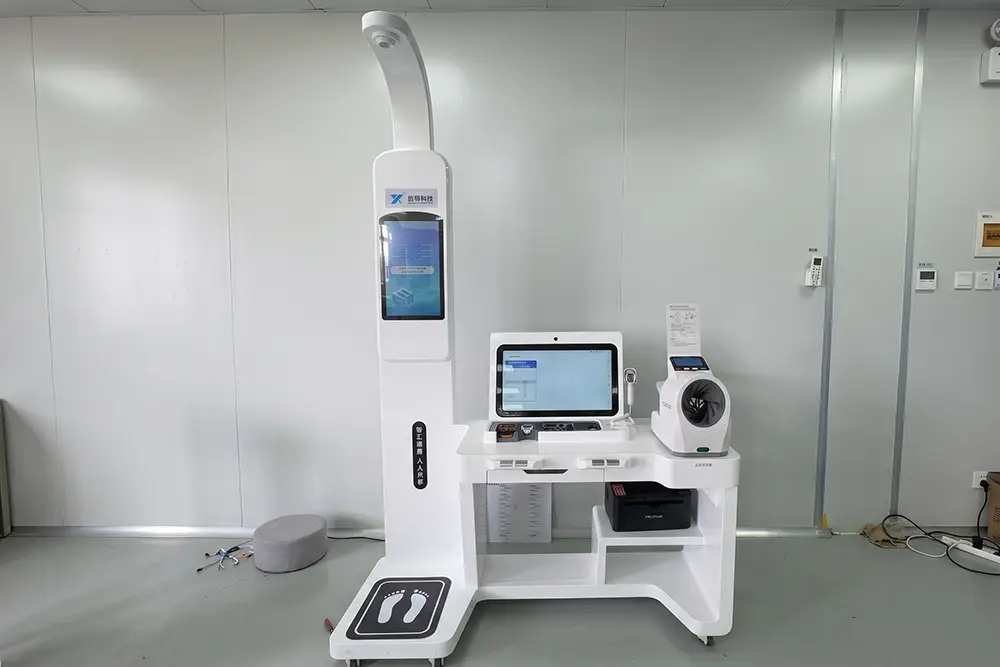
The structural stability and clean surface finishing make it suitable for non-invasive medical workstation housings.
Beauty Device Enclosures
Aesthetic surface quality and ergonomic geometry support beauty equipment applications requiring premium appearance.
Automation & Robotics
The reinforced internal structure supports motion systems, sensors, and embedded controllers.
Related capability: Automation & Robotics
Industrial Equipment
Ideal for desktop control systems, testing platforms, and compact industrial terminals requiring durable enclosure systems.
For more engineering capability, visit our Medical Device Enclosure solutions.
Conclusion
This case study demonstrates how a custom ABS vacuum formed enclosure can achieve high structural performance through hybrid manufacturing integration. By combining thick-sheet thermoforming, CNC precision machining, and sheet metal reinforcement engineering, we successfully resolved key challenges in deformation control, assembly accuracy, and mechanical durability.
This approach provides a scalable solution for OEMs requiring low-volume, high-complexity industrial enclosure systems without the cost burden of injection molding tooling.