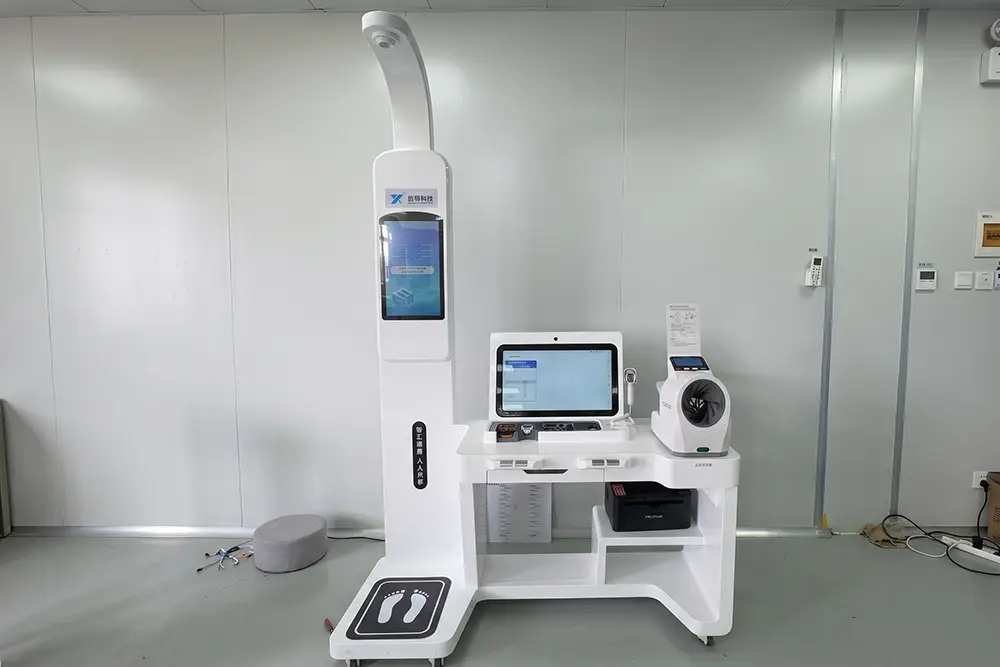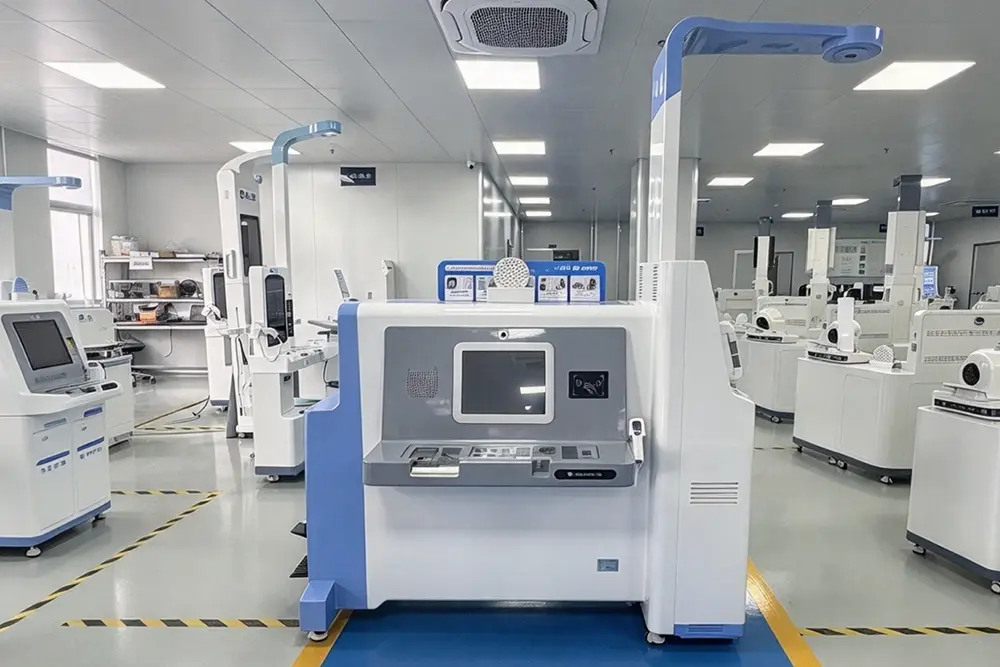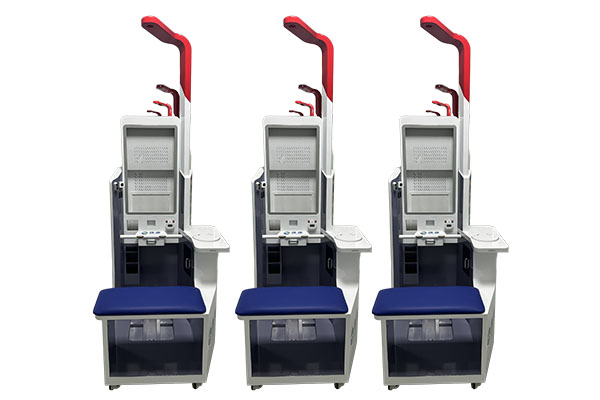
When a European healthcare equipment developer approached us with a challenging project, their engineering team had already spent months searching for a supplier capable of producing a highly integrated medical equipment cart enclosure.
The enclosure was not a simple sheet metal cabinet.
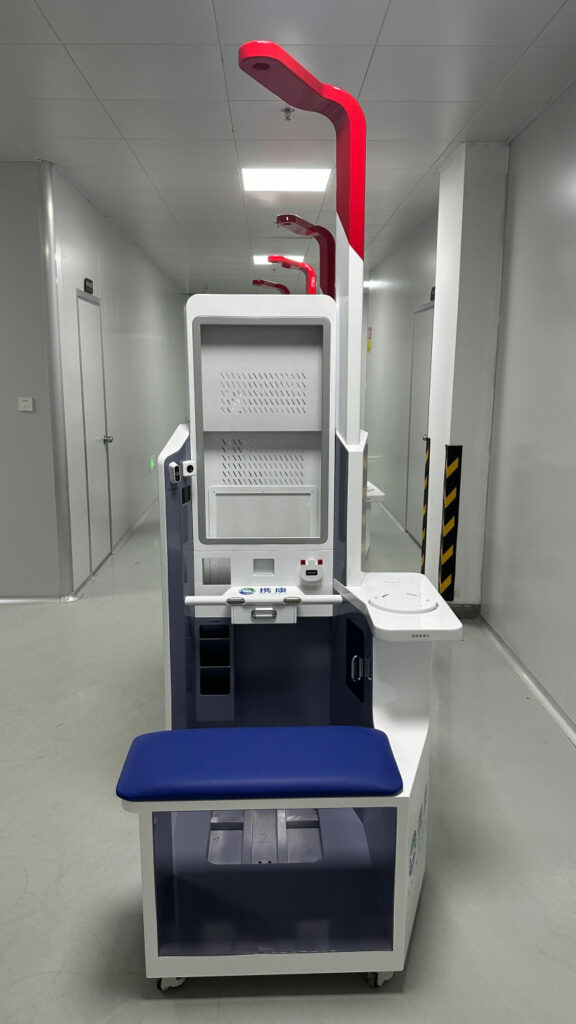
It combined a diagnostic workstation, equipment storage system, display mounting structure, cable management channels, ventilation features, and a large cantilever arm into a single product.
The customer had previously worked with two suppliers who were unable to solve the structural and cosmetic issues required for commercialization.
At Zhongrongda, our engineering team reviewed the design and immediately identified five major manufacturing risks that would determine whether the project succeeded or failed.
The final product measured:
- Length: 480 mm
- Width: 480 mm
- Height: 1400 mm
and required a balance between aesthetics, structural rigidity, equipment integration, and long-term reliability.
This article explains exactly how we solved these challenges and successfully delivered a production-ready medical equipment cart enclosure.
Medical Equipment Cart Enclosure Project Overview
The customer was developing a next-generation healthcare diagnostic terminal designed for deployment in:
- Hospitals
- Diagnostic laboratories
- Community healthcare centers
- Medical screening stations
- Self-service healthcare facilities
The enclosure needed to accommodate:
- Display equipment
- Medical testing devices
- Internal power systems
- Data communication modules
- Storage compartments
- Maintenance access panels
Unlike conventional equipment housings, this project required both structural engineering and industrial design considerations.
The final system needed to appear modern and premium while remaining durable enough for daily clinical use.
To support these requirements, we selected:
Main Materials
- 6063-T5 Aluminum Alloy
- Reinforced Cold-Rolled Steel
Manufacturing Processes
- Laser Cutting
- CNC Bending
- Precision Welding
- CNC Machining
- Multi-Color Powder Coating
- Final Assembly
Challenge 1: Forming the Oversized Cantilever Arm Structure
One of the most difficult aspects of this project involved the large red cantilever support arm located at the top of the enclosure.
This feature appears visually simple.
In reality, it represented one of the highest-risk manufacturing operations.
Why Most Suppliers Fail with Large Cantilever Structures
The arm required:
- Large-angle L-shaped bending
- Long unsupported span
- Tight assembly tolerances
- Consistent cosmetic appearance
During conventional bending operations, sheet metal components often experience:
- Springback
- Surface distortion
- Angle deviation
- Structural instability
Several suppliers attempted to fabricate similar structures using standard bending compensation values.
The results were inconsistent.
Even a small angular error can create significant alignment issues when integrated with display systems.
Zhongrongda Engineering Solution
Our engineering team performed multiple forming simulations before production.
We created dedicated bending fixtures specifically for this project.
Key production parameters included:
- Bending angle: 92.5°
- Compensation angle: 2.8°
- Forming tolerance: ±0.3°
To validate the process, we produced seven trial samples before releasing production tooling.
After optimization:
- Structural deviation reduced from 2.5 mm to 0.4 mm
- Assembly accuracy improved by 84%
- Final angle consistency reached ±0.3°
The completed arm maintained excellent rigidity while supporting the integrated display system.
This solution ultimately became one of the key selling points of the customer’s final product.
Challenge 2: Integrating Multiple Functional Compartments into a Single Structure
The enclosure incorporated multiple operating zones.
These included:
- Equipment chamber
- Storage drawer
- Side platform
- Internal electronics compartment
- Cable routing channel
The complexity created significant fabrication challenges.
Why Multi-Chamber Structures Often Develop Flatness Problems
In large assemblies, multiple welded sections frequently introduce:
- Panel warping
- Weld distortion
- Gap inconsistencies
- Poor visual alignment
These defects are especially visible on healthcare equipment because the surfaces are large and highly exposed.
The customer specifically required seamless transitions between compartments.
Zhongrongda Engineering Solution
Our fabrication team developed a staged welding strategy.
Rather than completing all welds sequentially, we controlled heat input throughout the process.
Production parameters included:
- Laser cutting accuracy: ±0.1 mm
- Weld gap control: <0.2 mm
- Flatness control: ≤0.5 mm/m
Each subassembly underwent dimensional inspection before final integration.
The result:
- Assembly pass rate increased from 89% to 100%
- Surface flatness improved by 67%
- Final structure exceeded customer requirements
The completed enclosure achieved excellent structural integrity while maintaining clean visual lines.
Challenge 3: Achieving Precise Three-Color Medical-Grade Surface Finishing
A major design requirement involved a sophisticated color scheme combining:
- High-gloss white
- Matte dark gray
- High-gloss red
This combination created one of the most demanding finishing operations in the entire project.
The customer wanted sharp transitions between colors while maintaining distinct surface textures.
Many manufacturers struggle to control coating boundaries on complex medical equipment.
Common Problems in Multi-Color Powder Coating
Without proper process control, manufacturers often experience:
- Color bleeding
- Uneven gloss levels
- Surface contamination
- Inconsistent texture appearance
These defects become highly visible under hospital lighting conditions.
For premium medical equipment, even minor imperfections can impact product perception.
Zhongrongda Engineering Solution
To achieve the required appearance, we developed a multi-stage coating workflow.
The process included:
Stage 1
Surface preparation and polishing
Stage 2
Precision masking
Stage 3
Individual color application
Stage 4
Controlled curing
Process parameters included:
- Surface roughness: Ra 1.6 μm
- Curing temperature: 190°C
- Curing time: 18 minutes
Final results:
- Color boundary deviation <0.3 mm
- Coating adhesion reached Grade 0
- Appearance inspection pass rate: 99.2%
The customer specifically praised the visual quality of the finished enclosure during project acceptance.
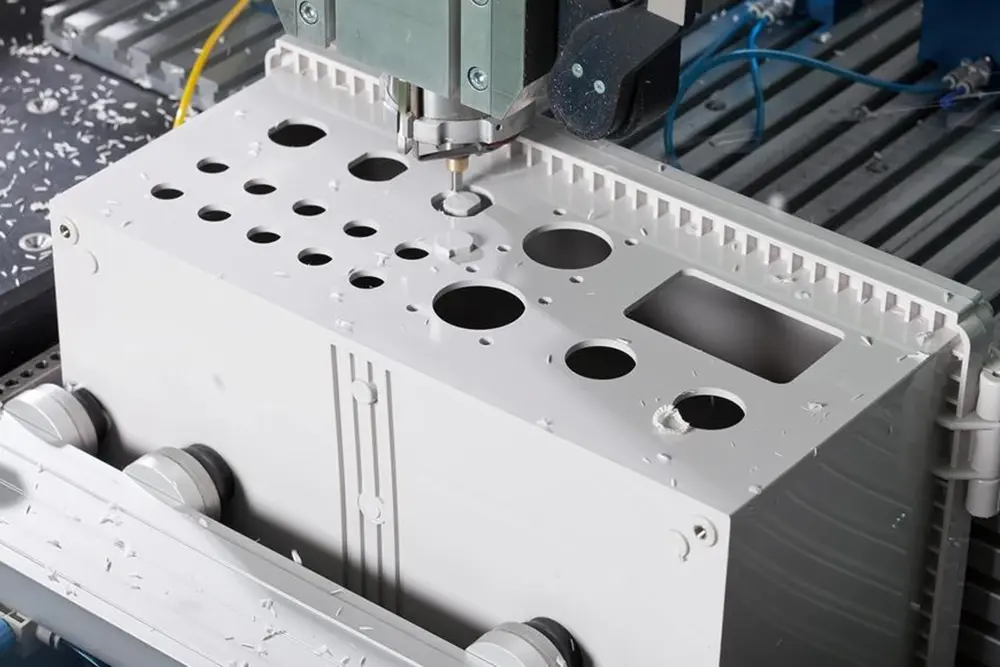
Challenge 4: Manufacturing Dense Ventilation Louvers and Micro-Perforation Arrays
The enclosure incorporated numerous ventilation structures to dissipate heat generated by internal electronic systems.
These features included:
- Ventilation louvers
- Micro-perforation arrays
- Equipment interface openings
At first glance, these appear to be standard fabrication operations.
However, maintaining consistency across hundreds of openings is extremely difficult.
Why Ventilation Features Become a Quality Risk
Common production problems include:
- Burr formation
- Hole position deviation
- Uneven spacing
- Surface scratching
For medical equipment, poor-quality ventilation features immediately reduce perceived product quality.
Additionally, burrs can create safety concerns during equipment installation and maintenance.
Zhongrongda Engineering Solution
To achieve consistent results, we combined laser processing with precision finishing operations.
Key parameters included:
- Hole positioning accuracy: ±0.05 mm
- Burr height control: <0.03 mm
- CNC finishing tolerance: ±0.02 mm
Every ventilation section underwent 100% visual inspection before assembly.
Results included:
- 99.5% manufacturing yield
- Zero customer-reported burr defects
- Improved airflow performance
The ventilation system successfully met both engineering and aesthetic requirements.
Related Manufacturing Capabilities
Projects like this often require multiple manufacturing disciplines working together.
At Zhongrongda, customers frequently combine:
to accelerate development while reducing project risk.
For material selection, engineers can also reference ABS plastic properties and applications when evaluating enclosure design options and material performance.
Quality Control System for Medical Equipment Cart Enclosure Manufacturing
For medical equipment projects, appearance alone is not enough.
The enclosure must also provide:
- Structural stability
- Installation accuracy
- Long-term durability
- Reliable assembly performance
Because this project would ultimately be installed in healthcare facilities, our team implemented a comprehensive quality control plan throughout production.
Incoming Material Verification
Before production began, every batch of materials underwent inspection.
6063-T5 Aluminum Alloy Inspection
We verified:
- Material certification
- Surface condition
- Hardness consistency
- Thickness tolerance
Cold-Rolled Steel Inspection
We verified:
- Thickness accuracy
- Surface flatness
- Corrosion protection condition
Acceptance criteria included:
- Thickness tolerance: ±0.05 mm
- Surface defect rate: <0.5%
- Material conformity: 100%
In-Process Quality Control
Each manufacturing stage had dedicated inspection checkpoints.
Laser Cutting Inspection
Inspection items:
- Hole position accuracy
- Profile accuracy
- Edge quality
Measured results:
- Position tolerance: ±0.1 mm
- Edge burr height: <0.03 mm
CNC Bending Inspection
Inspection items:
- Bend angle
- Structural dimensions
- Surface condition
Measured results:
- Angle accuracy: ±0.3°
- Dimensional tolerance: ±0.2 mm
Welding Inspection
Inspection items:
- Weld penetration
- Weld consistency
- Structural deformation
Measured results:
- Flatness deviation: <0.5 mm/m
- Visible weld defects: 0
Final Assembly Verification
Before shipment, every completed medical equipment cart enclosure underwent:
Mechanical Inspection
Verification of:
- Drawer operation
- Platform alignment
- Structural rigidity
Cosmetic Inspection
Verification of:
- Surface finish
- Color consistency
- Coating quality
Functional Inspection
Verification of:
- Assembly fit
- Cable routing clearance
- Equipment installation compatibility
Visual Inspection
Every enclosure received:
- 100% visual inspection
- 100% dimensional verification
- 100% assembly verification
This inspection process is performed under our ISO 9001:2015 quality management system.
Medical Equipment Cart Enclosure Project Results
After four weeks of engineering validation, fabrication, finishing, assembly, and inspection, the project was successfully delivered.
The customer completed equipment integration without requiring any structural modification.
This was especially important because the customer’s previous suppliers had been unable to achieve acceptable assembly accuracy.
Quantifiable Results
Structural Accuracy
Final assembly accuracy:
±0.3 mm
Ventilation Hole Accuracy
Hole positioning accuracy:
±0.05 mm
Surface Quality Yield
Coating appearance pass rate:
99.2%
Manufacturing Yield
Final production yield:
99.5%
Project Lead Time
Prototype delivery:
4 Weeks
Assembly Pass Rate
Final assembly success rate:
100%
Customer Engineering Approval
Engineering modifications required after delivery:
0
Why Large Medical Equipment Enclosures Fail During Development
During conversations with medical device companies, we frequently encounter the same problems.
Many projects fail because suppliers focus only on fabrication.
They do not fully understand medical equipment integration requirements.
For a successful large medical equipment enclosure, engineers must simultaneously consider:
Mechanical Structure
- Strength
- Stability
- Assembly
Industrial Design
- Appearance
- User interaction
- Product branding
Equipment Integration
- Internal space planning
- Maintenance access
- Cable routing
Manufacturing Feasibility
- Fabrication cost
- Lead time
- Scalability
Projects become significantly more successful when all four areas are considered together.
This is one reason many customers approach Zhongrongda during the early design stage.
Our engineering team can review concepts before manufacturing begins.
This often eliminates expensive redesigns later in development.
Why Sheet Metal Medical Enclosures Are Ideal for Prototyping
Many medical equipment companies initially consider injection molding.
However, for large products such as:
- Healthcare kiosks
- Diagnostic workstations
- Medical carts
- Self-service terminals
sheet metal fabrication often provides a more practical solution.
Benefits include:
Lower Initial Cost
No expensive mold investment.
Faster Design Iteration
Engineering modifications can be implemented within days rather than months.
Higher Structural Strength
Ideal for large equipment installations.
Reduced Project Risk
Design validation occurs before production tooling is required.
This approach is particularly beneficial for companies developing:
- custom medical kiosk enclosure
- medical self service terminal housing
- medical diagnostic equipment enclosure
- medical device workstation housing
Engineering Lessons from This Medical Equipment Cart Enclosure Project
Every project teaches valuable lessons.
This project reinforced several key principles.
Lesson 1
Large cantilever structures require simulation and physical testing.
Never rely solely on standard bending parameters.
Lesson 2
Complex multi-chamber assemblies demand controlled welding sequences.
Heat management directly affects final accuracy.
Lesson 3
Medical-grade cosmetic finishes require process discipline.
Surface preparation is often more important than coating itself.
Lesson 4
Ventilation features must be treated as precision components.
Minor burrs can create major installation issues.
By addressing these challenges early, we were able to achieve both engineering performance and premium appearance.
Conclusion
Manufacturing a high-quality medical equipment cart enclosure involves far more than cutting and bending sheet metal.
Success depends on solving structural, cosmetic, assembly, and integration challenges simultaneously.
In this project, our engineering team successfully produced a custom healthcare diagnostic terminal measuring 480 mm × 480 mm × 1400 mm while maintaining exceptional accuracy, appearance quality, and manufacturability.
Through precision fabrication, controlled welding, advanced finishing processes, and rigorous inspection standards, we delivered a production-ready solution that met the customer’s requirements without additional modifications.
Whether you are developing a custom medical kiosk enclosure, a medical diagnostic equipment enclosure, or a complete medical self service terminal housing, early engineering collaboration can significantly reduce risk and accelerate product launch.
FAQ
1. What is a medical equipment cart enclosure?
A medical equipment cart enclosure is a structural housing used to support diagnostic devices, displays, storage systems, power modules, and user interfaces in healthcare environments. It combines functionality, safety, and aesthetics into a single integrated system.
2. What materials are commonly used for medical equipment cart enclosures?
Most projects use aluminum alloys and cold-rolled steel. These materials provide excellent strength, corrosion resistance, dimensional stability, and compatibility with medical-grade surface finishes.
3. How long does it take to manufacture a custom medical kiosk enclosure?
Prototype lead times typically range from 3 to 6 weeks depending on project complexity, finishing requirements, and assembly requirements. This project was completed in 4 weeks.
4. What are the biggest challenges in medical terminal enclosure fabrication?
The most common challenges include structural deformation, large-part bending accuracy, cosmetic surface finishing, ventilation feature consistency, and equipment integration requirements.
5. Why is sheet metal preferred for large medical equipment enclosures?
Sheet metal provides higher structural strength, lower development cost, and faster design modification capability compared to injection molding for large products.
6. Can Zhongrongda support prototype development?
Yes. Our engineering team supports Rapid Prototyping for medical device manufacturers, helping validate designs before mass production.
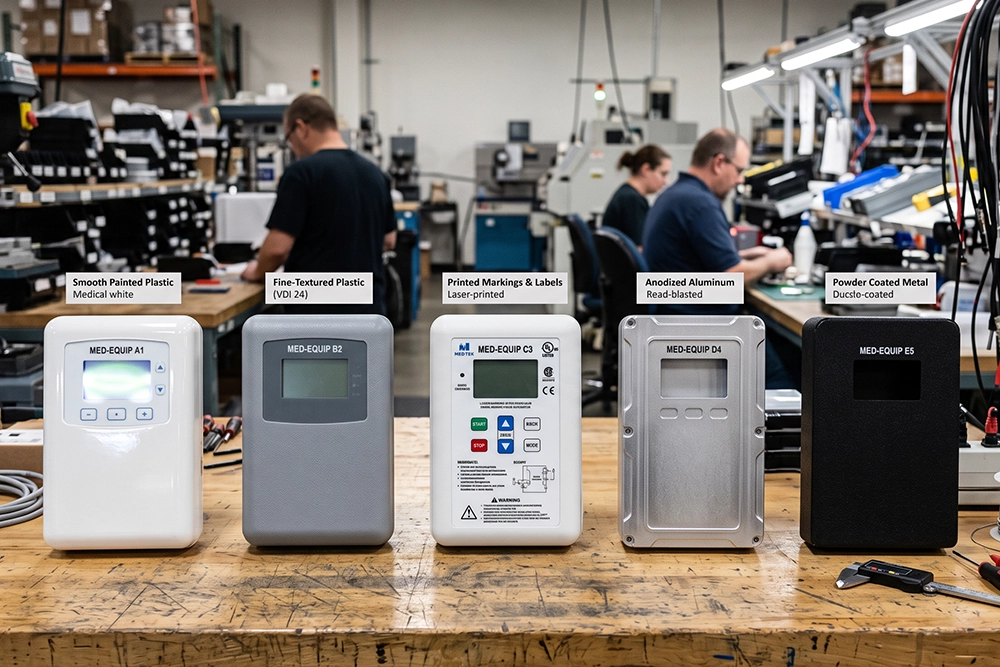
7. What surface finishes are available for medical device workstation housing?
Common options include powder coating, high-gloss painting, matte finishing, textured coatings, anodizing, and custom medical-grade finishing systems.
8. What dimensional accuracy can Zhongrongda achieve?
For most medical enclosure projects, we maintain tolerances between ±0.05 mm and ±0.3 mm depending on component size and manufacturing process.
9. Does Zhongrongda provide CNC machining for medical enclosures?
Yes. Our CNC Machining capabilities include precision milling, drilling, tapping, engraving, and finishing operations for medical equipment components.
10. How do I request a quote for a medical equipment cart enclosure?
Simply send your 2D drawings, 3D CAD files, quantity requirements, and target lead time. Our engineering team will review the project and provide feedback and pricing.
Request a Quote for Your Medical Equipment Cart Enclosure
Developing a large medical enclosure requires more than fabrication capacity—it requires engineering expertise from the earliest design stage.
At Zhongrongda, we help medical device manufacturers reduce development risk, shorten prototype cycles, and achieve production-ready enclosure solutions.
We support:
- Medical Equipment Cart Enclosures
- Medical Diagnostic Equipment Enclosures
- Medical Device Workstation Housing
- Medical Self-Service Terminal Housing
- Large Medical Equipment Enclosures
- Rapid Prototyping
- CNC Machining
- Low-Volume Manufacturing
Contact Our Engineering Team
Email: info@zrdmfg.com
Phone: +86 13972955806
Send us your CAD files, drawings, or concept sketches today, and our engineers will provide a manufacturability review and quotation within 24 hours.