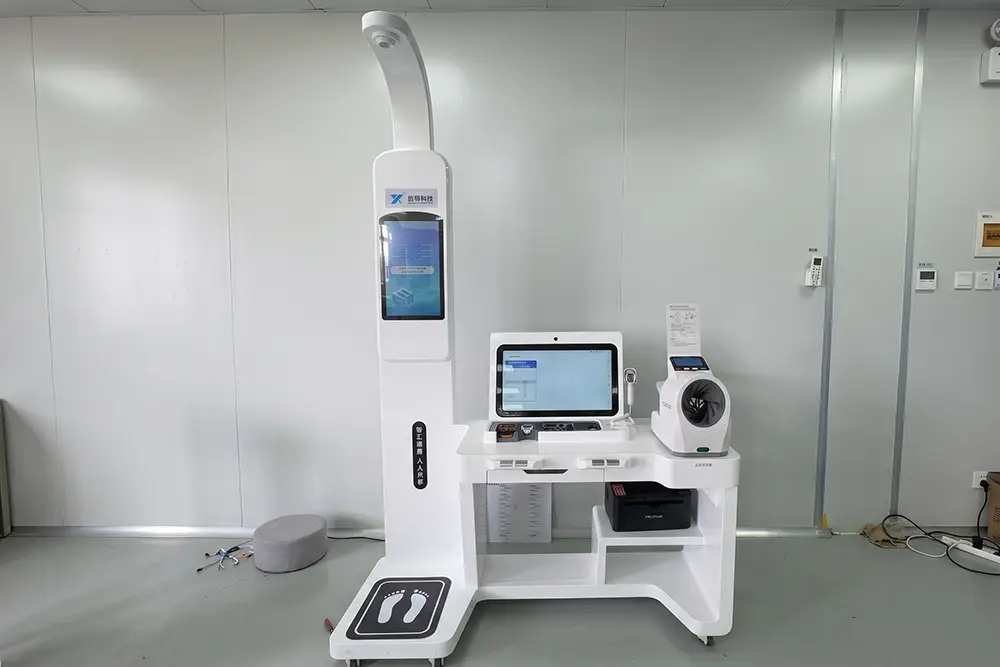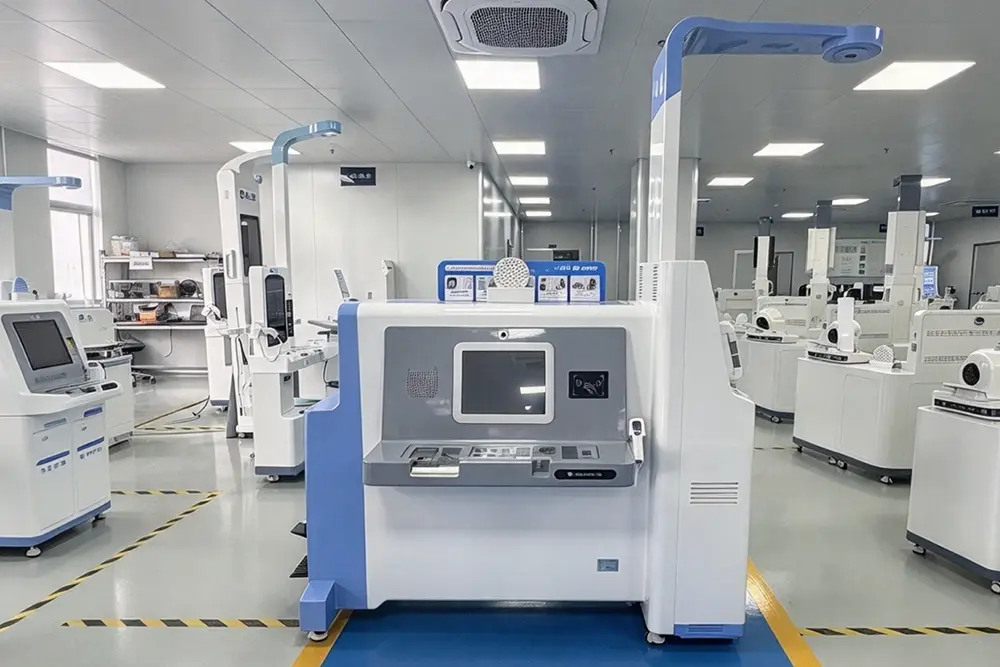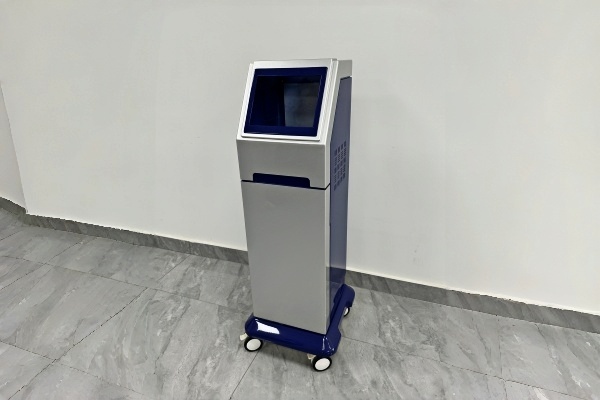
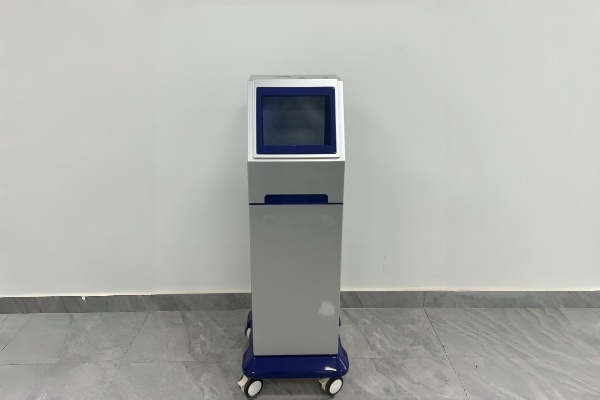
Manufacturing a Minimalist Medical Beauty Equipment Cart demands an uncompromising approach to dimensional accuracy and surface finishing. At Zhongrongda, our engineering team recently solved several complex fabrication bottlenecks to produce a high-end, vertical medical and physiotherapy instrument chassis.
This specific project required strict adherence to structural rigidity while maintaining a lightweight, elegant footprint. The final physical dimensions of this unit are strictly controlled at exactly 42cm in length, 42cm in width, and 110cm in height.
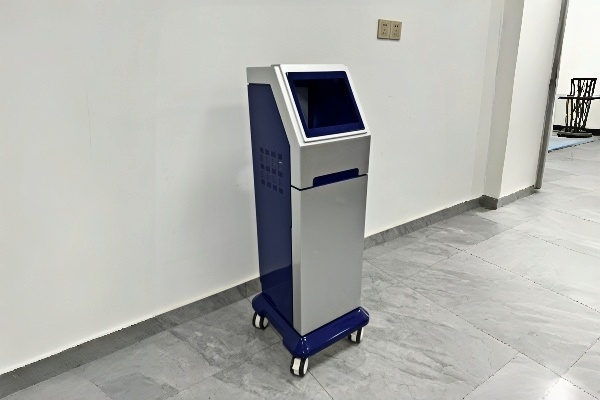
Balancing a slender vertical profile with a heavy internal payload creates significant deformation risks during the sheet metal forming process. Below, our team details the specific structural problems encountered and the exact manufacturing processes we implemented to resolve them. You can reference the visual result of this engineering in the file named IMG_4163.jpg.
Overcoming Deformation in the Vertical Physiotherapy Device Chassis
The primary structural foundation of this 110cm tall chassis utilizes 6063-T5 aluminum alloy sheet metal paired with thickened cold-rolled steel. This combination provides necessary rigidity while keeping the overall cart lightweight.
The core engineering problem arises from the slender, vertical design. Bending and welding large, flat metal panels over a 110cm span inevitably introduces thermal distortion and mechanical warping.
If the side panels warp by even one millimeter, the internal mounting brackets will misalign, compromising the entire internal equipment installation.
Controlling Heat During Aluminum Alloy Medical Cart Fabrication
To eliminate warping, our team bypassed standard manual press brake operations. We deployed advanced CNC press brakes equipped with laser angle measurement systems.
Before bending the 6063-T5 aluminum, we calculated the precise material springback coefficient. We programmed the CNC controller to apply varied, micro-adjusted pressure along the entire bend line.
- This ensures the large flat surfaces remain perfectly straight.
- It prevents the chassis from twisting or leaning over its 110cm height.
- It guarantees strict symmetry across all four sides of the vertical profile.
During the welding phase, standard TIG welding introduces excessive heat zones. Our engineers utilized continuous fiber laser welding, locking the pre-bent panels into massive, custom-machined heat-sinking fixtures.
This laser welding process creates deep penetration with a minimal heat-affected zone, resulting in a perfectly square chassis with absolutely no thermal warping. If your current fabrication partner struggles with panel distortion, our engineering team can audit your CAD models to optimize the flat patterns for laser welding.
Solving Split-Shell Sheet Metal Assembly Tolerances
Unlike a single-piece unibody design, this specific cart utilizes a top-and-bottom split-shell architecture. The upper display section must mate perfectly with the lower storage chassis.
The primary manufacturing challenge is ensuring that the joint gap between these two massive sections remains perfectly uniform and completely flat around the entire perimeter.
Variations in bending, welding, or painting will cause the two halves to sit unevenly, creating an unsightly, asymmetrical gap that fails medical-grade cosmetic standards.
Ensuring Uniform Gaps in the Two-Piece Shell
We addressed this tolerance stacking issue very early during the Rapid Prototyping phase. Our engineers designed an interlocking, concealed registration flange into the lower chassis.
Instead of relying on external fasteners, the upper shell slides down over this flange. To guarantee the gap remains uniform, we CNC milled the mating edges of the cold-rolled steel after the welding process was complete.
- Milling the edges post-welding removes any micro-distortions.
- It creates a perfectly flat, coplanar mating surface.
- It ensures the assembly gap remains under 0.2mm across the entire joint.
This precise upper and lower chassis assembly guarantees a seamless, premium appearance. This level of meticulous tolerance control is a foundational requirement for any Medical Device Enclosure we produce at Zhongrongda.
Precision Cutouts for the CNC Machined ABS Screen Bezel
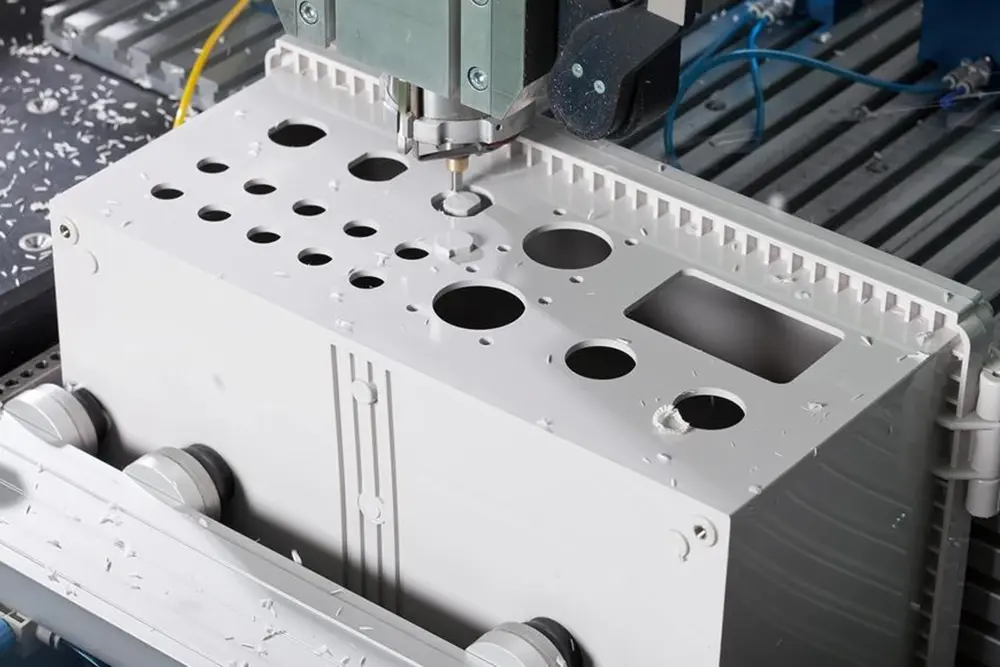
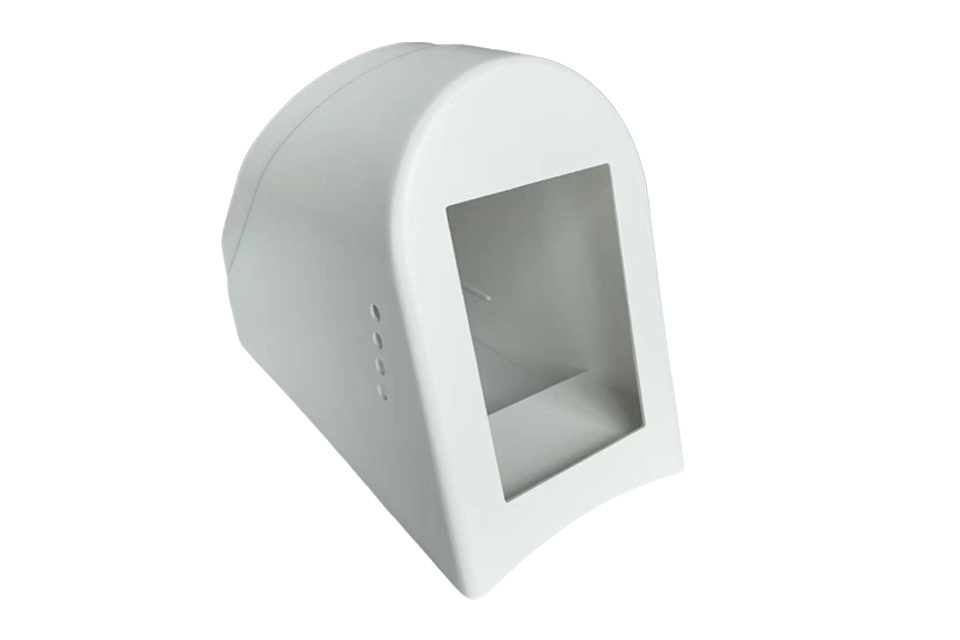
The upper section of the cart features a prominent display screen bezel. This bezel requires a perfectly square window to house the digital interface.
The screen bezel is constructed from a hybrid of painted sheet metal and high-gloss ABS plastic. The main problem is cutting a perfectly straight, right-angled square hole through these materials without causing edge chipping or leaving sharp burrs.
Standard punch pressing causes the ABS plastic to crack and leaves a raised, sharp edge on the aluminum alloy.
Avoiding Edge Chipping on Right Angles
To achieve a flawless, 90-degree internal corner, our team utilized simultaneous 5-axis CNC Machining. We clamped the integrated bezel into a custom vacuum fixture to prevent vibration.
By analyzing specific ABS plastic properties and applications, we determined the exact spindle speed and feed rate required to mill the plastic without generating melting heat.
- We utilized specialized single-flute end mills to clear plastic chips rapidly.
- We programmed trochoidal tool paths to reduce stress on the internal corners.
- This entirely eliminated micro-cracking and edge chipping.
The resulting square hole features absolute perpendicularity, strict dimensional symmetry, and zero burrs. This precise machining process allows the digital display to sit perfectly flush against the bezel, eliminating dust traps.
Executing Dual-Color Medical Cart Powder Coating
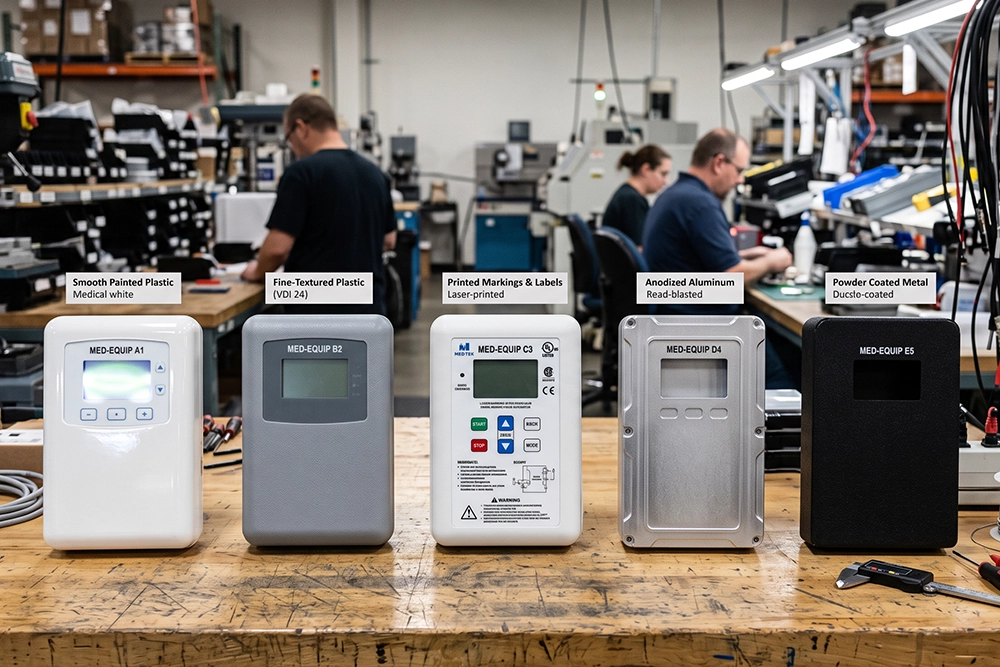
A premium medical aesthetic requires flawless surface treatments. This project specified a dual-color finish: a matte silver-grey electrostatic powder coating for the main body, and a high-gloss sapphire blue baking paint for the screen bezel and base.
The primary challenge is applying two drastically different textures (matte and high-gloss) to adjacent components and ensuring the boundary lines are razor-sharp.
Any overspray, color bleeding, or texture cross-contamination immediately ruins the high-end, luxury clinical feel.
Managing Matte and High-Gloss Boundary Lines
Our technicians separated the coating processes entirely. For the main body, we applied the silver-grey matte powder inside our climate-controlled electrostatic spray booths.
We optimized the spray gun voltage to ensure the matte powder distributed evenly across the large vertical panels, preventing any inconsistent textures or bare spots.
For the high-gloss sapphire blue components, we utilized a multi-layer liquid baking paint process.
- We applied a heavy base coat followed by a high-solids clear coat.
- We utilized a stepped infrared baking process to prevent the clear coat from sagging.
- We performed multi-stage mechanical polishing to achieve a glass-like, translucent depth.
During final assembly, these distinct components are mated together. Because we machined the assembly tolerances so precisely in the earlier steps, the matte silver and glossy blue surfaces meet with an absolute, crisp boundary line.
There is zero color bleeding and no cross-contamination. We apply these exact strict cosmetic defect controls to our Beauty Device Enclosures, ensuring your products stand out in any high-end clinical environment.
Frequently Asked Questions (FAQs)
Q1: What materials are used in the Minimalist Medical Beauty Equipment Cart?
We construct the main chassis using 6063-T5 aluminum alloy sheet metal and thickened cold-rolled steel for lightweight rigidity. We use high-gloss ABS and painted sheet metal for the screen bezels and base components.
Q2: How do you prevent the 110cm tall side panels from warping?
Our team uses advanced CNC press brakes with angle compensation to prevent bending distortion. We then use continuous fiber laser welding with heavy heat-sinking fixtures to completely eliminate thermal warping on the large flat surfaces.
Q3: What makes split-shell sheet metal assembly so difficult?
Aligning a separate upper and lower chassis requires perfect coplanarity. We solve this by CNC milling the mating edges after welding, ensuring the joint gap remains perfectly uniform and flat around the entire perimeter.
Q4: Why use CNC machining for the ABS screen bezel instead of punching?
Punching causes ABS plastic to crack and leaves sharp metal burrs. We use 5-axis CNC machining with specific feed rates to mill perfect right angles, ensuring zero edge chipping and absolute perpendicularity for the screen fitment.
Q5: How do you achieve a sharp boundary in dual-color medical cart powder coating?
We process the matte silver-grey powder coating and the high-gloss sapphire blue baking paint entirely separately. We rely on our ultra-precise CNC machining tolerances to ensure the components snap together with a clean, bleed-free boundary.
Q6: What are the exact dimensions of this vertical physiotherapy cart?
The physical dimensions for this specific integrated medical and physiotherapy equipment chassis cart are strictly manufactured to 42cm in length, 42cm in width, and 110cm in height.
Q7: How do you prevent high-gloss paint from sagging on the cart base?
To achieve the translucent sapphire blue finish, we apply a high-solids clear coat and immediately cure it using a stepped infrared baking profile. This cures the paint before gravity causes it to run or sag.
Q8: Can this matte silver-grey surface withstand clinical cleaning?
Yes. The electrostatic powder coating we apply creates a medical-grade, highly durable surface. It is designed to be anti-microbial, highly scratch-resistant, and easily wiped down with harsh chemical sterilizers.
Q9: How do you ensure internal components fit inside the vertical chassis?
We prevent structural twisting during the CNC bending phase. By keeping the chassis perfectly square and verifying tolerances during the prototyping phase, we ensure all internal mounting points align flawlessly with your equipment.
Q10: Why do you polish the welded corners instead of leaving them raw?
Medical carts require smooth, rounded touchpoints to prevent injury and snagging. After our seamless laser welding process, we perform multi-stage mechanical grinding to ensure all external corners are perfectly smooth with no sharp edges.
Contact Zhongrongda
Are asymmetrical assembly gaps or uneven surface coatings delaying your medical equipment production? Our engineering team specializes in resolving complex split-shell tolerances and flawless dual-color surface treatments. Partner with Zhongrongda for exact, medical-grade manufacturing execution.
Email: info@zrdmfg.com
Phone: +86 13972955806