How We Solve Thin-Blade Deformation and Complex Surface Machining Challenges
A Precision Aluminum Impeller may appear simple from the outside, but manufacturing one from a solid aluminum billet is one of the most demanding operations in advanced CNC machining.
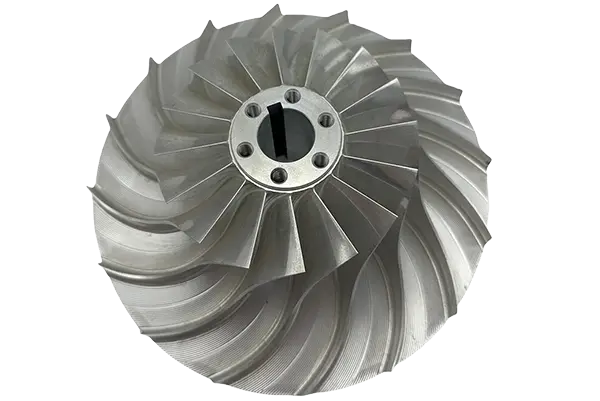
At Zhongrongda, we recently completed a precision aluminum impeller featuring thin twisted blades, complex freeform surfaces, and high-accuracy mounting features. The entire component was machined using simultaneous 5-axis CNC technology from a single aluminum workpiece without casting, welding, or assembly.
For applications such as turbochargers, air compressors, new energy equipment, and medical devices, impeller performance depends heavily on dimensional accuracy, blade consistency, and surface quality. Even minor deformation can reduce efficiency and create vibration during operation.
In this article, we explain the key machining challenges we faced, the manufacturing strategies we applied, and how our team achieved a stable and repeatable result.
Precision Aluminum Impeller Manufacturing Challenges
Thin Blades Are Highly Vulnerable to Vibration
The most significant challenge in this project was the blade structure.
The impeller contains multiple thin blades with large twist angles and continuously changing surface geometry. During machining, the remaining wall thickness becomes extremely small.
Common problems include:
- Tool chatter
- Blade deflection
- Surface waviness
- Dimensional inconsistency
- Edge damage
As material removal progresses, blade rigidity decreases rapidly. Conventional machining methods often create vibration marks that affect aerodynamic performance.
At Zhongrongda, our team optimized tool paths, cutting engagement, and machining sequences to maintain blade stability throughout the entire process.
Complex Freeform Surfaces Require Continuous Multi-Axis Control
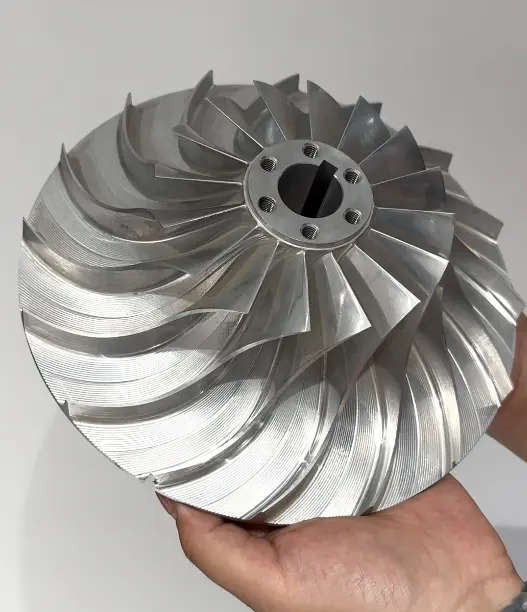
Unlike standard prismatic components, impeller blades contain continuously changing freeform surfaces.
Several difficulties arise:
- Constant changes in tool orientation
- Tight blade spacing
- Difficult tool accessibility
- High surface finish requirements
Three-axis machining typically requires multiple setups and repositioning operations. Each setup introduces additional tolerance accumulation.
To eliminate these risks, we selected simultaneous 5-axis machining for complete one-piece manufacturing.
For customers requiring similar high-precision components, our CNC Machining service supports complex geometries that cannot be efficiently produced using traditional machining methods.
Why We Chose Simultaneous 5-Axis CNC Machining
Single-Setup Machining Improves Accuracy
The entire impeller was machined from a solid aluminum billet.
Using simultaneous 5-axis technology allowed us to:
- Machine all blade surfaces in one setup
- Complete mounting holes without repositioning
- Maintain concentricity between features
- Reduce cumulative tolerance errors
The center bore, keyway, and mounting holes were all completed during the same machining cycle.
This approach significantly improved dimensional consistency across all critical features.
Better Surface Quality on Twisted Blades
Freeform impeller surfaces require continuous tool movement along multiple axes.
By dynamically adjusting tool orientation, we were able to:
- Reduce cutter marks
- Improve surface smoothness
- Maintain consistent blade profiles
- Achieve uniform material removal
The resulting surface finish minimized secondary polishing requirements while preserving blade geometry.
Toolpath Optimization for Thin-Blade Impeller Machining
Roughing Strategy
One common mistake in impeller machining is removing excessive material during roughing.
Aggressive cutting forces often create deformation before finishing even begins.
Our roughing process focused on:
- Controlled material removal
- Balanced cutting loads
- Uniform stock allowance
- Stable heat distribution
Maintaining consistent remaining material allowed us to prepare the blades for finishing without introducing unnecessary stress.
Semi-Finishing Strategy
Semi-finishing plays a critical role in blade stability.
Our team carefully reduced material in multiple stages to avoid sudden changes in structural rigidity.
Key objectives included:
- Equalizing blade thickness
- Stabilizing blade geometry
- Reducing residual stress
- Preparing for final finishing passes
This intermediate process significantly reduced the risk of deformation.
Finishing Strategy
The finishing stage required extremely precise control of cutting parameters.
We optimized:
- Tool diameter selection
- Feed rates
- Step-over values
- Tool engagement angles
The final result was a consistent blade profile across the entire impeller.
Maintaining Hole Position Accuracy During 5-Axis Machining
Critical Importance of Mounting Features
While the blades receive the most attention, mounting features are equally important.
The center bore and bolt circle determine assembly accuracy.
Any positional deviation may lead to:
- Rotor imbalance
- Increased vibration
- Reduced efficiency
- Premature bearing wear
To address this challenge, all mounting features were machined within the same coordinate system used for blade manufacturing.
This eliminated repositioning errors and improved overall concentricity.
Integrated Machining Eliminates Secondary Operations
Many manufacturers machine mounting features separately after blade production.
This approach introduces alignment risks.
At Zhongrongda, we completed:
- Blade machining
- Bore machining
- Bolt-hole machining
- Keyway machining
within a unified manufacturing process.
This integrated strategy improved dimensional reliability while reducing production time.
Material Selection Considerations for Aluminum Impellers
Why Aluminum Remains a Popular Choice
Aluminum offers several advantages for impeller manufacturing:
- Excellent machinability
- Lightweight construction
- Good strength-to-weight ratio
- Corrosion resistance
- High production efficiency
These characteristics make aluminum suitable for:
- Turbochargers
- Air compressors
- Industrial blowers
- New energy systems
- Medical equipment
Material behavior during machining is equally important.
Understanding cutting characteristics allows us to optimize tool life and surface quality.
For engineering reference, material scientists provide detailed information regarding mechanical properties and manufacturing behavior through resources such as MatWeb Material Property Database.
Applications of Precision Aluminum Impellers
Turbocharger Systems
Turbocharger impellers operate at extremely high rotational speeds.
Manufacturing precision directly affects:
- Airflow efficiency
- Rotor balance
- Performance consistency
Small geometric deviations can significantly impact operating performance.
Air Compressors
Air compressor impellers require:
- Consistent blade geometry
- Reliable dimensional accuracy
- Stable dynamic balance
Our machining strategy helps maintain these requirements throughout production.
New Energy Equipment
Many new energy systems rely on high-speed rotating components.
Precision aluminum impellers are frequently used where lightweight construction and efficient airflow are critical.
Medical Equipment Components
Medical equipment often requires compact, lightweight, and highly reliable rotating assemblies.
Through our Medical Device Enclosure manufacturing projects, we frequently encounter precision components that demand similar machining accuracy and quality control standards.
From Prototype Validation to Production
Rapid Verification Before Full Production
Many customers initially require prototype validation before committing to larger quantities.
Our Rapid Prototyping service allows engineers to evaluate:
- Fit and function
- Aerodynamic performance
- Assembly compatibility
- Design improvements
This approach helps identify optimization opportunities early in development.
Supporting Custom Industrial Products
In addition to impeller manufacturing, we also support precision custom projects across multiple industries.
For customers developing consumer and aesthetic equipment, our Beauty Device Enclosures service provides manufacturing solutions for complex external housings and precision internal components.
How We Controlled Quality Throughout the Process
Quality control began long before machining started.
Our engineering team reviewed:
- Blade geometry
- Tool accessibility
- Fixture design
- Machining risks
During production, we monitored:
- Tool wear conditions
- Cutting stability
- Surface finish consistency
- Critical dimensional features
After machining, dimensional verification focused on:
- Blade profiles
- Bore accuracy
- Hole positions
- Surface quality
This systematic approach helped ensure the finished impeller met customer requirements.
Conclusion
Manufacturing a Precision Aluminum Impeller with thin twisted blades and complex freeform surfaces requires much more than simply running a CNC program.
The real challenge lies in controlling vibration, maintaining blade integrity, preserving dimensional accuracy, and ensuring repeatability throughout the machining process.
By combining simultaneous 5-axis machining, optimized toolpaths, integrated feature manufacturing, and detailed process control, our team successfully produced a one-piece aluminum impeller with high dimensional consistency and excellent surface quality.
If you are developing a turbocharger impeller, compressor component, new energy rotor, or precision rotating part with complex geometry, our engineers can help evaluate manufacturability and recommend the most efficient machining strategy.
Contact Zhongrongda to discuss your next precision impeller project.