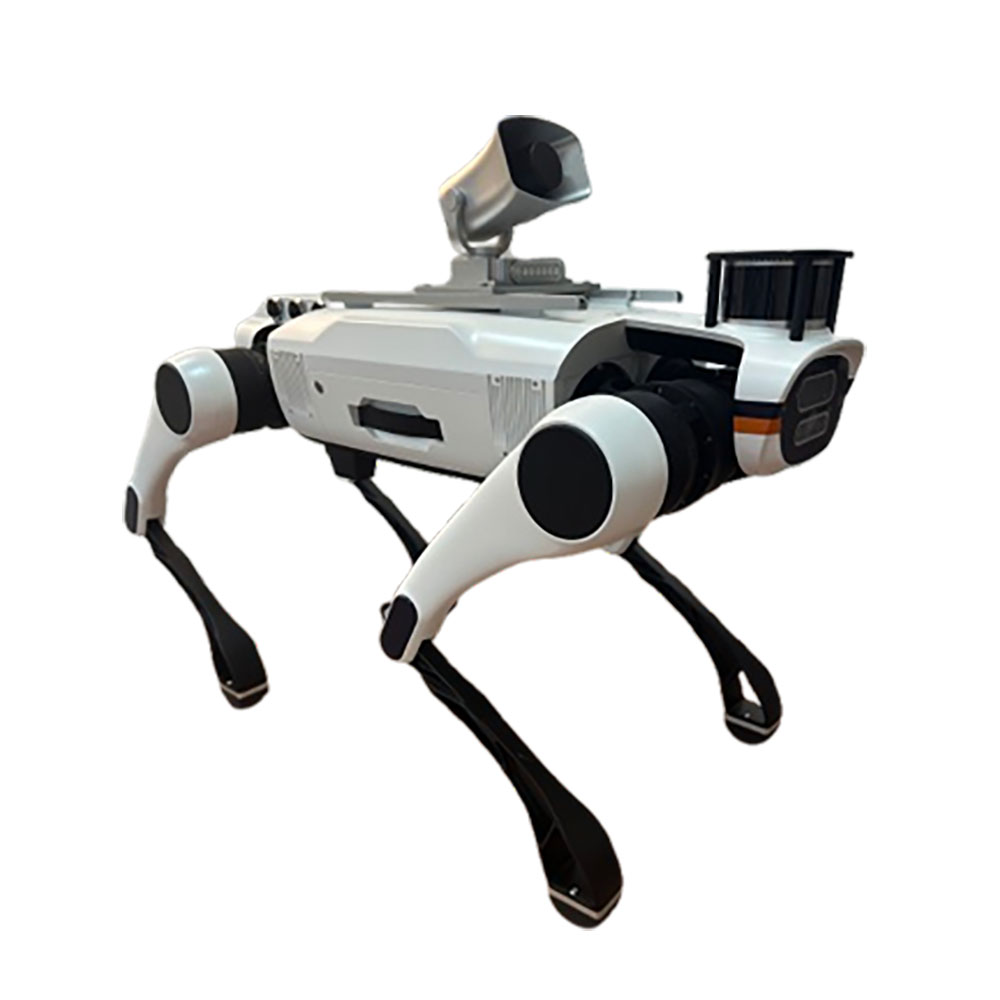
Translating a digital CAD design into a physical 1:1 scale model requires exact structural validation before investing in mass production tooling. At Zhongrongda, our engineering team regularly tackles the physical hardware hurdles of building a highly accurate police reconnaissance robot mockup.
This specific law enforcement quadruped model serves as a critical spatial and appearance verification tool. While it lacks internal driving motors, the external casing must precisely replicate the final injection-molded product to test payload mounting and mechanical interference.
This article details the specific manufacturing processes, material selections, and problem-solving strategies we deploy to create high-fidelity law enforcement hardware models without structural failures.
Dimensional Specifications for the Police Reconnaissance Robot Mockup
To accurately test physical interference and kinematic envelopes, our team fabricates the prototype to strictly adhere to the field-ready specifications.
- Length: 850mm
- Width: 400mm
- Height: 600mm
Maintaining these exact dimensions across multiple disparate materials requires a highly controlled manufacturing environment to prevent assembly failure.
Engineering the Law Enforcement Robot Dog Casing
Building a multi-part casing of this magnitude introduces severe tolerance stacking issues. Our team must assemble rigid metal components, large resin panels, and transparent acrylic visors seamlessly.
- The Problem: Different materials possess vastly different thermal expansion and machining shrinkage rates. A 0.2mm deviation in the main body panel will cause the front visor to warp, creating unsightly gaps and rendering the casing useless for waterproofing tests.
- The Solution: We implement strict environmental controls during our machining and printing phases. We target a general machining tolerance of ±0.05mm on all critical mating surfaces, utilizing custom-milled locating pins to guarantee exact alignment during final assembly.
Managing the Autonomous Patrol Robot Enclosure Structure
A mockup measuring 850mm in length carries significant physical weight, especially when equipped with heavy top-mounted payload blocks.
- The Problem: Relying entirely on rapid-prototyped plastics for the main load-bearing chassis guarantees structural failure. The heavy top payload will cause the plastic spine to sag, eventually cracking the cosmetic outer shell.
- The Solution: We engineer a concealed internal sub-frame milled from high-density POM (Delrin) and aluminum plates. This hidden skeleton carries the entire mechanical load, isolating the delicate autonomous patrol robot enclosure from physical stress and preventing deformation.
Fabricating the Custom Surveillance Quadruped Shell
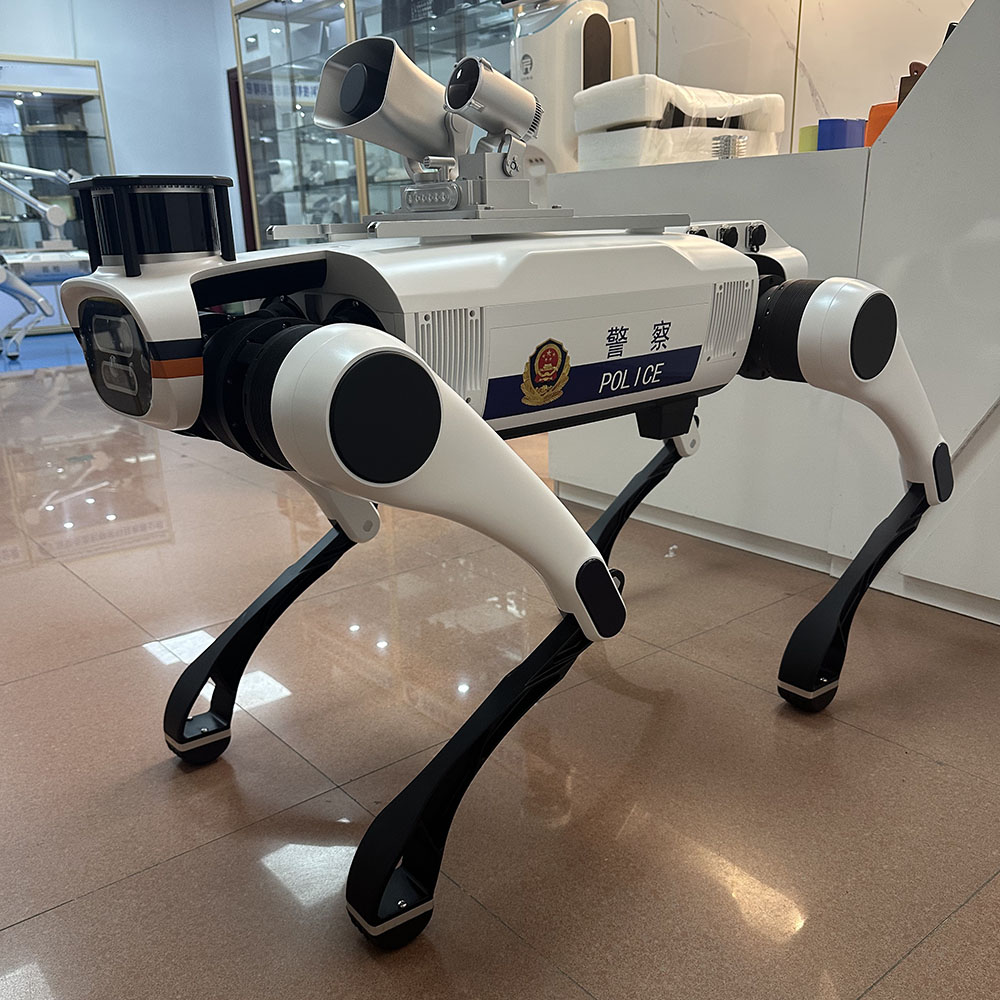
The sleek, bionic aesthetics of the main white body feature sweeping curves and integrated cooling louvers that pose significant machining difficulties.
- The Problem: CNC milling these large, complex organic shapes from solid plastic blocks is highly inefficient, wasting massive amounts of raw material and drastically increasing your prototyping costs.
- The Solution: We utilize industrial-grade Stereolithography (SLA) 3D printing for the custom surveillance quadruped shell. We specify a high-toughness, ABS-like photopolymer resin to print the complex front fascia and side panels in single, continuous operations.
Precision Assembly of the Rapid Prototyping Sensor Housing
The visual focal point of this model is the top-mounted payload, which includes a dual-camera gimbal and an acoustic warning horn.
- The Problem: These sensor housings consist of extremely thin-walled geometries (often under 1.5mm). During the post-curing phase of standard SLA printing, these thin walls warp and distort, making it impossible to install the simulated camera lenses.
- The Solution: We design custom, sacrificial support structures specifically for the rapid prototyping sensor housing. Furthermore, we execute a slow-curing thermal cycle in our UV ovens, which safely releases internal stresses and ensures the thin-walled components remain perfectly cylindrical.
Integrating CNC Machined Robotic Leg Joints
The legs of the quadruped must support the full weight of the chassis while providing a realistic, metallic aesthetic that mimics real tactical hardware.
- The Problem: Standard resin or plastic joints will snap under the shear weight of the 850mm body during manual posing and design reviews.
- The Solution: We manufacture the core load-bearing components using CNC machined robotic leg joints. We mill these parts from aerospace-grade 6061-T6 aluminum using 5-axis CNC centers.
- The Finish: We apply a fine sandblasting and silver anodizing surface treatment. This hardens the exterior against wear and provides the exact metallic visual required for a defense-grade presentation.
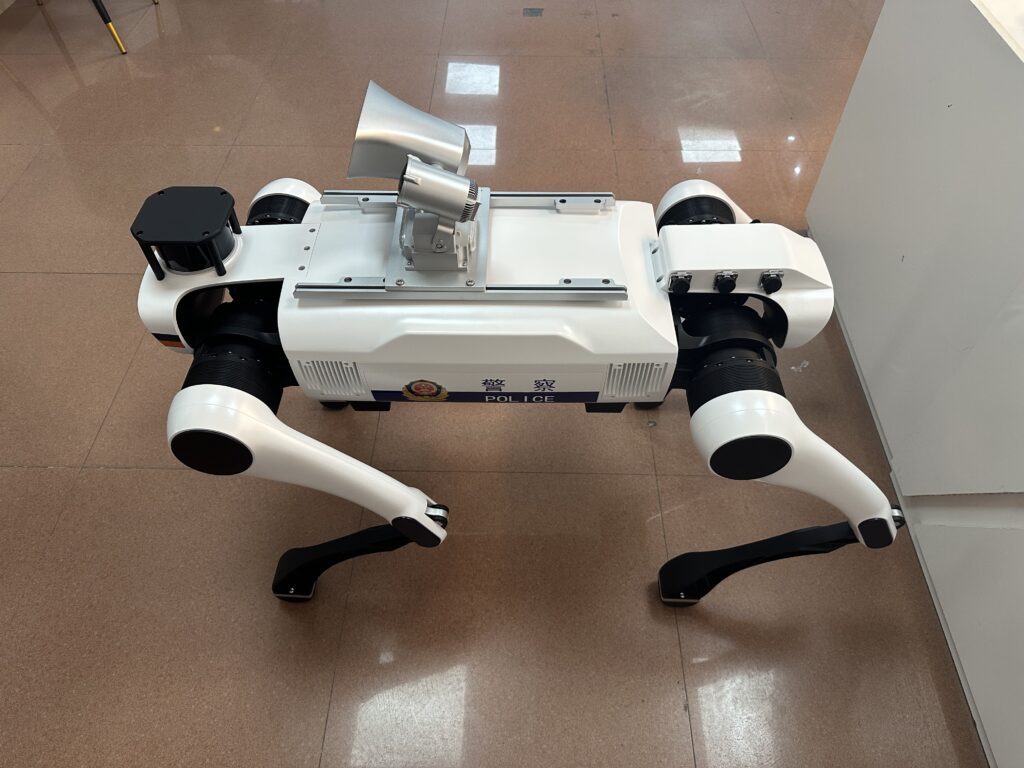
Advanced Cosmetic Finishing for Law Enforcement Mockups
The final perception of the prototype heavily depends on the quality of its surface finish. Industrial buyers will reject a model that looks like a cheap 3D print.
- The Problem: All SLA printed parts exhibit microscopic layer lines. If painted directly, these lines become magnified, destroying the illusion of an injection-molded, commercial-grade product.
- The Solution: Our craftsmen execute a strict, multi-stage hand-sanding protocol. We then apply automotive-grade polyurethane primers to fill any remaining micro-pores, sealing the resin completely.
- The Final Detail: We finish the shell with a durable matte white topcoat. The specific “POLICE” decals, warning stripes, and official law enforcement badges are applied utilizing precision water-transfer printing, resulting in a flawless, exhibition-ready model.
4. Frequently Asked Questions (FAQs)
1. Why use SLA printing for a police reconnaissance robot mockup?
SLA printing allows us to fabricate large, complex organic geometries like the main outer shell without the extreme costs and lead times of CNC machining solid plastic blocks. We use tough, ABS-like resins to ensure durability.
2. How do you prevent the rapid prototyping sensor housing from warping?
We prevent warpage on thin-walled sensor components by engineering custom thermal support structures during the printing phase and utilizing a highly controlled, slow UV-curing process to eliminate internal material stress.
3. Why are CNC machined robotic leg joints necessary for a mockup?
A mockup measuring 850mm in length is heavy. Plastic joints will shear or bend under the weight. We mill the joints from 6061 aluminum to provide the necessary load-bearing strength and authentic metallic finish.
4. Can you achieve an injection-molded look on a custom surveillance quadruped shell?
Yes. We achieve this by eliminating all 3D printing layer lines through intensive manual sanding, followed by the application of automotive-grade primers and specialized matte polyurethane paints.
5. How do you integrate the black acrylic visor into the law enforcement robot dog casing?
We CNC route the transparent black acrylic to the exact curvature of the front fascia. We then use specialized chemical bonding agents that securely attach the visor without causing the acrylic to craze or cloud.
6. What is the typical tolerance for your autonomous patrol robot enclosure assembly?
To ensure multiple different materials (aluminum, SLA resin, acrylic) fit together flawlessly, we maintain a strict machining and printing tolerance of ±0.05mm across all critical mating surfaces and mounting points.
7. Do you provide water-transfer printing for law enforcement decals?
Yes. We utilize precision water-transfer printing and silkscreen techniques to accurately apply highly detailed “POLICE” lettering, warning stripes, and complex badges directly onto the curved surfaces of the mockup.
5. Partner with Zhongrongda Today
Validating your robotic hardware design through a high-precision physical model is the most effective way to eliminate costly engineering errors before mass production. Our team is ready to analyze your CAD files and engineer a flawless structural prototype.
Contact our engineering team to start your project:
Email: info@zrdmfg.com
Phone: +86 13972955806