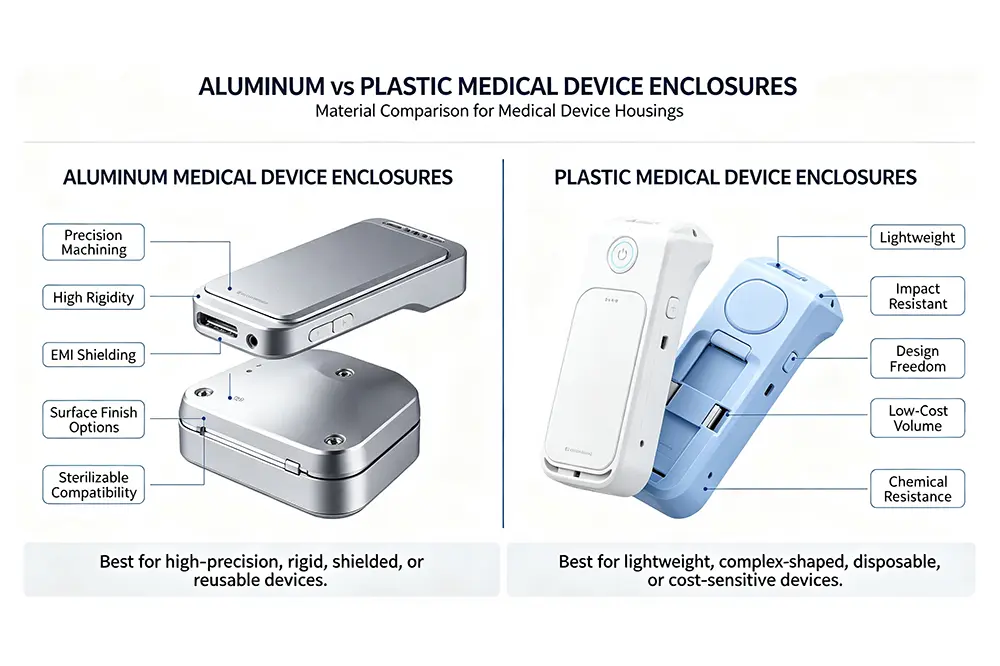
Choosing between aluminum and plastic is one of the most important early decisions when developing a custom medical device enclosure.
The right choice affects structural strength, weight, thermal performance, appearance, manufacturing cost, assembly and production scalability. It can also affect how easily the enclosure can accommodate displays, connectors, fans, internal frames and other components.
There is no universal winner.
Aluminum is often considered when structural strength, heat dissipation, rigidity or a premium machined appearance are priorities. Plastic can be a better fit when low weight, complex shapes, insulation, surface appearance and cost-efficient production are more important.
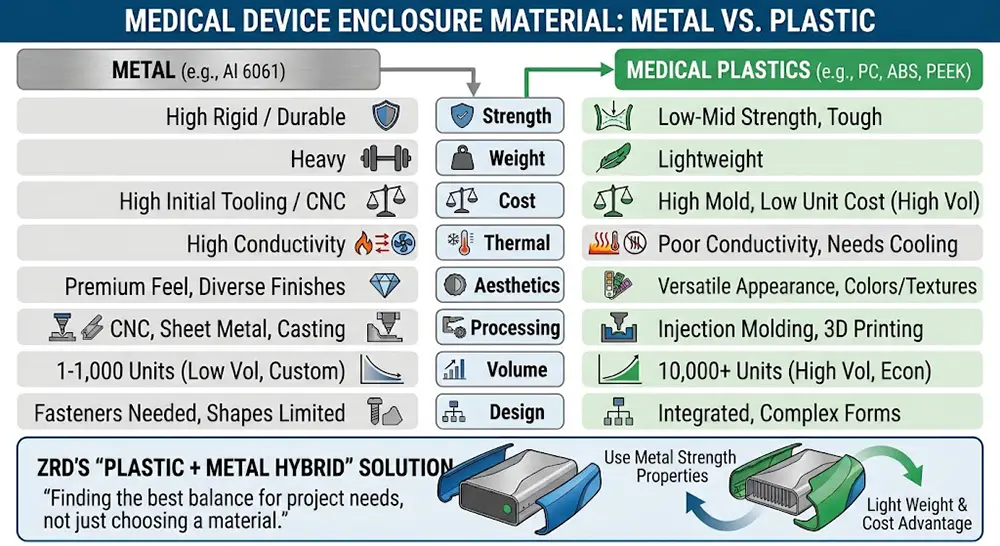
For many medical and laboratory equipment projects, the most practical solution is not necessarily 100% aluminum or 100% plastic. A hybrid construction using a plastic outer enclosure and internal metal structure can provide a better balance.
Quick Comparison: Aluminum vs Plastic Enclosures
| Requirement | Aluminum | Plastic |
|---|---|---|
| Structural rigidity | Excellent | Good to very good, depending on design |
| Weight | Higher than many plastics | Generally lower |
| Impact resistance | Good, but can dent | Depends strongly on material |
| Thermal conductivity | Excellent | Low |
| Electrical insulation | No | Generally good |
| Complex shapes | Moderate to good | Very good with suitable processes |
| Surface finishing | Excellent | Excellent with suitable finishing |
| Prototype flexibility | Excellent with CNC | Excellent with CNC / fabrication |
| Injection molding | Not applicable | Suitable for higher-volume plastic parts |
| Large lightweight housings | Less attractive | Often attractive |
| Internal structural frame | Excellent | Usually needs reinforcement for heavy loads |
| Typical cost drivers | Material, machining, finishing | Material, tooling, process, finishing |
| Best fit | Structural and thermal requirements | Lightweight, complex and appearance-driven housings |
The table is a starting point. The actual material decision should be based on the enclosure geometry, internal components, operating environment, manufacturing process and production quantity.
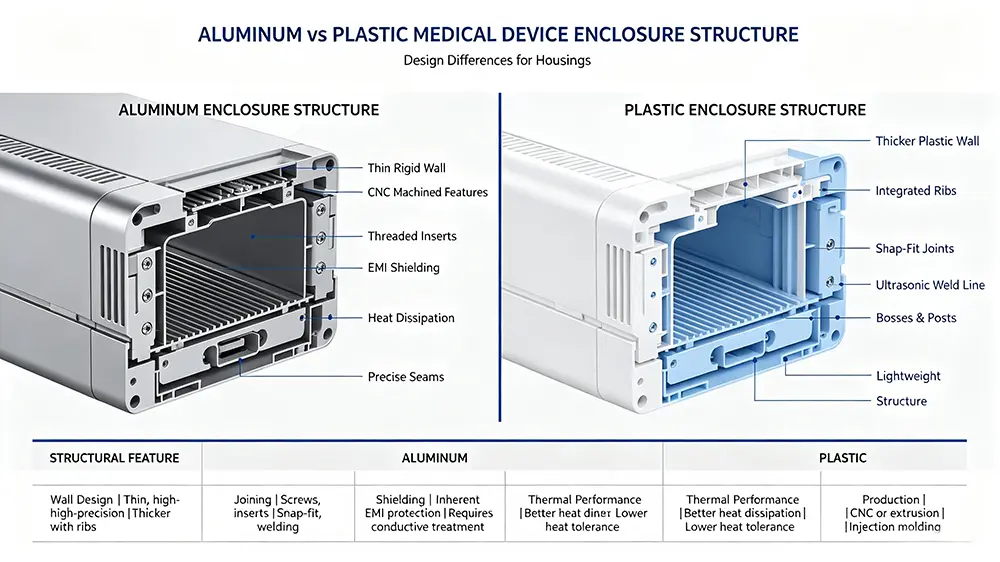
1. When Aluminum Makes Sense for a Medical Device Enclosure
Aluminum is often selected when the enclosure itself needs to provide significant structural support.
Its combination of rigidity, relatively low density compared with many other metals, machinability and thermal conductivity makes it useful for certain medical and laboratory equipment designs.
Aluminum can be a good choice when you need:
- High structural rigidity
- Strong mounting points
- Good heat transfer
- A metal enclosure appearance
- Durable machined surfaces
- Strong threaded connections
- A robust frame or structural chassis
- EMI shielding considerations
- A housing that must support heavy internal components
For example, equipment containing heavy power supplies, pumps, motors, heat-generating electronics or other concentrated loads may benefit from a metal structural solution.
However, the fact that aluminum is stronger or more rigid does not automatically mean that the entire enclosure should be made from aluminum.
The design should first determine where the structural load actually occurs.
2. When Plastic Makes Sense for a Medical Device Enclosure
Plastic is often attractive for equipment housings because it can combine low weight, design flexibility and good appearance.
Depending on the material and manufacturing process, plastic can be used for everything from small handheld housings to large equipment covers and mobile medical equipment enclosures.
Plastic can be a good choice when you need:
- Lower overall weight
- Complex exterior geometry
- Integrated features
- Electrical insulation
- Large curved panels
- Multiple cosmetic surfaces
- Lower-volume fabrication
- Injection-molded production
- Color integrated into the material
- Easy integration of buttons, displays and access panels
For medical equipment used by operators throughout the day, weight can become an important design factor.
A lighter enclosure can make equipment easier to move, handle and install.
For mobile equipment, however, the enclosure still needs sufficient structural support around wheels, handles, shelves and mounted components.
This is where enclosure design becomes more important than simply selecting “plastic.”
3. Strength Does Not Mean the Entire Enclosure Should Be Aluminum
A common assumption is:
“If the equipment needs strength, use aluminum for the entire enclosure.”
That is not always the most efficient solution.
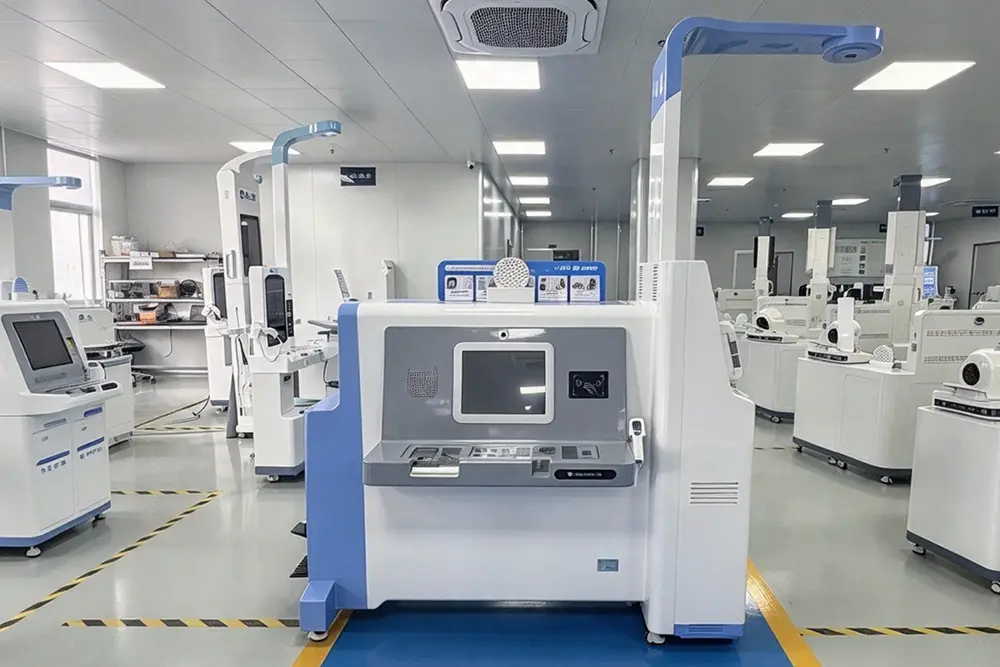
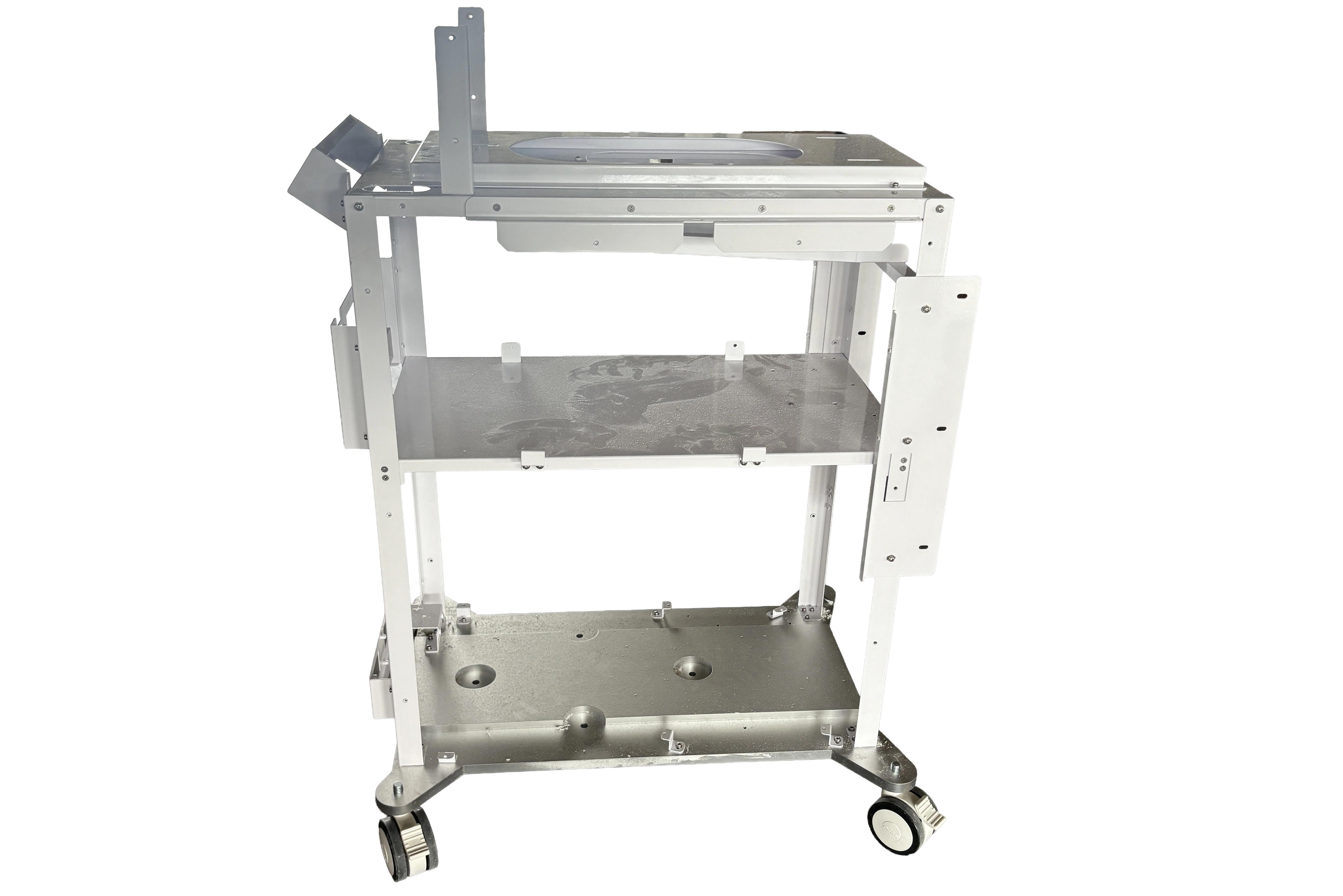
Consider a mobile medical cart.
The external enclosure may need to provide:
- A clean appearance
- Smooth surfaces
- Access panels
- Cable routing
- Openings for displays
- Storage areas
- Ventilation
- Easy cleaning
Meanwhile, the actual structural load may be concentrated around:
- Casters
- Handle mounting points
- Internal equipment supports
- Shelves
- Power supply mounting
- Heavy internal modules
Instead of making the entire enclosure from aluminum, the engineering team can place the metal where the loads actually occur.
This can produce a hybrid structure:
Plastic outer enclosure + metal internal frame
The result can provide a finished medical-equipment appearance while maintaining structural support where it is needed.
4. Aluminum vs Plastic: Weight
Weight is often one of the first practical considerations.
A medical device may need to be:
- Moved between rooms
- Placed on a cart
- Installed on a workstation
- Carried by technicians
- Transported between facilities
- Mounted onto another structure
Reducing enclosure weight can simplify handling.
Plastic generally provides more opportunities for lightweight large-area panels.
But lightweight does not automatically mean better.
If the enclosure is too flexible, the design may experience:
- Panel vibration
- Fastener movement
- Poor door alignment
- Cosmetic gaps
- Noise
- Structural deformation
The solution is usually not simply “use thicker plastic.”
Engineers can use:
- Ribs
- Internal frames
- Reinforcement plates
- Metal brackets
- Proper fastener locations
- Localized thickness changes
- Structural inserts
The goal is to place material where it contributes to the required performance.
5. Aluminum vs Plastic: Thermal Management
This is one area where aluminum and plastic behave very differently.
Aluminum conducts heat effectively.
Plastic generally has much lower thermal conductivity.
Therefore, if the enclosure needs to move heat away from internal electronics, aluminum can provide useful thermal pathways.
However, the enclosure material is only one part of thermal management.
The complete design may also involve:
- Fans
- Vents
- Heat sinks
- Thermal interfaces
- Airflow channels
- Internal partitions
- Exhaust paths
- Component placement
A plastic enclosure can still be used for equipment containing electronics if the thermal design is properly engineered.
Likewise, simply changing a plastic enclosure to aluminum does not automatically solve an overheating problem.
The internal heat generation and airflow should be evaluated first.
6. Aluminum vs Plastic: Electrical Insulation
Plastic has an important advantage when electrical insulation is part of the enclosure design.
Many engineering plastics are electrically insulating.
This can simplify certain enclosure designs where the outer housing does not need to function as a conductive enclosure.
Aluminum, by contrast, is electrically conductive.
That can be an advantage or a design consideration depending on the application.
For equipment containing sensitive electronics, the engineering team may need to consider:
- Grounding
- Shielding
- Insulation
- Cable routing
- Connector mounting
- Internal electrical isolation
These requirements should be considered during the enclosure design rather than after the housing is already manufactured.
7. Aluminum vs Plastic: Appearance and Surface Finish
Medical equipment is often expected to look clean, professional and consistent.
Both aluminum and plastic can achieve high-quality finishes, but the finishing methods are different.
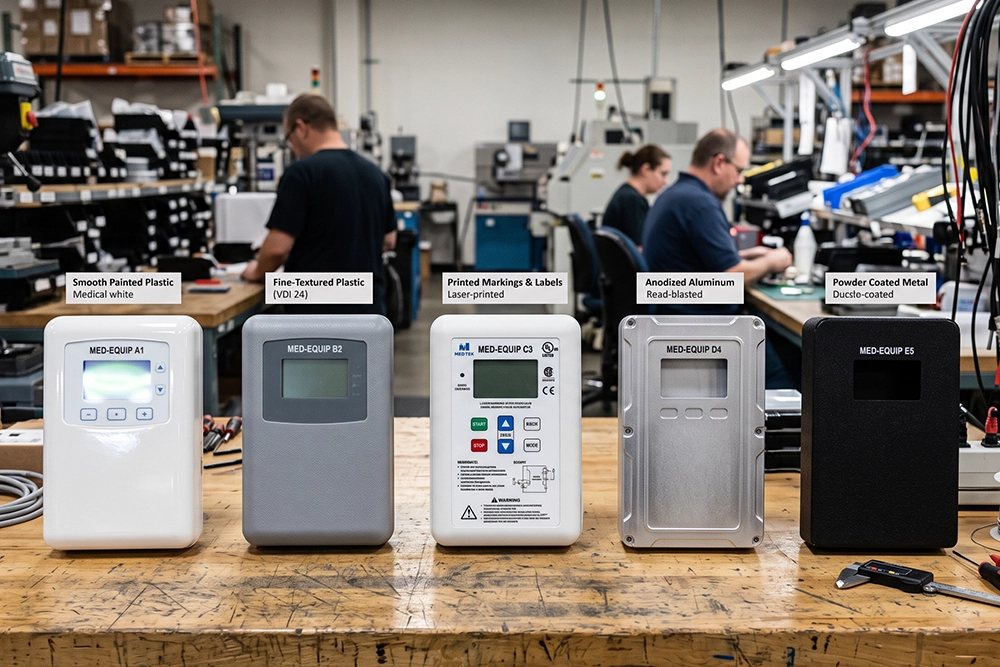
Aluminum finishing options
Depending on the manufacturing process, aluminum can be:
- Anodized
- Brushed
- Bead blasted
- Powder coated
- Painted
- CNC finished
Machined aluminum can also provide a premium technical appearance.
Plastic finishing options
Plastic enclosures can be:
- Molded with a texture
- Painted
- Polished
- Printed
- Laser marked
- Finished with different surface textures
- Produced in different base colors
For a medical equipment housing, the final appearance depends on the combination of material, geometry, manufacturing process and finishing method.
A well-designed plastic enclosure does not necessarily look less professional than a metal enclosure.
8. Aluminum vs Plastic: Manufacturing Process
Material selection and manufacturing process should be considered together.
Aluminum manufacturing
Common processes include:
- CNC machining
- Sheet-metal fabrication
- Bending
- Welding
- Laser cutting
- Extrusion
- Casting
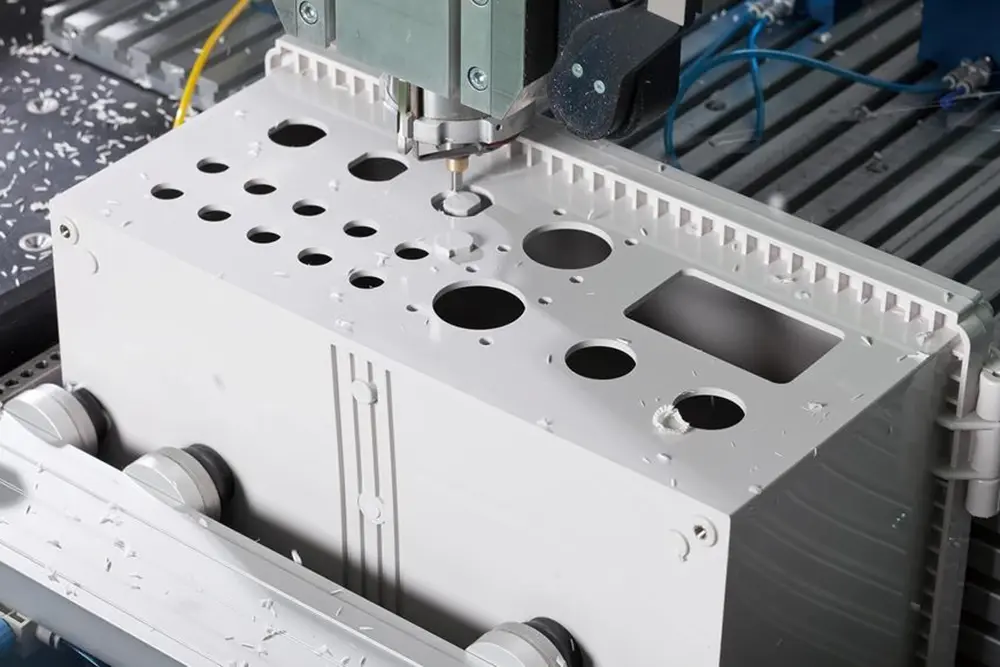
CNC machining is particularly useful for aluminum prototypes and low-volume precision components.
However, large aluminum housings can become expensive if they require extensive machining.
Plastic manufacturing
Depending on the design and quantity, plastic enclosures can be produced through:
- CNC machining
- Vacuum forming
- Injection molding
- Sheet fabrication
- Thermoforming
- Bonding
- Assembly
For prototypes and low-volume projects, CNC-machined or fabricated plastic can be useful because the project can move forward without immediately committing to injection-molding tooling.
For larger production volumes, injection molding may become attractive when the geometry and expected volume justify tooling investment.
The correct process depends on the part geometry, annual quantity, surface requirements and production schedule.
9. Prototype Requirements Can Change the Material Decision
The material selected for a production enclosure is not necessarily the best material for the first prototype.
This is especially important for medical device development.
During early development, you may need to verify:
- Component fit
- Display position
- Cable routing
- Door access
- Ergonomics
- Ventilation
- Assembly
- Serviceability
- Overall appearance
At this stage, the priority may be getting a functional prototype quickly rather than optimizing the final mass-production process.
A CNC-machined plastic prototype can sometimes be used to validate the design before moving to injection molding or another production process.
This reduces the risk of committing to expensive tooling before the enclosure design is sufficiently mature.
10. Production Volume Changes the Cost Equation
There is no simple rule that says aluminum is always more expensive or plastic is always cheaper.
The manufacturing process matters.
For example:
One or a few prototypes
CNC machining may be practical for both aluminum and engineering plastics.
Small batches
Vacuum forming, fabricated plastic panels, CNC machining or sheet-metal fabrication may be considered depending on the geometry.
Higher-volume production
Injection molding can become more attractive for plastic parts because tooling costs can be distributed across a larger number of units.
Complex large enclosure
Vacuum forming or fabricated plastic may offer a different cost structure from CNC-machined aluminum.
Therefore, when comparing aluminum and plastic, buyers should compare the complete manufacturing route, not only the raw material price.
11. Hybrid Aluminum + Plastic Enclosures
For many custom medical equipment projects, this is an option worth considering early in the design process.
A hybrid enclosure can use:
Plastic for the exterior
and
Metal for the internal structural components.
This approach can combine:
- Lightweight external panels
- Good cosmetic appearance
- Strong internal support
- Metal mounting points
- Better load distribution
- Flexible equipment integration
The exact combination can vary.
For example:
- ABS outer housing + SPCC frame
- PC-ABS outer housing + aluminum mounting structure
- Plastic panels + aluminum brackets
- Plastic enclosure + sheet-metal chassis
The best combination depends on where the structural and environmental requirements actually occur.
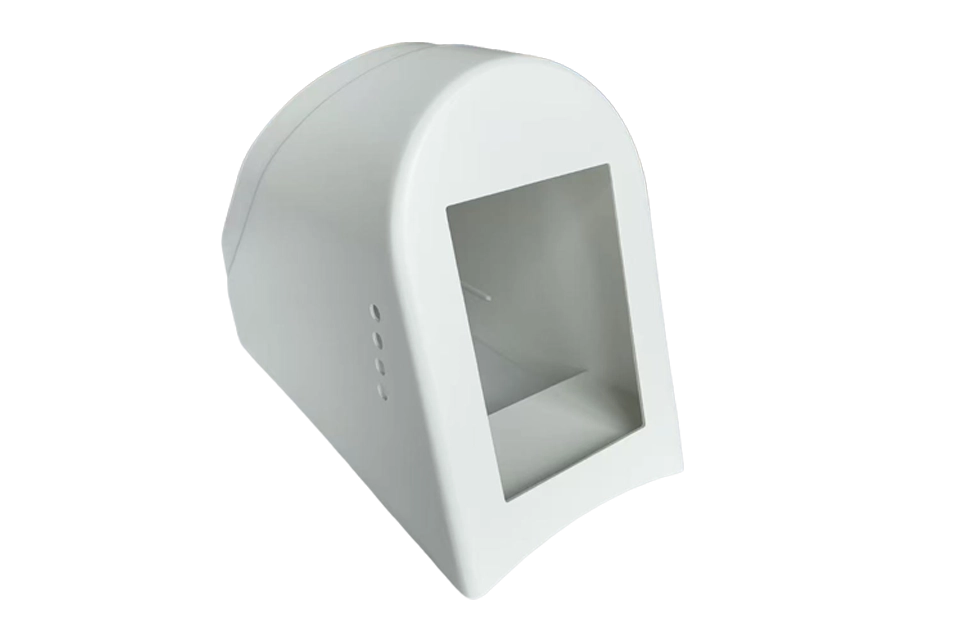
12. A Real Example: Plastic Housing + Metal Structural Frame
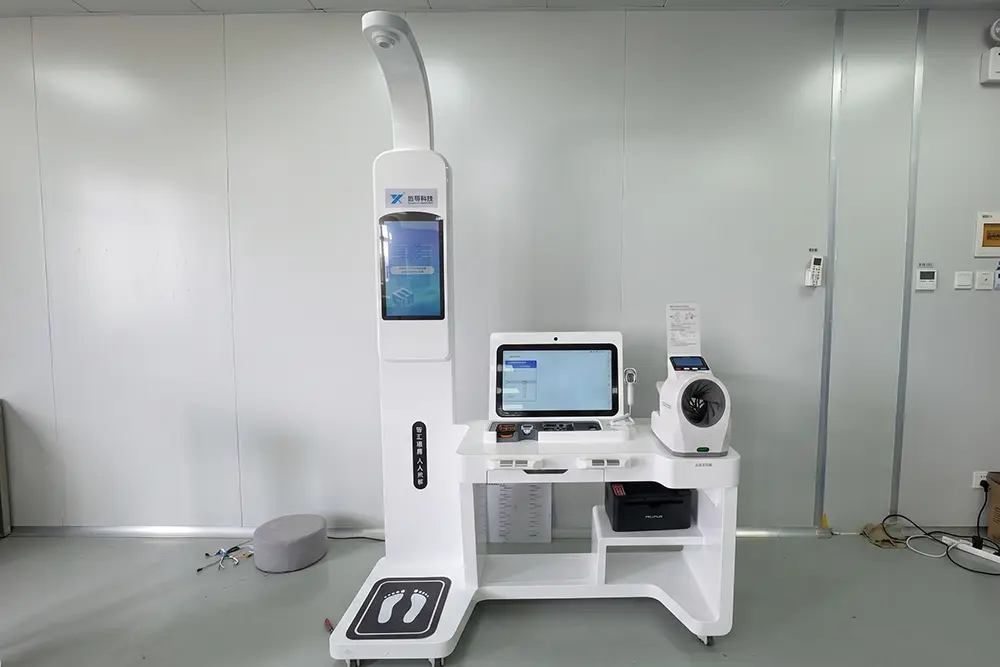
We have worked on medical equipment enclosure projects where the external appearance and internal structural requirements were different.
One example is a medical equipment housing using an ABS external enclosure combined with an SPCC internal structure.
The external plastic housing provided the product appearance and accommodated the equipment interfaces.
The internal metal structure provided support for the equipment and helped manage the structural loads.
This type of design can be particularly useful for larger equipment where making every exterior component from metal would add unnecessary weight, machining or finishing requirements.
The important engineering principle is simple:
Use each material where its properties provide the most value.
13. When Should You Choose Aluminum?
Aluminum may be worth considering when several of these requirements apply:
- The enclosure needs substantial rigidity.
- Internal components are heavy.
- Heat dissipation is important.
- Strong threaded mounting points are required.
- The enclosure itself forms part of the structural chassis.
- A metal appearance is important.
- EMI shielding is a design consideration.
- The enclosure is relatively compact and suitable for machining or metal fabrication.
However, the final design still needs to consider manufacturing cost, weight and finishing.
14. When Should You Choose Plastic?
Plastic may be worth considering when several of these requirements apply:
- Low weight is important.
- The enclosure has large exterior surfaces.
- Complex curves or integrated features are required.
- Electrical insulation is useful.
- Cosmetic appearance is important.
- The equipment requires molded features.
- Production quantities may justify injection molding.
- The enclosure does not need to carry the majority of the structural load.
Material selection should then continue to the specific plastic grade.
ABS, PC, PC-ABS and other engineering plastics have different performance characteristics.
For a comparison of these common enclosure materials, see our guide to ABS vs PC vs PC-ABS medical enclosure materials.
15. What Buyers Should Provide Before Asking for a Quote
A supplier cannot reliably recommend aluminum or plastic from the enclosure dimensions alone.
When requesting a quote, provide as much of the following as possible:
Product information
- Equipment type
- Intended application
- Operating environment
- Internal components
- Expected service life
Mechanical information
- Overall dimensions
- Approximate weight
- Load requirements
- Mounting points
- Door or panel requirements
Manufacturing information
- Prototype quantity
- Expected annual volume
- Target production schedule
- Required surface finish
- Assembly requirements
Environmental information
- Cleaning chemicals
- Operating temperature
- Humidity
- Ventilation requirements
- Exposure to impact or repeated handling
Documentation requirements
- Material documentation
- Inspection requirements
- Customer specifications
- Applicable regulatory requirements
The more complete the project information, the more accurately the enclosure manufacturer can recommend a material and process.
16. Do Medical Enclosures Always Need “Medical-Grade” Materials?
Not necessarily.
The appropriate material requirements depend on the actual medical device and its intended use.
This distinction is important because an external equipment enclosure with no patient or user tissue contact has a different material-risk profile from a component that directly or indirectly contacts the body.
FDA guidance evaluates medical-device biocompatibility using a risk-based approach that considers factors including the nature, degree, frequency and duration of contact, as well as the materials and manufacturing process.
Therefore, buyers should not simply ask:
“Is this aluminum or plastic medical grade?”
A better question is:
“What material and documentation are required for this specific device and intended use?”
If your enclosure has direct or indirect body contact, the material evaluation should be handled as part of the device’s broader regulatory and risk-management process.
17. Aluminum vs Plastic: A Simple Decision Framework
You can use this framework during the early design stage.
Start with structural requirements
If the enclosure itself must carry significant loads, evaluate aluminum and metal-frame solutions first.
Then evaluate weight
If the equipment must be mobile or frequently handled, investigate whether plastic can reduce unnecessary enclosure weight.
Then evaluate thermal requirements
If heat dissipation is critical, investigate aluminum or a hybrid thermal structure.
Then evaluate geometry
If the housing contains complex curves, large panels or integrated cosmetic features, investigate plastic manufacturing options.
Then evaluate production volume
Prototype, small-batch and mass-production requirements can lead to different manufacturing choices.
Finally, evaluate the complete assembly
Do not evaluate the outer shell independently from:
- Internal frame
- Displays
- Electronics
- Cooling system
- Casters
- Handles
- Mounting points
- Access panels
The best enclosure solution is the one that works as a complete system.
18. How Zhongrongda Approaches Material Selection
At Zhongrongda, we approach custom enclosure projects from the equipment requirements first.
Our engineering review can consider:
- Enclosure structure
- Plastic vs metal construction
- Hybrid structures
- Material selection
- DFM
- Prototype requirements
- Production volume
- Surface finishing
- Assembly
- Internal component integration
Our manufacturing capabilities cover plastic and metal enclosure requirements, allowing the design to use different materials where they make the most engineering sense.
For example, a project may require:
Plastic exterior + sheet-metal frame
rather than choosing between “all plastic” and “all aluminum.”
For a new medical or laboratory equipment project, this can be a useful option to evaluate during the DFM stage.
Frequently Asked Questions
Is aluminum stronger than plastic for medical device enclosures?
Aluminum generally provides higher rigidity and structural strength than many enclosure plastics, but the comparison depends on the specific plastic grade, geometry and structural design. A properly designed plastic enclosure with ribs or a metal frame can meet substantial structural requirements.
Is plastic cheaper than aluminum for a medical equipment enclosure?
Not automatically. Total cost depends on material, enclosure size, geometry, manufacturing process, tooling, finishing, quantity and assembly. Plastic can offer cost advantages in some designs, particularly when complex shapes or higher-volume production make molding practical.
Is aluminum better for heat dissipation?
Aluminum has much higher thermal conductivity than typical enclosure plastics, so it can provide a useful heat-transfer path. However, complete thermal performance also depends on heat sources, heat sinks, airflow and enclosure ventilation.
Can a medical equipment enclosure use both plastic and aluminum?
Yes. Hybrid construction can combine a plastic exterior with aluminum or steel structural components. The materials can be assigned to different parts according to their mechanical, thermal and cosmetic requirements.
Which is better for a mobile medical cart: aluminum or plastic?
It depends on the cart design. A mobile cart may benefit from a lightweight plastic exterior while using metal around the caster, frame and equipment mounting points. The load path should be evaluated before selecting the material.
Should I choose aluminum or plastic before finishing the enclosure design?
Material and manufacturing process should be considered during the early DFM stage. Changing materials late in development can affect wall thickness, mounting points, fasteners, finishing, assembly and production cost.
Final Takeaway
The question should not be:
“Is aluminum better than plastic?”
The better engineering question is:
“Where does the enclosure need strength, where does it need low weight, and which manufacturing process can deliver both at the required volume?”
Aluminum can be a strong option for rigid, thermally demanding or structurally integrated enclosures.
Plastic can be a strong option for lightweight, complex, appearance-focused and production-oriented housings.
And for many custom medical equipment projects, a plastic outer enclosure combined with a metal structural frame can provide a practical balance between appearance, weight, strength and manufacturability.
If you are developing a new medical, laboratory or diagnostic equipment enclosure, send your drawings, estimated quantity and application requirements to our engineering team. We can review the material and manufacturing route before production.