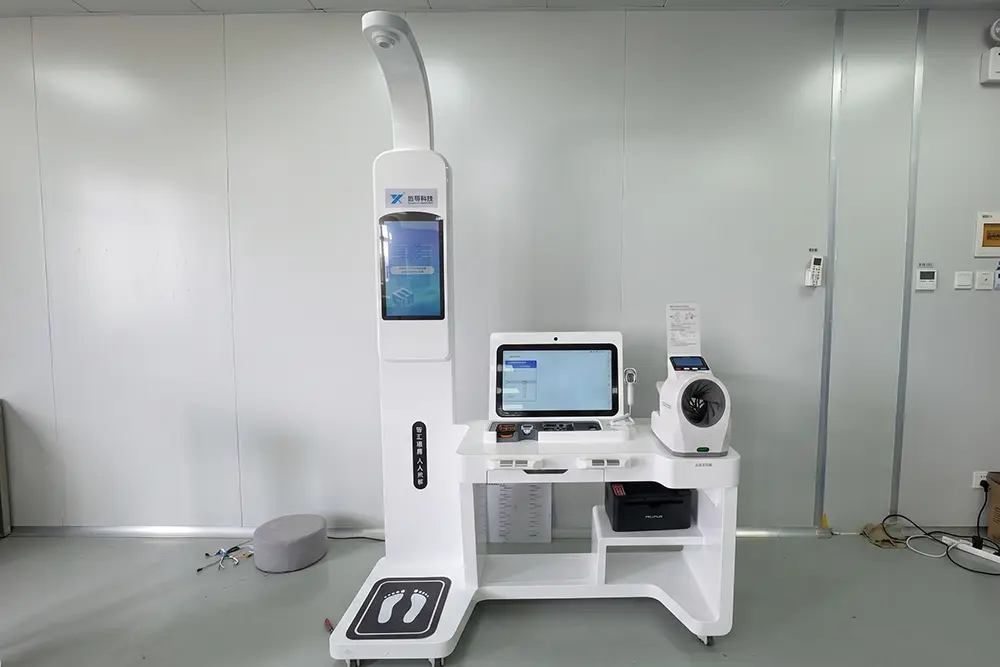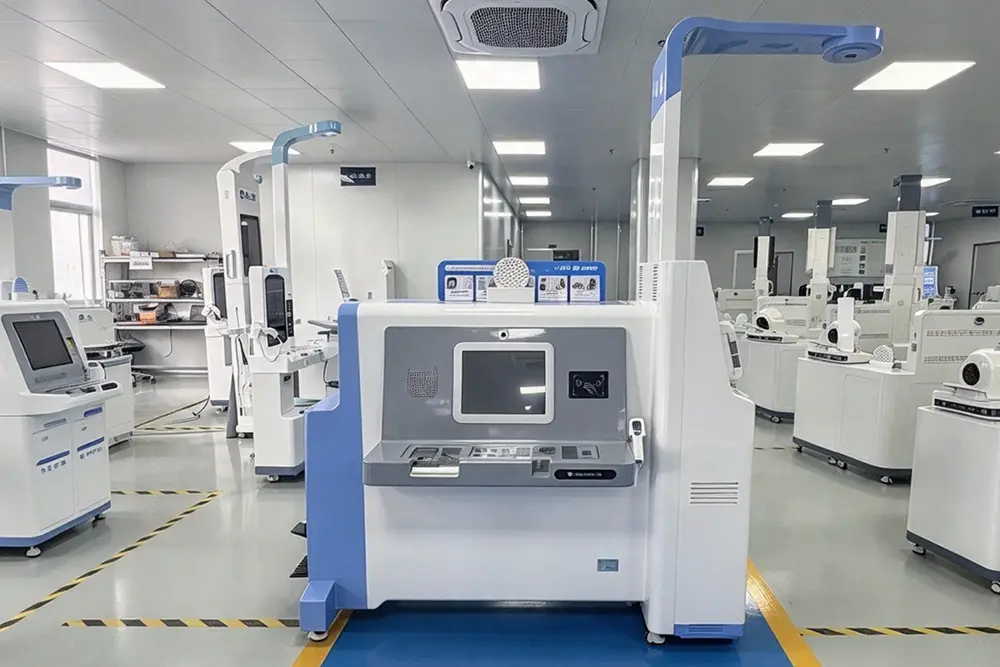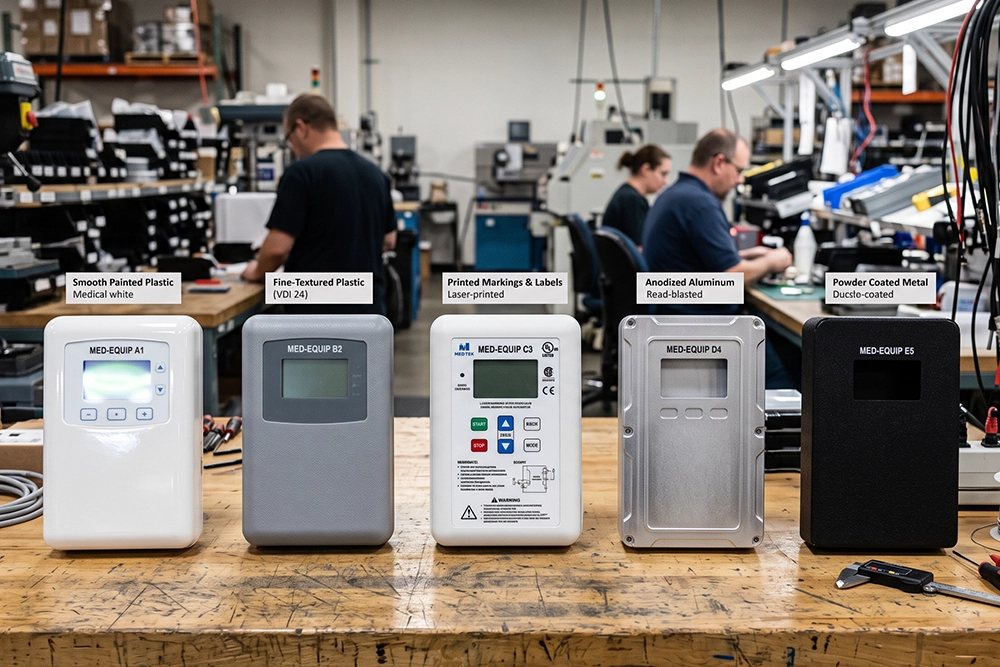
A beauty device enclosure has to do more than protect internal electronics. For tabletop aesthetic and physiotherapy equipment, the housing also defines the product’s appearance, user interface, serviceability, and perceived quality. Display openings, connector locations, split lines, internal component space, and surface finish all need to work together.
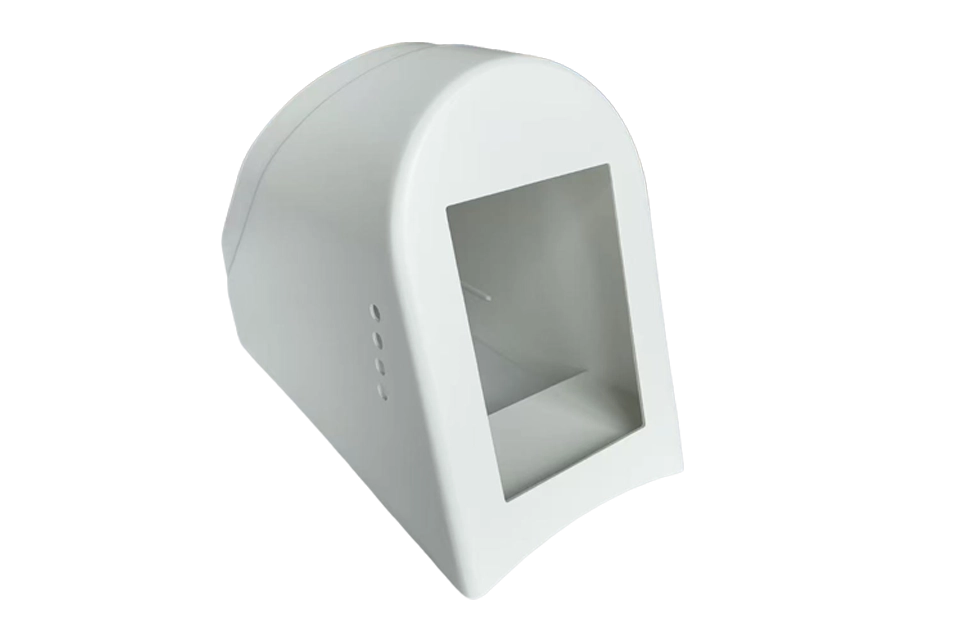
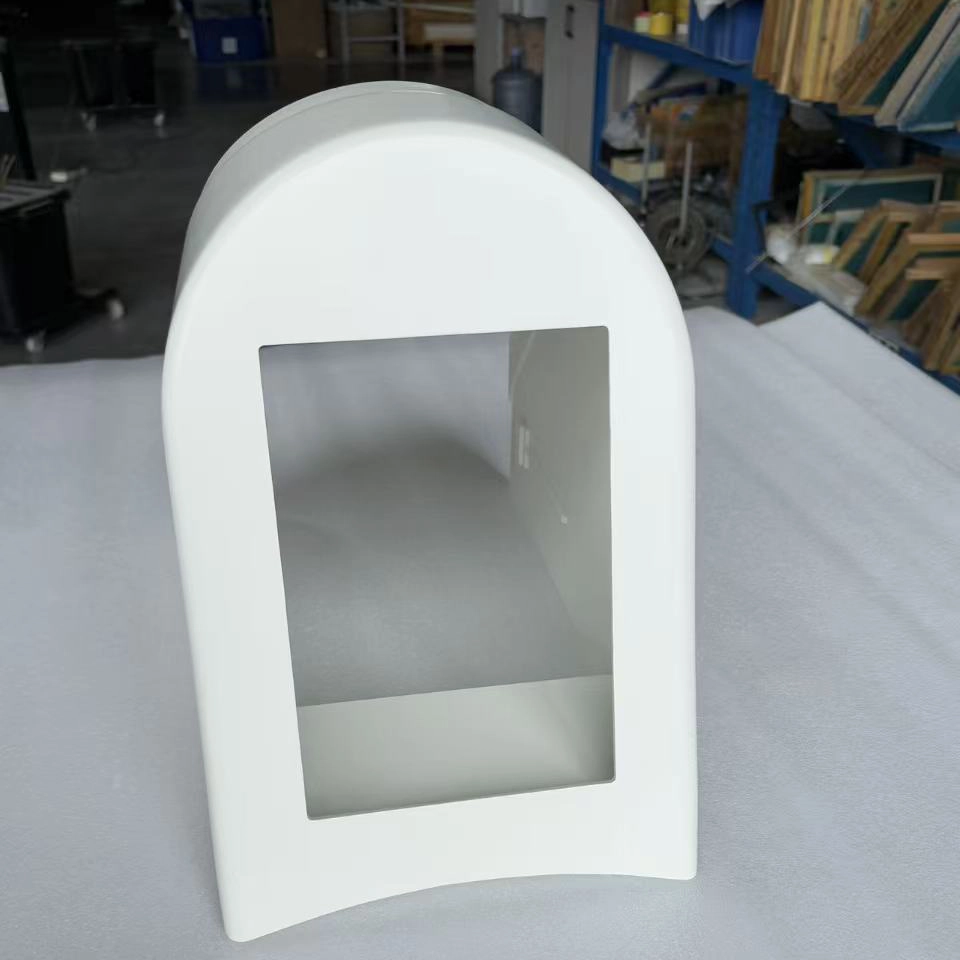
At Zhongrongda, we recently completed a small-batch production project for a tabletop beauty and medical aesthetic device. The customer required a compact ABS plastic housing with a smooth curved profile, a front display opening, four side connector openings, and a two-piece structure for maintenance access.
The finished enclosure measured 210 × 430 × 310 mm. The main housing was manufactured from ABS using vacuum forming, followed by machining of the display window and side interface openings, surface preparation, matte white painting, and final assembly.
This project is a good example of how our engineering team approaches custom equipment housings: we do not treat the enclosure as simply an outer shell. We consider the relationship between the housing, display, connectors, internal electronics, assembly process, appearance, and future production requirements.
For similar projects, our Beauty Device Enclosures service covers custom housings for aesthetic and beauty equipment from prototype development through low-volume production.
Project Overview
| Item | Project Specification |
|---|---|
| Industry | Beauty & Medical Aesthetic Equipment |
| Application | Tabletop physiotherapy / beauty equipment housing |
| Country | China — Wuhan, Hubei |
| Material | ABS Plastic |
| Dimensions | 210 × 430 × 310 mm |
| Surface Finish | Matte white baked paint |
| Critical Tolerance | Display window inner frame ±0.2 mm |
| Manufacturing Process | Vacuum forming + CNC trimming/machining + finishing + assembly |
| Quantity | Small batch |
| Lead Time | Project-specific; confirmed according to production requirements |
Customer Requirements
The customer needed a compact external housing for a tabletop aesthetic and physiotherapy device. The enclosure had to contain the internal control electronics and power module while providing a clean, modern appearance suitable for a professional medical and beauty equipment environment.
Functional Requirements
The front of the housing needed a dedicated opening for the display. The display interface was one of the most important functional features because the inner frame dimension directly affected screen installation.
Four external connector openings were required on the side of the enclosure. Their locations had to correspond accurately with the internal electrical components and external cable interfaces.
The housing also needed sufficient internal space for the PCB, power supply, wiring, and other electrical components.
Assembly Requirements
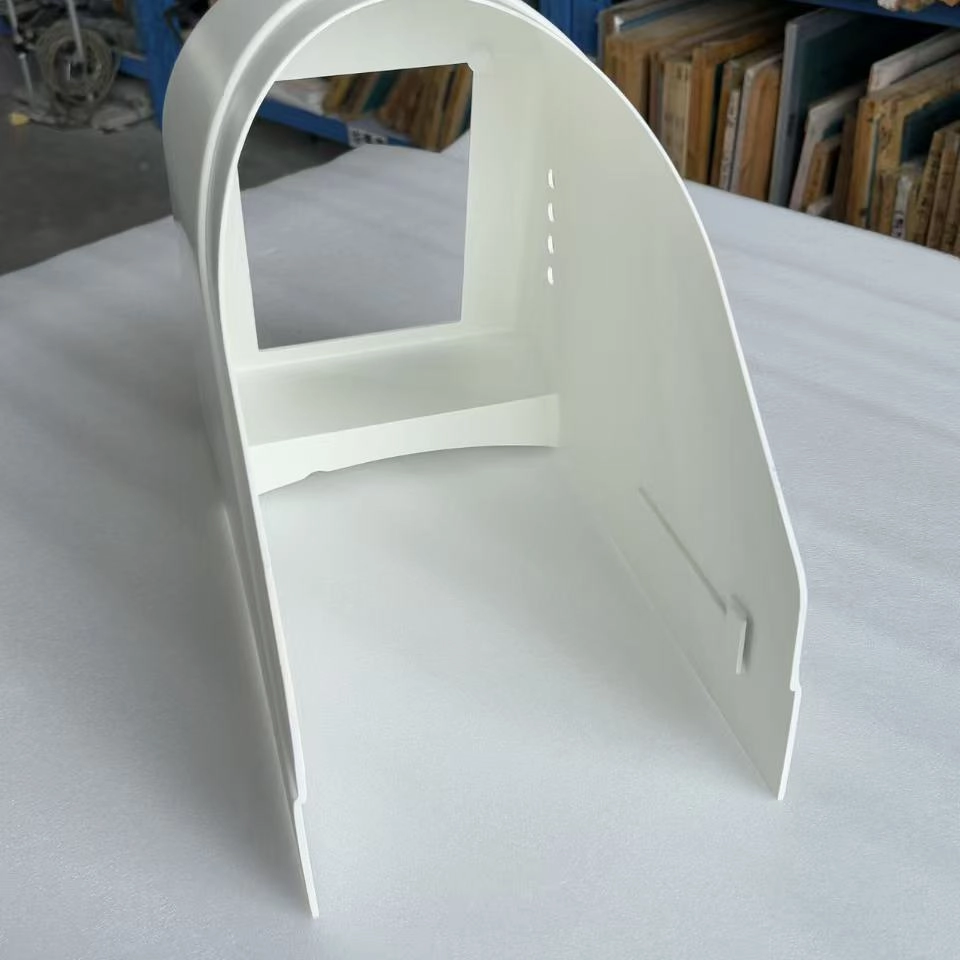
The enclosure was designed as an upper and lower shell. This two-piece construction allowed technicians to open the housing for maintenance instead of permanently sealing the electronics inside.
The two halves needed to align correctly and lock together with a consistent joint gap.
The display and side connectors also needed to install without interference.
Appearance Requirements
The customer specified an integrated curved design with rounded corners and no sharp external edges.
The desired finish was a clean matte white appearance with a simple medical and aesthetic equipment style. Logo printing could also be added according to the customer’s branding requirements.
Manufacturing Challenges
The project involved several challenges that needed to be addressed before production.
1. Large Curved Surface
The enclosure contained large-radius curved surfaces. With vacuum forming, uneven forming, trimming, or excessive surface preparation can become visible on a large cosmetic panel.
Our goal was to maintain a smooth transition across the curved areas while minimizing visible tool and processing marks.
2. Display Window Accuracy
The display opening was a critical interface rather than a purely cosmetic feature.
The inner frame dimension required a tolerance of ±0.2 mm. If the opening was undersized, display installation could become difficult. If it was oversized, the screen could have excessive movement or an uneven visual gap.
3. Upper and Lower Shell Joint
Because the enclosure was divided into two parts, the joint between the upper and lower shells had to remain visually consistent.
A large or uneven split line would immediately affect the appearance of the finished product.
4. Side Connector Openings
The four side openings had to align with the internal connectors. Their position therefore depended on both the external housing geometry and the internal electronic layout.
5. Surface Finish
The matte white finish needed to remain visually consistent across the curved ABS housing.
Surface preparation before painting was therefore important. Any obvious scratches, uneven sanding, or forming marks could become more visible after painting.
Our Engineering Solution
At Zhongrongda, our Engineering Team reviewed the housing structure and critical interfaces before manufacturing.
The first decision was to use vacuum forming for the main ABS shell. For this type of large curved housing and small-batch requirement, the process provided a practical way to achieve the required form without treating the project like a conventional high-volume injection-molded enclosure.
DFM Optimization
During DFM review, we focused on:
- Curved surface continuity
- Display opening geometry
- Side connector positions
- Upper/lower shell alignment
- Internal component clearance
- Trimming references
- Surface preparation requirements
- Assembly accessibility
The display opening was treated as a critical dimensional feature, while the external curved surfaces were treated as key cosmetic features.
Machining and Tool Selection
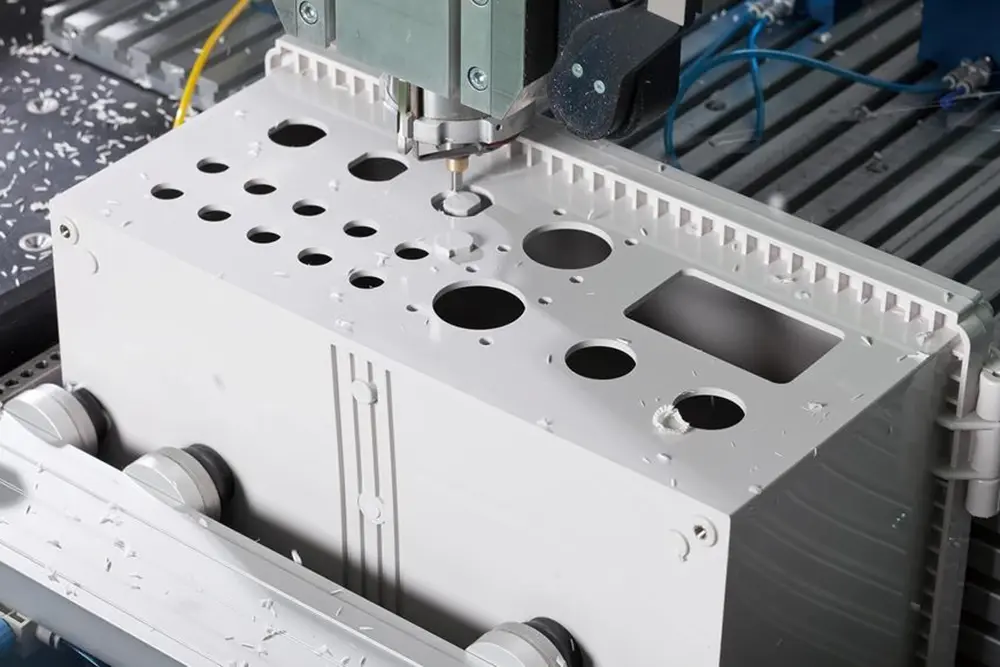
After vacuum forming, the display window and connector openings required secondary machining.
We selected the machining approach based on the ABS material, opening geometry, required edge quality, and dimensional requirements.
The objective was not simply to remove material quickly. The machining process had to produce clean edges and maintain the positional relationship between each opening and the housing reference features.
Fixture and Dimensional Control
For secondary machining, stable positioning was important because a formed plastic shell does not behave like a solid metal block.
The housing had to be positioned consistently before trimming and opening operations. Reference points were therefore established around the formed geometry so that the display window and connector openings could be processed repeatably.
Manufacturing Process
Our production workflow for this project followed a controlled sequence:
1. DFM Review
We reviewed the housing structure, material, critical dimensions, openings, split line, and assembly requirements.
2. Programming
Machining data and cutting paths were prepared for the display window and side interface openings.
3. Material Preparation
ABS sheet material was prepared for the vacuum forming process.
4. Vacuum Forming
The ABS material was heated and vacuum formed over the required curved geometry.
5. Trimming and CNC Machining
The formed shell was trimmed to the required profile. The front display opening and four side connector openings were then machined.
6. Deburring
Edges around the openings and trimmed areas were cleaned and deburred to prevent interference during assembly.
7. Surface Finishing
The external surface was progressively prepared before receiving the specified matte white baked-paint finish.
8. Assembly
The upper and lower shells were aligned and assembled. The display interface and side connector openings were checked for interference.
9. Inspection and Packaging
Critical dimensions, appearance, assembly fit, and finished surfaces were checked before packaging and delivery.
For projects requiring a different development path, our Rapid Prototyping capability can also be used to validate enclosure geometry and assembly before production.
Quality Inspection
Quality control focused on both dimensional accuracy and finished-product appearance.
For critical dimensions, our inspection approach can include:
- CMM inspection where applicable
- Height gauge measurement
- Micrometer measurement
- Caliper measurement
- First Article Inspection
- Final inspection
For this project, particular attention was given to the display window’s inner frame dimension, side connector locations, upper/lower shell alignment, and overall visual consistency.
Dimensional inspection alone is not sufficient for a cosmetic equipment housing. We also inspected the curved surfaces, painted finish, edge quality, joint lines, and assembly condition.
Our quality management system is supported by ISO9001 and ISO13485, which is important for customers developing medical, aesthetic, diagnostic, and other equipment requiring controlled manufacturing processes.
Final Results
The project successfully progressed into mass production after the initial small-batch manufacturing stage.
The final housing combined:
- ABS vacuum-formed construction
- Smooth curved external geometry
- Front display integration
- Four side connector openings
- Two-piece serviceable construction
- Matte white painted finish
- Optional branding capability
The project demonstrates an important principle we apply to custom enclosure manufacturing: appearance, dimensional accuracy, and assembly requirements cannot be treated as separate issues.
For example, the display opening affected both dimensional control and appearance. The shell split line affected both serviceability and cosmetic quality. The side connector openings depended on the relationship between the external housing and internal electronics.
That is why our engineering team evaluates the complete enclosure system rather than only the outer shape.
For additional project examples, see our Case Studies, where we document different medical, laboratory, diagnostic, and beauty equipment enclosure projects.
Why Choose Zhongrongda?
For custom beauty and medical aesthetic equipment housings, our support includes:
Engineering Support
Our engineering team reviews drawings, materials, critical dimensions, assembly relationships, and manufacturing risks before production.
Fast Quotation and DFM Review
Customers can provide 2D drawings, 3D CAD files, material requirements, quantity, and surface-finish specifications for project evaluation.
Rapid Prototyping
Physical prototypes can be used to verify appearance, dimensions, component clearance, and assembly before larger production quantities.
Small-Batch Manufacturing
We support small-batch equipment enclosure projects as well as projects that later transition into larger production volumes.
Quality Control
Our manufacturing process is supported by ISO9001 and ISO13485 quality management systems.
NDA Confidentiality
For new product development projects containing proprietary designs, drawings, or equipment structures, NDA arrangements can be supported.
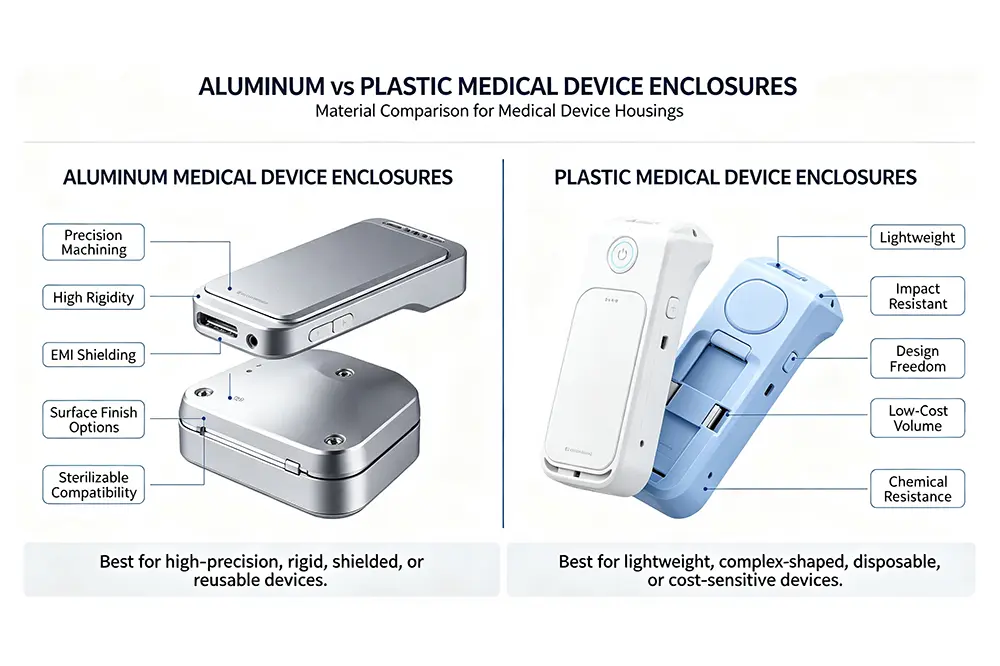
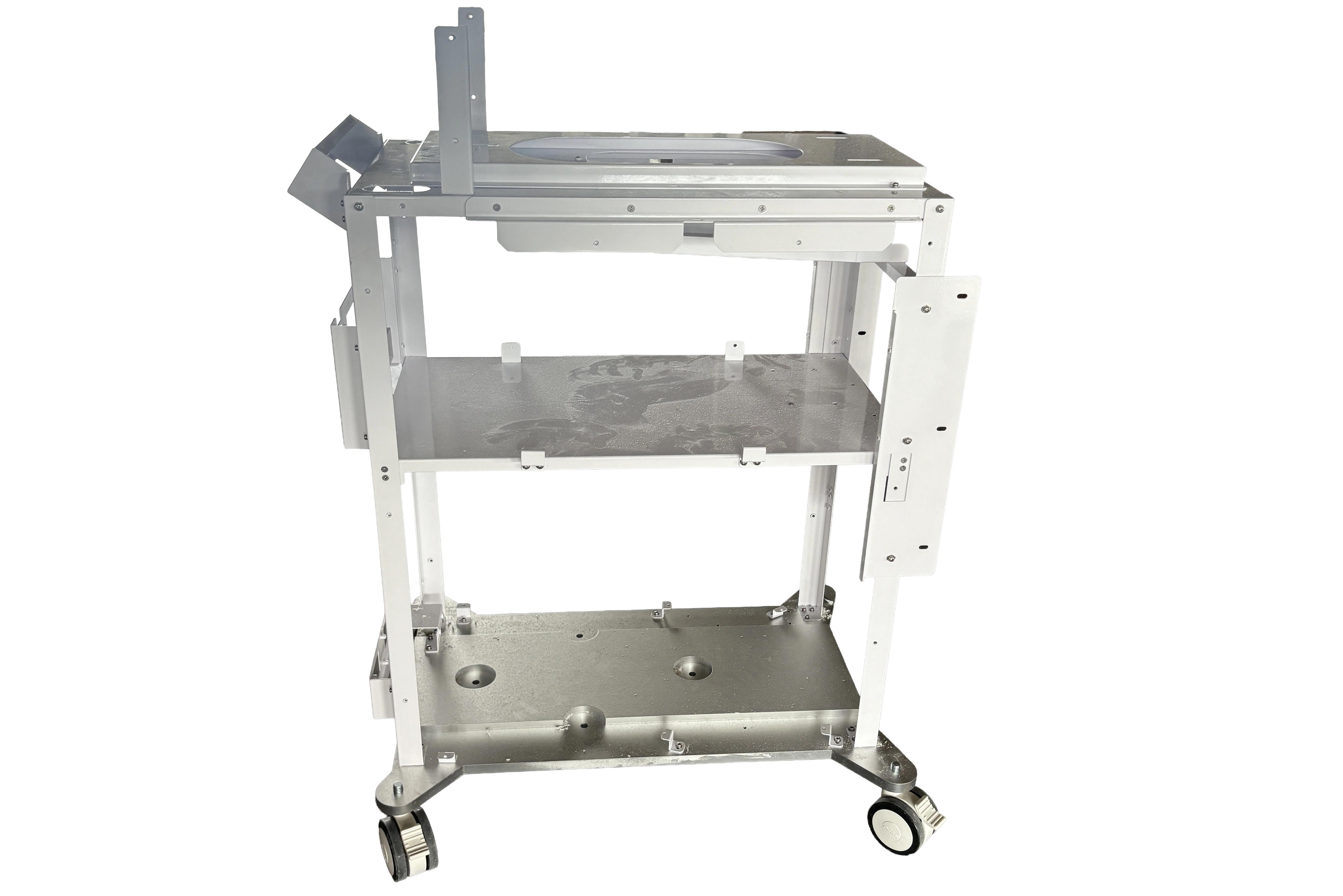
Our experience extends beyond beauty equipment to Medical Device Enclosures, diagnostic equipment, laboratory equipment, medical carts, medical robots, and large equipment housings.
FAQ
1. What is a beauty device enclosure?
A beauty device enclosure is the external housing used to protect and organize the internal electronics, power systems, displays, connectors, and other components of aesthetic or beauty equipment. It also provides the product’s external appearance and user-facing interfaces.
2. What material was used for this beauty device enclosure?
This project used ABS plastic. ABS was selected for the enclosure because it was suitable for the required curved housing geometry, appearance, secondary machining, and small-batch production requirements.
3. What manufacturing process was used?
The main housing was produced using vacuum forming, followed by trimming, machining of the display and connector openings, surface preparation, painting, and assembly.
4. Can you manufacture custom ABS beauty device housings?
Yes. We manufacture custom equipment housings according to customer drawings, CAD files, dimensions, material requirements, and functional specifications.
5. What tolerance can you achieve on a custom enclosure?
Tolerance depends on the material, manufacturing process, feature geometry, and measurement location. For this project, the display window inner frame required ±0.2 mm, while connector locations and shell alignment were controlled according to their functional requirements.
6. Can you support small-batch manufacturing?
Yes. We support small-batch manufacturing for new equipment, product validation, pilot production, and specialized medical and beauty equipment projects.
7. Can the enclosure be painted or branded?
Yes. Surface finishing can be specified according to the application. This project used a matte white baked-paint finish, and logo printing can be added when required.
8. Can you provide rapid prototypes before production?
Yes. Our Rapid Prototyping service can help validate enclosure dimensions, appearance, component fit, and assembly before larger production.
9. Can you sign an NDA for a new beauty device project?
Yes. NDA arrangements can be discussed when customers need confidentiality protection for proprietary product designs, drawings, technical information, or new equipment development.
10. Do you manufacture medical and aesthetic equipment enclosures?
Yes. Our enclosure manufacturing experience covers medical devices, beauty equipment, diagnostic equipment, laboratory equipment, medical carts, medical robots, and other specialized equipment housings.
CTA
Need a reliable CNC machining partner for your next project?
Upload your drawings today and our engineering team will provide a free DFM review and quotation within 24 hours.
Whether you are developing a new beauty device, medical aesthetic system, diagnostic product, or other equipment enclosure, we can review the material, geometry, critical dimensions, finishing requirements, quantity, and assembly requirements before production.
Contact Zhongrongda today and tell us about your next enclosure project.