Introduction
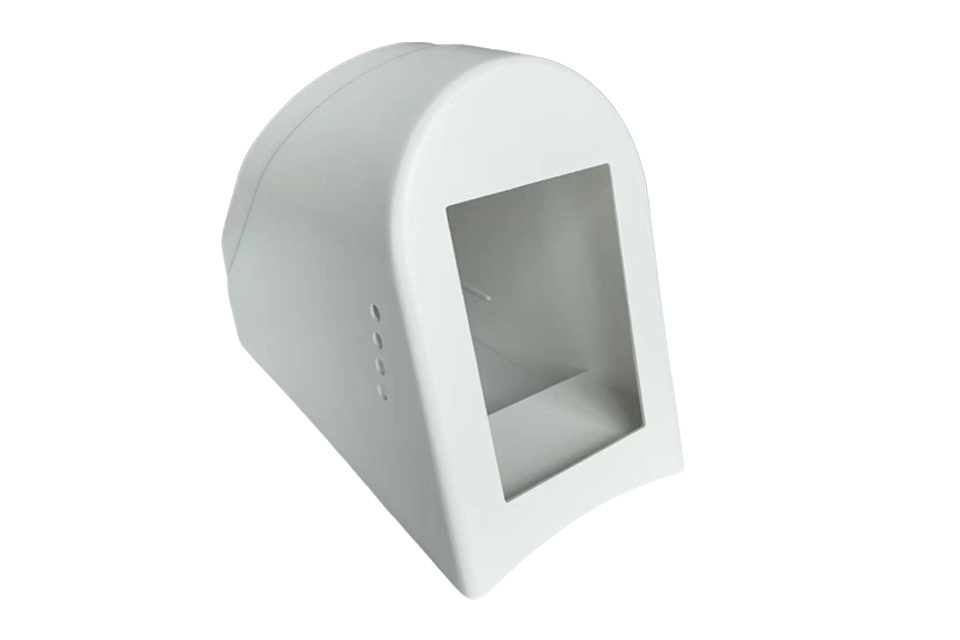
In the beauty equipment industry, product appearance and structural reliability are equally important. A professional Beauty Device Enclosure must not only provide protection for internal electronic and mechanical components but also deliver a premium appearance that matches the expectations of clinics, beauty centers, and end users.
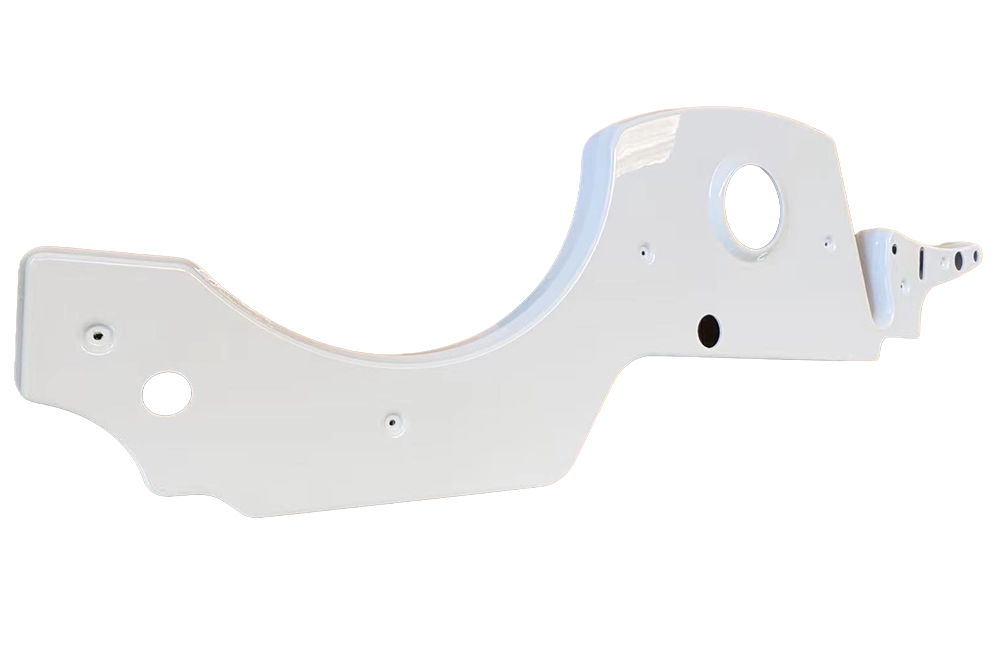
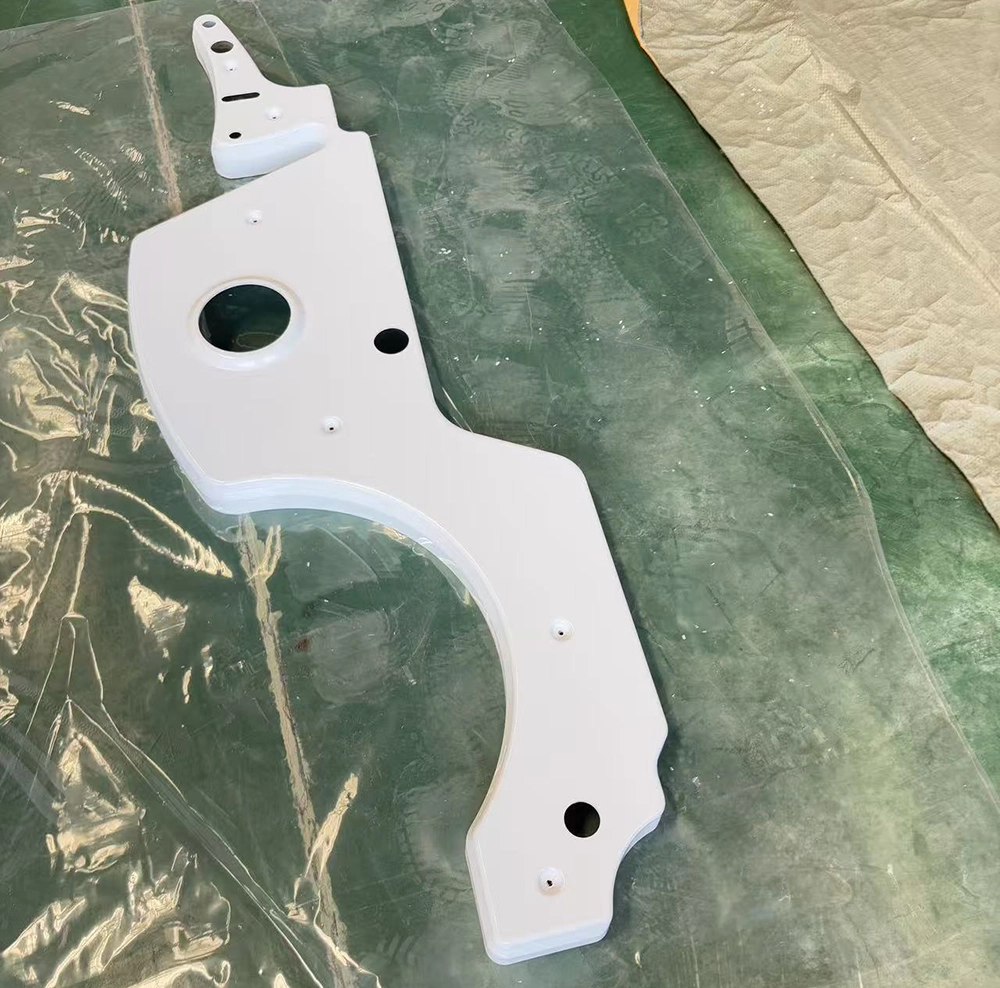
At Zhongrongda, we recently completed a custom ABS curved protective panel project for a beauty equipment manufacturer. The project involved a large-size irregular S-shaped enclosure component manufactured through vacuum forming, CNC machining, and high-gloss surface finishing.
The customer required a lightweight plastic enclosure with complex curved geometry, accurate mounting positions, and a cosmetic-grade surface appearance. Unlike standard plastic covers, this component included large curved surfaces, deep recessed areas, multiple precision holes, and thin edge structures, creating significant challenges during forming, machining, painting, and dimensional control.
Based on our experience in Rapid Prototyping, plastic enclosure manufacturing, and small batch production, our engineering team developed a complete manufacturing solution to control deformation, improve surface quality, and ensure reliable assembly performance.
This project demonstrates how Zhongrongda combines engineering analysis, process optimization, and quality control to manufacture complex plastic housings for beauty equipment applications.
Project Overview
The project was developed for a beauty equipment manufacturer requiring a customized ABS protective panel for a new generation beauty device.
The component was designed as a large curved external housing panel with both aesthetic and functional requirements. Because the product would be visible to end users, the customer required a premium high-gloss appearance while maintaining accurate mechanical interfaces with the internal structure.
The following table summarizes the main project information:
| Item | Details |
|---|---|
| Industry | Beauty Equipment Manufacturing |
| Application | Beauty Device External Protective Panel |
| Country | International Beauty Equipment Market |
| Material | ABS Engineering Plastic |
| Dimensions | 400mm × 1440mm × 70mm |
| Surface Finish | High Gloss White Painting |
| Tolerance Requirement | Precision CNC machining control |
| Manufacturing Process | Vacuum Forming + CNC Machining + Painting |
| Quantity | Prototype and Small Batch Production |
| Lead Time | Developed according to customer project schedule |
The project required close cooperation between the customer’s design team and our engineering department. From the initial design review to final production, our team focused on improving manufacturability while maintaining the original product appearance.
Customer Requirements
The customer approached Zhongrongda with a challenging requirement: develop a large-size curved ABS enclosure component that could achieve both premium appearance and stable production quality.
The main requirements included the following:
Complex Curved Appearance
The enclosure featured an irregular S-shaped structure combined with a large concave curved surface. The customer required the final product to maintain smooth transitions and consistent visual quality across the entire panel.
For beauty equipment, even small surface defects can significantly affect product perception. Therefore, the customer required:
- Smooth curved surfaces
- Uniform gloss appearance
- No visible deformation
- No obvious surface defects
Accurate Assembly Interface
The enclosure needed to integrate with the internal frame and electronic components.
The product included:
- Multiple mounting holes
- Through holes
- Countersunk screw holes
- Raised positioning structures
The hole locations and mounting features needed to be accurately machined to ensure proper assembly during final equipment integration.
Cosmetic Surface Quality
Because the component was used as an external beauty equipment cover, appearance quality was one of the customer’s highest priorities.
The required surface performance included:
- High-gloss white finish
- Consistent paint thickness
- Smooth touch feeling
- Professional cosmetic appearance
Unlike industrial plastic parts where minor surface marks may be acceptable, beauty equipment housings require much higher visual standards.
Manufacturing Challenges
This project involved several difficult manufacturing challenges caused by the combination of large size, complex curvature, ABS material characteristics, and high appearance requirements.
Our engineering team analyzed these risks before production and developed targeted solutions.
Challenge 1: Large Curved Vacuum Forming Difficulty
The biggest challenge was the vacuum forming process.
The enclosure was not a simple flat cover. It included an irregular S-shaped structure with a large curved concave surface.
During vacuum forming, the ABS sheet needed to stretch significantly to follow the mold shape.
The main risks included:
Uneven Material Stretching
Because different areas of the mold had different forming depths, the plastic sheet experienced uneven stretching.
Potential defects included:
- Local wall thickness reduction
- Thin areas on curved sections
- Material whitening caused by excessive stretching
- Reduced structural strength
Maintaining consistent wall thickness across such a large curved component required precise control of heating temperature, vacuum pressure, and forming conditions.
Deep Hole and Raised Boss Forming Problems
The enclosure included:
- Large circular openings
- Smaller side holes
- Raised mounting areas
During forming, these areas created multi-directional stretching forces.
Without proper process control, possible defects included:
- Air bubbles
- Wrinkles
- Edge collapse
- Local deformation
The challenge was not only achieving the correct shape but also maintaining dimensional stability after cooling.
Challenge 2: CNC Machining Accuracy on Complex Curved Surfaces
After vacuum forming, additional CNC machining was required to achieve accurate installation features.
The main difficulties included:
Multiple Hole Position Accuracy
The enclosure contained multiple holes with different sizes and functions.
These included:
- Assembly holes
- Countersunk screw holes
- Positioning holes
Because the product surface was curved rather than flat, establishing accurate machining references was critical.
Small positioning errors could cause:
- Misalignment during assembly
- Uneven screw fitting
- Poor connection with internal components
Thin Edge Machining Risk
After vacuum forming, some curved edge areas had reduced wall thickness.
During CNC milling, ABS material created several machining challenges:
- Edge burr formation
- Material chipping
- Thin wall deformation
- Additional manual finishing requirements
Our engineers needed to balance machining speed, cutting force, and surface quality.
Challenge 3: High Gloss Painting Surface Control
The final appearance requirement created another major challenge.
The customer required a high-gloss white surface finish, which has very strict appearance standards.
ABS vacuum formed parts contain internal stress from heating and forming.
During painting and baking, these stresses can release and create defects.
Potential problems included:
- Pinholes
- Air bubbles
- Orange peel texture
- Surface shrink marks
- Uneven gloss
In addition, the complex curved geometry made paint thickness control more difficult.
Areas such as:
- Concave corners
- Curved transitions
- Raised structures
were especially difficult because excessive paint accumulation could create uneven appearance.
Challenge 4: Dimensional Stability and Deformation Control
Large ABS components are sensitive to temperature changes.
This project experienced two major thermal processes:
- Vacuum forming heating cycle
- Painting baking process
Because the structure was large and asymmetric, uneven shrinkage could cause:
- Warping
- Curved profile distortion
- Assembly mismatch
Maintaining dimensional stability throughout the entire manufacturing process required continuous process monitoring and engineering adjustments.
Our Engineering Solution
To successfully manufacture this complex Beauty Device Enclosure, our engineering team focused on controlling the complete production process from design review to final inspection.
Instead of treating each manufacturing step separately, we developed an integrated solution combining vacuum forming optimization, CNC machining control, surface finishing management, and dimensional inspection.
This approach helped reduce production risks and ensured the final enclosure achieved both functional requirements and premium cosmetic standards.
DFM Review and Manufacturing Optimization
Before production started, our engineering team performed a detailed DFM (Design for Manufacturing) review based on the customer’s 3D model and technical requirements.
The review focused on:
- Vacuum forming feasibility
- Material stretching areas
- Wall thickness distribution
- CNC machining allowance
- Assembly interface requirements
- Surface finishing risks
During the review process, we identified potential deformation risks around:
- Large curved surfaces
- Deep recessed structures
- Thin mounting ears
- Hole locations
We provided manufacturing suggestions to improve:
- Forming stability
- Machining reliability
- Surface appearance consistency
This early engineering involvement helped reduce trial-and-error during production and improved overall project efficiency.
Vacuum Forming Process Optimization
For this large ABS curved panel, vacuum forming accuracy was the key factor affecting final product quality.
Our team optimized several process parameters, including:
Heating Control
ABS sheets require precise temperature control before forming.
Insufficient heating can cause:
- Poor mold replication
- Surface stress
- Incomplete forming
Excessive heating may lead to:
- Material thinning
- Uneven stretching
- Surface deformation
Our engineers adjusted heating conditions according to the product geometry to achieve balanced material flow.
Mold and Forming Adjustment
Because the product contained large S-shaped curves and deep concave structures, the forming process required careful control.
The engineering team focused on:
- Improving material distribution
- Reducing excessive stretching
- Controlling corner deformation
- Maintaining consistent wall thickness
Through process adjustment, the ABS panel achieved better structural stability after cooling.
CNC Machining Fixture Design
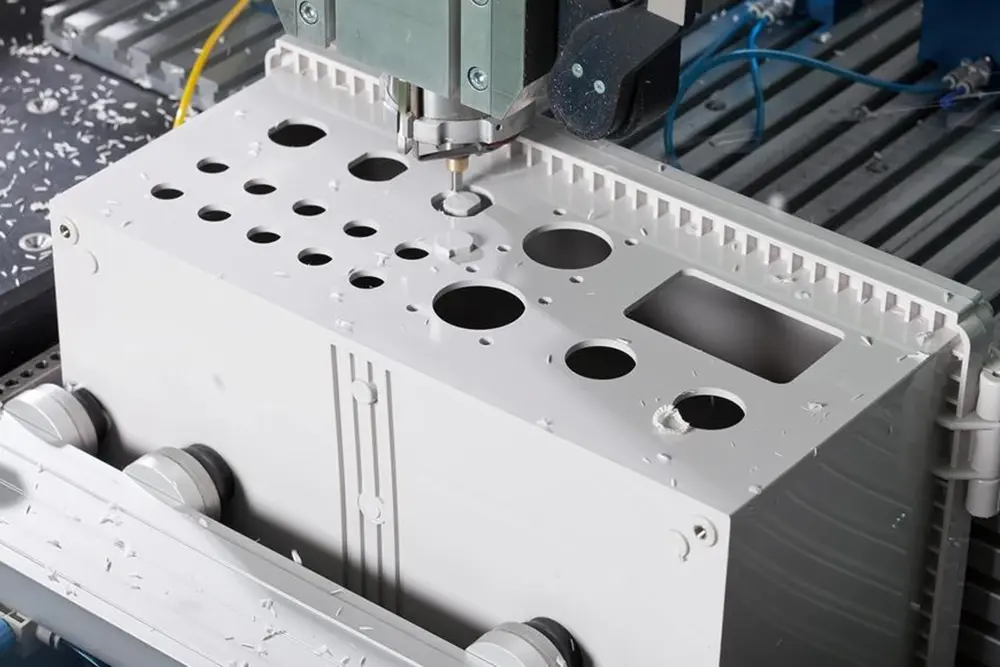
After vacuum forming, secondary CNC machining was required to create accurate holes and mounting features.
Due to the curved surface geometry, traditional flat positioning methods were not suitable.
Our engineering team developed a customized positioning solution to ensure:
- Stable clamping
- Accurate machining reference
- Repeatable positioning
- Reduced deformation during machining
The fixture allowed our CNC equipment to accurately process:
- Mounting holes
- Countersunk holes
- Edge trimming areas
- Precision installation features
This was especially important because small positioning deviations could directly affect final assembly.
CNC Tool Selection and Machining Parameter Optimization
ABS plastic has different machining characteristics compared with metal materials.
Incorrect machining parameters may cause:
- Burr formation
- Edge cracking
- Surface scratches
- Thermal deformation
Our engineers optimized:
- Cutting speed
- Feed rate
- Tool geometry
- Machining sequence
Suitable cutting tools were selected to achieve:
- Clean edges
- Smooth machined surfaces
- Reduced post-processing workload
The goal was not only machining accuracy but also maintaining the cosmetic quality required for a premium beauty equipment product.
Surface Finishing Process Control
The high-gloss appearance was one of the most important customer requirements.
To achieve a cosmetic-grade finish, the surface treatment process included:
1. Surface Preparation
Before painting, the formed and machined ABS surface was carefully inspected and prepared.
The process included:
- Surface cleaning
- Fine sanding
- Defect correction
This step was critical because high-gloss paint can amplify even minor surface imperfections.
2. Primer Application
A primer layer was applied to improve:
- Paint adhesion
- Surface uniformity
- Final coating stability
3. High Gloss Painting
The final coating required careful control of:
- Paint thickness
- Spraying angle
- Drying conditions
Special attention was given to:
- Curved areas
- Recessed sections
- Corner transitions
to prevent:
- Paint accumulation
- Uneven gloss
- Color variation
Manufacturing Process
The complete manufacturing workflow followed a controlled process:
Step 1: DFM Review
Our engineering team reviewed:
- 3D CAD data
- Product structure
- Manufacturing feasibility
- Assembly requirements
Potential risks were identified before production.
Step 2: Material Preparation
The ABS plastic sheet was inspected before forming.
Inspection included:
- Material thickness
- Surface condition
- Visual defects
Only qualified materials entered production.
Step 3: Vacuum Forming
The ABS sheet was heated and formed over the customized mold.
During forming, we controlled:
- Heating temperature
- Vacuum pressure
- Cooling time
The goal was achieving:
- Smooth curved surfaces
- Stable dimensions
- Uniform material distribution
Step 4: CNC Machining
After forming, the enclosure entered CNC machining.
Machining operations included:
- Hole drilling
- Countersink machining
- Edge trimming
- Installation feature processing
The customized fixture ensured repeatable accuracy.
Step 5: Deburring and Surface Preparation
After CNC machining:
- Burrs were removed
- Edges were refined
- Surfaces were prepared for painting
This step improved both appearance and assembly safety.
Step 6: Surface Finishing
The finishing process included:
- Sanding
- Primer coating
- High gloss painting
- Baking
The final appearance was inspected according to customer cosmetic requirements.
Step 7: Final Assembly and Inspection
Before shipment, the completed parts were checked for:
- Dimensional accuracy
- Appearance quality
- Assembly compatibility
Quality Inspection
Quality control is an essential part of our manufacturing process at Zhongrongda.
For complex plastic enclosures, appearance alone is not enough. Dimensional accuracy and assembly reliability are equally important.
Inspection Equipment
During production, we used professional measurement tools including:
- CMM Inspection Equipment
- Height Gauge
- Digital Caliper
- Micrometer
These tools were used to verify critical dimensions and manufacturing consistency.
Inspection Items
The inspection process included:
Dimensional Inspection
Checked:
- Overall dimensions
- Hole positions
- Installation features
- Edge dimensions
Surface Quality Inspection
Checked:
- Paint uniformity
- Gloss consistency
- Surface defects
- Scratches
- Visible imperfections
Assembly Verification
The enclosure was checked to ensure:
- Proper fitting with internal components
- Accurate mounting position
- Reliable installation
Final Results
Through engineering optimization and strict process control, Zhongrongda successfully completed the custom ABS beauty equipment enclosure project.
The final product achieved:
- Stable vacuum formed structure
- Accurate CNC machined features
- High-gloss cosmetic appearance
- Reliable assembly performance
The project helped the customer reduce manufacturing risks during product development and establish a reliable supply chain for future production.
By combining plastic forming technology, CNC precision machining, and surface finishing capability, Zhongrongda provided a complete manufacturing solution from prototype development to small batch production.
Why Choose Zhongrongda
Engineering Support From Design to Production
At Zhongrongda, we do not simply manufacture parts according to drawings.
Our engineering team supports customers through:
- DFM analysis
- Manufacturing optimization
- Process selection
- Prototype improvement
This approach helps customers avoid production problems before they happen.
Rapid Prototyping and Small Batch Manufacturing
We support companies developing new products with:
- Fast prototype production
- Engineering validation parts
- Small batch manufacturing
Our capabilities help product designers and engineers move from concept to production faster.
For more information about our development services, visit our Rapid Prototyping capability page.
Plastic Enclosure Manufacturing Experience
With experience producing complex housings and covers, Zhongrongda supports industries including:
- Beauty equipment
- Medical equipment
- Laboratory equipment
- Industrial equipment
Our team understands the importance of both engineering performance and product appearance.
Quality Management and Confidential Production
We support professional manufacturing requirements including:
- ISO9001 quality management system
- ISO13485 medical device quality requirements
- NDA confidentiality agreements
Customer drawings, designs, and product information are handled with strict confidentiality.
FAQ
1. What materials can Zhongrongda use for beauty device enclosures?
Zhongrongda manufactures beauty device housings using engineering plastics including ABS, PC, PC+ABS, PMMA, PA, and other customer-specified materials.
Material selection depends on:
- Appearance requirements
- Strength requirements
- Temperature resistance
- Production volume
2. Can Zhongrongda manufacture custom beauty device enclosures from drawings?
Yes.
We support custom enclosure manufacturing based on:
- 3D CAD files
- 2D drawings
- Physical samples
Our engineering team can provide DFM suggestions before production.
3. What is the typical lead time for a beauty device enclosure prototype?
Lead time depends on:
- Product complexity
- Material availability
- Surface finishing requirements
For prototype projects, we typically provide engineering evaluation and production scheduling after reviewing project details.
4. Does Zhongrongda support small batch production?
Yes.
We support prototype manufacturing and small batch production for companies developing new beauty equipment products.
5. What tolerances can Zhongrongda achieve?
For plastic machining applications, our standard CNC machining capability can achieve approximately ±0.02mm depending on:
- Material
- Geometry
- Machining requirements
6. Can Zhongrongda provide high-gloss painted plastic enclosures?
Yes.
We provide surface finishing solutions including:
- Sanding
- Priming
- Spray painting
- High gloss finishing
7. Does Zhongrongda sign NDA agreements?
Yes.
We support NDA agreements to protect customer:
- Product designs
- Technical drawings
- Manufacturing information
8. Does Zhongrongda manufacture medical beauty equipment housings?
Yes.
We provide customized enclosure solutions for beauty equipment, medical devices, and laboratory equipment manufacturers.
Related capabilities include Medical Device Enclosure manufacturing.
9. Can Zhongrongda help optimize enclosure designs?
Yes.
Our engineering team provides:
- DFM analysis
- Structural suggestions
- Manufacturing recommendations
10. What industries does Zhongrongda serve?
We serve:
- Beauty equipment manufacturers
- Medical device companies
- Robotics companies
- Industrial equipment manufacturers
CTA
Need a reliable manufacturing partner for your next beauty equipment project?
At Zhongrongda, our engineering team provides custom enclosure manufacturing solutions including vacuum forming, CNC machining, surface finishing, and small batch production.
Upload your drawings today and our engineering team will provide a free DFM review and quotation within 24 hours.
Contact our team today to discuss your next Beauty Device Enclosure project.
Visit our Contact page to start your project.