Introduction
A Medical Device Enclosure has to do more than protect the equipment inside. For medical beauty and physiotherapy equipment, the enclosure is also part of the product’s visual identity, user experience, thermal management and internal installation structure.
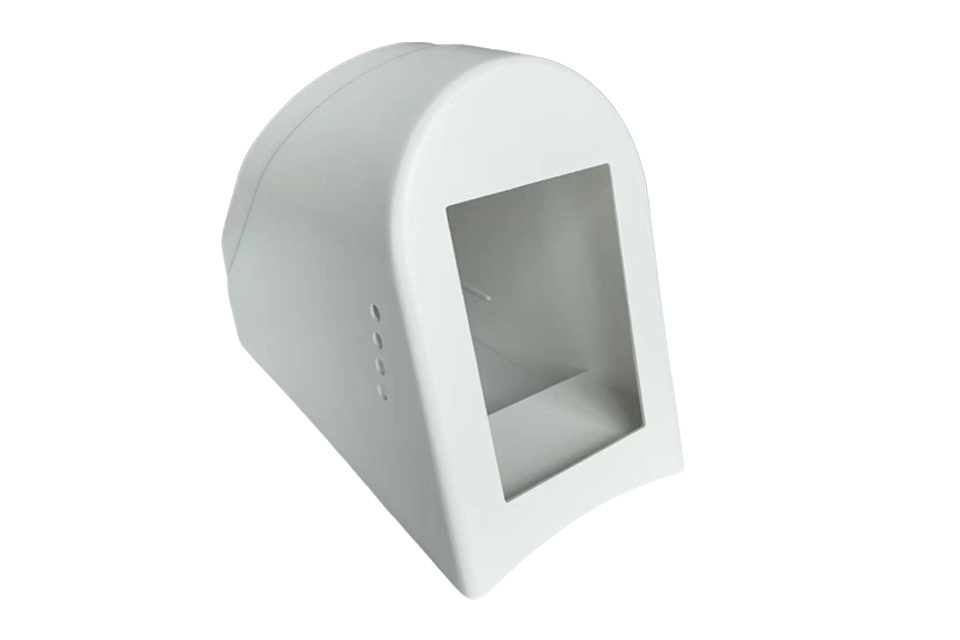
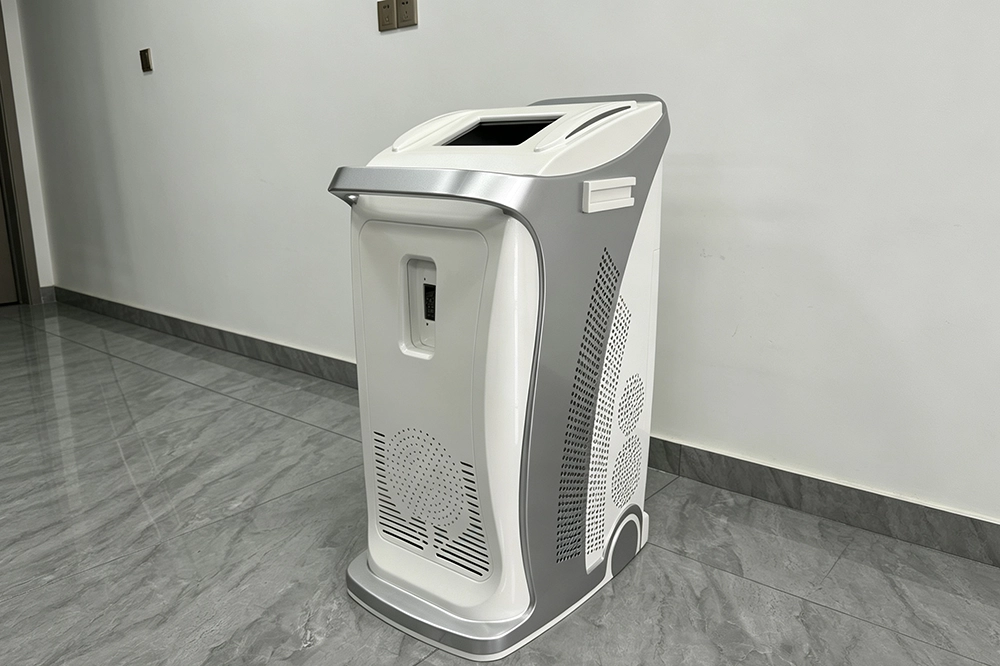
At Zhongrongda, our Engineering Team recently completed a custom vertical enclosure project for a high-end aesthetic and physiotherapy device. The design combined a tall cabinet structure, large curved surfaces, integrated decorative aluminum profiles, dense ventilation openings and precision-machined functional interfaces.
The finished enclosure measures approximately 390 mm in length, 580 mm in width and 980 mm in height. The project required a combination of laser cutting, CNC bending, seamless laser welding, five-axis CNC machining, multi-stage surface preparation and high-gloss finishing.
The main engineering challenge was balancing three requirements at the same time: a visually clean curved exterior, sufficient structural rigidity and accurate internal interfaces for the equipment installed inside.
This type of project is where enclosure manufacturing experience becomes particularly important. The manufacturing sequence, forming strategy and finishing process all influence the final appearance and assembly accuracy.
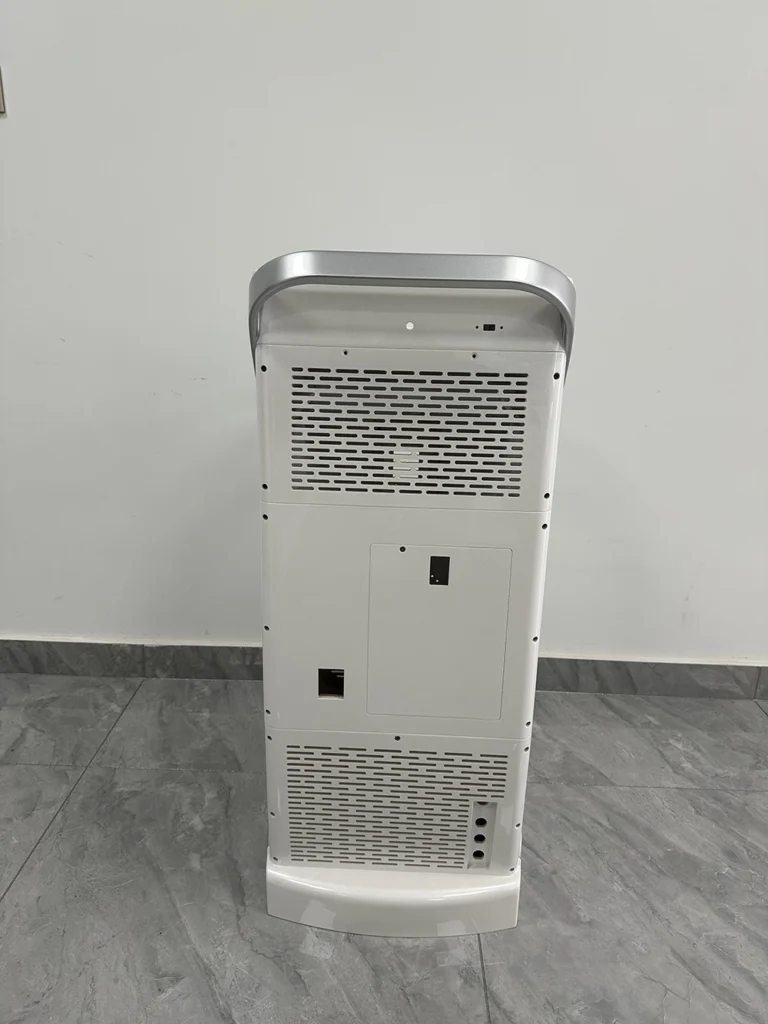 Laser welding creates a clean integrated structure before surface finishing.
Project Overview
| Project Item | Specification |
|---|---|
| Industry | Medical Beauty / Physiotherapy Equipment |
| Application | Vertical Aesthetic & Therapy Equipment Enclosure |
| Country | Not disclosed in the supplied project data |
| Material | Thickened cold-rolled steel sheet + 6063-T5 aluminum alloy sheet/profile |
| Dimensions | 390 × 580 × 980 mm |
| Surface Finish | High-gloss white electrostatic powder coating / high-gloss coating + silver decorative trim |
| Tolerance | According to approved customer drawings; numerical tolerance not provided |
| Manufacturing Process | Laser Cutting, CNC Bending, Laser Welding, 5-Axis CNC Machining, Finishing |
| Quantity | Not disclosed |
| Lead Time | Not disclosed |
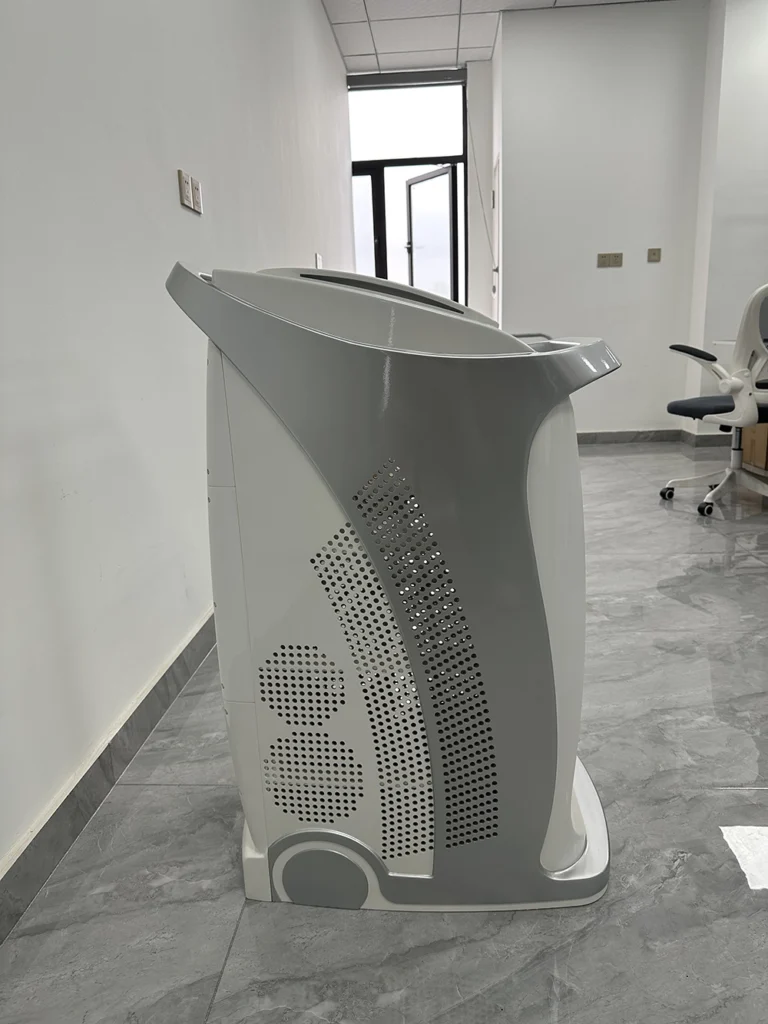
The enclosure was designed as a large vertical cabinet rather than a simple flat-panel housing. Its exterior incorporates curved transitions, waist-shaped sections and smooth corner lines intended to create a premium appearance suitable for medical beauty and physiotherapy environments.
Customer Requirements
The project required the enclosure to combine structural performance with a refined exterior appearance.
From an engineering perspective, the customer needed a rigid cabinet capable of supporting internal equipment while maintaining its designed curved geometry. The exterior also needed to remain visually consistent across large surfaces because even small forming or finishing defects can become highly visible on a high-gloss white enclosure.
The design included an aluminum decorative trim system that needed to follow the curved body closely. Uneven gaps between the trim and enclosure would be immediately visible after final assembly.
Another important requirement was functional integration. The housing needed openings for the display, functional interfaces, ventilation louvers and dense ventilation micro-holes. These features had to work with the internal equipment layout while remaining visually aligned with the exterior design.
This required our team to consider the enclosure as a complete system rather than treating each panel as an independent manufacturing component.
For projects with similar requirements, our Medical Device Enclosure manufacturing capability can be combined with Rapid Prototyping during the design-validation stage.
Manufacturing Challenges
Complex Double-Curved Forming
The most difficult structural feature was the three-dimensional curved body.
The upper and lower sections narrow toward the center, creating a waist-shaped transition. Because the curved surfaces are large and visually symmetrical, even a small forming deviation can create noticeable asymmetry.
During CNC bending, the material naturally experiences elastic deformation and springback. If the forming sequence is not properly planned, the two sides can develop different radii or angles.
Our engineering team therefore treated forming sequence and reference control as critical manufacturing factors rather than relying on post-process correction.
Dense Ventilation Openings
The enclosure contains both circular micro-holes and elongated ventilation louvers.
These openings have two functions: supporting airflow around the internal equipment and maintaining the visual language of the enclosure.
Dense hole patterns create several manufacturing risks, including positional deviation, burr formation, deformation around openings and inconsistent spacing.
The functional openings were therefore treated as precision features during the machining stage.
High-Gloss Curved Surface
Large high-gloss surfaces are particularly demanding.
Minor scratches, sanding marks, orange peel, paint runs or color variation can become obvious under strong lighting. The curved geometry also makes manual surface preparation more difficult because technicians must maintain consistent preparation across changing surface angles.
We used multiple surface-preparation and polishing stages before applying the final coating.
Seamless Decorative Trim Assembly
The silver aluminum decorative profile needed to follow the curved enclosure without visible discontinuities.
The assembly challenge was not simply attaching the profile. The profile had to maintain consistent spacing and remain tightly fitted against the curved body.
This required dimensional control of both the enclosure and the aluminum profile before final assembly.
Exterior Appearance vs. Internal Structure
The outer shape also had to accommodate internal equipment installation, wiring routes, functional interfaces and ventilation requirements.
A visually attractive enclosure is not successful if the internal components cannot be installed efficiently. Our engineering review therefore considered both the exterior appearance and internal functional space.
Our Engineering Solution
At Zhongrongda, we approach complex enclosure projects from the manufacturing process backward.
DFM and Forming Strategy
Before production, our engineering team reviewed the enclosure geometry and identified the areas most likely to experience deformation during forming.
The curved body was divided into a controlled manufacturing sequence covering laser cutting, CNC bending, structural joining and subsequent machining.
This helped us preserve the intended symmetry while reducing unnecessary correction after forming.
For complex enclosure projects, our CNC Machining capability is used where precision functional features require machining beyond conventional sheet-metal processing.
Seamless Laser Welding
The formed components were joined using laser welding.
Compared with conventional welding methods, controlled laser welding is particularly useful when the finished enclosure requires clean seams and minimal visible joint lines.
After welding, the joints were processed to create a smooth transition before surface finishing. The objective was to prevent the welded areas from becoming visible through the final high-gloss coating.
Five-Axis CNC Machining
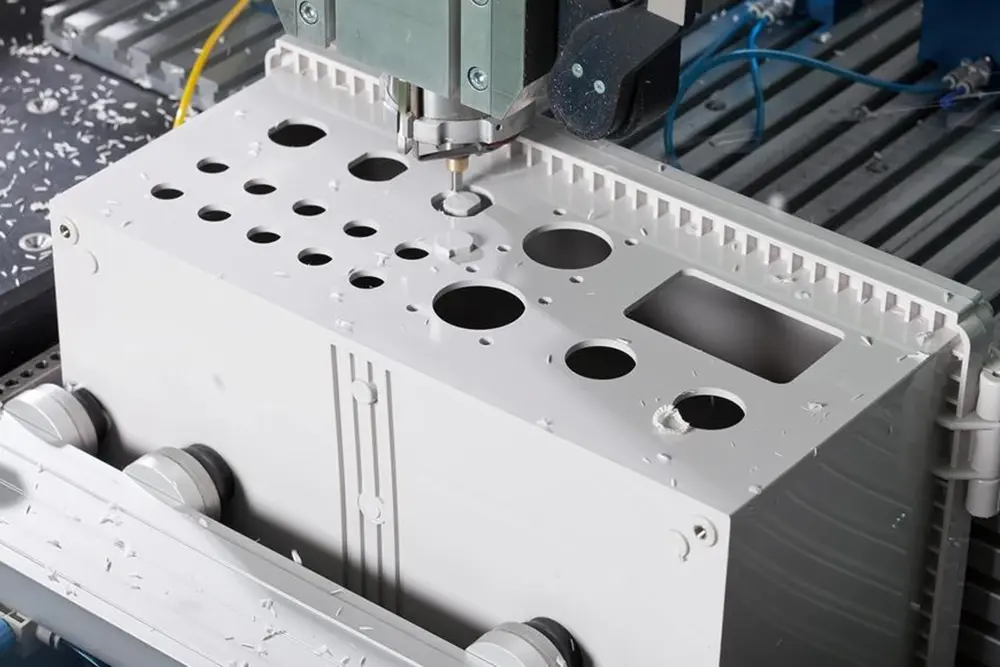
After the main enclosure structure was formed, five-axis CNC machining was used for functional features including:
- Display opening
- Functional interface holes
- Ventilation louvers
- Dense ventilation micro-holes
- Other precision interfaces
Five-axis machining provided greater flexibility when accessing curved or angled areas of the finished structure and reduced the need for repeated repositioning.
Controlled Surface Preparation
The high-gloss appearance required multiple preparation stages.
Our technicians progressively removed machining marks, welding traces and surface imperfections before coating. Particular attention was given to large curved surfaces because defects that are difficult to notice on unfinished metal can become highly visible after high-gloss treatment.
The final exterior used a high-gloss white finish with silver-colored decorative trim, producing a clean appearance suitable for premium aesthetic equipment.
Manufacturing Process
The project followed a controlled manufacturing sequence:
- DFM Review – We reviewed the enclosure geometry, forming requirements, functional openings and assembly interfaces.
- Programming – Laser cutting, CNC bending and five-axis machining programs were prepared according to the approved design.
- Material Preparation – Thickened cold-rolled steel and 6063-T5 aluminum alloy materials were prepared according to the project structure.
- Laser Cutting – Primary sheet-metal profiles and openings were cut to the required geometry.
- CNC Bending – The flat components were formed into the required three-dimensional curved structure.
- Laser Welding – Formed components were joined to create the integrated enclosure structure.
- 5-Axis CNC Machining – Display openings, interfaces and ventilation features were precision machined.
- Deburring and Grinding – Sharp edges, burrs and visible transition areas were carefully processed.
- Surface Finishing – Multiple preparation stages were followed by high-gloss white coating.
- Assembly and Inspection – Aluminum decorative profiles were precisely fitted and the completed enclosure was inspected before packaging.
The combination of sheet-metal fabrication and precision machining allowed us to treat structural and functional features differently instead of forcing every feature through one manufacturing process.
Quality Inspection
Quality control was integrated throughout the manufacturing process rather than being limited to the final inspection.
For a large curved enclosure, dimensional inspection focuses on more than individual hole sizes. We also need to evaluate overall geometry, feature positions, assembly interfaces and visual consistency.
Depending on the customer’s drawing requirements, our inspection resources include:
- CMM Inspection for critical dimensional and positional requirements
- Height Gauge for reference heights and feature locations
- Micrometer for precision dimensional verification
- Caliper for general dimensional inspection
- First Article Inspection for initial production validation
- Final Inspection for dimensions, surface quality and assembly condition
For this project, the numerical tolerance requirement was not included in the supplied project information, so we do not assign an unsupported tolerance value to the case study.
Our quality management experience also supports projects in Medical & Laboratory Equipment and other applications where consistent manufacturing documentation and inspection are important.
Final Results
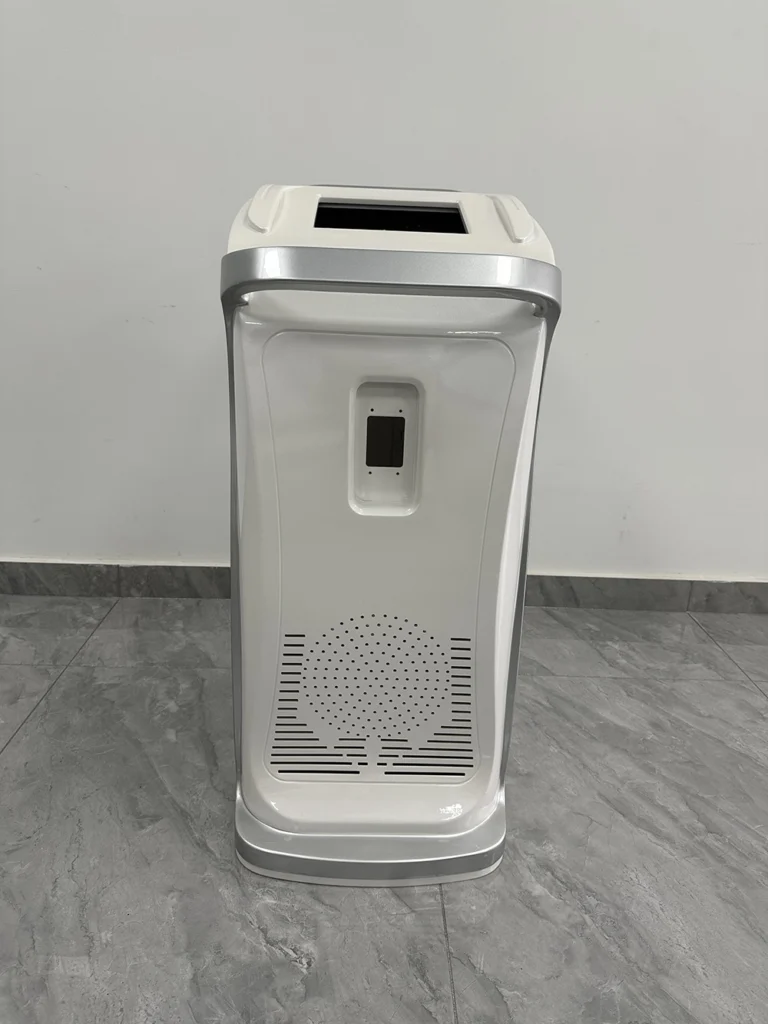
The completed enclosure combines a large vertical cabinet structure with complex curved geometry, precision functional openings and a high-gloss exterior.
The final product characteristics include:
- Approximately 390 × 580 × 980 mm overall dimensions
- Thickened cold-rolled steel and 6063-T5 aluminum components
- Complex double-curved body geometry
- Seamless laser-welded structure
- Five-axis CNC-machined functional openings
- Dense ventilation holes and louvers
- High-gloss white exterior finish
- Silver aluminum decorative trim
- Smooth rounded edges with controlled surface preparation
The most important result was the integration of appearance and engineering requirements into one manufacturable enclosure.
The customer feedback and production quantity were not included in the supplied project information, so these details have not been fabricated for this case study.
Why Choose Zhongrongda
Complex enclosure projects require more than individual machining capabilities. The supplier needs to understand how material, forming, welding, machining, finishing and assembly influence one another.
At Zhongrongda, our Engineering Team supports customers through:
Engineering Support
We review drawings and 3D models before manufacturing and identify potential issues related to forming, machining, finishing and assembly.
Fast Quotation and DFM Review
Customers can provide drawings or 3D CAD files for engineering review. Our team can evaluate manufacturing feasibility and provide quotation feedback based on the project requirements.
Rapid Prototyping
When the enclosure design requires physical validation, Rapid Prototyping can be used to verify dimensions, appearance and assembly before moving to the next production stage.
Small Batch Manufacturing
Our production capabilities support prototypes, low-volume projects and repeat small-batch manufacturing according to customer requirements.
NDA and Confidentiality
We understand that new medical and aesthetic equipment projects often contain confidential design information. NDA arrangements can be reviewed before detailed project information is exchanged.
Quality Management
Zhongrongda operates with ISO9001 and ISO13485 quality management capabilities to support customers in demanding industrial and medical-related applications.
More information about our engineering capabilities is available through About Us.
FAQ
1. What materials can be used for a custom medical device enclosure?
Material selection depends on structural requirements, weight, appearance, corrosion resistance, finishing requirements and the internal equipment. This project used thickened cold-rolled steel together with 6063-T5 aluminum alloy components.
2. Can you manufacture large curved medical equipment housings?
Yes. Our manufacturing process can combine laser cutting, CNC bending, laser welding and CNC machining for large and complex enclosure structures.
3. How do you control deformation during curved sheet-metal bending?
We review the geometry and forming sequence before production. The bending strategy is planned around material behavior, geometry and required symmetry rather than relying only on post-bending correction.
4. Can you machine ventilation holes and louvers after forming?
Yes. Depending on the geometry, functional openings can be produced or precision-machined after forming. Five-axis CNC machining can provide improved access to curved and angled surfaces.
5. Can you provide high-gloss finishes for medical beauty equipment?
Yes. We support surface preparation and high-gloss coating processes for equipment housings where appearance consistency and easy cleaning are important.
6. What surface finishes are available for medical device enclosures?
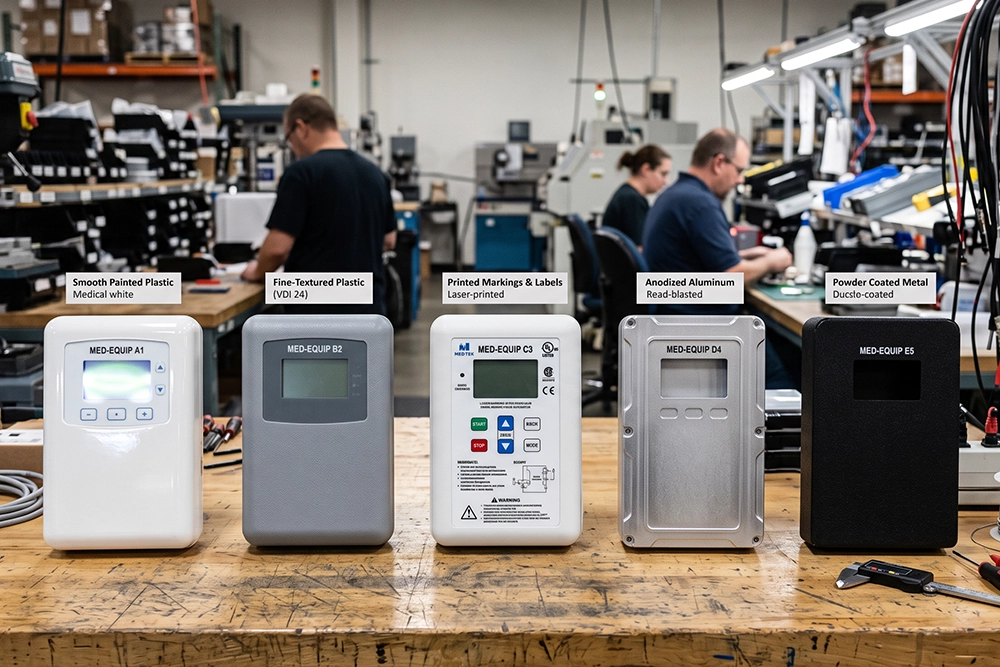
Depending on the material and application, available options can include powder coating, high-gloss coating, anodizing, polishing, sandblasting and other customized finishes.
7. Can Zhongrongda sign an NDA?
Yes. NDA arrangements can be reviewed before confidential drawings, CAD files and other project information are exchanged.
8. Do you support rapid prototyping?
Yes. Our Rapid Prototyping service can be used to validate enclosure geometry, assembly interfaces and manufacturing concepts before larger production commitments.
9. Can you support small-batch production?
Yes. We support prototype and small-batch manufacturing for customers who need flexible production quantities before scaling.
10. How can I request a quote for a medical device enclosure?
You can provide 3D CAD files, 2D drawings, material requirements, surface-finish requirements and estimated quantity. Our engineering team can then review the project and provide manufacturing feedback.
CTA
Need a reliable CNC machining partner for your next project?
Upload your drawings today and our engineering team will provide a free DFM review and quotation within 24 hours.
For custom medical equipment housings, aesthetic equipment enclosures and complex low-volume projects, contact Zhongrongda through Contact and send us your project requirements.