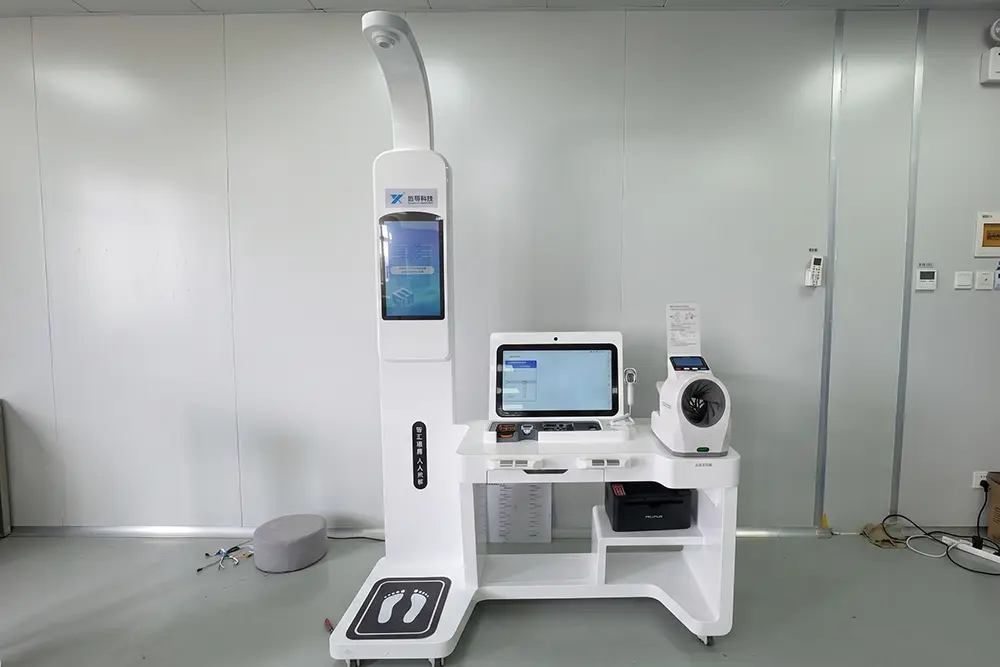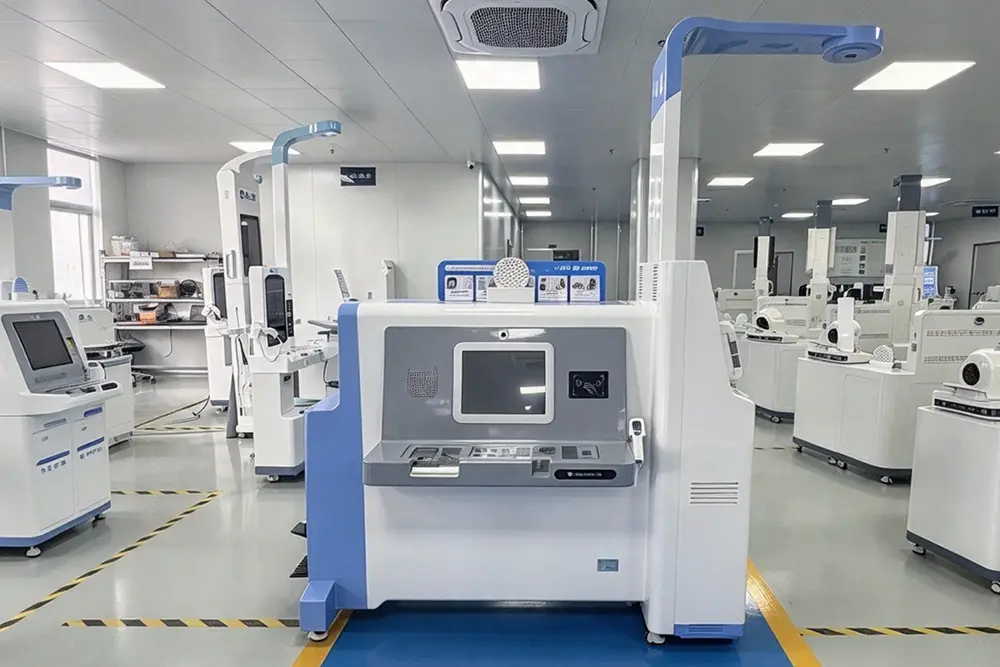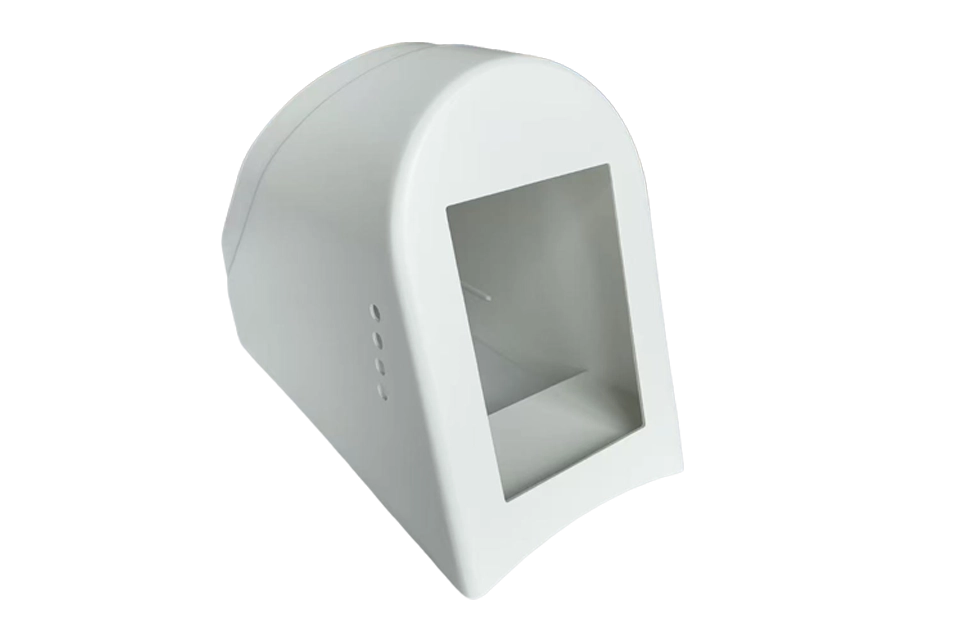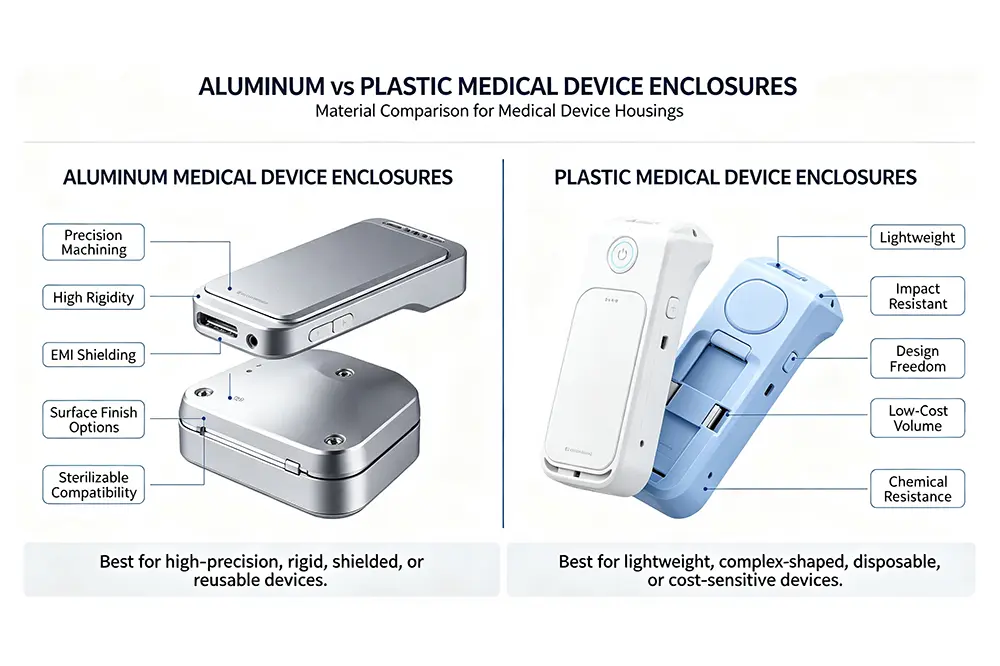
Designing a large medical device enclosure requires much more than producing an attractive outer shell. The enclosure must support the internal equipment, provide access for maintenance, accommodate displays and controls, withstand repeated movement, and maintain a consistent appearance after assembly and finishing.
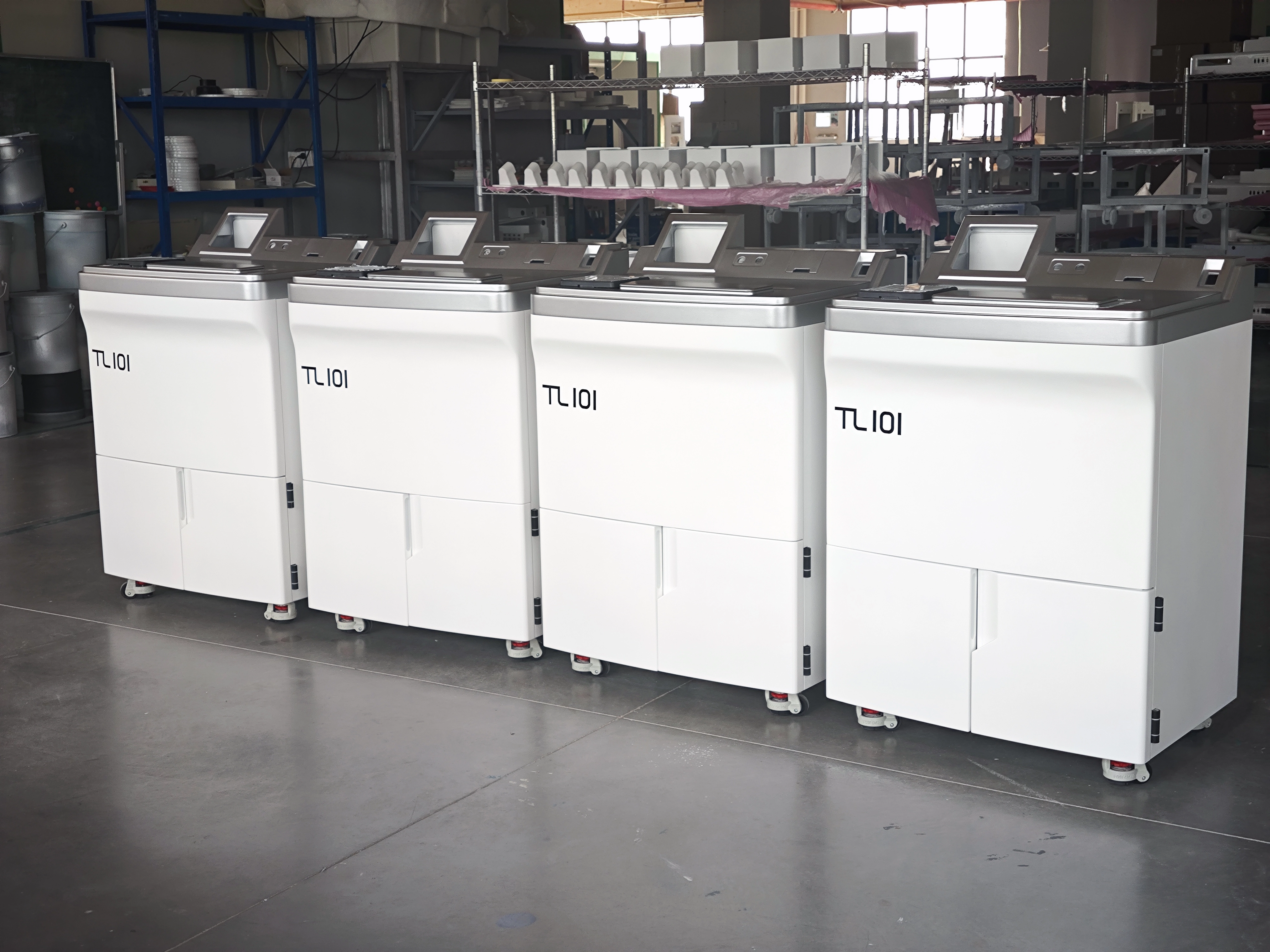
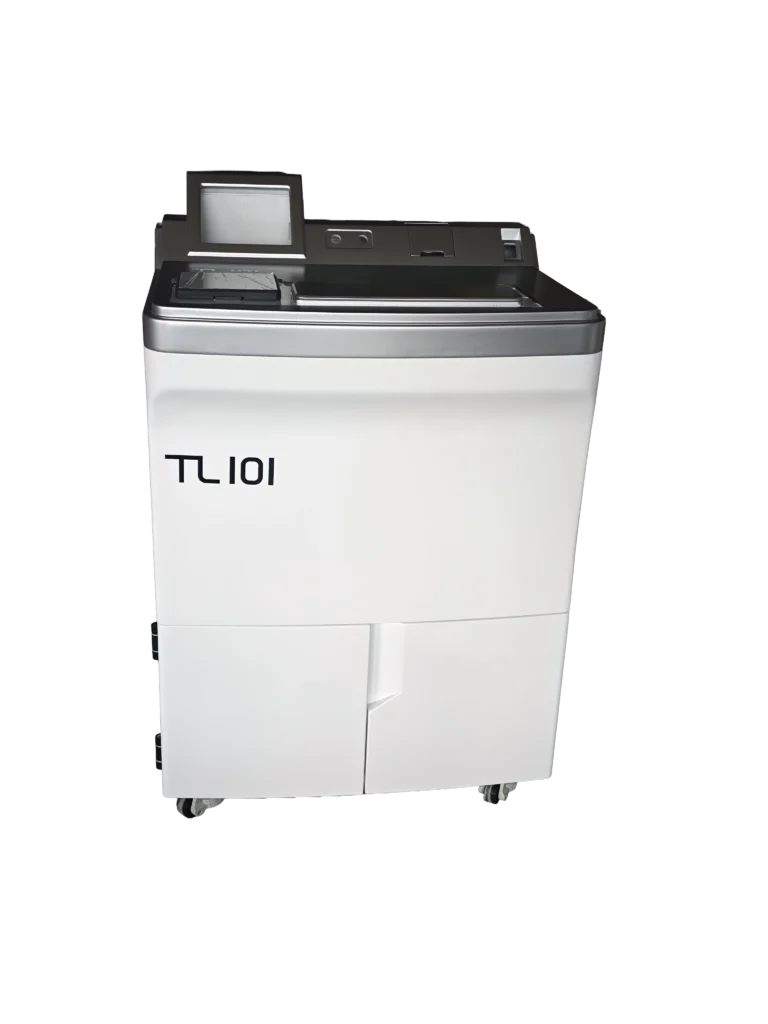
At Zhongrongda, we recently completed a production project for a large floor-standing medical equipment enclosure designed for use in hospital clinical environments. The enclosure was developed around a substantial internal system containing a water tank, control electronics, power components, pumps and other heavy assemblies. A top operating area integrated the display and controls, while the lower cabinet incorporated two service doors for maintenance access.
The project required a combination of PC-ABS enclosure components, CNC machining, vacuum forming, metal decorative components, painting and screen printing. Because the final equipment weighed approximately 50 kg and included casters for mobility, structural rigidity, dimensional control and weight distribution were important considerations throughout manufacturing.
Our engineering team worked through the enclosure structure, openings, assembly interfaces and finishing requirements before production. The project was ultimately moved into mass production after the prototype and manufacturing process were validated.
Project Overview
| Item | Project Specification |
|---|---|
| Industry | Medical Equipment |
| Application | Floor-standing mobile medical diagnostic/treatment equipment |
| Country | Not disclosed |
| Material | PC-ABS plastic + metal top decorative components |
| Dimensions | 700 × 500 × 1000 mm |
| Surface Finish | Matte white paint + silver-gray top + black screen printing |
| Tolerance | Display opening ±0.2 mm; controlled assembly interfaces |
| Manufacturing Process | CNC machining, vacuum forming, hand assembly, painting, screen printing |
| Quantity | Small batch, subsequently moved into production |
| Lead Time | Project-specific; optimized through DFM and process planning |
Customer Requirements
The customer needed a large enclosure capable of accommodating a complete medical equipment system rather than simply covering individual components.
The main enclosure measured approximately 700 mm long × 500 mm wide × 1000 mm high. The lower section provided a large internal cavity for components such as the water tank, circuit boards, pumps and other heavy assemblies. The upper section incorporated the operating area, including the display and control interfaces.
From a purchasing and engineering perspective, the enclosure needed to satisfy several requirements simultaneously.
Functional Requirements
The enclosure needed sufficient internal space for the equipment while maintaining reasonable accessibility for service personnel. The lower cabinet therefore incorporated two separate service doors with hinges, allowing technicians to access internal components without removing the complete enclosure.
The base incorporated swivel casters to make the approximately 50 kg machine easier to move between locations. Stability during movement was important because the equipment had a relatively tall vertical profile.
Dimensional Requirements
One of the most important dimensional requirements was the display opening. The screen window required approximately ±0.2 mm dimensional control to ensure proper installation.
Other important interfaces included:
- Control and button openings
- Caster mounting holes
- Upper and lower enclosure alignment
- Internal metal frame interfaces
- Service door gaps
- Display and operating-area components
For vacuum-formed or large plastic enclosure components, these interfaces require careful consideration because material thickness, forming behavior and post-processing can influence final dimensions.
Appearance Requirements
The customer specified a professional medical-equipment appearance rather than a conventional industrial cabinet.
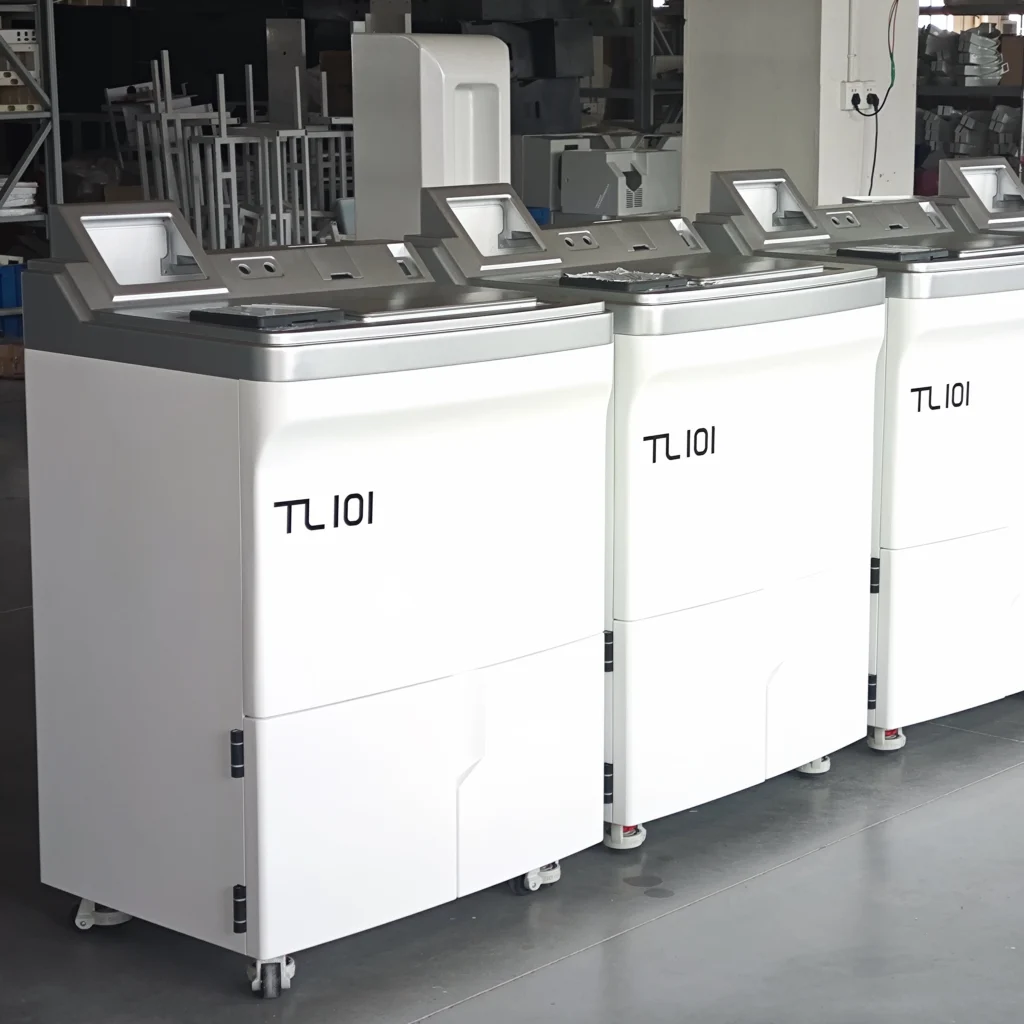
The main body was designed in matte white, with a silver-gray decorative top section. Rounded corners were used to create a more stable and refined medical-equipment appearance. The front of the machine required black screen-printed model identification, including TL101.
The two lower service doors also needed consistent gaps and smooth opening and closing after assembly.
Manufacturing Challenges
1. Maintaining Rigidity in a Large Plastic Enclosure
Large vertical plastic housings can become difficult to control when the enclosure has a relatively large unsupported surface area.
In this project, the enclosure needed to contain heavy internal components while maintaining its external shape. The approximately 50 kg finished equipment weight also meant that the enclosure structure, internal frame and caster arrangement had to work together.
Our engineering team therefore considered the relationship between the external PC-ABS enclosure, internal metal structure and mounting interfaces rather than treating the plastic shell as an isolated component.
2. Controlling Split-Line and Door Gaps
The enclosure was divided into upper and lower sections, while the lower cabinet included two service doors.
The visual quality depended heavily on the consistency of these interfaces. Large gaps could make the equipment look poorly assembled, while insufficient clearance could cause interference during opening and closing.
We therefore paid particular attention to the assembly interfaces and reserved appropriate clearance for production and assembly.
3. Accurate Openings for the Display and Controls
The top operating area included multiple openings for the display and controls.
The display window had a specified dimensional tolerance of approximately ±0.2 mm. These openings needed to align with the corresponding internal components without excessive clearance.
The engineering process therefore separated the forming and machining considerations from the final dimensional inspection requirements.
4. Surface Finishing on Large Plastic Parts
Large enclosure surfaces make finishing defects more visible.
Scratches, uneven sanding, inconsistent paint coverage and visible transition marks can become particularly noticeable on a large white housing.
The parts therefore required controlled sanding and finishing before matte painting. The black screen printing also needed to remain clean and correctly positioned on the finished enclosure.
5. Stability During Mobile Operation
The machine had a relatively tall 1000 mm overall profile and weighed approximately 50 kg.
The caster position, internal component arrangement and equipment center of gravity therefore had to be considered together. The objective was to make the equipment easier to move while reducing the risk of unstable movement under load.
Our Engineering Solution
At Zhongrongda, our approach to a project like this starts before machining.
DFM Review
Our engineering team first reviewed the enclosure structure, major dimensions, openings and assembly relationships.
For the vacuum-formed sections, we considered forming requirements and the practical limitations of producing large curved plastic surfaces. For machined areas, we identified features requiring tighter dimensional control.
The objective was to prevent problems from being discovered only after production had started.
Process Optimization
The enclosure used a combination of CNC machining and vacuum forming rather than relying on one manufacturing process for every feature.
Large plastic shell sections were produced using the appropriate forming or hand-built approach, while functional openings and interface features were subsequently machined where higher dimensional accuracy was required.
This hybrid approach allowed the large enclosure geometry and tighter interface features to be addressed separately.
Fixture and Positioning Considerations
Large enclosure components can be difficult to position consistently during secondary machining.
Our production process therefore focused on stable positioning and repeatable reference points for operations such as display-window machining and other openings.
Consistent positioning was particularly important because the finished parts had to align with the internal metal frame and other components during assembly.
Dimensional Control
Critical features were prioritized rather than applying unnecessarily tight tolerances to every feature.
The display opening, caster mounting positions and upper/lower enclosure alignment were treated as important functional interfaces. This helped balance manufacturing cost, production efficiency and assembly performance.
Quality Control
During production, dimensional inspection was combined with visual and assembly checks.
We inspected critical dimensions using appropriate measuring equipment and verified the finished enclosure through assembly inspection before final packaging.
Manufacturing Process
The manufacturing workflow was organized around the specific requirements of this large medical equipment housing.
1. DFM Review
Engineering reviewed the enclosure structure, dimensions, openings, assembly interfaces and manufacturing requirements.
2. Programming
CNC machining programs were prepared for the required openings and precision features.
3. Material Preparation
PC-ABS plastic material and metal components were prepared according to the approved design and production requirements.
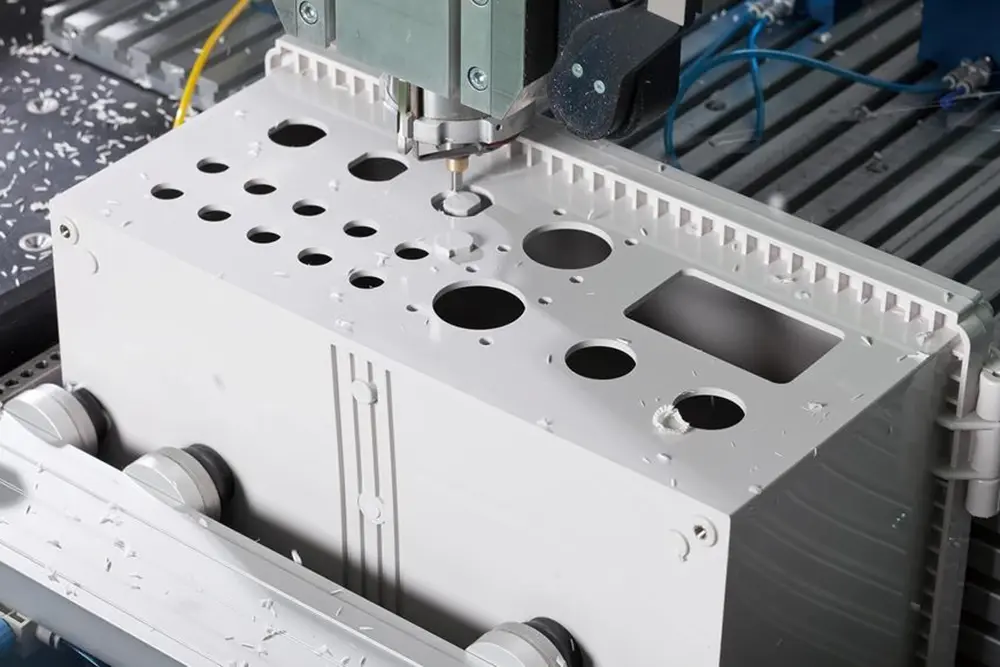
4. CNC Machining
CNC machining was used for display, button and other functional openings requiring controlled dimensions.
5. Deburring
Machined edges were cleaned and deburred to remove sharp edges and prepare the components for assembly and finishing.
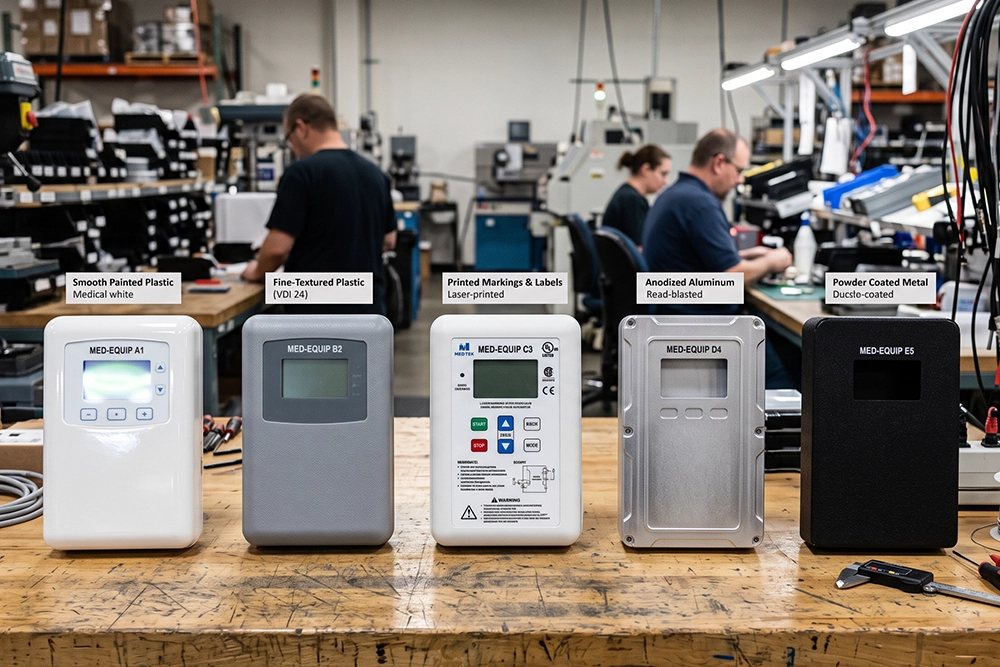
6. Surface Finishing
The plastic enclosure surfaces were sanded and prepared for matte painting. The main body received a matte white finish, while the top decorative area used a silver-gray appearance.
7. Assembly
The enclosure sections were assembled with the internal metal frame. The two lower service doors, hinges and caster-related components were installed and checked for interference.
8. Inspection
Critical dimensions, openings, alignment, surface appearance and assembly interfaces were inspected.
9. Packaging
After final inspection, completed components were prepared for shipment and subsequent equipment assembly.
Quality Inspection
Quality control for a large medical equipment enclosure cannot rely only on visual inspection.
For critical dimensions, our team can use measuring tools including:
- CMM inspection where required
- Height gauge
- Micrometer
- Caliper
- First Article Inspection
- Final dimensional inspection
- Visual surface inspection
- Assembly and functional checks
For this project, particular attention was given to the display opening, mounting locations, enclosure alignment and door interfaces.
The final inspection also considered whether the service doors opened and closed smoothly, whether the enclosure components interfered with the internal structure, and whether the finished surface met the required visual standard.
Final Results
The completed enclosure achieved the intended combination of functionality, appearance and serviceability.
The final equipment enclosure provided:
- A large internal cavity for water tanks, pumps, electronics and other components
- A dedicated upper operating area
- Display and control openings
- Two lower maintenance doors
- Mobile caster support
- Matte white exterior surfaces
- Silver-gray top decorative elements
- Black screen-printed equipment identification
- Controlled enclosure alignment and door gaps
The project successfully progressed from enclosure development into production, demonstrating that the manufacturing process could support the customer’s ongoing requirements rather than being limited to a one-off prototype.
For medical equipment manufacturers, this type of project also demonstrates why enclosure development should involve manufacturing engineering early in the design process. Large plastic housings combine structural, dimensional, aesthetic and assembly requirements, and these factors need to be considered together.
Why Choose Zhongrongda
At Zhongrongda, we support customers from initial enclosure development through prototype and production.
Engineering Support
Our engineering team reviews drawings and enclosure concepts from a manufacturing perspective. We look at material selection, assembly interfaces, machining requirements, finishing and production feasibility.
Fast Quotation and DFM Review
Customers can send drawings, 3D models or available project information for an initial engineering review. We focus on identifying practical manufacturing considerations before production begins.
Rapid Prototyping
When a new enclosure requires physical validation, our Rapid Prototyping capability can support prototype development before production quantities are released.
Medical Enclosure Manufacturing
Our core business focuses on custom equipment housings, with particular experience in Medical Device Enclosure projects.
For larger systems, our Large Medical Equipment Enclosures service is particularly relevant to floor-standing medical equipment and integrated equipment cabinets.
Small-Batch Production
This project started as a small-batch requirement and subsequently moved into production. We support customers who need prototypes, engineering samples and controlled small-batch manufacturing before larger production programs.
Quality Systems
Our manufacturing operation is supported by ISO 9001 and ISO 13485 certifications, providing a structured quality-management foundation for customers working in medical and equipment-related industries.
Confidentiality
For proprietary medical equipment designs, we can support customers with NDA confidentiality agreements when required to protect drawings, product concepts and technical information.
FAQ
1. What is the MOQ for a custom medical device enclosure?
MOQ depends on the enclosure structure, material, manufacturing process and production requirements. We can support prototype development, small-batch production and larger production programs.
2. How long does it take to manufacture a medical equipment enclosure?
Lead time depends on design complexity, material availability, finishing requirements, tooling and quantity. After reviewing your drawings, our engineering team can provide a project-specific production schedule.
3. What tolerance can you achieve for a custom medical enclosure?
Different features require different tolerances. For this project, the display opening required approximately ±0.2 mm control. We recommend defining tighter tolerances only where they are functionally necessary.
4. Can you manufacture PC-ABS medical device housings?
Yes. PC-ABS can be used for suitable equipment enclosure applications, subject to the product’s structural, environmental, regulatory and finishing requirements.
5. What surface finishes are available?
Depending on the material and application, we can support processes including sanding, painting, matte finishes and screen printing. The project described here used matte white painting, a silver-gray decorative area and black screen printing.
6. Can you manufacture large medical equipment cabinets?
Yes. We manufacture custom housings for larger medical and equipment systems. Our Large Medical Equipment Enclosures service is designed for larger equipment housing requirements.
7. Can you sign an NDA before reviewing our drawings?
Yes. NDA arrangements can be discussed when customers need confidentiality protection before sharing proprietary designs and technical information.
8. Do you provide rapid prototypes before small-batch production?
Yes. Prototype development can be used to validate dimensions, assembly, appearance and functional interfaces before moving into small-batch manufacturing.
9. Can you manufacture the enclosure and handle assembly?
Depending on the project scope, we can support enclosure component manufacturing and assembly-related requirements. The exact scope should be confirmed during the engineering review.
10. Do you support medical device enclosure projects from overseas customers?
Yes. We work with international customers and can review engineering drawings and project requirements remotely before quotation and production.
CTA
Need a reliable CNC machining partner for your next project?
Upload your drawings today and our engineering team will provide a free DFM review and quotation within 24 hours.
Whether you need a prototype, small-batch production or a complete medical equipment enclosure, we can help evaluate your material, structure, tolerances, finishing and assembly requirements before manufacturing.
Contact our engineering team to discuss your next enclosure project.