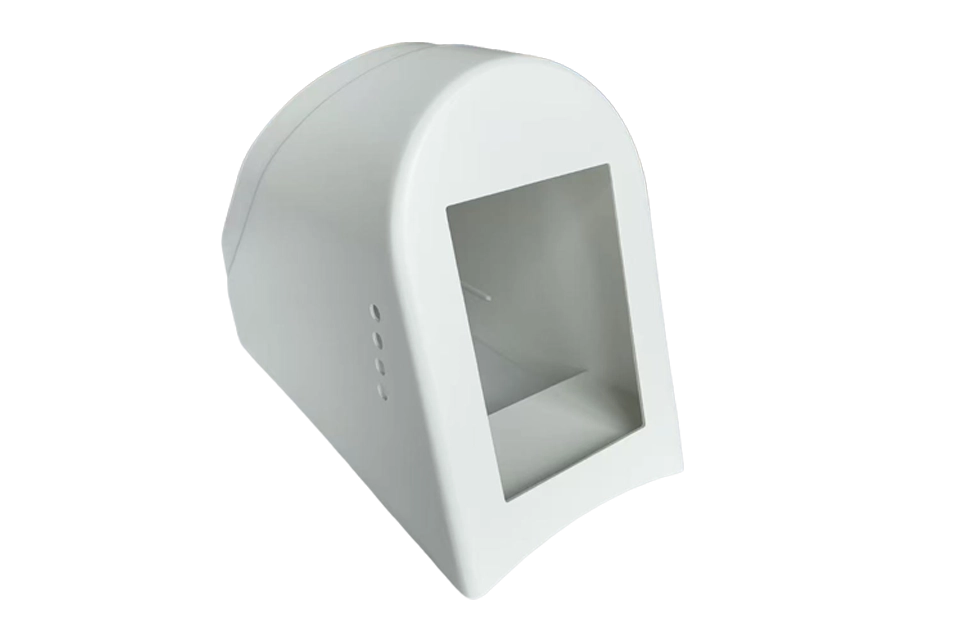
Developing a reliable Medical Device Enclosure is not simply a matter of producing an attractive outer shell. For mobile rehabilitation and therapy equipment, the enclosure must support heavy internal components, provide sufficient space for wiring and heat dissipation, maintain accurate component openings, and remain stable during repeated movement.
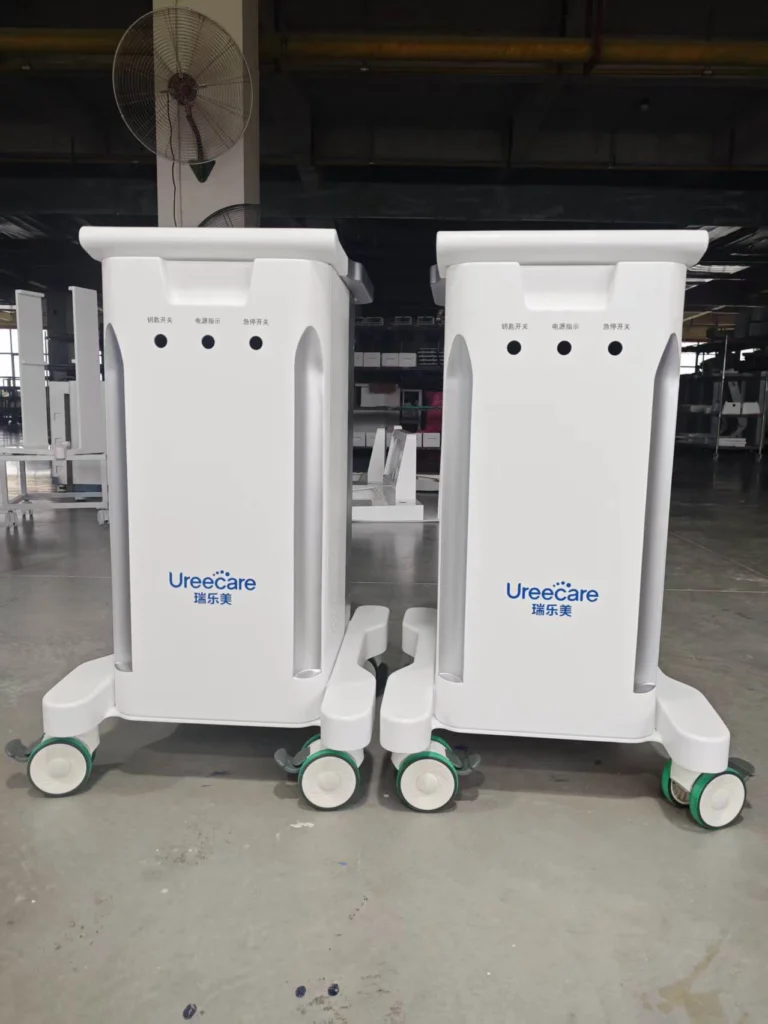
At Zhongrongda, we recently completed a small-batch enclosure project for a mobile shortwave therapy unit used in rehabilitation and physical therapy environments. The project combined a SPCC cold-rolled sheet metal structural frame with a CNC-machined ABS enclosure to balance structural strength, appearance, serviceability, and prototype flexibility.
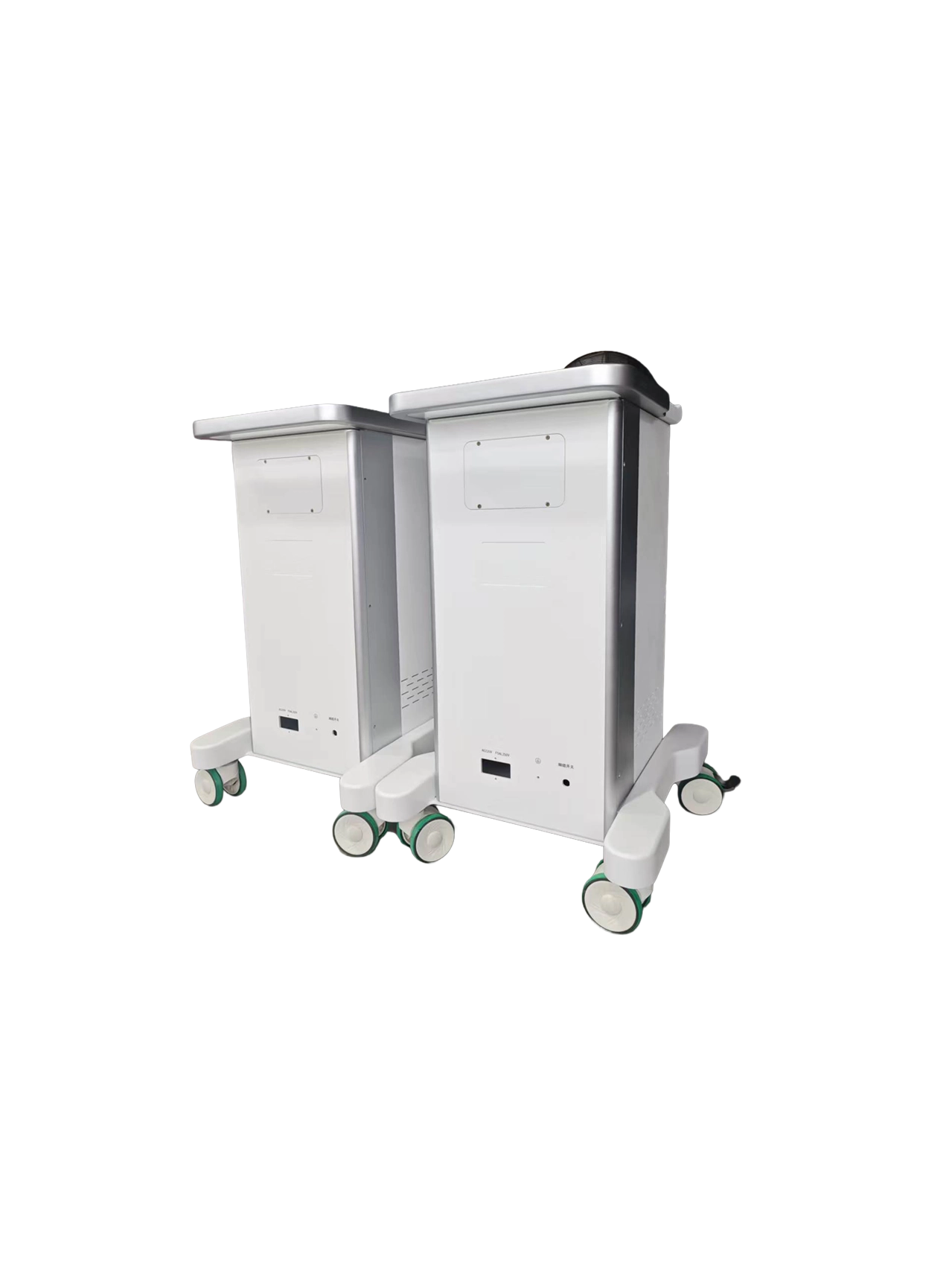
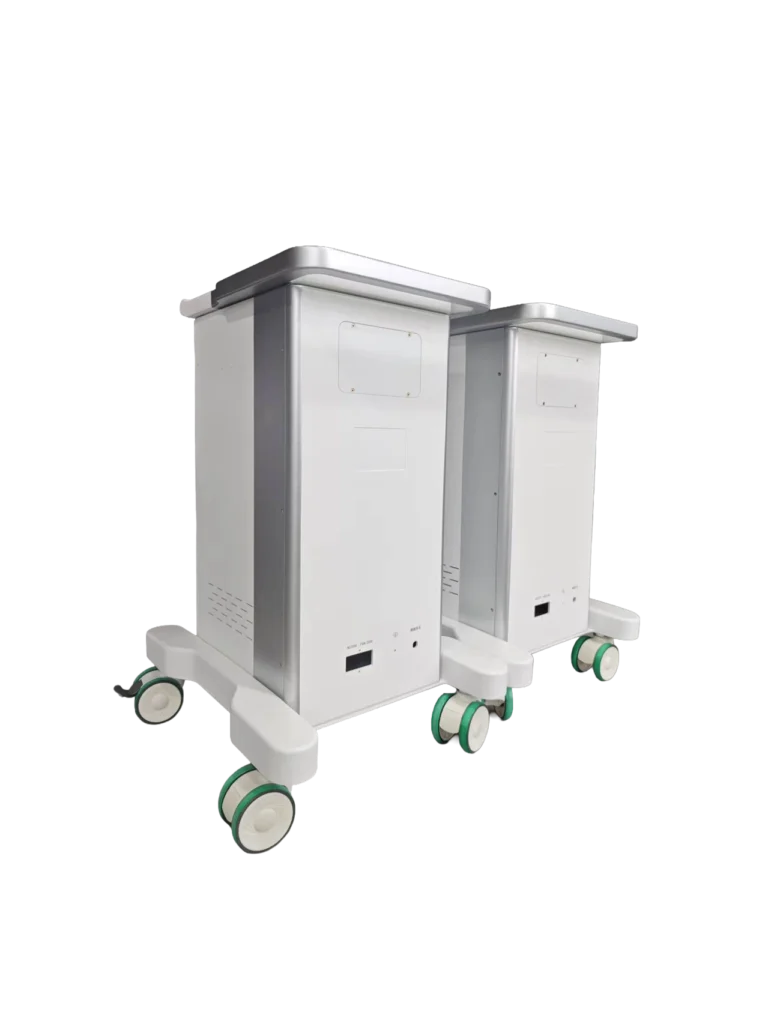
The equipment measured approximately 630 mm × 520 mm × 800 mm and incorporated a heavy shortwave main unit, transformer, control electronics, wiring, and other internal components. The enclosure also required medical casters with brakes, a top operating platform, multiple front-panel openings, ventilation provisions, cable-routing space, and a detachable structure for assembly and maintenance.
Our engineering team handled the enclosure fabrication, CNC prototype machining, sheet metal fabrication, joining, surface preparation, two-color painting, assembly, and final inspection. The completed enclosure passed structural and appearance acceptance and was delivered to the equipment manufacturer for integration into the finished machine.
Project Overview
| Project Item | Specification |
|---|---|
| Industry | Medical & Rehabilitation Equipment |
| Application | Mobile Shortwave Therapy Equipment |
| Country | China |
| Material | ABS + SPCC Cold-Rolled Sheet Metal |
| Dimensions | 630 × 520 × 800 mm |
| Surface Finish | White + Silver Gray, Semi-Matte |
| Tolerance | Controlled according to component and assembly requirements |
| Manufacturing Process | CNC Prototype Fabrication + SPCC Sheet Metal Fabrication |
| Quantity | Small Batch / Prototype / Validation |
| Lead Time | Project-dependent |
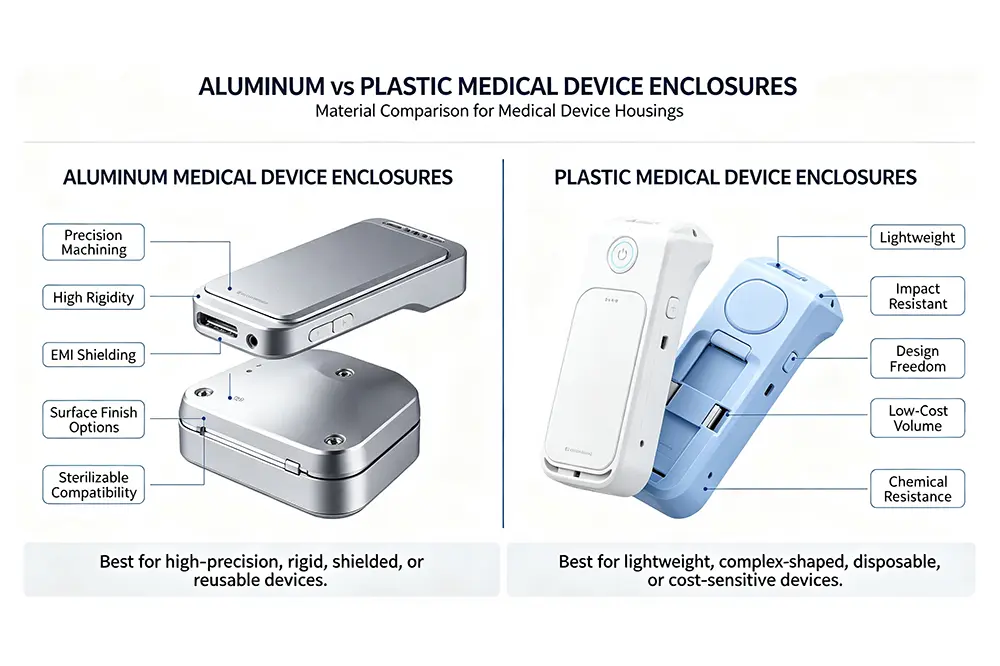
The project required a hybrid manufacturing approach rather than a single-process solution. The SPCC structure provided the required load-bearing capability, while CNC-machined ABS panels provided the required industrial design appearance and flexibility during prototype and validation stages.
For projects requiring similar engineering support, our [Medical Device Enclosure] manufacturing capability covers prototype development, enclosure fabrication, finishing, assembly, and small-batch production.
Customer Requirements
The customer’s primary objective was to create a complete enclosure system that could accommodate the internal components of a mobile shortwave therapy machine while maintaining a clean, professional medical-equipment appearance.
Structural Requirements
The internal sheet metal frame needed sufficient strength to support the shortwave main unit, transformer, control board, and other relatively heavy components.
The frame also had to resist deformation during assembly and normal movement. Because the finished equipment was mounted on medical casters, structural stability was particularly important.
The enclosure needed to include:
- A load-bearing internal sheet metal frame
- Reinforced structural sections
- A top operating platform
- An integrated lower base
- Medical casters with brakes
- Internal cable-routing paths
- Adequate ventilation space
- Removable enclosure sections for maintenance
Functional Requirements
The front panel required accurately positioned openings for:
- Key switches
- Power indicators
- Emergency stop switch
- Equipment identification
- Functional markings
The enclosure also incorporated ventilation openings and cable-routing holes.
The openings needed to align correctly with the internal components. Incorrect positioning could create assembly interference or make the finished equipment difficult to operate.
Appearance Requirements
The customer specified a predominantly white enclosure with silver-gray decorative elements.
The design featured a tall, vertically flowing form with curved corners and recessed decorative sections on both sides.
The finished surface needed to be:
- Clean and uniform
- Semi-matte
- Free from visible scratches and dents
- Free from paint runs and exposed substrate
- Consistent at color boundaries
- Free from excessive gaps or misalignment between enclosure sections
The final geometry was manufactured according to the customer’s 3D design.
Manufacturing Challenges
This project presented several challenges because the enclosure combined two different materials and several manufacturing processes.
1. ABS and Sheet Metal Assembly Tolerance
The ABS enclosure and SPCC structural frame had different manufacturing characteristics.
Sheet metal components could experience deformation during bending and welding, while large ABS panels could change slightly during machining, bonding, filling, and finishing.
Our engineering team therefore treated the enclosure as an integrated assembly rather than manufacturing every component independently.
The mounting interfaces between the ABS panels and sheet metal frame were carefully considered to provide practical assembly clearance without creating excessive movement.
2. Large Vertical Enclosure Geometry
At approximately 800 mm high, the enclosure was relatively tall.
Large vertical panels are more difficult to control during machining, bonding, sanding, painting, and assembly. Excessive handling or uneven finishing pressure could affect flatness and create visible distortion.
We therefore paid particular attention to deformation control throughout the manufacturing process.
3. Complex Side Recesses
The two sides incorporated curved recessed decorative features.
These areas required CNC machining followed by manual surface preparation. Any remaining tool marks, joint lines, or uneven transitions could become more visible after painting.
The surface therefore went through multiple stages of sanding and contour correction before primer and finishing coats were applied.
4. Heavy Internal Equipment
The shortwave therapy system contained relatively heavy internal components.
This meant that the enclosure could not rely solely on ABS panels for structural support. The SPCC frame was designed and fabricated as the primary load-bearing structure.
5. Two-Color Painting
The white and silver-gray finish introduced another quality-control challenge.
The curved surfaces required careful masking to produce clean color boundaries. Overspray, paint buildup, insufficient coverage, or leakage at masking edges could affect the final appearance.
Because ABS is sensitive to excessive heat, the curing process also needed to be controlled to reduce the risk of deformation.
Our Engineering Solution
At Zhongrongda, we approached the project as a combined engineering and manufacturing problem, rather than treating the enclosure as a simple cosmetic housing.
DFM Review
Before fabrication, our engineering team reviewed the 3D model and evaluated the relationship between:
- ABS panels
- SPCC structural components
- Mounting holes
- Switch openings
- Ventilation openings
- Cable-routing holes
- Decorative components
- Top platform
- Lower base
- Caster mounting points
This helped us identify potential interference and assembly issues before production.
Hybrid Material Strategy
The most important manufacturing decision was to separate structural and cosmetic functions.
SPCC cold-rolled sheet metal was used for the internal load-bearing frame, supports, and reinforcement.
ABS sheet was used for the visible enclosure components, including the main housing, top platform, and base covers.
This approach allowed the structure to handle the equipment load while keeping the external enclosure suitable for CNC prototype fabrication and visual refinement.
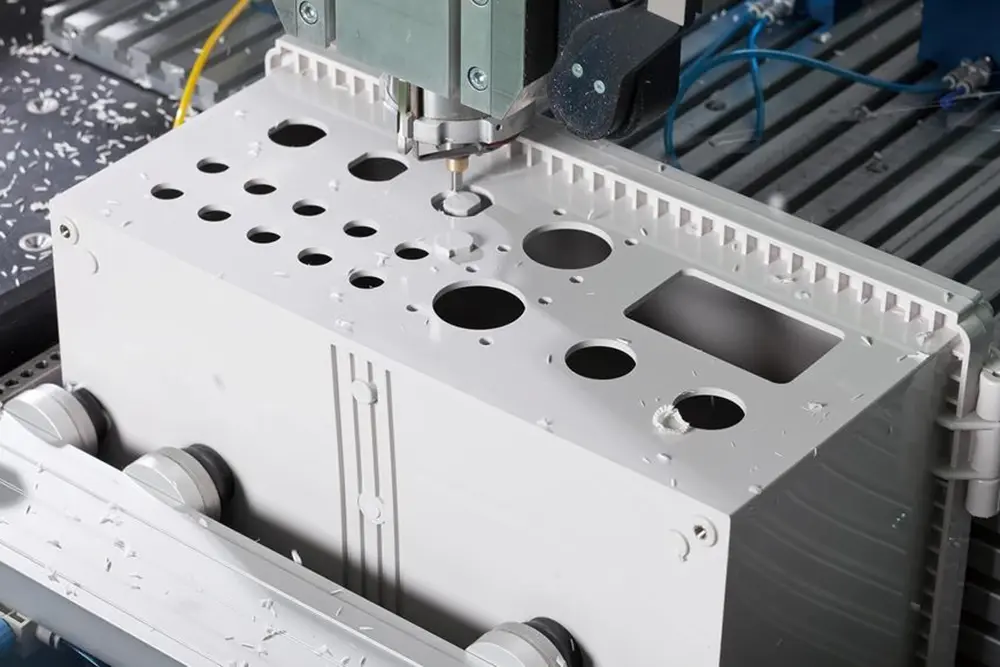
CNC Machining
The ABS components were cut from sheet material and CNC machined to produce:
- External profiles
- Side recessed surfaces
- Front-panel openings
- Ventilation holes
- Cable-routing openings
- Component mounting holes
- Curved and rounded features
After machining, the individual ABS sections were bonded and joined into larger enclosure assemblies.
Fixture and Assembly Control
During assembly, the engineering team focused on the relationship between the ABS panels and the metal frame.
The goal was to achieve proper alignment without forcing components into position.
We checked mounting-hole alignment, panel interfaces, enclosure joints, and the position of functional openings before final fastening.
Manufacturing Process
The project followed a controlled multi-stage manufacturing workflow.
1. DFM Review
The 3D design was reviewed for manufacturability, assembly access, material selection, structural requirements, and interface relationships.
2. Programming
CNC machining programs were prepared for the ABS enclosure components according to the approved geometry.
3. Material Preparation
ABS sheet and SPCC cold-rolled sheet were prepared according to the component requirements.
4. CNC Machining
ABS panels were CNC machined for the external geometry, openings, recessed features, ventilation holes, and mounting interfaces.
5. Sheet Metal Fabrication
SPCC sheet was laser cut and CNC bent to create the internal frame, supports, and reinforcement components.
The sheet metal structure was welded, followed by weld cleanup and deformation correction.
6. Deburring and Surface Preparation
ABS components were deburred, sanded, filled, and surface-corrected.
The SPCC frame was cleaned and prepared for primer application.
7. Surface Finishing
The ABS components received ABS-compatible primer and multiple stages of sanding.
The sheet metal structure received pretreatment and epoxy primer to improve coating adhesion and corrosion resistance.
The final enclosure was painted white and silver gray with a semi-matte appearance.
8. Assembly
The ABS enclosure was mounted to the sheet metal frame.
The main body, side decorative components, top platform, and base were assembled and adjusted.
Medical casters with brakes were installed, followed by logo and functional marking application.
9. Inspection and Packaging
The completed enclosure was checked for dimensions, appearance, opening positions, assembly condition, panel alignment, and overall structural stability before delivery.
More information about our broader production capabilities is available through [Manufacturing].
Quality Inspection
Quality control was performed throughout the manufacturing process rather than only at the final stage.
Depending on the component and dimensional requirement, our inspection process can include CMM inspection, height gauge measurement, micrometer measurement, and caliper inspection.
For this project, particular attention was given to the interfaces that directly affected assembly.
Dimensional Inspection
Critical dimensions and mounting interfaces were checked using appropriate measuring equipment, including:
- Calipers
- Micrometers
- Height gauges
- CMM inspection where required
First Article Inspection
The first completed enclosure components were evaluated before proceeding with the remaining small-batch production.
We checked the relationship between the ABS enclosure and SPCC frame, including mounting interfaces and functional openings.
Appearance Inspection
The finished enclosure was inspected for:
- Scratches
- Dents
- Paint runs
- Pinholes
- Orange peel
- Exposed substrate
- Uneven color separation
- Excessive assembly gaps
- Panel misalignment
- Surface defects
Final Assembly Inspection
The completed unit was checked for overall appearance, enclosure alignment, caster installation, brake function, component-opening alignment, and assembly stability.
Final Results
The complete enclosure set was successfully fabricated, joined, finished, assembled, and inspected.
The final product achieved the required combination of:
- SPCC structural strength
- CNC-machined ABS exterior panels
- Controlled enclosure interfaces
- White and silver-gray two-tone finishing
- Semi-matte surface appearance
- Accurate functional openings
- Removable enclosure construction
- Integrated medical casters
- Internal space for wiring and heat dissipation
After final structural and appearance acceptance, the enclosure was delivered to the equipment manufacturer.
The finished enclosure was subsequently integrated into the complete shortwave therapy equipment and put into use.
This project demonstrated the value of combining sheet metal fabrication and CNC-machined plastic enclosure manufacturing when developing large medical equipment housings in prototype and small-batch quantities.
For companies developing similar diagnostic, rehabilitation, therapy, or laboratory equipment, our [Case Studies] provide additional examples of how we approach enclosure development and manufacturing.
Why Choose Zhongrongda
Engineering Support
Our engineering team works with customers from design review through manufacturing. We focus on manufacturability, assembly interfaces, material selection, and production risks before fabrication begins.
Fast Quotation and DFM Review
Customers can provide 3D CAD files, 2D drawings, or project specifications for engineering evaluation.
We can review the design and identify potential manufacturing and assembly issues before production.
Rapid Prototyping
For medical equipment still undergoing design validation, CNC-machined ABS prototypes can provide a practical way to verify:
- Form
- Fit
- Component placement
- Assembly
- Appearance
- Ergonomics
Our [Rapid Prototyping] service supports this development stage.
Small-Batch Manufacturing
Not every medical equipment project immediately requires mass production.
Prototype, validation, pilot-run, and small-batch quantities can require flexible manufacturing. Our manufacturing approach supports projects where design changes and engineering validation remain important.
Quality Control
We combine dimensional inspection, first-article evaluation, assembly inspection, and final appearance inspection to control enclosure quality.
NDA and Confidentiality
For customers developing new medical equipment, protecting design information is important.
We can work under an NDA when required to help protect customer drawings, 3D models, product concepts, and technical information.
ISO9001 and ISO13485
Zhongrongda operates with ISO9001 and ISO13485 certifications, supporting our quality-management approach for manufacturing projects serving medical-equipment applications.
FAQ
1. What is the MOQ for a medical device enclosure?
Our MOQ depends on the enclosure design, materials, manufacturing processes, and project stage. We can support prototype quantities, validation samples, and small-batch production rather than requiring large-volume orders for every project.
2. How long does it take to manufacture a medical device enclosure?
Lead time depends on enclosure size, geometry, material combination, finishing requirements, assembly complexity, and quantity. After reviewing the drawings, our engineering team can provide a project-specific production schedule.
3. What tolerances can you achieve?
Tolerance requirements depend on the material and manufacturing process. For projects requiring tighter dimensional control, we identify critical dimensions during the DFM review and establish the appropriate inspection method.
4. What materials can you use for medical equipment enclosures?
Depending on the application, we can work with engineering plastics such as ABS as well as sheet metals including SPCC cold-rolled steel. Material selection depends on structural requirements, appearance, weight, environment, and production quantity.
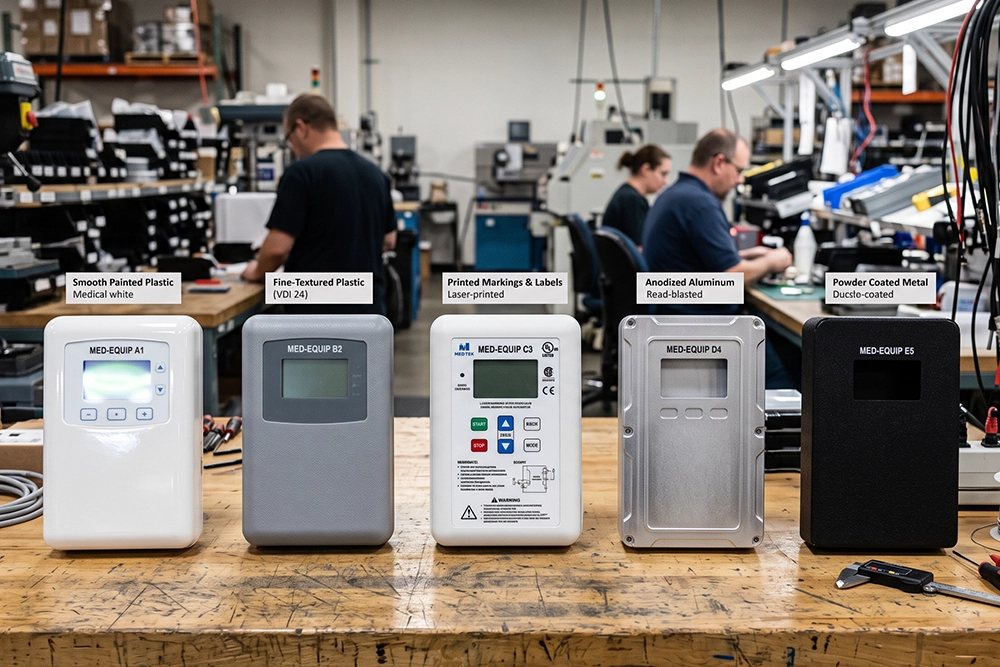
5. Can you provide custom surface finishes?
Yes. Depending on the material and design, finishing options can include primer, painted finishes, two-color painting, sanding, and other customized treatments.
For medical equipment housings, we pay particular attention to surface consistency, color separation, coating defects, and the appearance of assembly joints.
6. Can Zhongrongda manufacture medical enclosure prototypes?
Yes. We support rapid prototyping and engineering validation using processes such as CNC machining, sheet metal fabrication, bonding, finishing, and assembly.
7. Can you manufacture medical device enclosures in small quantities?
Yes. Prototype and small-batch manufacturing is an important part of our enclosure work. This is particularly useful for medical equipment manufacturers that need to validate product design before committing to higher-volume production.
8. Can you sign an NDA before reviewing my drawings?
Yes. We can work under an NDA when confidentiality protection is required before sharing product drawings, 3D models, specifications, or other technical information.
9. Can you manufacture large medical equipment enclosures?
Yes. We manufacture larger enclosure assemblies using combinations of sheet metal structures and CNC-machined plastic panels when the application requires both structural strength and a finished exterior appearance.
Our [Large Medical Equipment Enclosures] capability is particularly relevant to equipment with larger dimensions, heavy internal components, and complex assembly requirements.
10. Do you manufacture complete medical devices?
Our focus is on custom medical and equipment enclosures and related manufacturing services. We manufacture the enclosure, structural components, finishing, and assembly according to customer-provided product designs. We do not represent ourselves as the medical-device OEM or final device manufacturer.
CTA
Need a reliable CNC machining partner for your next project?
Upload your drawings today and our engineering team will provide a free DFM review and quotation within 24 hours.
Whether you are developing a medical therapy system, diagnostic device, laboratory instrument, rehabilitation machine, or other equipment requiring a custom housing, we can help evaluate the enclosure structure, materials, manufacturing process, finishing, and assembly requirements.
[Contact] our engineering team to discuss your next enclosure project.