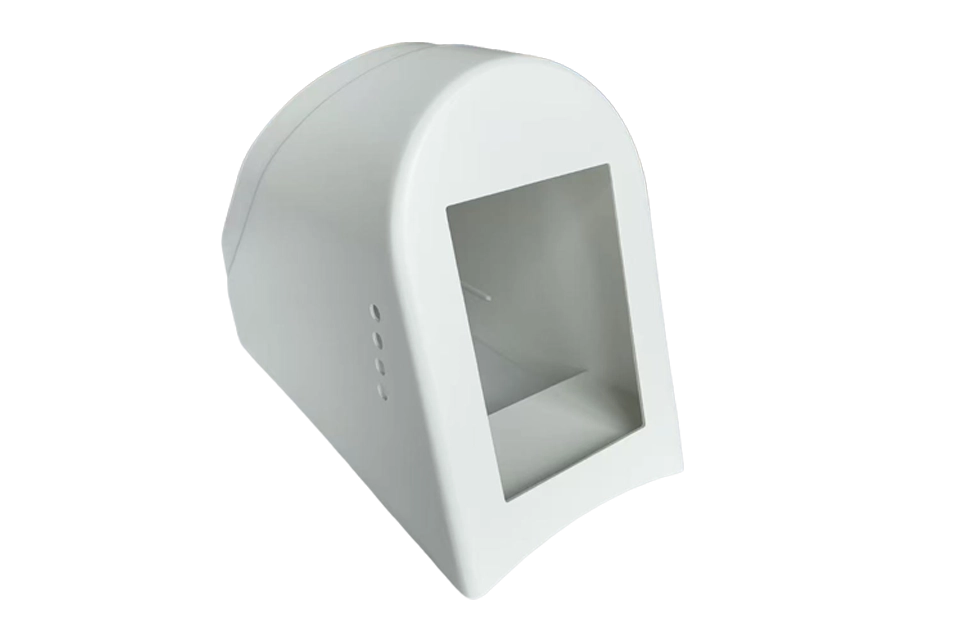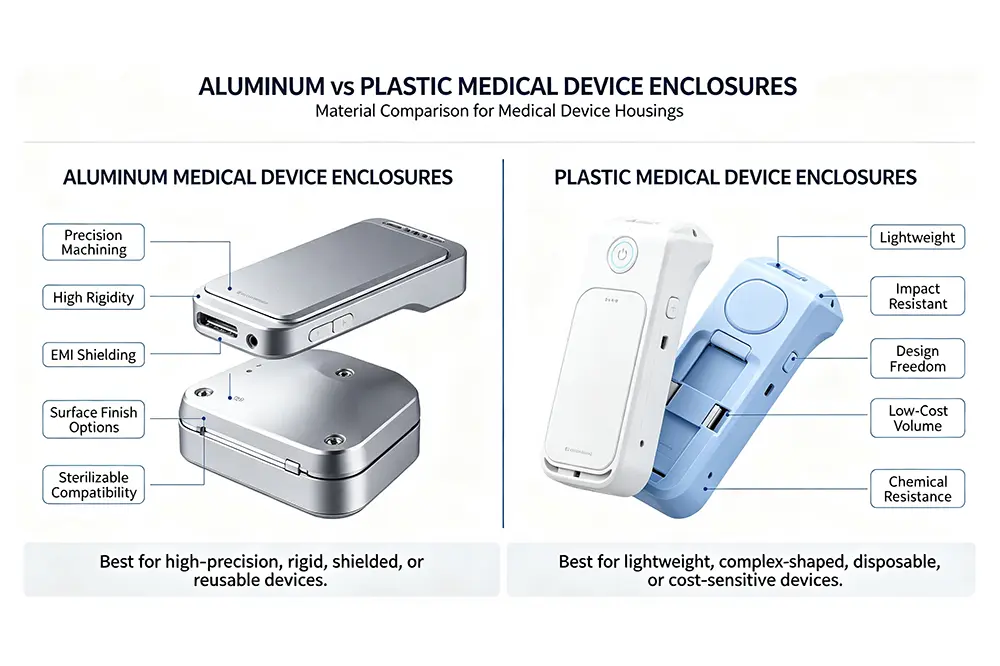
An ABS medical device enclosure needs to balance appearance, structural strength, serviceability and manufacturing consistency. For equipment used in humid operating environments, the enclosure also needs to accommodate water-related components while protecting the internal structure and maintaining a professional medical-equipment appearance.
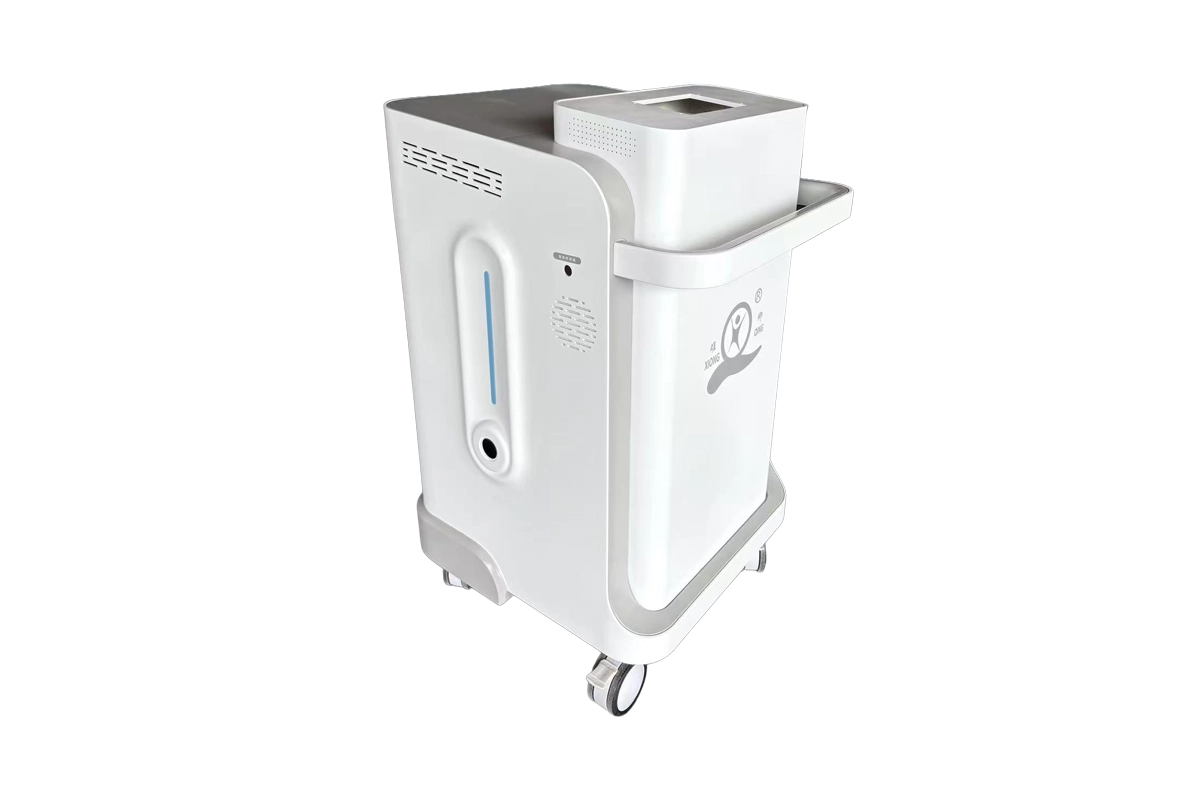
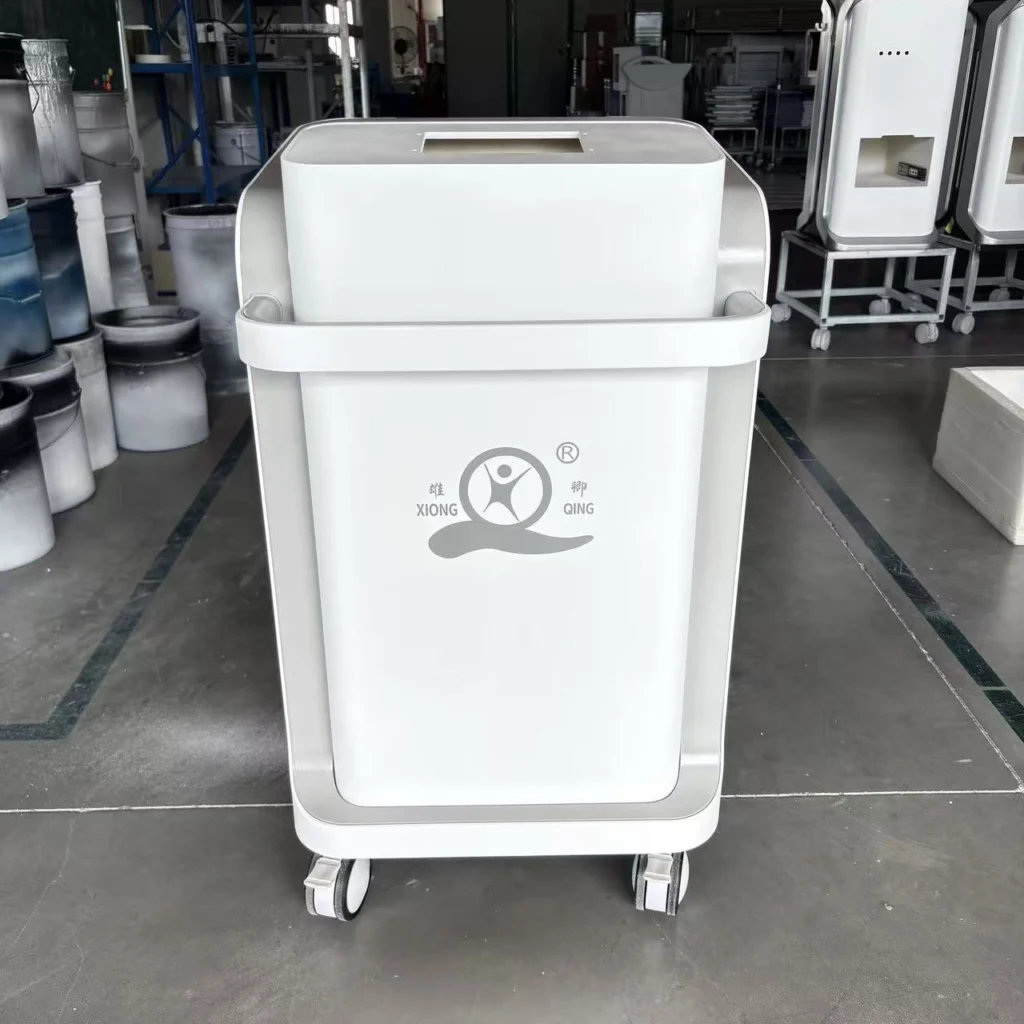
At Zhongrongda, we recently completed a small-batch enclosure project for a mobile traditional Chinese medicine steaming therapy system. The finished housing combined an ABS outer enclosure with an SPCC cold-rolled steel internal frame. The equipment was designed as a mobile medical cart-style system, with internal space for a medicine tank, steam-generation module, power components and control electronics.
The project presented several practical manufacturing challenges. The enclosure contained large curved surfaces, multiple functional openings, two different materials and several detachable sections. At the same time, the customer required consistent panel gaps, smooth transitions, clean two-tone painting and resistance to moisture and routine cleaning.
Our engineering team used a combination of CNC fabrication, hand-built ABS assembly, laser-cut and bent sheet metal, welding, surface preparation, painting and final assembly to produce the complete enclosure. After structural, dimensional and appearance inspection, the finished housing was delivered to the equipment manufacturer and put into use.
Project Overview
| Item | Project Specification |
|---|---|
| Industry | Medical / Therapy Equipment |
| Application | Mobile traditional Chinese medicine steaming therapy equipment |
| Country | China |
| Material | ABS + SPCC cold-rolled steel |
| Dimensions | 580 × 550 × 660 mm |
| Surface Finish | White + silver-gray, semi-matte painted finish |
| Tolerance | Project-specific; critical functional tolerances defined by assembly requirements |
| Manufacturing Process | CNC fabrication, ABS hand-built assembly, laser cutting, bending, welding, painting and assembly |
| Quantity | Small batch for prototyping, validation and production |
| Lead Time | Project-specific based on drawings, finishing and quantity |
Customer Requirements
The customer needed a complete enclosure for a mobile steaming therapy system rather than a simple protective cover.
The enclosure had to accommodate a substantial internal metal structure supporting the equipment and provide sufficient space for a medicine tank, steam-generation components, power supply and control electronics.
Functional Requirements
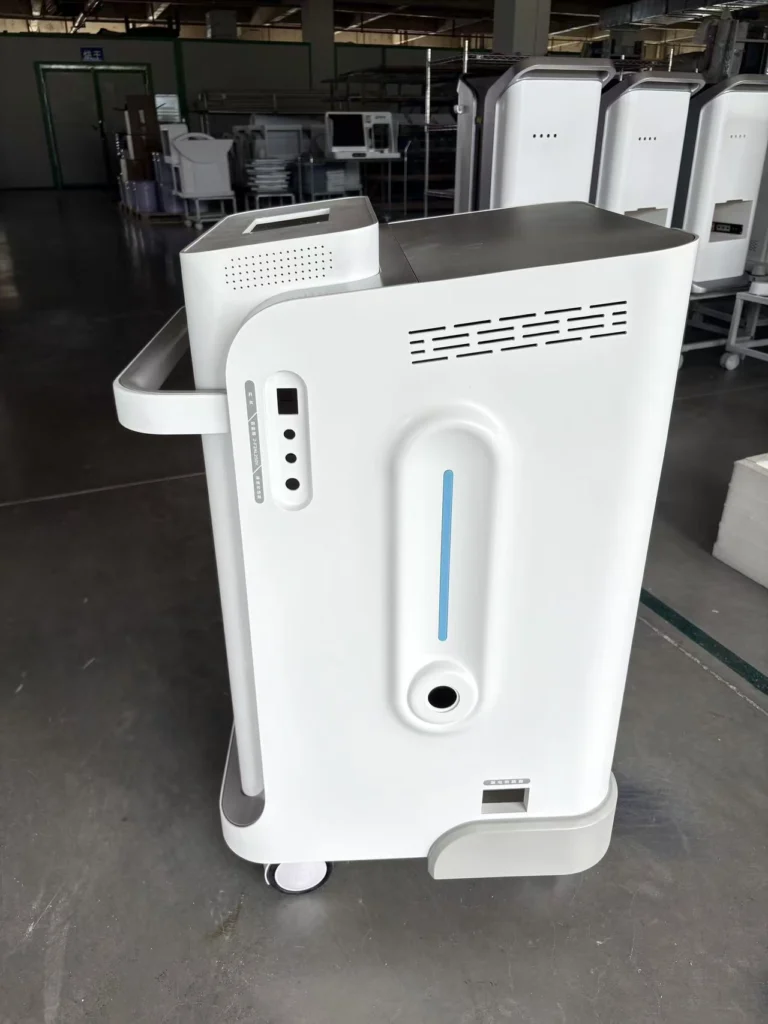
The side of the enclosure required several functional interfaces, including:
- Water-level viewing window
- Drainage opening
- Ventilation louvers
- Component mounting openings
- Top equipment access compartment
- Push handle
- Medical casters
Because the equipment operates with water and steam, the enclosure also required internal space that could help avoid unwanted water accumulation and provide suitable drainage and routing areas.
The outer panels needed to remain removable so that technicians could access the water tank, steam module and other internal components for installation, cleaning and maintenance.
Structural Requirements
The SPCC internal frame was designed to provide the primary structural support.
The frame needed sufficient strength to carry the internal equipment while providing stable mounting locations for the ABS outer housing.
This created an important engineering requirement: the ABS enclosure and metal frame could not be designed independently. Their mounting holes, interfaces and overall geometry had to work together during final assembly.
Appearance Requirements
The customer specified a large-radius, streamlined enclosure design.
The primary body was white, while the frame and handle areas used a silver-gray finish. The boundary between the two colors needed to remain clean and consistent without overspray, bleeding or visible masking problems.
The ABS surfaces also needed to be free from scratches, dents, excessive sanding marks, visible adhesive joints and uneven transitions.
The final finish was specified as semi-matte, with sufficient durability for contact with moisture and routine cleaning.
Manufacturing Challenges
1. Combining ABS and SPCC in One Enclosure
One of the most important challenges was controlling the assembly relationship between two very different materials.
ABS and SPCC behave differently during fabrication, finishing and assembly. The ABS panels could be shaped and machined to create the required exterior geometry, while the SPCC frame provided structural support.
If mounting locations were not properly coordinated, the finished enclosure could experience misalignment, uneven gaps or excessive assembly force.
Our engineering team therefore treated the metal frame and ABS housing as one integrated assembly during process planning.
2. Large Curved ABS Surfaces
The enclosure included multiple large-radius curved surfaces.
For CNC-machined and hand-built ABS components, machining marks, adhesive joints and transitions can become visible after painting if the surface is not properly prepared.
The ABS components therefore went through progressive surface preparation, including deburring, joint filling, sanding and curved-surface leveling before primer and topcoat application.
3. Multiple Functional Openings
The housing required several functional openings in different locations.
The water-level window, drainage opening, ventilation louvers, top equipment compartment and component mounting holes all needed to correspond with the internal structure.
The challenge was not simply machining individual holes. Their positions had to be coordinated with the components behind the enclosure.
4. Moisture and Surface-Finish Requirements
Because the equipment works with water and steam, moisture resistance was an important consideration.
For the SPCC components, the welded and corrected frame was cleaned and prepared before receiving an epoxy primer to improve coating adhesion and corrosion protection.
The ABS components received an ABS-compatible primer before the final paint process.
5. Two-Color Painting
The white and silver-gray color scheme required controlled masking.
The curved enclosure geometry made the color boundary more difficult to manage than a simple flat panel.
Our finishing process therefore included masking after primer preparation, separate application of the two colors, low-temperature oven curing and subsequent inspection for overspray, paint runs, pinholes, exposed areas and other visible defects.
Our Engineering Solution
At Zhongrongda, we approached this project as a complete enclosure manufacturing problem rather than treating each component separately.
DFM Review
Before production, our engineering team reviewed the 3D geometry and considered the relationship between the ABS shell, SPCC frame, handle, top compartment, base and caster system.
Particular attention was given to mounting points and areas where ABS components connected to the metal frame.
The objective was to create sufficient assembly clearance without compromising the appearance of the finished housing.
SPCC Frame Manufacturing
The internal steel frame was produced from SPCC cold-rolled steel.
The basic process included:
- Laser cutting
- CNC bending
- Frame welding
- Weld correction
- Grinding and cleaning
- Degreasing and surface preparation
- Epoxy primer application
The welded structure provided the main load-bearing support for the internal components.
CNC ABS Fabrication
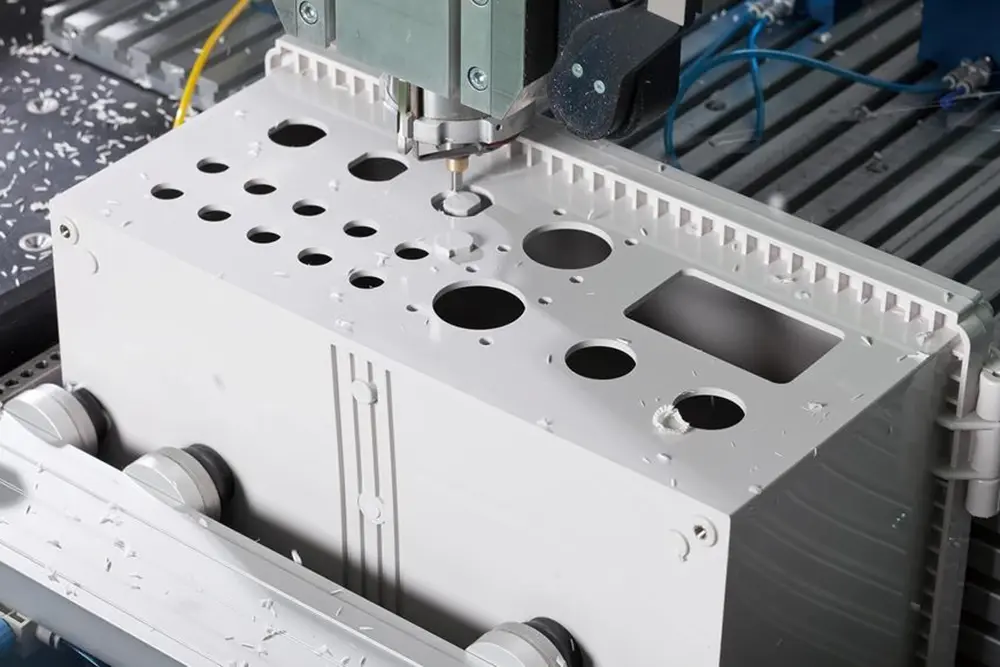
ABS sheets were cut according to the required dimensions and then CNC machined to produce the enclosure geometry and functional features.
CNC machining was used for areas including:
- External profiles
- Large-radius surfaces
- Water-level window
- Drainage openings
- Ventilation louvers
- Top compartment
- Component mounting holes
Multiple ABS components were then manually assembled and bonded to create the complete enclosure structure.
Surface Preparation
After fabrication, the ABS housing was carefully prepared for painting.
Our team removed burrs and machining marks, filled and corrected visible joints, and progressively sanded the surfaces until the curved areas were sufficiently smooth and consistent.
This preparation stage is particularly important because painting does not hide poor substrate preparation. Large curved surfaces tend to make defects more visible under finished paint.
Assembly and Fit Control
The ABS enclosure was then mounted onto the SPCC frame.
Our team adjusted the enclosure sections to control panel gaps, prevent interference and ensure that the top compartment, handle, base and other components aligned correctly.
The casters were installed at the base and checked for smooth movement and stable support.
Manufacturing Process
1. DFM Review
Review the 3D design, material combination, mounting interfaces, functional openings and assembly sequence.
2. Programming
Prepare CNC machining programs for the required ABS geometry and precision features.
3. Material Preparation
Prepare ABS sheet material and SPCC cold-rolled steel according to the approved design.
4. CNC Machining
Machine the ABS enclosure profiles, curved surfaces, windows, louvers and mounting features.
5. Deburring
Remove burrs and sharp edges from machined and fabricated components.
6. Surface Finishing
Grind and correct welded SPCC surfaces. Prepare ABS surfaces through filling and multi-stage sanding before primer application.
7. Assembly
Combine the ABS enclosure with the SPCC structural frame, top compartment, handle, base and caster system.
8. Inspection
Check dimensions, openings, assembly alignment, surface quality, color separation and overall appearance.
9. Packaging
After final acceptance, the completed enclosure was prepared for delivery to the equipment manufacturer.
Quality Inspection
Quality inspection covered both individual components and the finished enclosure.
For dimensional verification, our team can use measuring equipment such as:
- CMM
- Height gauge
- Micrometer
- Caliper
For this project, inspection focused on functional openings, mounting positions, enclosure alignment and assembly interfaces.
First Article Inspection
During prototype and validation production, first-article inspection is important for identifying issues before repeating the same process across a batch.
We checked the relationship between the ABS enclosure and SPCC frame and verified that the major openings aligned with their corresponding components.
Final Inspection
The finished enclosure was inspected for:
- Overall dimensions
- Functional openings
- ABS-to-metal alignment
- Panel gaps
- Surface defects
- Paint coverage
- White/silver-gray color boundaries
- Fastener security
- Handle installation
- Caster movement
- Overall stability
Visual inspection was particularly important because the enclosure had large curved painted surfaces where scratches, dents, uneven coating or poor masking could be easily noticed.
Final Results
The complete enclosure was successfully fabricated, assembled, painted and inspected.
The finished product combined an SPCC structural frame with a CNC-fabricated ABS outer housing and incorporated the required functional interfaces for the steaming therapy system.
The final enclosure provided:
- Structural support for internal equipment
- Space for the medicine tank and steam-generation module
- Water-level viewing access
- Drainage and ventilation openings
- A top equipment access compartment
- Push-handle mobility
- Medical caster installation
- Removable enclosure sections for maintenance
- White and silver-gray two-tone finishing
- Semi-matte surface appearance
- Customer logo and branding capability
The completed enclosure passed the required structural, assembly and appearance acceptance and was delivered to the equipment manufacturer. The finished housing has since been put into use.
Because this was a small-batch project covering prototyping, validation and production requirements, the experience also provided a practical manufacturing reference for similar medical equipment housing projects.
Why Choose Zhongrongda
At Zhongrongda, we understand that a custom enclosure is part of the equipment—not simply an external cover.
Engineering Support
Our engineering team evaluates enclosure structure, materials, assembly interfaces and manufacturing processes before production.
Rapid Prototyping
For new equipment designs, our Rapid Prototyping service can help customers validate enclosure dimensions, assembly and appearance before committing to larger production quantities.
Medical Equipment Enclosures
Our Medical Device Enclosure service supports custom housings for medical and therapy equipment.
For larger or integrated equipment, we also provide Large Medical Equipment Enclosures.
Small-Batch Manufacturing
This project was produced in small batches for prototype development and validation. We support customers who need engineering samples, prototypes and small production runs before scaling.
Integrated Manufacturing
The project demonstrates our ability to combine plastic fabrication and metal manufacturing within one enclosure.
This can simplify supplier coordination when a project requires both a structural metal frame and a finished plastic exterior.
Quality Management
Our manufacturing operation is supported by ISO 9001 and ISO 13485 quality management certifications.
These systems provide a structured foundation for customers looking for a manufacturing partner for medical and equipment-related enclosure projects.
NDA and Confidential Development
When projects involve proprietary medical equipment designs, we can support NDA requirements to help protect drawings, product concepts and technical information during development.
FAQ
1. Can you manufacture an ABS medical device enclosure with a metal frame?
Yes. We can combine ABS or other engineering plastics with SPCC or other metal structures when the enclosure requires both appearance flexibility and structural support.
2. What materials can be used for medical equipment enclosures?
Material selection depends on the equipment structure, operating environment, appearance requirements and production volume. Common options may include ABS, PC-ABS, sheet metal and other engineering plastics.
3. Can you manufacture small batches for prototype validation?
Yes. We support prototype, validation and small-batch production programs. This allows customers to verify the enclosure before moving to higher production quantities.
4. Can ABS be CNC machined for a custom enclosure?
Yes. CNC machining can be used to produce ABS enclosure profiles, openings, curved surfaces and mounting features. For large or complex housings, CNC fabrication can also be combined with hand-built assembly techniques.
5. How do you connect ABS panels to a sheet metal frame?
The connection method depends on the enclosure design. Mounting holes, brackets, fasteners and suitable assembly clearances can be incorporated during the engineering stage to avoid forced assembly or interference.
6. Can you manufacture enclosures for equipment exposed to water or steam?
Yes, we can manufacture housings for equipment operating in moisture-related environments. However, the required sealing, drainage and material selection should be evaluated according to the actual equipment design and operating conditions.
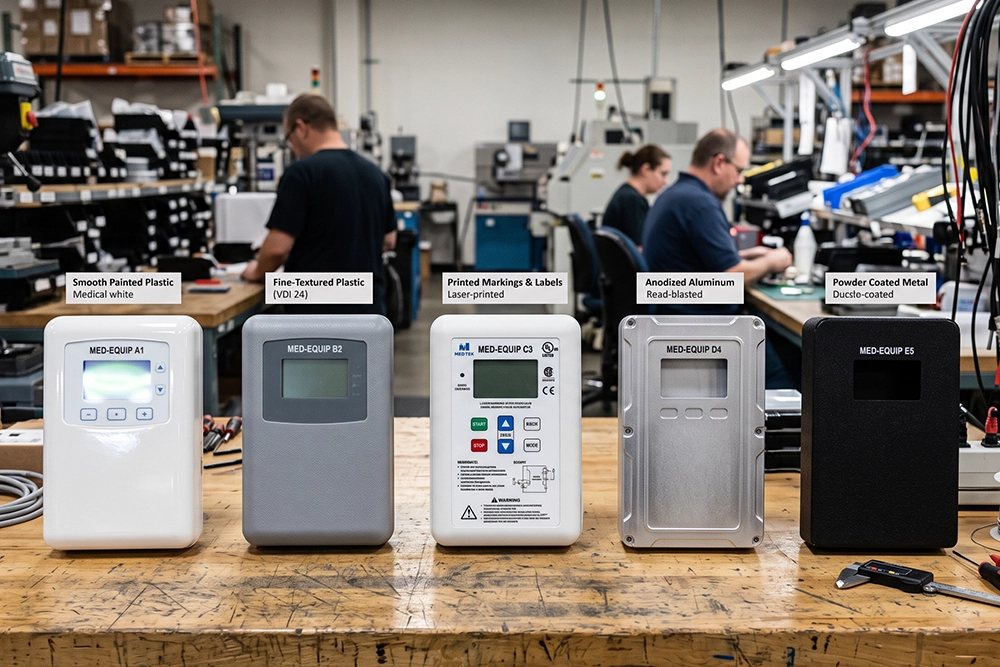
7. What surface finishes can you provide for ABS enclosures?
Depending on the project, we can provide sanding, primer application, painting, semi-matte finishes, two-color painting and screen printing.
8. Can you produce two-color painted medical equipment housings?
Yes. Two-color painting requires careful masking and process control, especially on large curved surfaces. We can coordinate the color separation and finishing requirements according to the approved design.
9. Can you sign an NDA before reviewing our design?
Yes. NDA requirements can be discussed before customers share confidential drawings, 3D models or product information.
10. Can you handle both enclosure manufacturing and final assembly?
Depending on the project scope, we can support enclosure fabrication, surface finishing and assembly of the enclosure components. The exact assembly scope can be confirmed during the quotation and engineering review.
CTA
Need a reliable CNC machining partner for your next project?
Upload your drawings today and our engineering team will provide a free DFM review and quotation within 24 hours.
Whether you need an ABS medical device enclosure, a hybrid plastic-and-sheet-metal housing, a prototype or small-batch production, our team can help evaluate the structure, materials, manufacturing process, finishing and assembly requirements.
Contact our engineering team to discuss your next enclosure project.