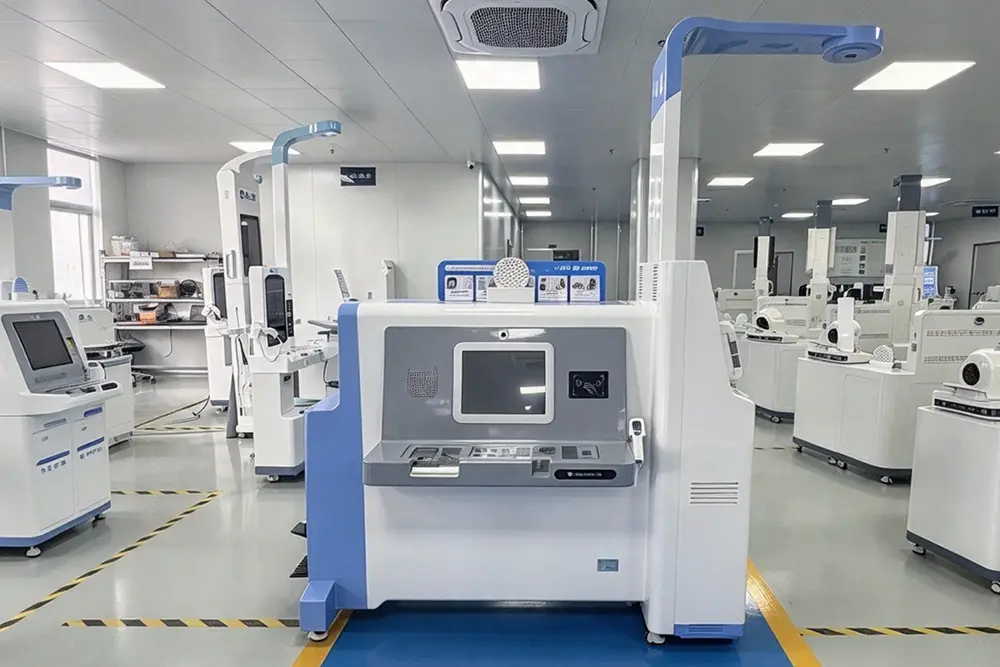
Healthcare equipment manufacturers often need to integrate multiple measurement modules into one compact, professional-looking system. The challenge is not simply making an attractive cabinet. The enclosure must support the internal structure, provide accurate mounting interfaces, allow sufficient space for wiring and maintenance, and protect the equipment while maintaining a clean medical appearance.
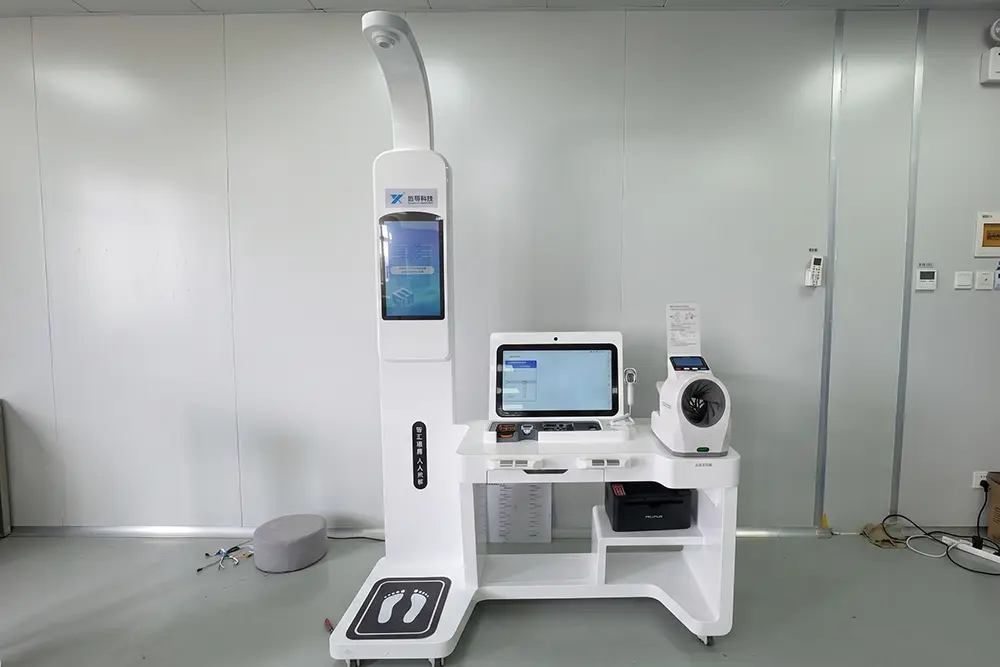
For this project, our customer needed a custom healthcare kiosk enclosure for a multi-function health screening system. The equipment was designed to integrate multiple health measurement and assessment functions into one self-service station.
We worked closely with the customer and their medical technology team to verify the functional requirements, internal component layout, enclosure structure, assembly interfaces and surface finishing requirements.
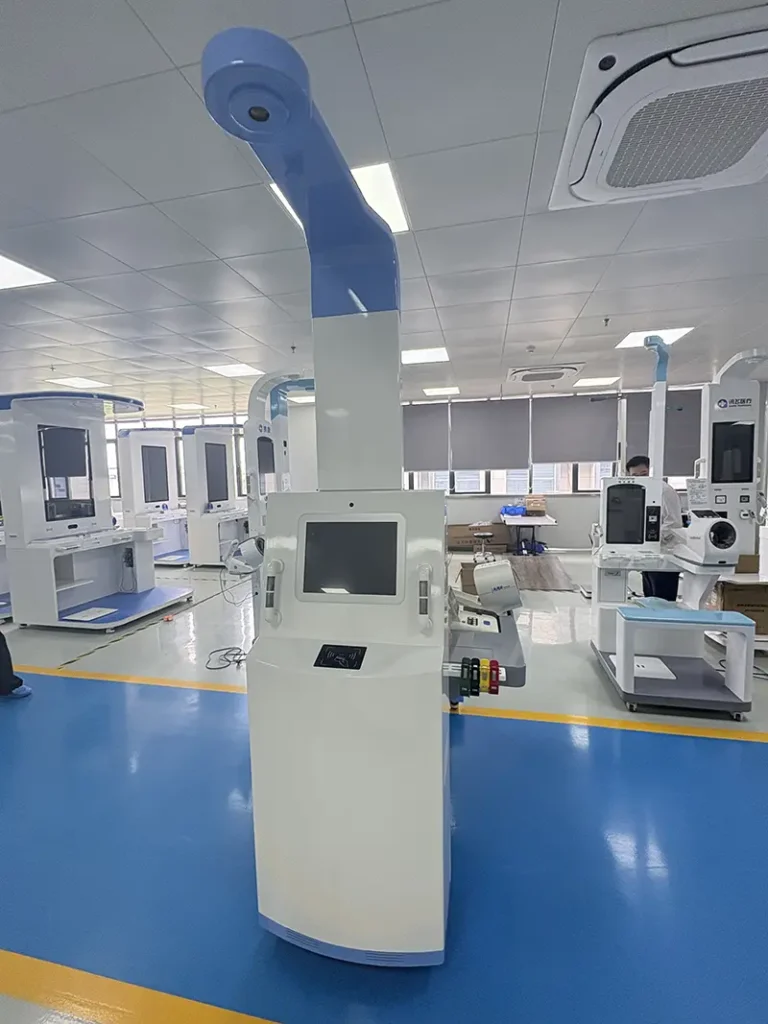
The final enclosure combines an SPCC cold-rolled sheet metal structural frame, CNC-machined ABS housing panels and a custom acrylic identification panel. After assembly, two-color painting and final inspection, the completed enclosure was delivered to the customer’s equipment factory and has been put into use.
Project Overview
This project was developed for a Chinese healthcare technology company developing an integrated health measurement and assessment system.
The customer wanted to combine multiple health measurement functions into a single healthcare screening kiosk instead of using separate devices for each measurement.
The final equipment measures and supports a wide range of health indicators and services, including:
- Height
- Weight
- BMI
- Ideal body weight
- Body fat percentage
- Protein
- Inorganic salt
- Skeletal muscle percentage
- Bone mineral content
- Body water percentage
- Total body water
- Extracellular water
- Intracellular water
- Visceral fat
- Basal metabolic rate
- Body temperature
- Blood oxygen
- ECG
- Blood pressure
- Traditional Chinese medicine constitution assessment
- Psychological assessment
- Breathing training
- Psychological guidance
- AI health assessment
- Health information query
- Electronic health records
Because so many functions had to be integrated into one machine, the enclosure needed to accommodate numerous sensors, electronic modules, a display, card reader, wiring paths and service-access areas while maintaining a clean external appearance.
What Problems Was the Healthcare Kiosk Designed to Solve?
The customer’s goal was not simply to build a measurement device. The system was designed to improve the efficiency of health screening and make routine health data easier to collect and manage.
1. Faster Self-Service Registration
The kiosk allows users to complete registration and basic information input through a self-service interface.
This can reduce manual paperwork, shorten waiting time and reduce the possibility of registration errors.
For hospitals and health screening facilities, this type of workflow can also reduce the amount of repetitive administrative work handled by front-desk staff.
2. Long-Term Chronic Disease Monitoring
Health data can be automatically stored and used to create historical trends.
When abnormal indicators are identified, the system can support alerts and follow-up workflows, making it easier to monitor changes over time.
3. Early Health Risk Screening
The system combines multiple measurements with health assessment functions to identify potentially abnormal indicators that may otherwise go unnoticed.
This provides a convenient way to perform preliminary health screening and support earlier intervention.
4. Easier-to-Understand Health Reports
Instead of presenting users with only raw measurement numbers, the system can generate personalized recommendations covering areas such as:
- Diet
- Exercise
- Sleep
- Daily routines
- Health management
This makes the measurement results easier for users to understand and act upon.
5. Electronic Health Records
Historical measurement records can be stored electronically, allowing users and healthcare organizations to access previous results and review health trends.
The system can therefore serve as a connection point between physical health measurements and digital health information.
6. Easier Access for Elderly and Mobility-Limited Users
The system can support voice-guided operation and simplified self-service workflows.
Depending on the customer’s software and deployment configuration, abnormal results can also trigger notifications to family members or support subsequent consultation and referral processes.
Healthcare Kiosk Enclosure Design Requirements
From the beginning of the project, our focus was on designing the enclosure around the actual equipment rather than treating the housing as a separate cosmetic component.
The finished machine measures approximately:
1.8 m × 0.6 m × 2.4 m
The large vertical structure had to accommodate the measurement column, operator interface, internal electrical components and multiple health screening modules.
Structural Requirements
The internal sheet metal frame needed sufficient strength to support:
- Height measurement sensor and cantilever structure
- Blood pressure module
- ECG module
- Blood glucose and blood oxygen modules
- Touchscreen
- ID card reader
- Internal electronic components
- Wiring and connectors
The main housing also required a dedicated display opening, card reader area, component mounting slots, paper outlet, ventilation openings and cable routing holes.
Because the equipment contains many different modules, each opening and mounting interface needed to be positioned according to the customer’s internal component layout.
We also reserved sufficient internal space for wiring and future maintenance.
This was particularly important because the enclosure cannot simply fit the components during initial assembly. Technicians must also be able to access the components later for inspection, replacement and maintenance.
Moving Structure and Service Access
The height measurement sensor is installed on a vertical cantilever structure.
Therefore, the enclosure could not interfere with the movement of the cantilever or the operation of the measurement module.
We also incorporated:
- Mounting provisions for the height sensor
- Removable service panels
- Internal maintenance space
- Swivel casters
- Cable routing openings
- Ventilation openings
The removable enclosure panels allow technicians to access internal circuit boards, sensors and electrical components without disassembling the entire machine.
Material Selection: ABS + SPCC Sheet Metal
For this healthcare kiosk enclosure, we used a combination of ABS and SPCC cold-rolled steel.
This combination allowed us to separate structural requirements from external appearance requirements.
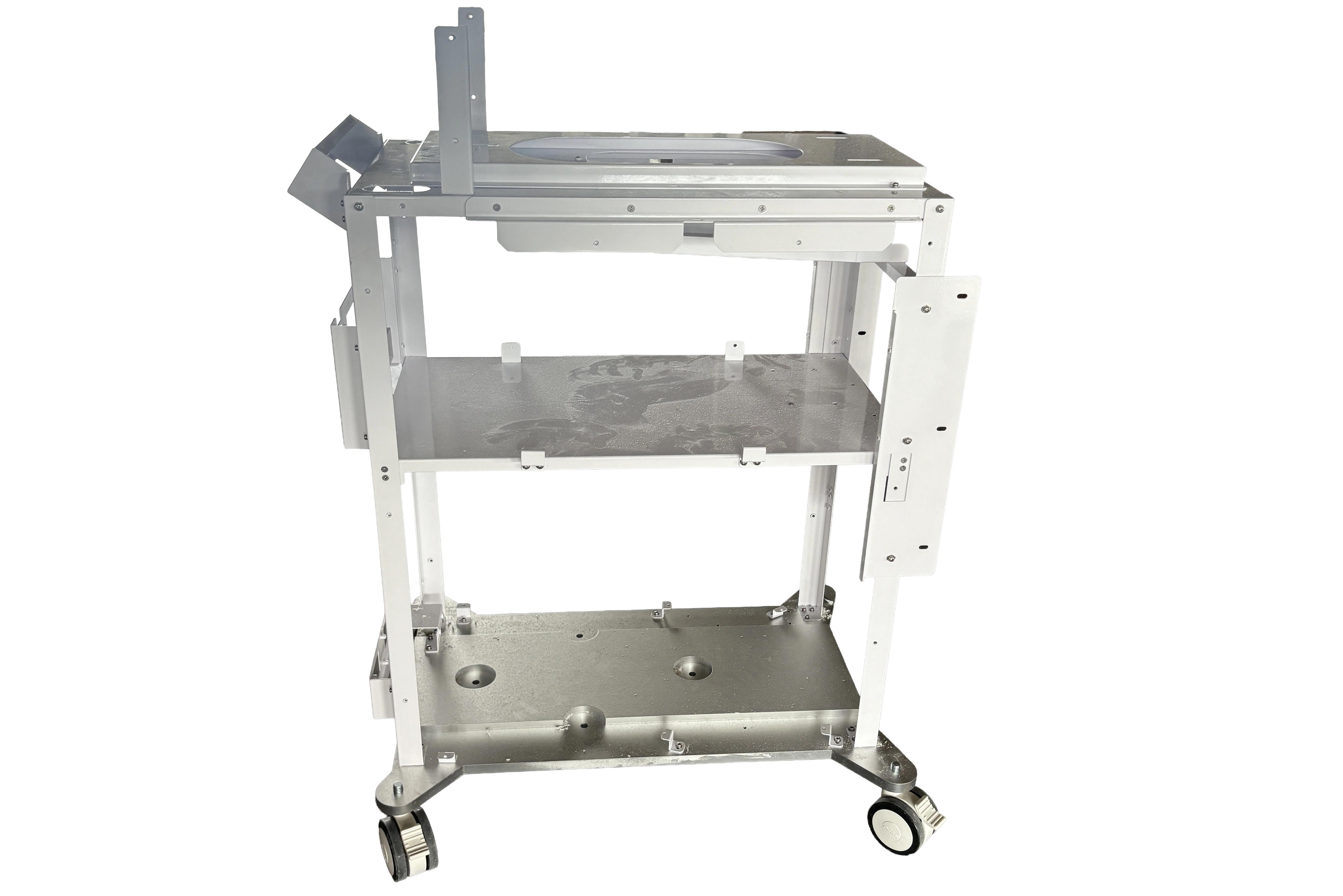
SPCC Sheet Metal Frame
The SPCC cold-rolled steel frame provides the structural support required for the large floor-standing enclosure.
It carries the load of the cantilever, measurement modules, display and internal components.
The frame was produced using:
- Laser cutting
- CNC bending
- Welding
- Weld grinding
- Structural correction
- Surface preparation
- Epoxy primer
The result is a rigid internal framework onto which the ABS exterior panels can be accurately assembled.
CNC-Machined ABS Housing
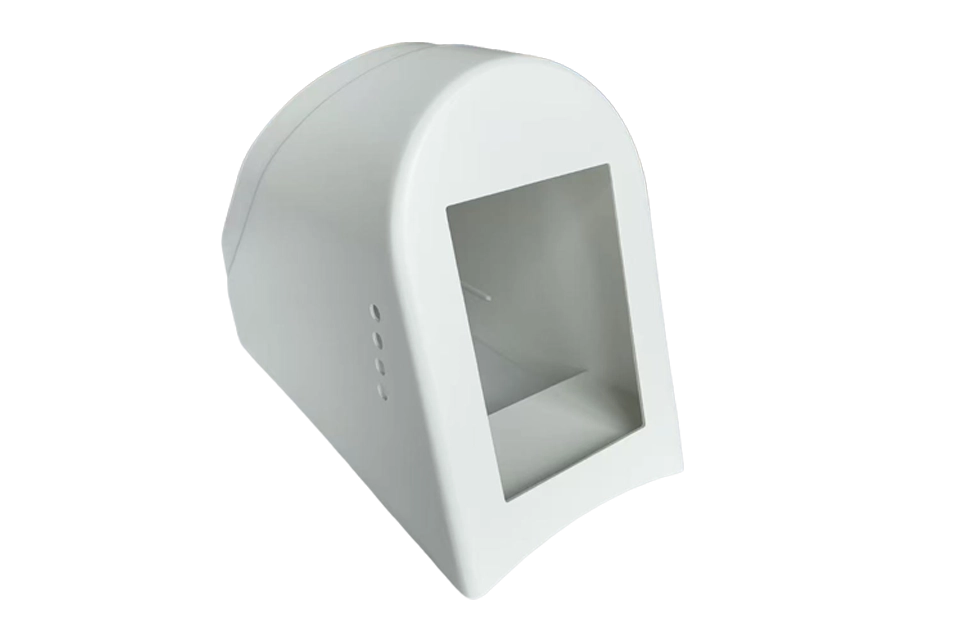
ABS was selected for the external housing because the project required a large-radius appearance, smooth curved transitions and a refined two-color finish.
The ABS panels include the:
- Main cabinet housing
- Vertical cantilever housing
- Operator console housing
- Display opening
- Sensor openings
- Component slots
- Card reader panel slot
- Ventilation openings
- Cable routing holes
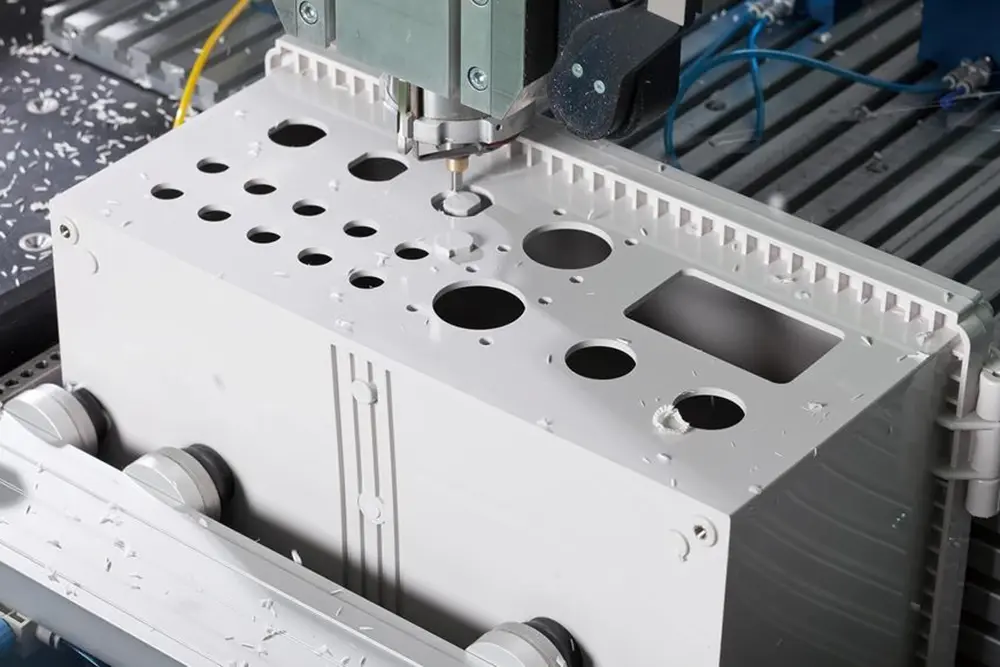
The external panels were CNC machined to achieve the required geometry and interfaces.
CNC ABS Enclosure Manufacturing Process
The ABS enclosure required more than simply cutting flat plastic sheets.
We started with ABS sheet material and machined the required external geometry and functional interfaces using CNC equipment.
The manufacturing process included:
ABS sheet cutting → CNC milling → multi-part bonding → gap filling → sanding → surface preparation → primer application → painting
The CNC machining process created the required:
- Large-radius corners
- Curved surfaces
- Display window
- Component mounting slots
- Acrylic panel slot
- Ventilation openings
- Cable holes
Because several large ABS panels needed to be joined together, we paid particular attention to the transitions between individual parts.
After bonding and filling, the surfaces were progressively sanded to remove machining marks and visible joint lines.
The objective was to create a continuous surface before painting.
Custom Acrylic Card Reader Panel
The ID card reader area required a dedicated acrylic identification panel.
The acrylic panel was:
- Cut to size
- CNC engraved with the required identification text
- Edge chamfered
- Deburred and polished
- Protected with a scratch-resistant film
- Installed after painting
We deliberately did not paint the acrylic together with the ABS housing.
This prevented overspray and paint contamination from affecting the card reader identification area.
After the enclosure was painted, the acrylic panel was installed into the dedicated slot.
The final panel needed to sit flush with the surrounding housing without lifting, looseness or visible gaps.
Two-Color Surface Finishing
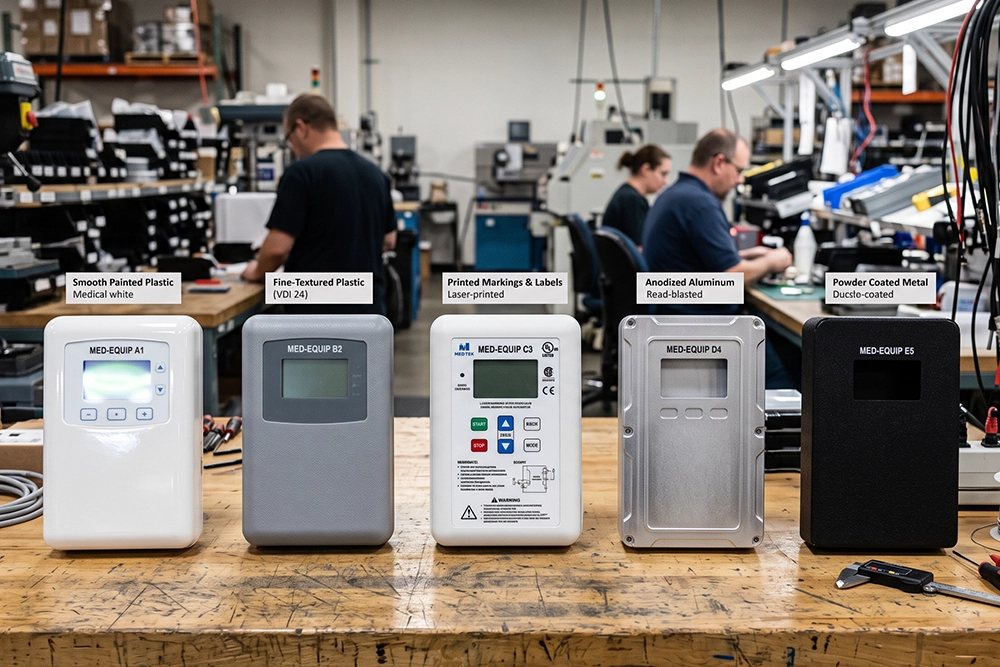
The customer specified a white and blue semi-matte finish.
For a large healthcare equipment enclosure, color consistency and edge definition are particularly important because the housing occupies a large visible area.
Our finishing process included:
- Surface preparation
- ABS-specific primer
- Primer sanding
- Masking
- White topcoat
- Blue topcoat
- Low-temperature oven curing
- Cooling
- Masking removal
- Local touch-up
- Final inspection
The masking process was carefully controlled to ensure that the white and blue sections had clean boundaries without:
- Color bleeding
- Overspray
- Uneven edges
- Paint buildup
- Exposed substrate
The low-temperature curing process also helped reduce the risk of heat-related deformation of the ABS panels.
Assembly Requirements for the Healthcare Kiosk Enclosure
The enclosure was designed as a combination of separate structural and external components.
The main assembly included:
- SPCC internal frame
- Main ABS housing
- Vertical cantilever housing
- Operator console housing
- Acrylic card reader panel
- Casters
- Internal mounting components
The ABS panels needed to align accurately with the mounting holes on the sheet metal frame.
We controlled the assembly interfaces carefully to avoid forced installation.
The main requirements included:
- Accurate hole alignment
- Consistent panel gaps
- No housing deformation
- Secure fasteners
- Accurate display opening alignment
- Accurate sensor slot positioning
- Flush acrylic panel installation
- Smooth cantilever movement
- Stable overall structure
The cantilever was checked after assembly to ensure that the housing did not interfere with its movement.
Appearance Quality Control
Because the healthcare kiosk is installed in a user-facing environment, appearance quality was one of the key project requirements.
The customer required:
- Smooth large-radius corners
- Consistent curved transitions
- Uniform panel gaps
- No dents
- No scratches
- No visible impact marks
- No warping
- No excessive paint accumulation
- No exposed substrate
- No visible sanding defects
- No paint bubbles
- No pinholes
- No orange peel
- Clear identification markings
The external shape was manufactured according to the customer’s approved 3D drawings.
We also prepared the housing for silk-screened logos and functional markings.
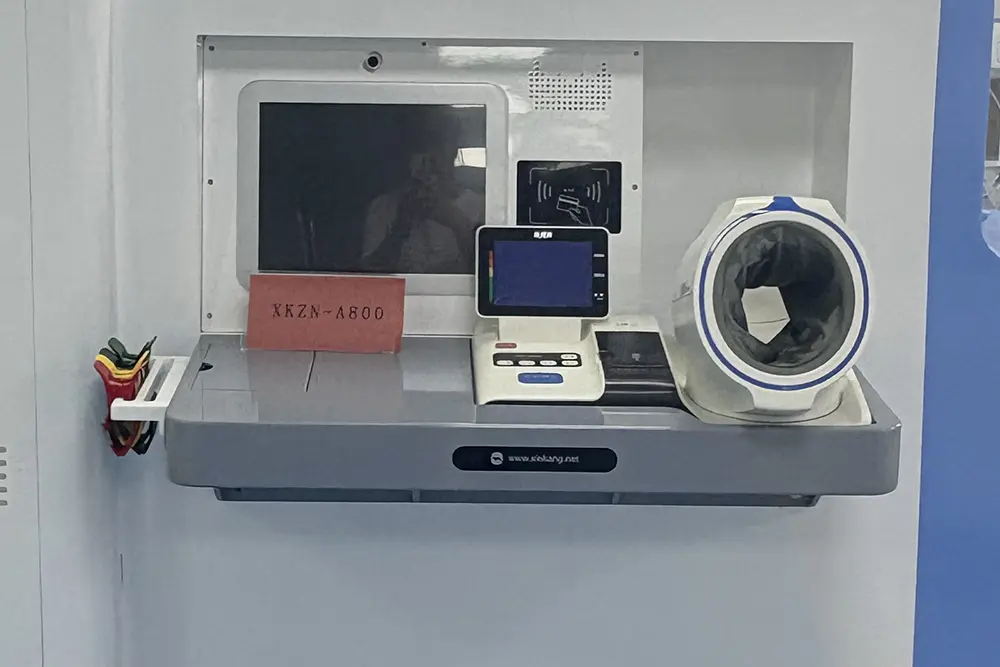
Our Manufacturing Process
The complete manufacturing route for this custom healthcare kiosk enclosure was:
SPCC sheet metal frame fabrication → ABS CNC machining → ABS panel bonding and finishing → Acrylic card reader panel machining → Assembly → Two-color painting → Acrylic panel installation → Final inspection
Step 1: SPCC Structural Frame
We laser cut the SPCC sheet metal, formed the structural components using CNC bending and welded the frame and reinforcement structures.
The welded areas were then ground and the frame was corrected to control deformation.
After cleaning and surface preparation, epoxy primer was applied to improve corrosion resistance and topcoat adhesion.
Step 2: CNC ABS Housing
The ABS sheets were cut and CNC machined according to the approved geometry.
The main housing, cantilever column and operator console were manufactured as multiple components and then bonded together.
The joints were filled and repaired before multi-stage sanding.
Step 3: Surface Preparation
The ABS housing was sanded to remove CNC machining marks and visible joint transitions.
Multiple coats of ABS-compatible primer were applied and sanded to create a dense, smooth surface suitable for final painting.
Step 4: Two-Color Painting
The prepared housing entered a controlled spray-painting environment.
The white and blue areas were masked separately before applying the two-color finish.
After low-temperature curing, the masking was removed and the painted surfaces were inspected.
Step 5: Final Assembly
The finished ABS housing was installed onto the SPCC frame.
The main cabinet, vertical column and operator console were assembled and adjusted.
Casters were installed for mobility, and the acrylic card reader panel was fitted after painting.
Step 6: Final Inspection
Before delivery, we inspected:
- Overall dimensions
- Component openings
- Mounting holes
- Panel alignment
- Panel gaps
- Acrylic panel fit
- Surface finish
- Color separation
- Structural stability
- Cantilever movement
- Assembly quality
What We Helped the Customer Achieve
The final healthcare kiosk enclosure transformed a complex collection of measurement modules into one integrated healthcare equipment platform.
Instead of designing separate housings for individual devices, the customer received an enclosure capable of integrating multiple measurement and interaction functions into one system.
From the enclosure manufacturing perspective, our work helped the customer achieve:
Integrated Equipment Architecture
Multiple measurement modules, sensors, display components and identification interfaces were organized into one enclosure.
Structural Support
The SPCC internal frame provides the required structural support for the large floor-standing equipment.
Precise Component Integration
CNC-machined openings and mounting interfaces were developed around the customer’s actual internal components.
Better Serviceability
Removable panels, cable routing space and internal access areas make future maintenance easier.
Professional Healthcare Appearance
The combination of large-radius ABS housing, white and blue semi-matte finishing and integrated acrylic identification panels creates a clean appearance suitable for healthcare and public-facing environments.
Production-Ready Delivery
The complete housing was processed, assembled, painted, inspected and delivered to the customer’s equipment factory.
The customer subsequently integrated the enclosure with the complete health screening system and put the finished equipment into use.
Where Can This Healthcare Kiosk Be Used?
The customer’s healthcare screening equipment can be deployed in a variety of health measurement and assessment environments, including:
- Hospitals
- Clinics
- Health examination centers
- Schools
- Community health centers
- Health management centers
- Elderly care centers
- Wellness facilities
- Fitness centers
- Beauty and wellness facilities
- Public health screening locations
- Community health kiosks
The specific deployment configuration depends on the customer’s equipment functions, software system and target environment.
Why Healthcare Kiosk Enclosure Design Matters
A healthcare kiosk enclosure is not simply an outer shell.
It is the interface between the internal technology and the person using the equipment.
The enclosure must simultaneously consider:
Structural strength + component integration + human interaction + maintenance + ventilation + cable routing + appearance + manufacturing feasibility
For large healthcare kiosks, these requirements become more complex because the enclosure can contain many independent measurement modules.
Our approach is therefore to review the enclosure from the inside out.
We first understand the customer’s internal components and functional requirements, then evaluate:
- Component positions
- Mounting interfaces
- Structural support
- Display openings
- Sensor positions
- Cable routing
- Ventilation
- Maintenance access
- Panel assembly
- Surface finishing
- Manufacturing process
This helps reduce problems that could otherwise appear during final assembly.
From Customer Requirements to a Production-Ready Enclosure
This project demonstrates how we approach complex custom medical enclosure projects at Zhongrongda.
The customer did not simply provide a request for an attractive healthcare kiosk housing.
They needed an enclosure that could support a complete multi-function health screening system.
Our engineering and manufacturing team worked through the requirements with the customer, verified the structure and interfaces, selected the appropriate combination of SPCC sheet metal and ABS, manufactured the prototype enclosure, completed the surface finishing and assembly, and delivered the final housing to the equipment manufacturer.
The finished healthcare kiosk enclosure has now entered actual use.
For medical equipment manufacturers developing health screening kiosks, diagnostic stations or other large healthcare equipment, we can support projects from enclosure requirements and DFM review through prototype manufacturing, finishing, assembly and production.
If you are developing a healthcare kiosk enclosure and already have 3D drawings, 2D drawings or an internal component layout, send your project requirements to our engineering team for a manufacturing review.
FAQ 1
What is a healthcare kiosk enclosure?
A healthcare kiosk enclosure is the protective and structural housing used to integrate medical sensors, displays, control electronics, card readers and other components into a self-service healthcare screening system. A custom enclosure can be designed around the equipment’s internal components, mounting requirements, cable routing, ventilation and maintenance access.
FAQ 2
What materials are commonly used for healthcare kiosk enclosures?
Healthcare kiosk enclosures can use materials such as ABS, PC, PC-ABS, sheet metal and acrylic depending on the structural, appearance and application requirements. For this project, we used a combination of CNC-machined ABS panels and an SPCC cold-rolled steel internal frame.
FAQ 3
Can a healthcare kiosk enclosure integrate multiple medical measurement modules?
Yes. A custom healthcare kiosk enclosure can be designed around multiple sensors and modules, including blood pressure, ECG, blood oxygen, temperature, weight and height measurement systems. The enclosure structure should be developed around the actual component layout and movement requirements.
FAQ 4
Can you manufacture a healthcare kiosk enclosure from 3D drawings?
Yes. We can develop the enclosure around customer-provided 3D models, 2D drawings and internal component layouts. Our engineering team can review mounting interfaces, panel structure, cable routing, ventilation, assembly and manufacturing requirements before production.
FAQ 5
Can ABS be used for large healthcare equipment enclosures?
Yes. ABS can be suitable for large healthcare equipment housings when the design requires complex curves, smooth surfaces and a refined appearance. For larger floor-standing equipment, ABS can also be combined with a sheet metal structural frame to provide additional mechanical support.
FAQ 6
Do you provide healthcare kiosk enclosure prototyping?
Yes. Zhongrongda supports medical enclosure prototyping, including CNC-machined ABS housings, sheet metal structures, surface finishing and assembly. Prototype manufacturing allows the customer to verify component fit, appearance, assembly and functionality before moving toward production.
FAQ 7
Can you provide custom painting and finishing for healthcare kiosk enclosures?
Yes. We can support custom finishing requirements including primer application, sanding, two-color painting, semi-matte finishes, logo printing and acrylic identification panels. The finishing process can be developed according to the customer’s appearance specifications.
FAQ 8
How do you ensure components fit accurately inside a healthcare kiosk enclosure?
We develop the enclosure around the customer’s internal components and approved 3D/2D design data. Mounting holes, display openings, sensor positions, cable routing holes and service panels are manufactured according to the required interfaces and checked during final assembly.