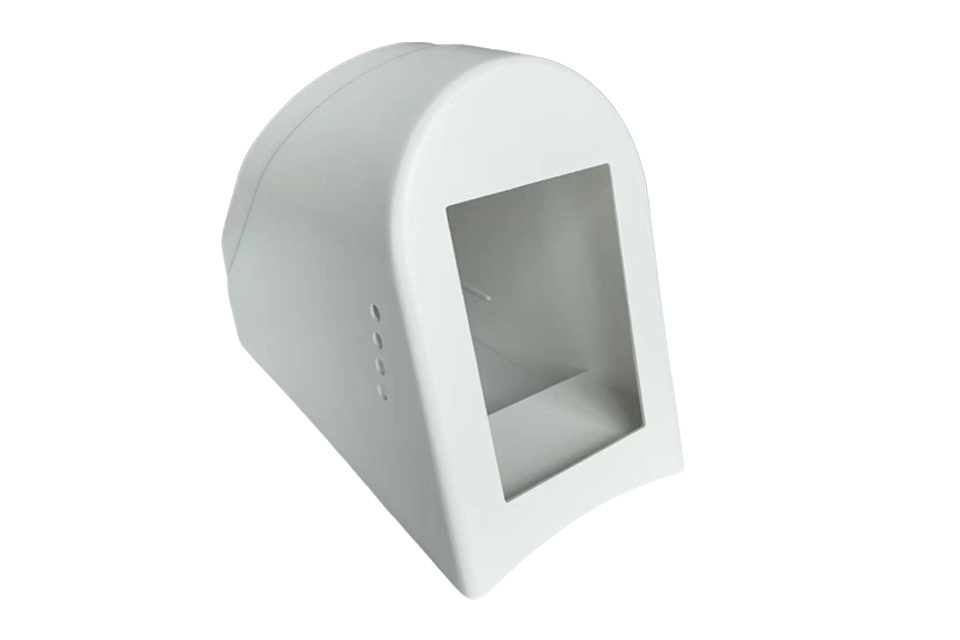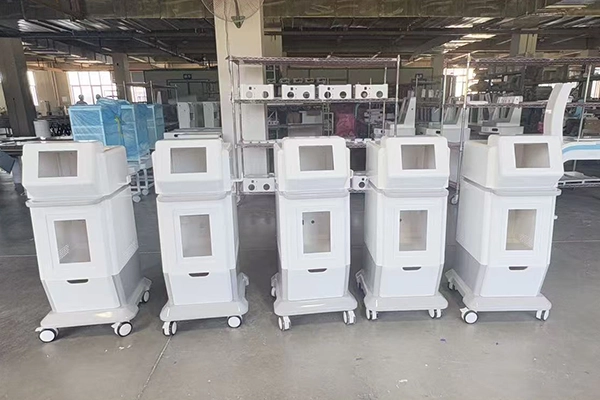
An eye-wave analyzer trolley must combine a professional medical appearance with practical serviceability and stable mobility. The enclosure protects the power supply, water tank, and main control board while presenting an angled screen for operation and a dedicated compartment for treatment-handle accessories. For this small-batch project, Hubei ZRD Intelligent Technology Co., Ltd. developed a multi-section ABS trolley housing measuring 420 x 450 x 105 mm. The approved design has now entered mass production.
Project Overview
| Project field | Specification |
|---|---|
| Product | Eye-wave analyzer trolley housing |
| Application | Mobile ophthalmic / beauty therapy equipment |
| Quantity | Small batch; released to mass production |
| Material | ABS |
| Dimensions | 420 mm L x 450 mm W x 105 mm H |
| Internal contents | Power supply, water tank, main control circuit board, wiring |
| Critical tolerances | Display window ±0.2 mm; accessory window accuracy; uniform multi-section seams; caster-hole accuracy |
| Exterior design | Matte white upper body, light-gray base and waistline, layered two-tone styling |
| Features | Angled display opening, accessory compartment, side louvered vents, storage tray, quiet casters |
| Manufacturing route |
Customer Requirements
The customer requested a layered medical-aesthetic appearance. The upper body uses a matte white ABS shell, while the base and waistline use light gray for a restrained color transition. A sloped display platform places the operation screen at a practical viewing angle. A circular side storage tray holds treatment handles and consumables, and generous radii create a smooth, approachable silhouette.
Functionally, the top needs a precise display-screen opening, while the middle section includes a fitted storage bay for treatment handles. Side louvered vents provide cooling for internal electronics. The lower section carries quiet swivel casters for movement between consultation and treatment rooms. Multiple internal cavities reserve space for the water tank, power components, main PCB, and cable routing. The segmented shell must detach easily for maintenance and assemble around the metal frame without interference.
Manufacturing Challenges
The angled display area combines a curved exterior with a precise rectangular opening. Any distortion or uneven transition would be visible around the screen and could prevent flush installation. The shell was divided into several sections, so seam width and color boundaries had to remain small, consistent, and visually balanced across the complete trolley.
The upright enclosure also required sufficient rigidity for long-term use without side bending. Ventilation openings had to form a clean, regular louver array without burrs or broken edges. Finally, the base and caster layout needed balanced loading so the trolley would roll smoothly and resist tipping during direction changes.
Our Engineering Solution
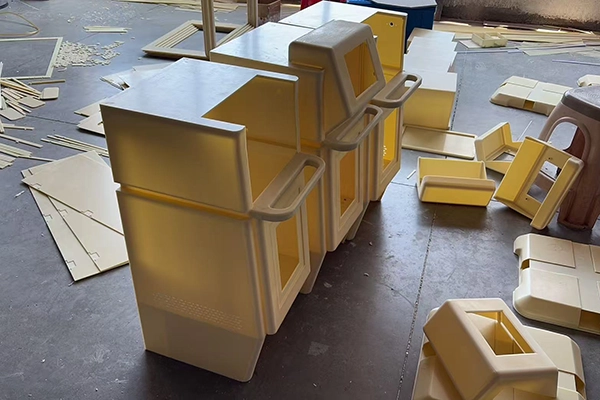
Zhongrongda reviewed the 3D layout, screen module, metal-frame envelope, center of gravity, and service path before fabrication. We established datums for the angled display opening, accessory window, section joints, vent array, and caster mounting points. ABS hand-built panels were bonded over supportive forms, then blended to create the large-radius body and smooth sloped screen surface.
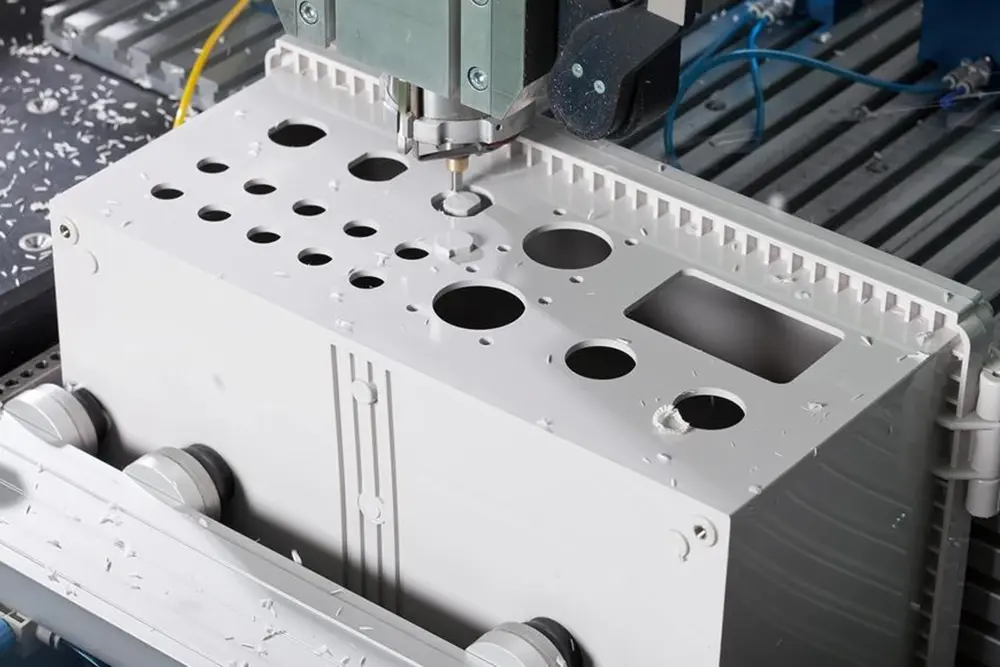
The display and accessory windows were CNC finished after bonding so their dimensions could be held independently from the outer shell contour. Dedicated templates and assembly fixtures controlled the multi-section seam and the white-to-gray transition. Internal reinforcement and mounting features were positioned around the metal chassis to improve stiffness while keeping water-tank and wiring clearances. Louvered vents were machined with consistent spacing and fully deburred before coating.
Manufacturing Process
- Review 2D/3D data, screen dimensions, internal frame, service access, and critical datums.
- Prepare ABS hand-built panels and supportive forming fixtures.
- Bond and align the shell sections to create the angled display surface, accessory bay, base, and waistline.
- CNC machine the display window, accessory window, louvered cooling vents, and mounting features.
- Fit internal reinforcement, inspection openings, and cable-routing passages.
- Trial assemble the segmented shell around the metal frame; correct interference and seam variation.
- Progressively sand and blend curved transitions, joints, and sloped faces.
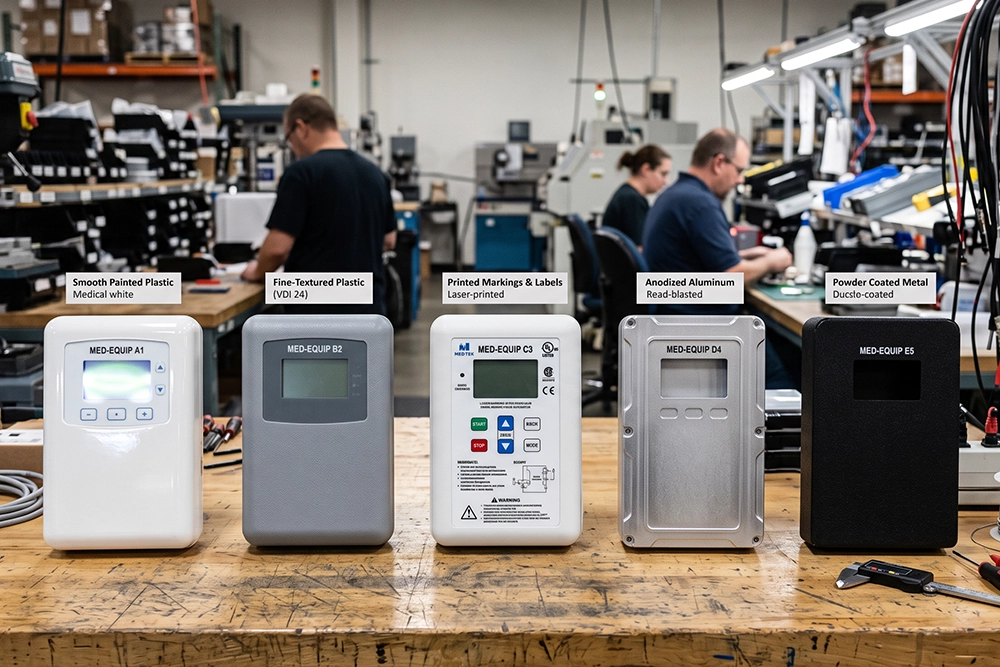
- Apply ABS primer, matte white and light-gray baked paint, and optional screen-printed logo.
- Install the storage tray and quiet swivel casters.
- Inspect dimensions, appearance, rolling stability, screen fit, accessory fit, and final assembly.
Quality Control and Final Results
Calipers, depth gauges, profile templates, hole gauges, and dedicated assembly fixtures verify the finished trolley. First-article inspection focuses on the upper display window at ±0.2 mm, the middle accessory window, section-to-section seam uniformity, vent-array spacing, and caster mounting-hole accuracy. Visual inspection checks the matte paint, white-to-gray color transition, radiused surfaces, logo clarity, scratches, pinholes, and sanding marks.
Functional assembly confirms that the display sits flush in the angled opening, treatment handles fit the middle compartment, the shell clears the internal metal frame, and service sections can be removed without damaging wiring. Rolling tests verify smooth caster movement, balanced loading, brake operation, and resistance to tipping. The approved ABS trolley housing is now in mass production.
Why Choose ZRD
ZRD coordinates ABS hand-built prototyping, CNC secondary machining, enclosure finishing, screen printing, fixtures, and assembly inspection in one workflow. We support DFM review, prototypes, small-batch builds, and repeat production for ophthalmic, beauty, and therapy equipment. NDA protection, inspection records, logo printing, and documentation aligned with ISO 9001 or ISO 13485 workflows can be arranged where applicable.
FAQ
Can you make a smooth curved housing around an angled display?
Yes. Supportive forms, bonded ABS panels, CNC window finishing, and progressive sanding are used to create a smooth, distortion-free screen surround.
Can the display opening hold ±0.2 mm?
Yes. The opening is CNC finished after shell bonding and verified with calibrated gauges or dedicated fixtures.
How do you control seams on a multi-section shell?
Locating features, trial assembly, and fixtures control the mating sections so the seam remains small and uniform across the white and gray areas.
How are the louvered vents finished?
Vent arrays are machined to a controlled pattern, deburred, and visually inspected for consistent spacing and clean edges.
Can the shell be removed for maintenance?
Yes. Segmented panels, inspection access, and cable passages are designed for convenient service around the internal metal frame.
Can you add our brand logo?
Yes. Customer logos can be screen printed after the matte paint and color transition are approved.
Is the trolley stable during movement?
The base and caster pattern are checked for balanced loading, smooth rolling, brake function, and resistance to tipping.
Do you support small batches and mass production?
Yes. We can validate the enclosure in small batches and continue with repeat mass production after approval.
What is needed for quotation?
Please send 2D/3D drawings, screen and accessory dimensions, metal-frame data, final quantity, finish targets, tolerance requirements, and caster specifications.
CTA
Need a reliable partner for an ABS eye-wave analyzer trolley housing? Send your drawings and quantity for a free DFM review and quotation. ZRD can help validate curved display fit, section seams, ventilation, frame clearance, caster stability, and medical-device appearance before production.