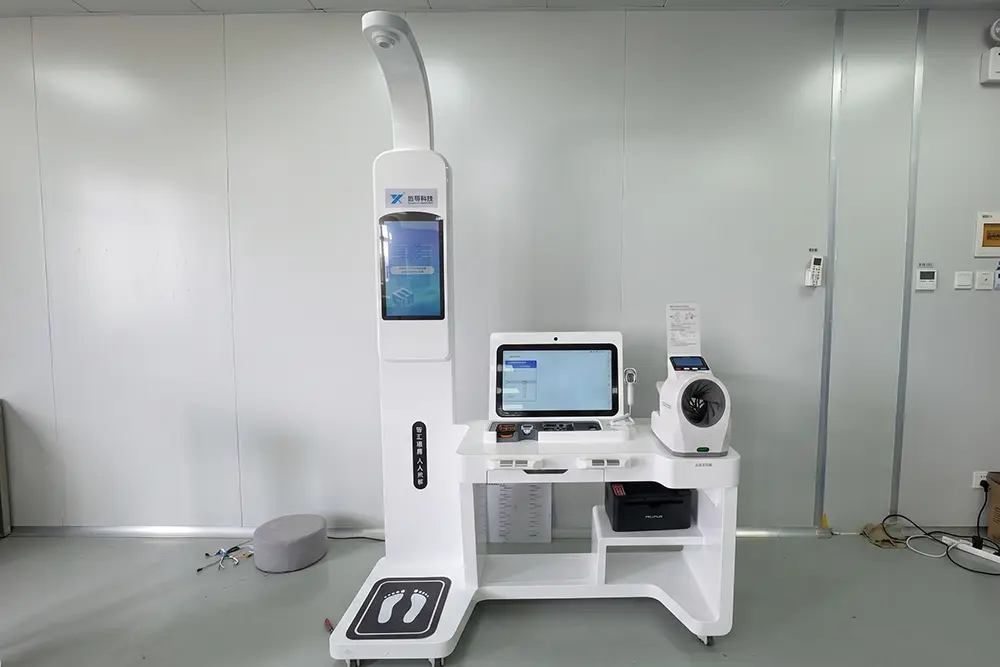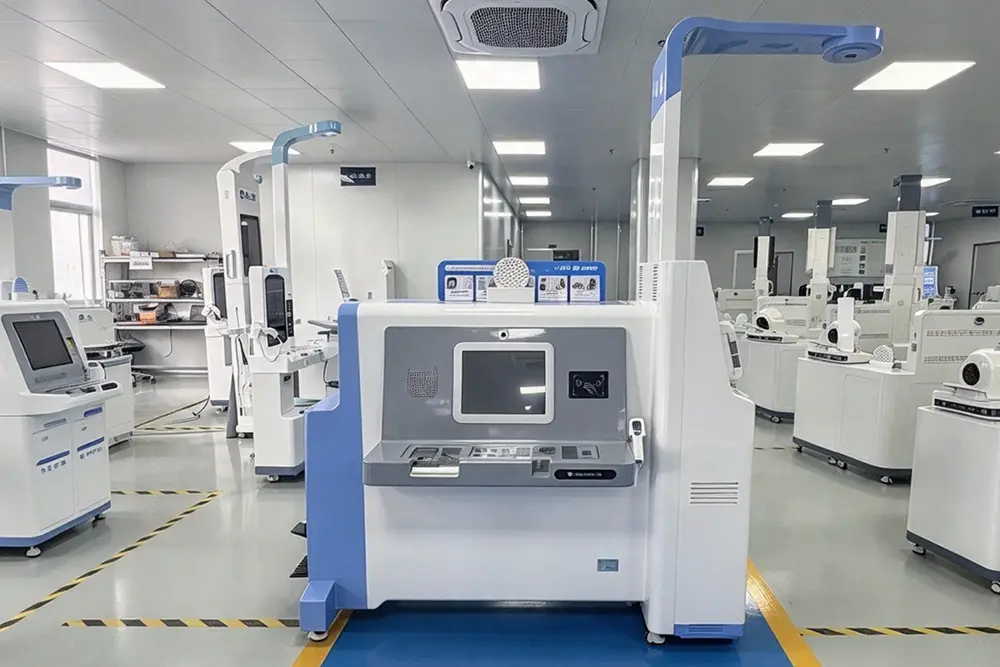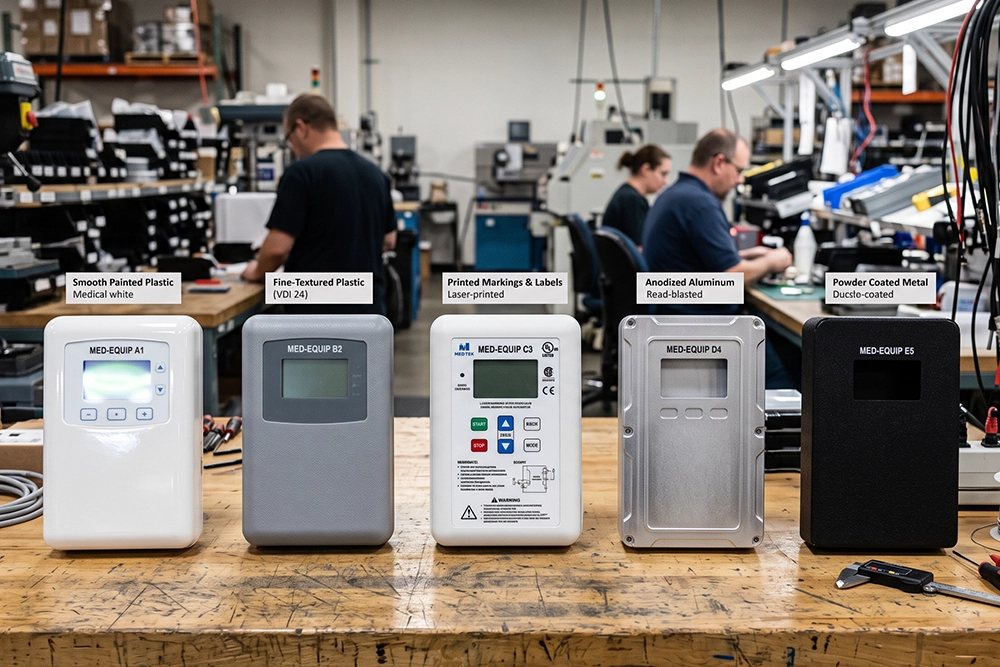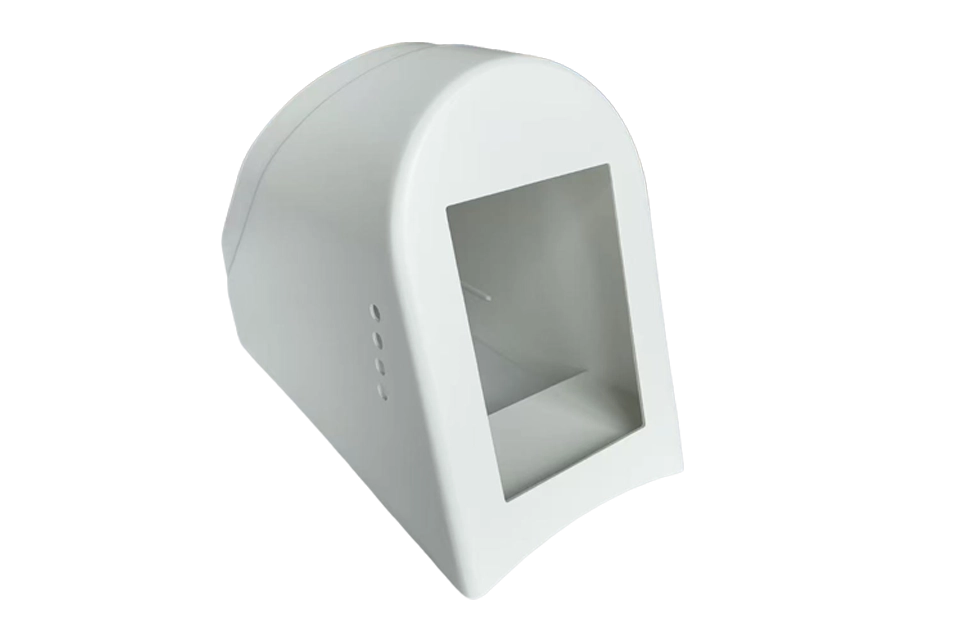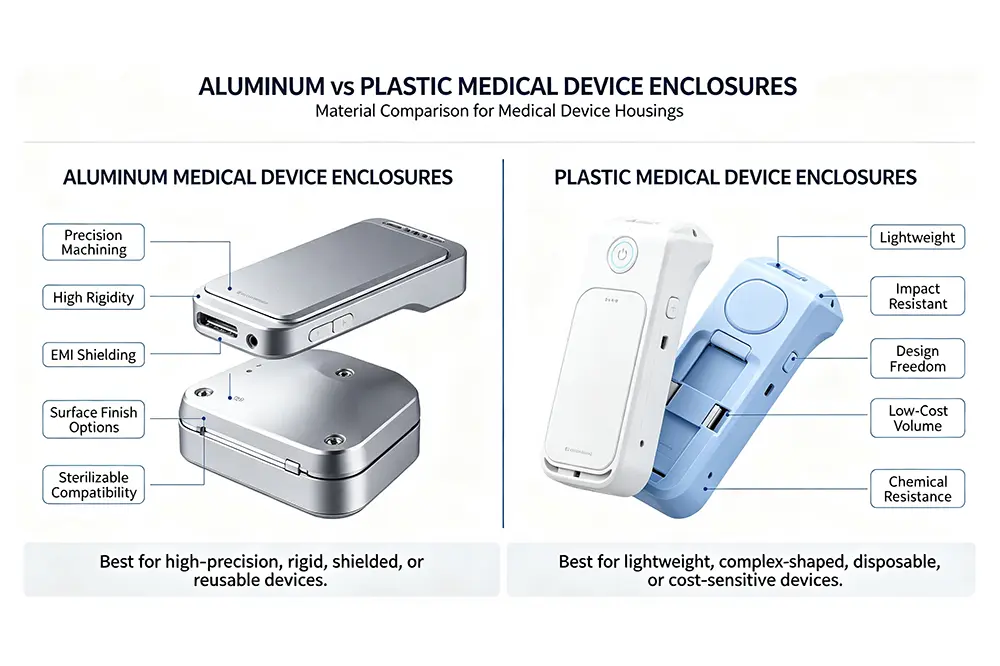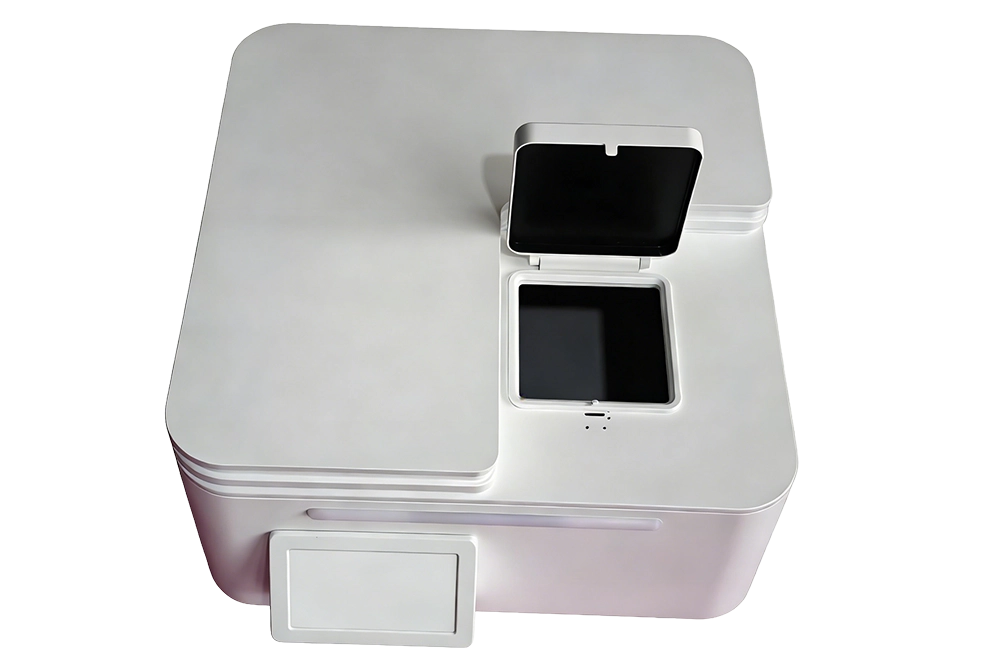
A diagnostic instrument enclosure needs to do more than protect internal electronics. It must provide accurate openings, reliable assembly interfaces, adequate maintenance access, controlled heat dissipation, and a finished appearance suitable for equipment used in professional medical and laboratory environments.
we recently completed a small-batch diagnostic equipment enclosure project for a medical testing instrument used in hospital laboratories and third-party medical testing facilities. The equipment performs sample loading, reagent reaction, and optical detection analysis, so the enclosure had to accommodate several functional modules while maintaining a clean external appearance.
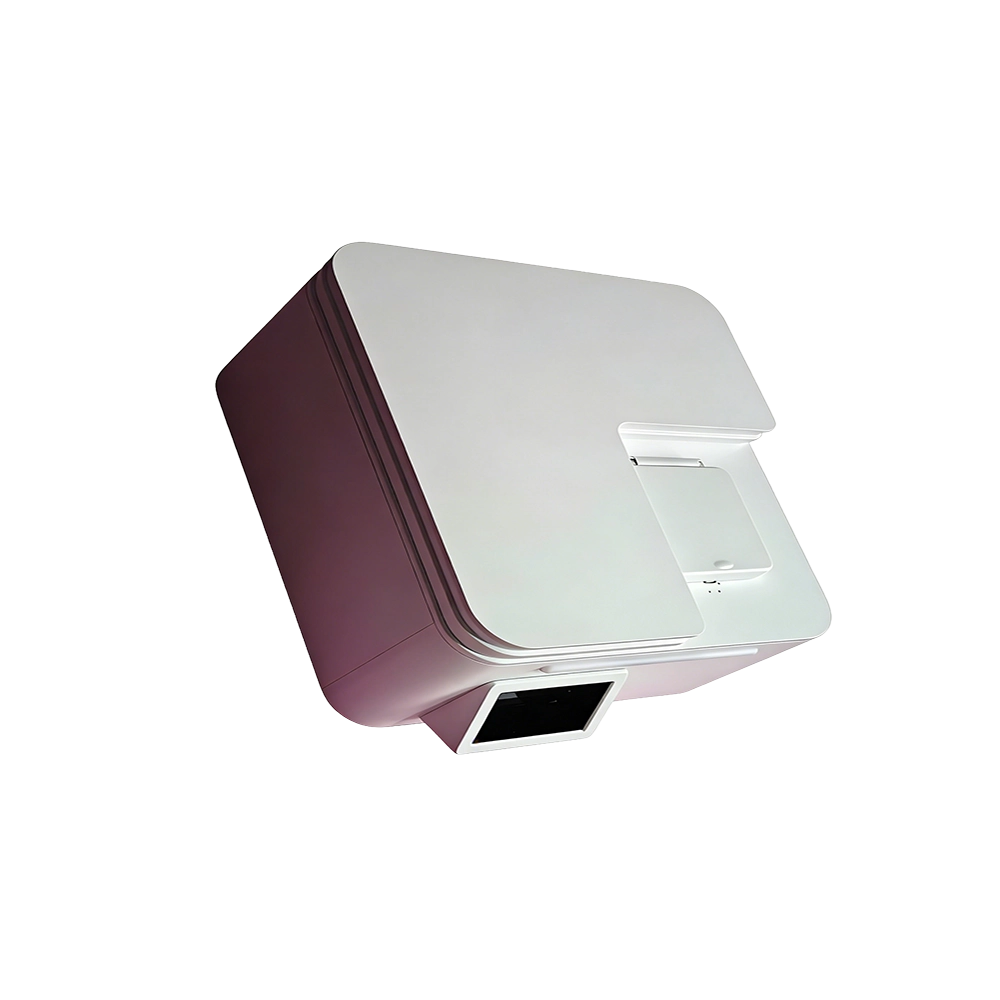
The project combined three different manufacturing approaches: an SPCC cold-rolled sheet metal frame for the main structural support, CNC-machined ABS sheet components for the external housing, and SLA photosensitive resin 3D printing for the sample-loading cover.
Our engineering team handled the process from component preparation and CNC machining through bonding, surface finishing, assembly, and final inspection. The result was a completed enclosure assembly delivered to the equipment manufacturer for prototype validation.
Project Overview
| Project Item | Specification |
|---|---|
| Industry | Medical / Laboratory Equipment |
| Application | Diagnostic analysis instrument |
| Country | Not disclosed |
| Main Housing Material | ABS sheet |
| Structural Frame | SPCC cold-rolled steel |
| Sample Cover | SLA photosensitive resin |
| Dimensions | Based on customer 3D drawings; specific dimensions not disclosed |
| Key Tolerance | Defined according to functional interfaces and customer drawings; specific values not disclosed |
| Surface Finish | White fine-texture coating |
| Manufacturing Process | Sheet metal fabrication + ABS CNC machining + SLA 3D printing + assembly + painting |
| Quantity | Small batch for prototyping and validation |
| Lead Time | Project-specific; exact lead time not disclosed |
| Production Stage | Prototype / small-batch validation |
Customer Requirements
The customer needed a housing system capable of protecting and supporting the internal components of a diagnostic analysis instrument.
The internal SPCC sheet metal frame was designed to carry the primary load of the equipment. It supports the optical detection module, sample cover mechanism, mainboard, power components, and other internal assemblies.
The ABS housing had a different purpose. It was designed as a quick-release protective cover rather than a primary load-bearing structure. This distinction was important during engineering because the external housing needed sufficient rigidity and dimensional stability without unnecessarily increasing the structural requirements of the plastic components.
The enclosure also required several functional interfaces, including:
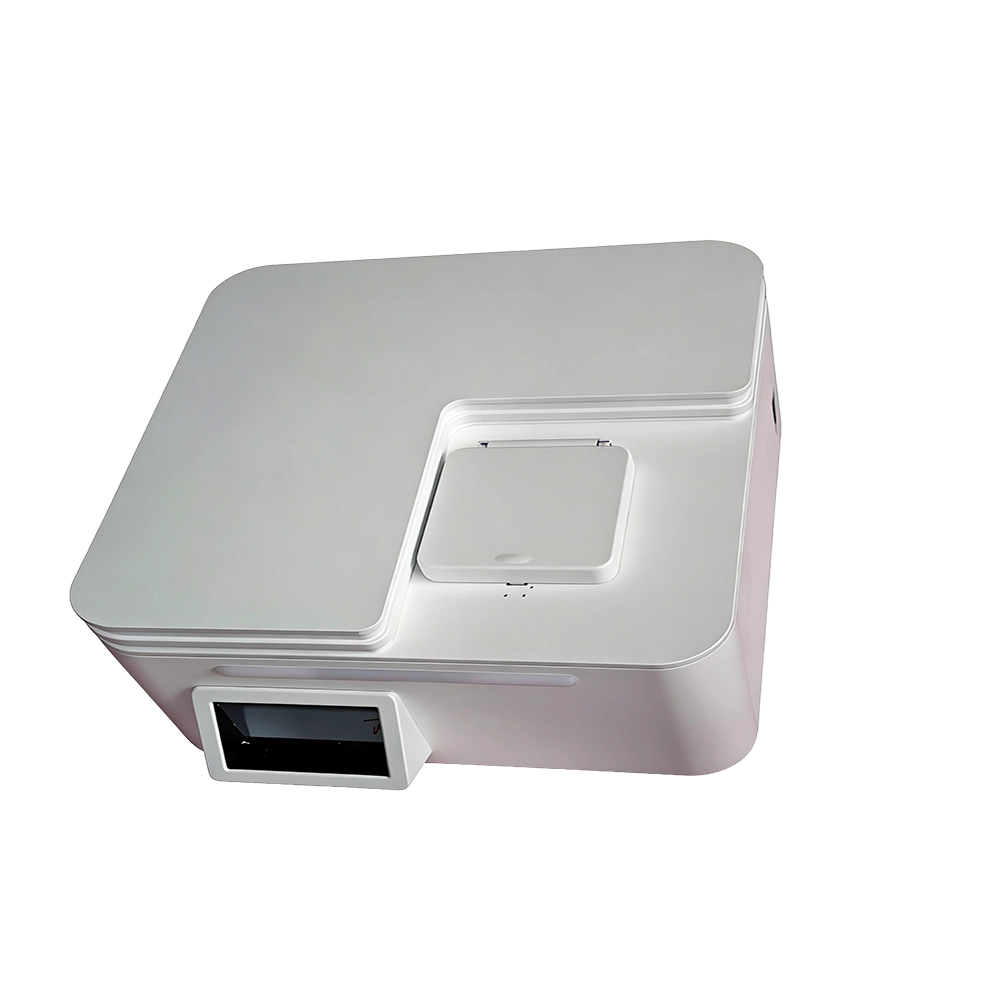
- An embedded display installation opening
- A sample-cover assembly position
- Cooling vents
- Cable routing holes
- Internal cavities matching the customer’s components
- Adequate maintenance and wiring space
- Quick-release access to internal components
The sample cover was manufactured using SLA 3D printing and had to work together with a hinge mechanism. Its movement path needed to remain clear of the surrounding enclosure.
From an appearance perspective, the customer required a predominantly white housing with clean color boundaries and a fine-textured painted finish. Large-radius corners and multiple stepped curved surfaces had to transition smoothly.
The final enclosure also required screen printing for the company logo and equipment function markings.
Manufacturing Challenges
1. Controlling a Long Dimensional Chain
The ABS housing consisted of multiple CNC-machined components that were bonded and assembled together. Because the final enclosure depended on several individual components, accumulated dimensional variation could affect the overall fit.
Our engineering team therefore treated the housing as an assembly rather than simply machining each component independently.
The positioning of mounting holes, quick-release interfaces, stepped surfaces, and adjoining components had to be considered together.
2. Large ABS Surfaces and Warpage
Large flat ABS components can become difficult to control during machining and finishing. In this project, maintaining the shape of the housing was especially important because the customer required smooth large-radius surfaces and consistent gaps between assembled parts.
The risk did not end after CNC machining. Filling, sanding, primer application, painting, and curing could also affect the final appearance and dimensional stability.
3. Quick-Release Structure
The housing needed to be removable without complicated tools so that technicians could access the optical module, circuit boards, and transmission mechanism.
The quick-release positioning structure therefore had to balance two requirements: sufficiently secure positioning during normal operation and smooth removal during maintenance.
4. SLA Sample Cover
The SLA-printed sample cover had to provide a clean visual surface while maintaining appropriate clearance around the hinge.
The printed layer texture therefore needed to be removed through post-processing before primer and painting. At the same time, the hinge interface required enough dimensional control to prevent excessive movement or interference.
5. Multi-Material Finishing
The project combined SPCC steel, ABS, and photosensitive resin.
Each material required appropriate surface preparation and primer treatment before the final coating. Consistent appearance across different substrates was therefore an important manufacturing consideration.
Our Engineering Solution
At Zhongrongda, we approached this project as a complete enclosure assembly rather than three unrelated manufacturing processes.
DFM and Process Planning
Our engineering team reviewed the customer’s 3D design and separated the product into three main manufacturing groups:
- SPCC structural frame
- CNC-machined ABS housing
- SLA-printed sample cover
This allowed each material to use an appropriate manufacturing process while keeping the interfaces between components under control.
Sheet Metal Structural Frame
The SPCC frame was produced through laser cutting, CNC bending, welding, grinding, and dimensional correction.
After welding, the frame was checked and corrected to reduce deformation. The surface was then degreased and derusted before epoxy primer was applied.
This created the structural foundation for the internal equipment.
CNC-Machined ABS Housing
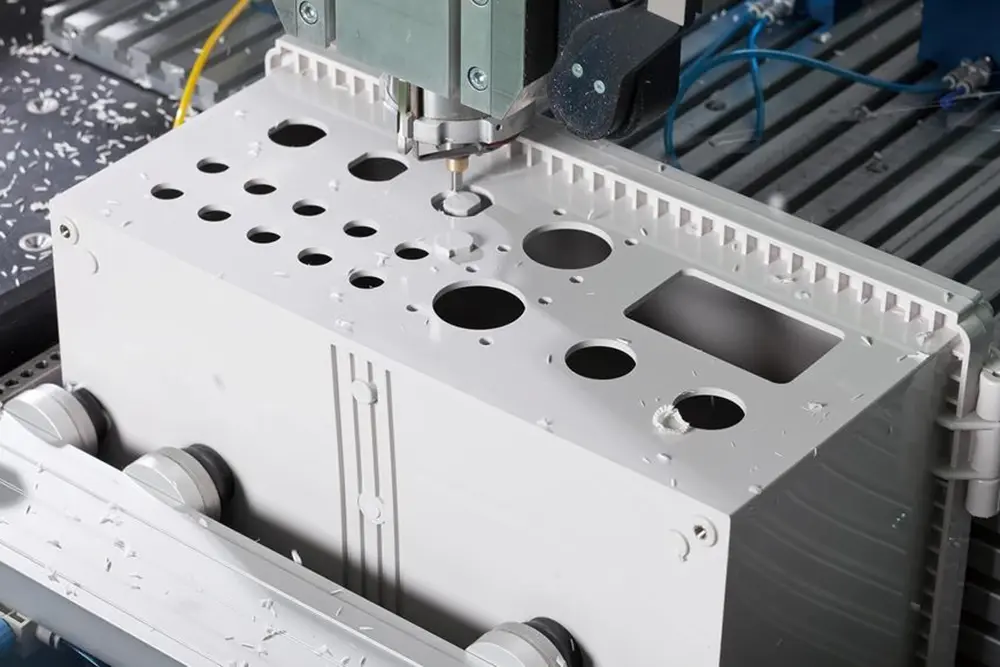
ABS sheet was cut into individual components and CNC machined to create the external housing geometry.
The process included machining:
- Outer contours
- Stepped surfaces
- Rounded corners
- Installation openings
- Mounting posts
- Cable holes
- Quick-release positioning structures
After machining, the individual components were bonded together. The joints were filled, repaired, and sanded to remove visible machining and bonding marks.
SLA Sample Cover
The sample cover was produced using SLA photosensitive resin.
After printing, the support structures were removed and the surface was sanded to reduce visible printing layers and edge defects. Primer filling and additional sanding were then used to prepare the component for painting.
Dimensional and Assembly Control
Special attention was given to the display opening, sample cover interface, hinge position, mounting holes, and quick-release structure.
Before final finishing, the components were assembled to verify alignment and movement. This helped identify potential interference before the final coating process.
Manufacturing Process
The manufacturing workflow for this diagnostic equipment enclosure followed these main stages:
DFM Review → Material Preparation → Programming → CNC Machining / Sheet Metal Fabrication / SLA Printing → Deburring → Bonding → Surface Finishing → Assembly → Inspection → Packaging
DFM Review
The engineering team reviewed the customer’s 3D drawings, component interfaces, assembly relationships, and manufacturing requirements.
Programming
CNC machining programs were prepared for the ABS housing components based on the required geometry.
Material Preparation
SPCC cold-rolled steel, ABS sheet, and SLA photosensitive resin were prepared according to their respective manufacturing processes.
CNC Machining
ABS components were CNC machined to produce the enclosure surfaces, openings, mounting features, and positioning structures.
Deburring and Surface Preparation
Machined edges were deburred and surfaces were prepared for bonding and finishing.
Bonding and Housing Assembly
The individual ABS components were bonded into the required enclosure structure. Joint gaps were filled and sanded to create a continuous surface.
Surface Finishing
The metal frame received surface preparation and epoxy primer.
ABS components received ABS-compatible primer after machining and surface preparation.
The SLA component was similarly sanded and prepared before coating.
The complete enclosure was then finished with a white fine-texture coating. Low-temperature oven curing was used to reduce the risk of plastic deformation.
Final Assembly
The sheet metal frame served as the structural base. Internal functional modules were installed, followed by the ABS quick-release housing, sample cover, hinge, and display-related components.
Logo and functional markings were screen printed onto the housing.
Quality Inspection
Quality control was performed throughout the manufacturing process rather than only at the end.
Our inspection focused on:
- Overall dimensional consistency
- Mounting hole positions
- Housing alignment
- Quick-release function
- Sample cover movement
- Hinge fit
- Surface appearance
- Paint quality
- Assembly stability
- Clearance around moving components
The final inspection also checked for scratches, dents, burrs, uneven gaps, paint defects, bubbles, pinholes, orange peel, and visible machining or bonding marks.
For projects where specific drawing tolerances are supplied, our inspection process can be matched directly to the customer’s dimensional requirements. In this project, the source project information does not disclose specific numerical tolerance values, so we do not claim unsupported measurements.
Final Results
The diagnostic equipment enclosure was completed through CNC-machined ABS housing fabrication, SLA sample-cover printing, sheet metal frame fabrication, assembly, painting, and inspection.
The completed structure achieved the required quick-release function and allowed the sample cover to operate smoothly without interference.
The external housing also met the specified visual requirements, including the white fine-texture finish, smooth transitions, controlled assembly gaps, and screen-printed markings.
After final inspection, the enclosure was delivered to the equipment manufacturer for prototype validation.
For medical and laboratory equipment manufacturers, this type of project demonstrates the value of combining different prototype manufacturing processes according to the functional requirements of each component rather than forcing the entire enclosure into a single production method.
Why Choose Zhongrongda
At Zhongrongda, we support customers who need more than a simple machined prototype.
For diagnostic equipment and other professional equipment housings, our engineering support can cover the transition from design drawings to manufacturable enclosure components.
Our capabilities include:
- Engineering and DFM support
- Fast quotation
- Prototype manufacturing
- Small-batch production
- CNC machining
- Sheet metal fabrication
- 3D printing
- Surface finishing
- Assembly
- Quality inspection
We also understand that product development projects may involve confidential designs. NDA arrangements can be supported when required.
Our manufacturing experience includes enclosure projects where different materials and processes must work together as one finished product.
For customers developing medical and laboratory equipment, related capabilities such as Medical Device Enclosure, Diagnostic Equipment Enclosures, Laboratory Equipment Enclosures, and Rapid Prototyping can be evaluated according to the actual product requirements.
FAQ
1. What is the typical MOQ for a diagnostic equipment enclosure?
The MOQ depends on the product development stage. Prototype and validation projects can be produced in small quantities, while production quantities can be planned according to the customer’s requirements.
2. How long does a custom diagnostic equipment enclosure take?
Lead time depends on the enclosure size, material combination, surface finishing requirements, assembly complexity, and quantity. A confirmed schedule can be provided after reviewing the drawings and requirements.
3. Can you manufacture diagnostic equipment housings from ABS?
Yes. ABS sheet can be CNC machined into enclosure components and then bonded, filled, sanded, primed, and painted to achieve the required appearance.
4. Can you combine CNC machining with 3D printing?
Yes. This project used CNC-machined ABS components together with an SLA 3D-printed sample cover and an SPCC sheet metal structural frame.
5. Can you manufacture the internal metal frame as well as the plastic housing?
Yes. The project demonstrates a combined approach using SPCC cold-rolled sheet metal for the structural frame and ABS for the external protective housing.
6. What surface finishes are available for diagnostic equipment enclosures?
Finishing options depend on the material and product requirements. This project used primer preparation followed by a white fine-texture coating and screen-printed markings.
7. Can you support rapid prototyping before small-batch production?
Yes. Prototype manufacturing can be used for functional, structural, appearance, and assembly validation before moving toward small-batch production.
8. Can you manufacture Medical Device Enclosures?
Yes. Zhongrongda provides enclosure manufacturing support for medical and laboratory equipment projects. Requirements should be reviewed individually according to the product design, materials, assembly, and applicable quality requirements.
9. Can you sign an NDA for a confidential enclosure project?
NDA arrangements can be supported for projects where customers require confidentiality for drawings, product designs, or development information.
10. How do I request a quotation?
Send your 3D files, 2D drawings, material requirements, quantity, and surface finishing requirements to our team. We can review the design and provide engineering feedback and a quotation.
CTA
Need a reliable CNC machining partner for your next project?
Upload your drawings today and our engineering team will provide a free DFM review and quotation within 24 hours.
For a custom diagnostic equipment enclosure, medical equipment housing, or prototype enclosure project, contact Zhongrongda to discuss your requirements.