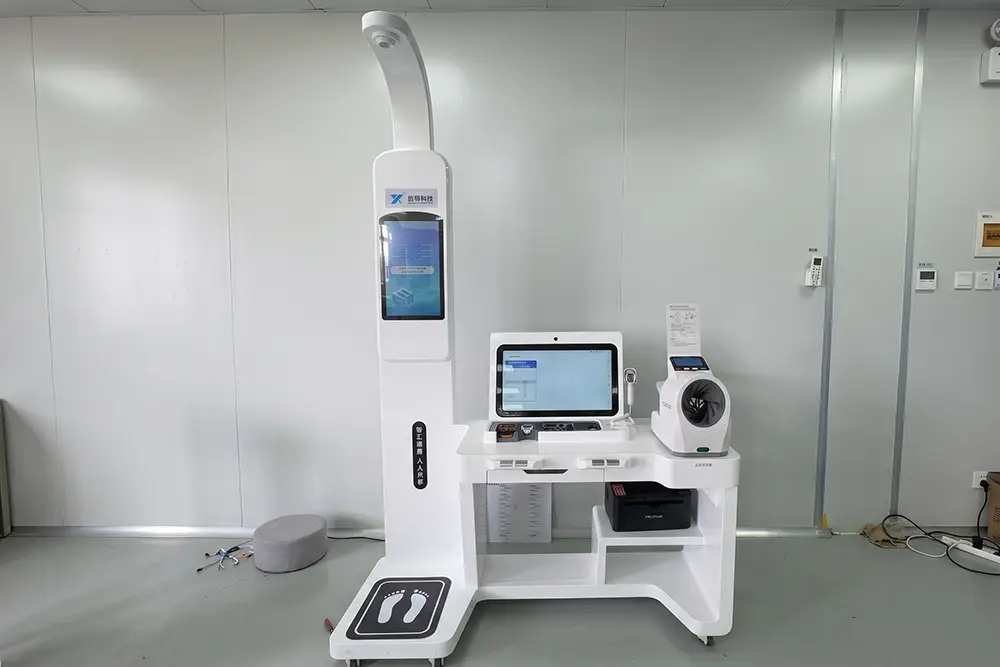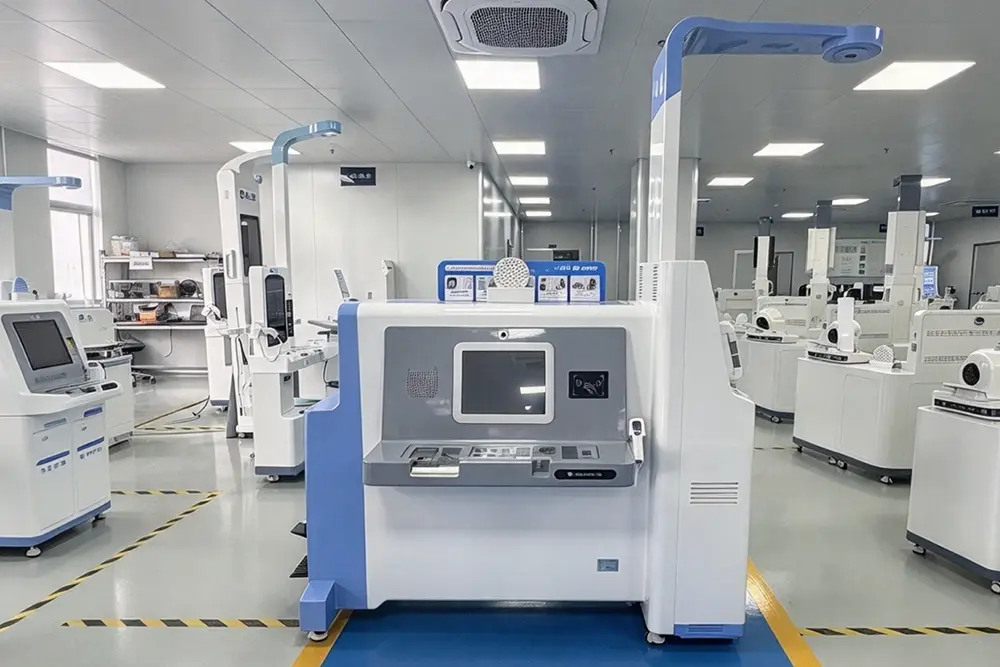
At Zhongrongda, our engineering team has spent over 15 years manufacturing precision CNC-machined parts and enclosures for medical, robotics, and industrial customers across the United States, Canada, Germany, and the UK. So when a U.S.-based medical device developer approached us with a next-generation eye wave instrument designed to travel on a wheeled trolley cart, we understood the stakes. The enclosure had to protect sensitive optics, survive daily movement through hospitals and clinics, and present a clean, professional appearance worthy of a regulated medical product.
What the customer needed was a custom medical device enclosure that could be produced quickly and in low volume without sacrificing quality. Their internal optics and electronics were already designed; what they lacked was an outer shell that met strict dimensional, assembly, and aesthetic requirements while supporting a fast path to market. After reviewing their 3D models, our engineering team recommended a rapid prototyping approach: CNC-machined ABS panels joined into a single seamless shell and finished with a two-tone matte paint scheme. The result became one of the most demanding — and most rewarding — medical device enclosure projects our workshop has ever delivered.
Project Overview: The Custom Medical Device Enclosure Build
| Field | Project Detail |
|---|---|
| Industry | Medical devices |
| Application | Eye wave instrument trolley enclosure |
| Country | United States |
| Material | CNC-machined ABS plastic panels |
| Dimensions | 420 mm (L) × 450 mm (W) × 105 mm (H) |
| Surface Finish | Matte two-tone paint: white body with light gray accents |
| Tolerance | ±0.1 mm per panel; assembled seams ≤ 0.2 mm |
| Manufacturing Process | Rapid prototyping panel machining, UV adhesive bonding, filling & sanding, two-tone painting, assembly |
| Quantity | Prototype plus small batch production |
| Lead Time | 3 weeks (prototype); 4 weeks (small batch) |
Customer Requirements
The customer’s requirements fell into four areas.
Purchasing goals. As a medical device manufacturer with a tight development schedule, they wanted one partner who could move from prototype to small batch production without changing vendors, keep communication clear, and hold a fixed lead time.
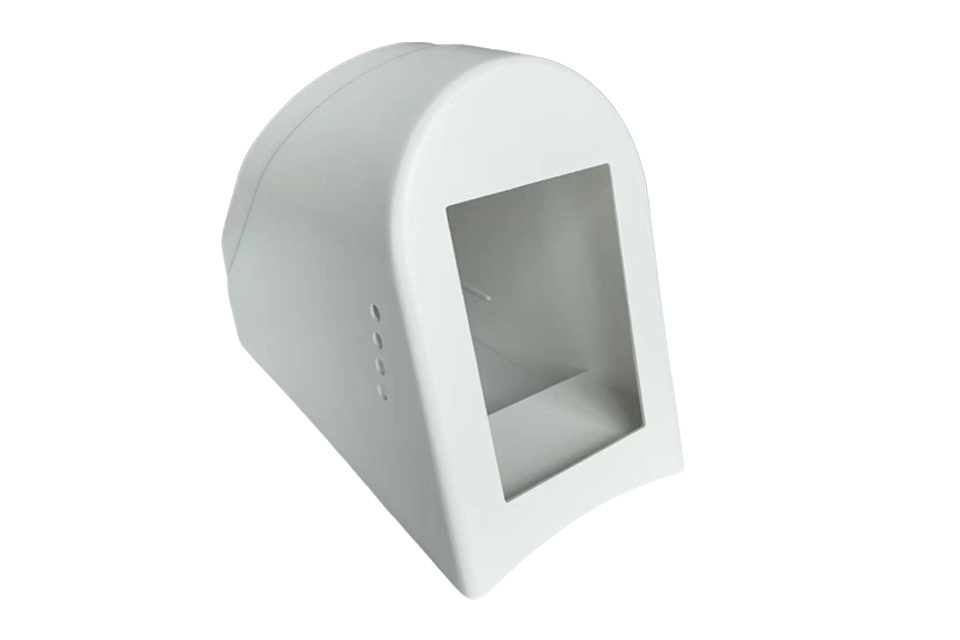
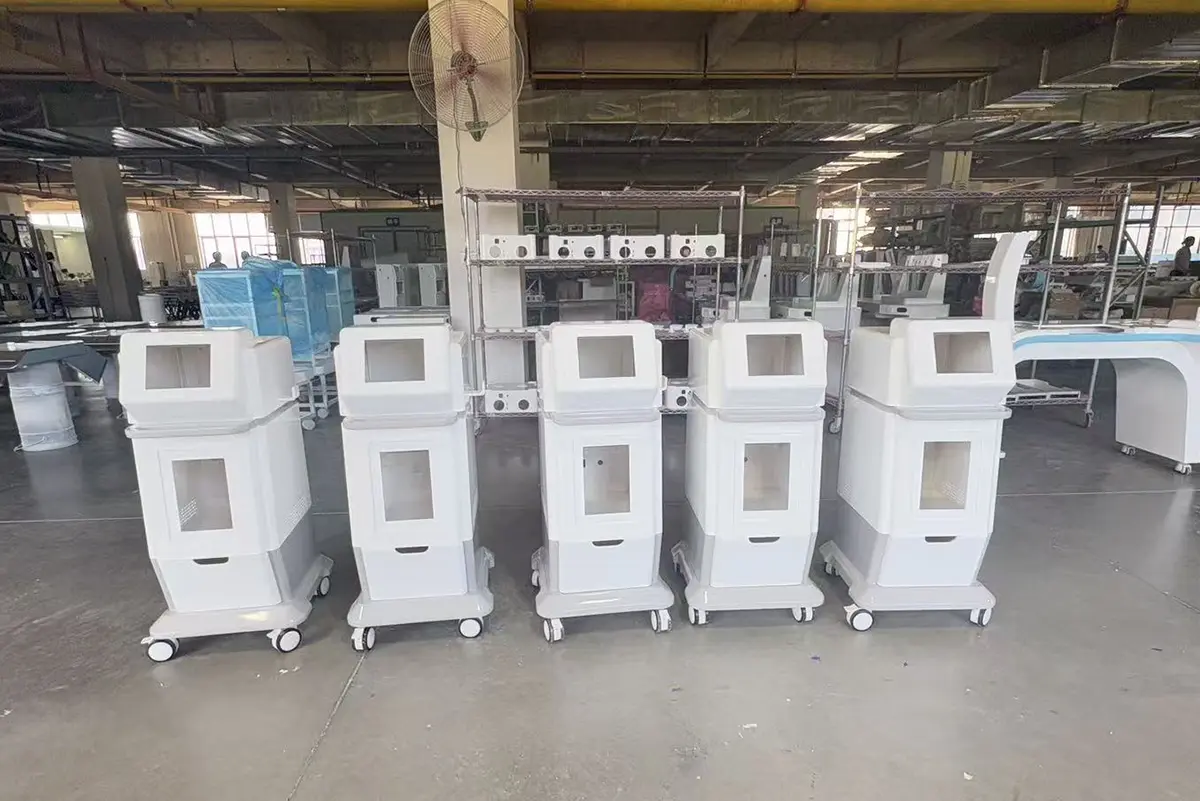
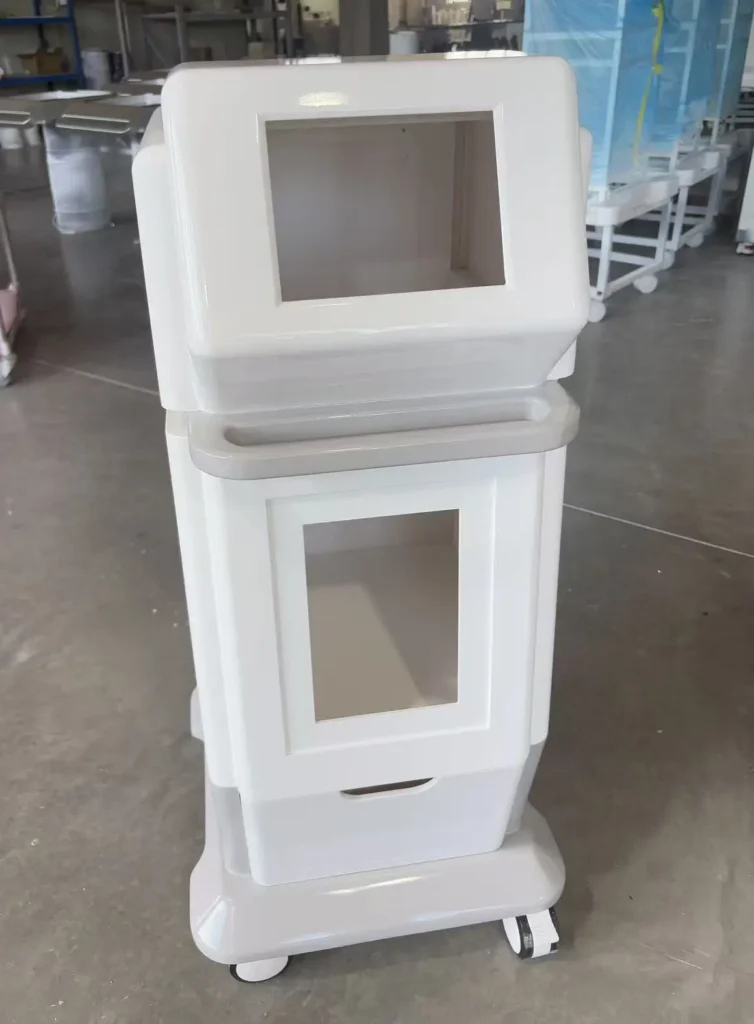
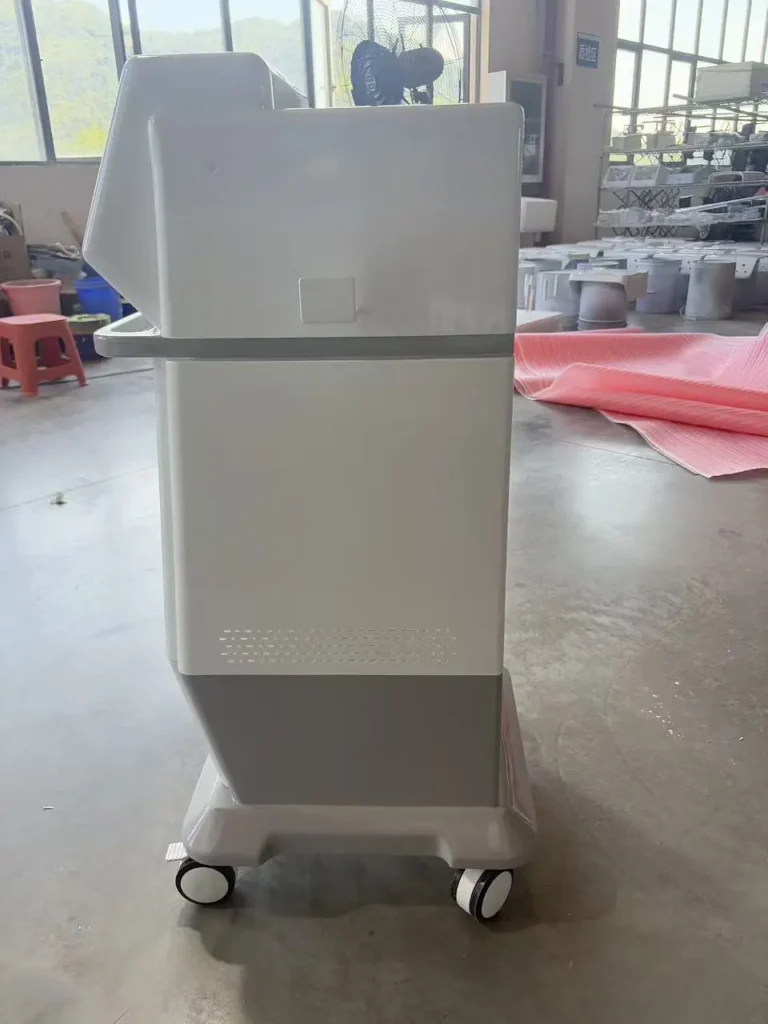
Technical requirements. The shell had to provide two large display window openings on the front, dense ventilation grilles on both sides, uniform large-radius corners across every edge, and precise mounting points for the internal electronics and the caster base.
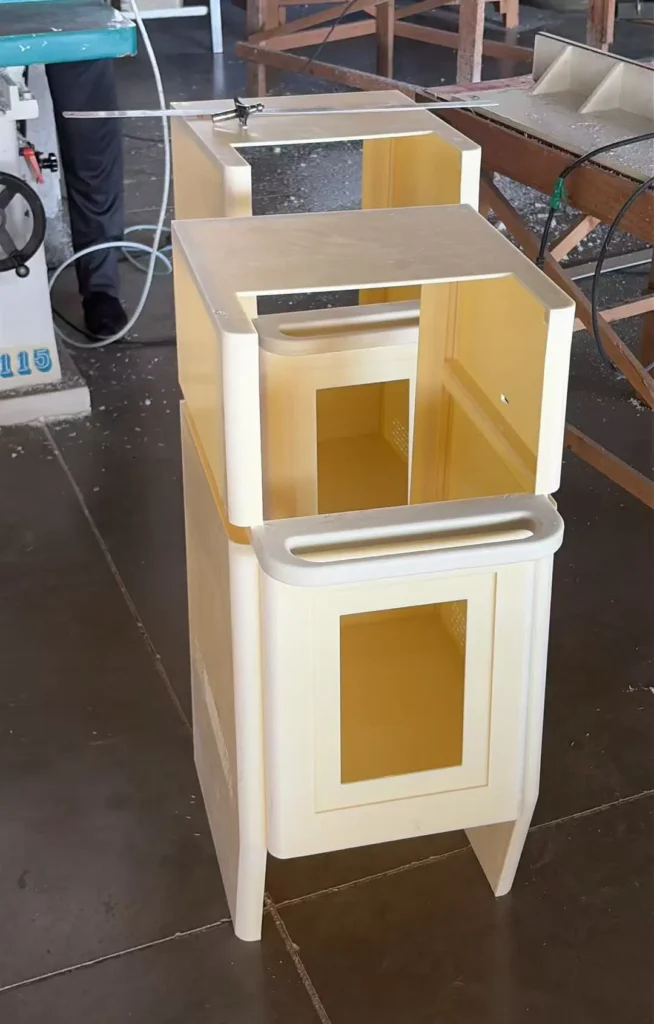
Assembly requirements. More than ten separate panels had to be joined into one visually seamless structure. Every joint, step, and color boundary needed to align perfectly, because any mismatch would be immediately visible on the finished product.
Appearance requirements. The design called for a white body with light gray accents, a matte finish, and a clean, minimal medical aesthetic — no visible screws, no visible seams, no blemishes.
Manufacturing Challenges
This project looked simple on paper and was anything but in the workshop. Our engineering team tracked five groups of challenges.
Multi-curved, multi-panel structure. The unit is split into more than ten individual boards — head section, mid-body, rear cover, base, and side handrails — each with a different geometry: a tilted head surface, a double-layer stepped body, and a smoothly rounded base. Each board was machined separately for its outer profile, inner cavity, screen openings, and vents. If any single panel deviated by more than 0.1 mm, the assembled shell would show steps and gaps.
Thin-wall hollowed areas. The two large display windows on the front and the dense side ventilation grilles are thin-wall open structures. Once the panels were milled thin, rigidity dropped, and tool vibration could cause edge warping and uneven surfaces that would be magnified after painting.
Uniform large-radius corners. Every corner, caster housing, and outer edge had to share the same large R radius. When each panel is machined separately, matching the exact arc across boards is difficult, and misaligned arcs show up as broken transitions at the joints.
Seamless multi-panel bonding. The shell was assembled from over ten plastic boards bonded with UV-curing adhesive. If any seam exceeded 0.2 mm, filling and sanding would leave a visible trace and the paint would show uneven shading. With multiple surfaces needing simultaneous positioning, panel shift and misalignment were constant risks.
Two-tone boundaries and load-bearing base. The white/gray waistline runs across panel boundaries, so thickness stacking errors translated directly into an uneven waistline and stepped sides. The caster base also carries the full load of the trolley, and with limited bonding surface on thin panels, pulling and pushing could crack the joints without internal reinforcement.
The finishing side added three more difficulties: filling and sanding curved seams without sanding through the panel, masking the two-tone boundary without bleeding or color contamination, and removing burrs and paint buildup inside the narrow window openings.
Our Engineering Solution
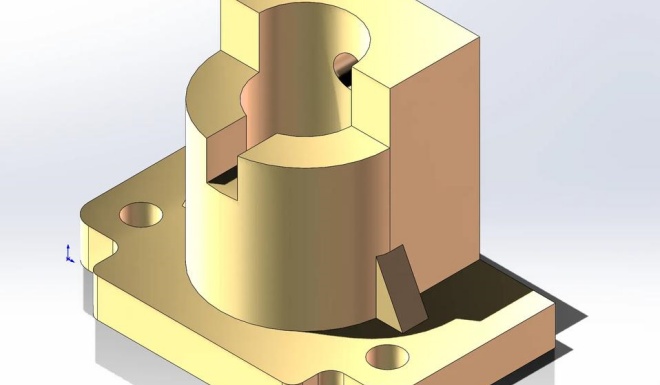
DFM optimization. We started with a DFM review of the customer’s 3D files. Our engineering team reworked the split-line strategy, added alignment datums, and designed internal locating slots for the caster base so the joint areas carried load instead of relying on adhesive alone. We also adjusted fillet radii and wall thicknesses in the hollowed areas to restore rigidity while preserving the design intent.
Fixture design. Dedicated fixtures and clamping jigs were built for every panel geometry. Bonding jigs held all boards in simultaneous alignment, eliminating the shifting that causes steps and mismatched waistlines.
Tooling and programming. For the thin-wall structures we selected sharp, small-diameter end mills and programmed climb milling with reduced stepover and controlled feed rates to suppress vibration. All machining setups referenced the same coordinate datums so every panel matched the CAD model.
Dimension control. Every panel was measured against the model before bonding. Any panel outside the ±0.1 mm window was reworked before it could cause assembly errors.
Surface preparation. Sanding blocks with controlled pressure replaced freehand sanding on curved seams, and the two-tone masking was cut with precision templates so the white/gray boundary stayed clean.
Manufacturing Process
- DFM review. Files were analyzed, split lines confirmed, and manufacturability issues resolved with the customer.
- Programming. CAM programs and fixtures were prepared for each panel.
- Material preparation. ABS panels were cut to blank size and checked for flatness.
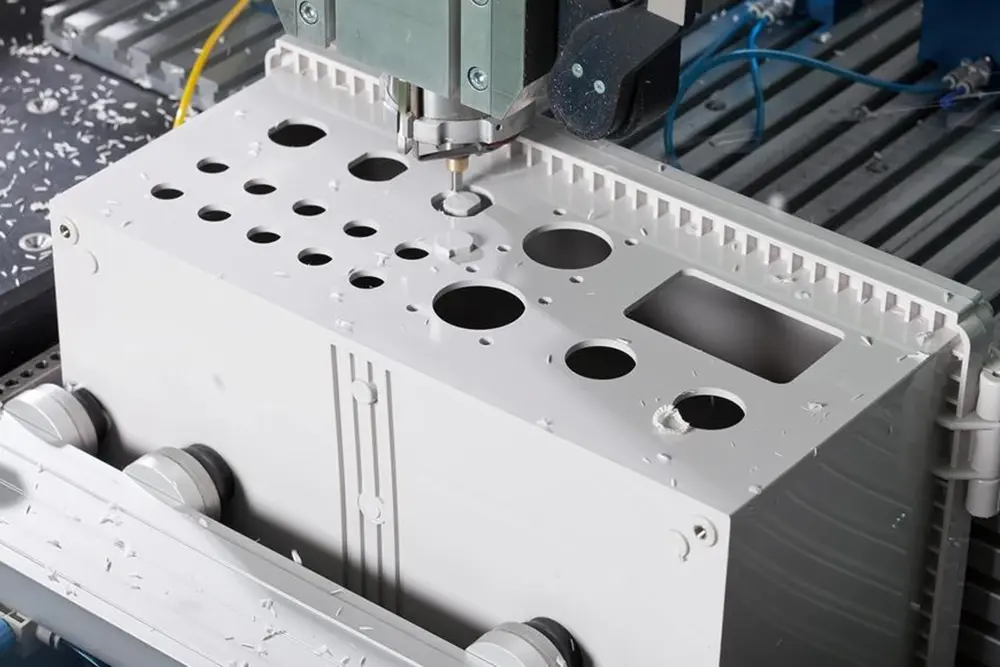
- CNC machining. Outer profiles, inner cavities, screen openings, and vents were machined on our CNC milling centers, with thin-wall areas run at conservative speeds.
- Deburring. Every edge was deburred by hand, including the narrow vent slots.
- Surface finishing. Seams were filled, sanded, and smoothed; the shell was masked and painted in two tones with a matte clear coat.
- Assembly. Electronics brackets, the caster base, and all panels were joined with UV adhesive and the internal locating features.
- Inspection. The completed unit underwent first article and final inspection.
- Packaging. The enclosure was foam-protected and shipped in a reinforced carton.
Quality Inspection
Quality control ran throughout the project. Each machined panel was checked with calipers and micrometers against the ±0.1 mm tolerance. After bonding, a height gauge verified the waistline and step alignment across the shell. Critical features — screen openings, mounting positions, and the caster base — were verified on our CMM, and a complete first article inspection (FAI) was performed before production began. A final inspection checked surface finish, color boundaries, seam quality, and overall dimensions before packaging, and the inspection report was shipped with the order.
Final Results
We delivered the prototype in three weeks and the small batch in four, with all panels fitting together without rework on the customer’s side. The two-tone finish came out clean, with no bleeding at the color boundaries, and the caster base has held up in daily use. The customer’s feedback was direct: the enclosure looked like a production tool rather than a prototype, and the fit of the display windows and vents exceeded what they had seen from previous suppliers. Since then, they have used the same enclosure platform as the basis for a second product variant.
Video Showcase
This project was documented throughout the manufacturing process and the production video is available on our YouTube channel.
We also shared this manufacturing project on Facebook to give customers a closer look at the machining, finishing, inspection and packaging process.
Why Choose Zhongrongda
- Engineering support. Every medical device enclosure project starts with a free DFM review by our engineering team, and we stay involved through production.
- Fast quotation. We provide quotations within 24 hours for most inquiries.
- Rapid prototyping. Our rapid prototyping capabilities let you validate fit, finish, and ergonomics before committing to volume.
- Small batch manufacturing. We specialize in small batch runs, so you are never forced to order more than you need.
- Quality control. First article inspection, CMM verification, and final inspection are standard on every order.
- NDA protection. We routinely sign NDAs and protect your drawings, IP, and product details.
- Certifications. Our processes follow ISO 9001 and ISO 13485 quality management requirements, which matter for medical & laboratory equipment customers.
We apply the same finish discipline used for consumer-facing beauty device enclosures to every medical housing we build. For more about our capabilities, see our CNC machining materials, our applications, and our about us page — or contact us directly.
FAQ
- What is your MOQ for a custom medical device enclosure?
Our MOQ for custom enclosures is typically one prototype, followed by small batch production starting at 10–50 units depending on panel count and process complexity. We are happy to discuss lower volumes for validation builds. - What lead times should I expect?
Prototypes usually ship in 2–4 weeks depending on geometry, and small batch production follows in 2–4 additional weeks. For this eye wave trolley enclosure, the prototype took three weeks and the small batch four weeks. - What tolerances can you hold?
We machine panels to ±0.1 mm and assemble seams to within 0.2 mm. Tighter tolerances are possible for specific features after a DFM review. - Which materials can I choose from?
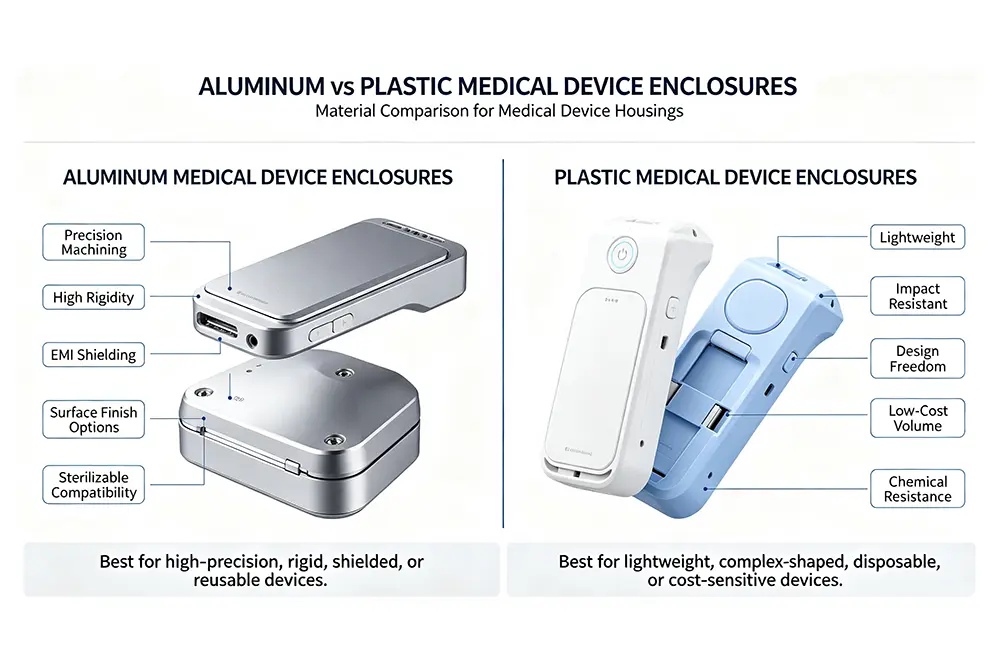
ABS, PC, ABS/PC blends, PMMA, PA, POM, aluminum, and stainless steel are common choices. We will recommend the best CNC machining material for your application, cost, and regulatory needs. - What surface finishes do you offer?
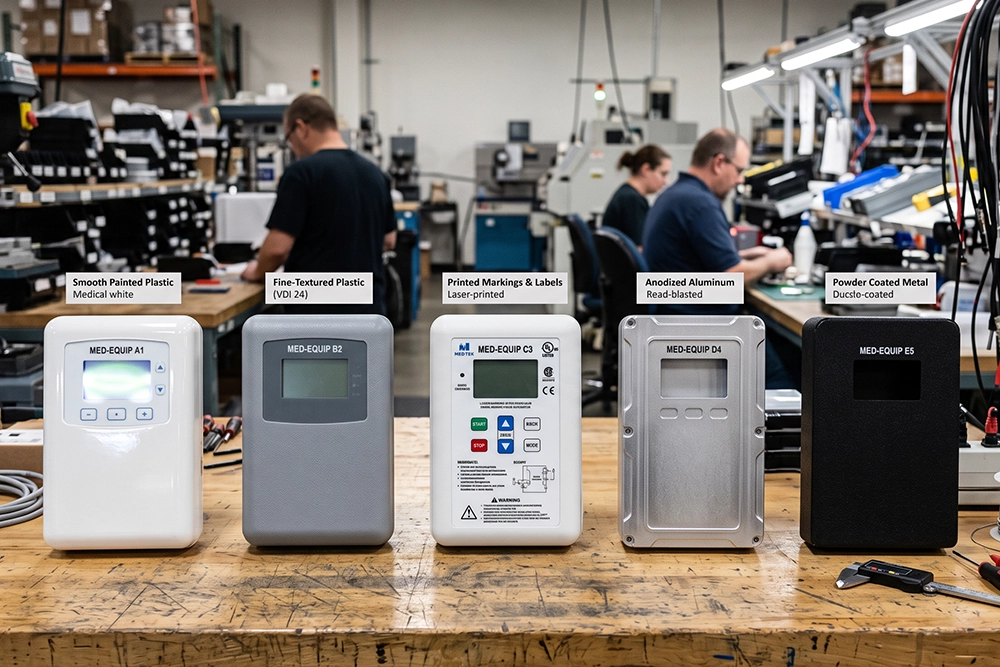
Matte or glossy paint, two-tone paint, texture paint, silk-screen printing, anodizing, sandblasting, and polishing. Two-tone medical enclosures with masked color boundaries are a specialty of ours. - Do you sign NDAs?
Yes. We sign NDAs before reviewing any drawings and treat your IP, tooling, and product information as confidential. - Can you help with rapid prototyping before production?
That is our core strength. We machine functional prototypes that match production materials and finishes, so you can test fit, electronics, and aesthetics before committing to volume. - Why should I choose a specialist for medical device enclosures?
Medical housings demand tight tolerances, clean surfaces, reliable assembly, and documentation. Our ISO 9001 and ISO 13485-aligned processes, plus years of medical project experience, reduce risk in your development cycle. - Can you handle small batch manufacturing economically?
Yes. Our small batch workflow is built around flexible tooling and shared fixtures, which keeps setup costs low for 10–500 unit runs. - How do I start a project?
Upload your drawings or 3D files, and our engineering team will provide a free DFM review and quotation within 24 hours.
CTA
Need a reliable CNC machining partner for your next project? Upload your drawings today and our engineering team will provide a free DFM review and quotation within 24 hours. Contact us to discuss your enclosure, prototyping, or small batch requirements.