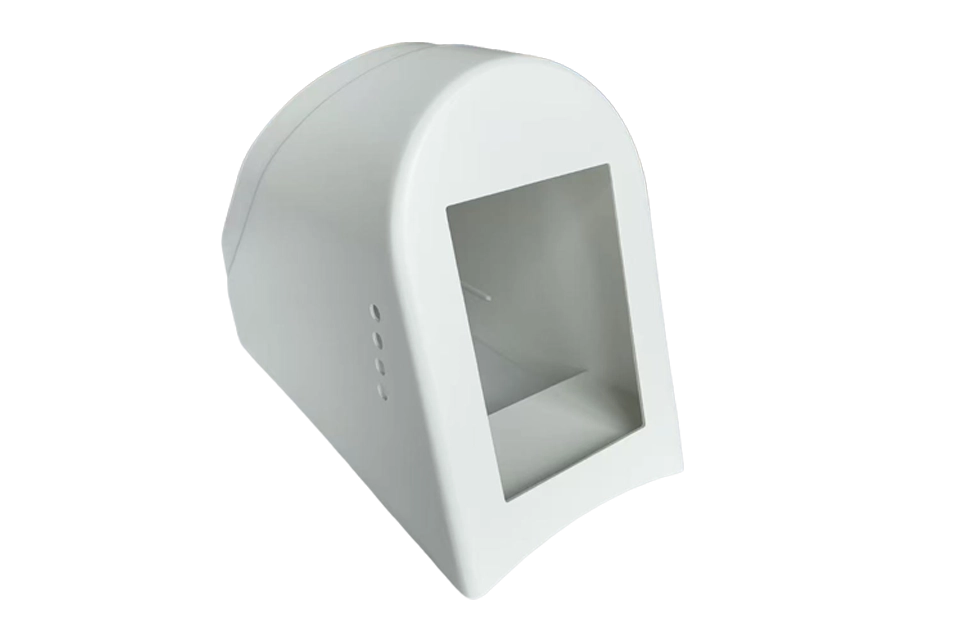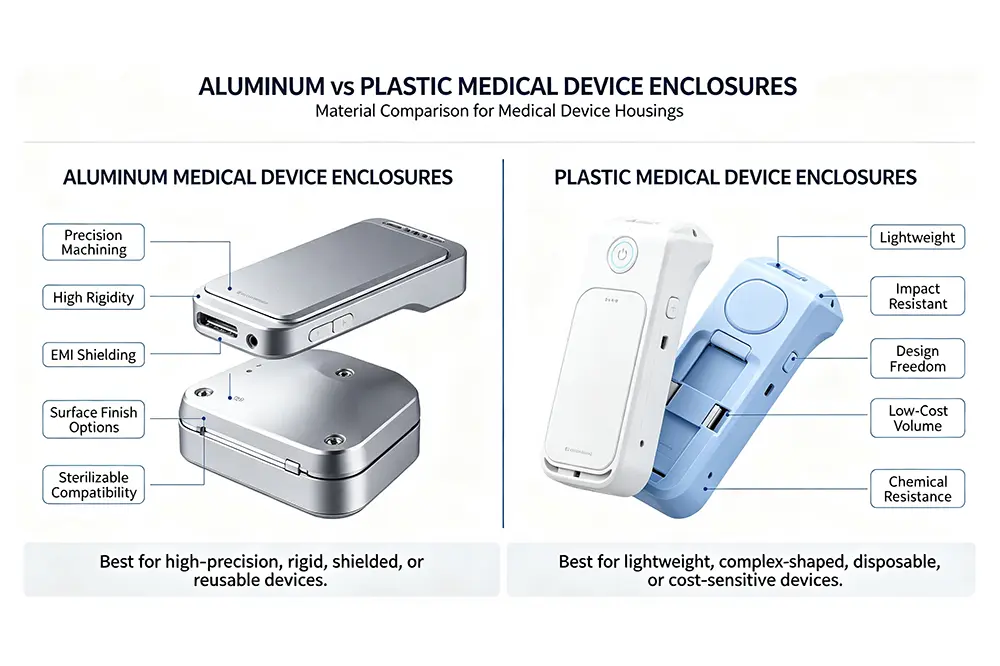
A custom medical device enclosure must do more than cover the equipment inside. For laboratory and diagnostic instruments, the enclosure has to protect internal mechanisms, separate moving components from operators, provide access for maintenance, accommodate interfaces and sample-loading areas, and present a clean appearance suitable for a professional laboratory environment.
At Zhongrongda, we recently completed a small-batch enclosure project for a fully automatic laboratory stainer. The equipment is designed for laboratory inspection and research applications and contains internal transmission components, electronic control boards and reagent-related assemblies.
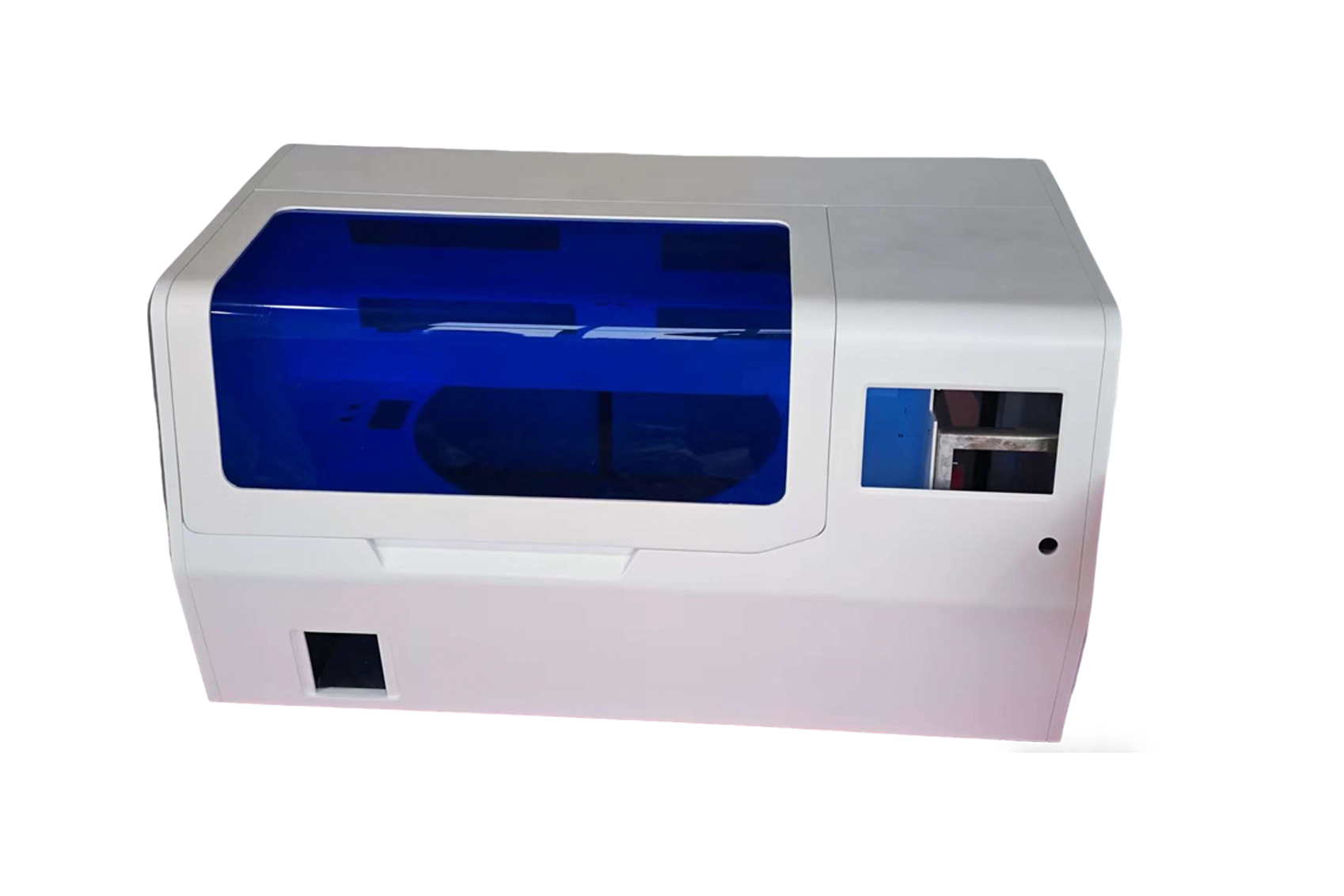
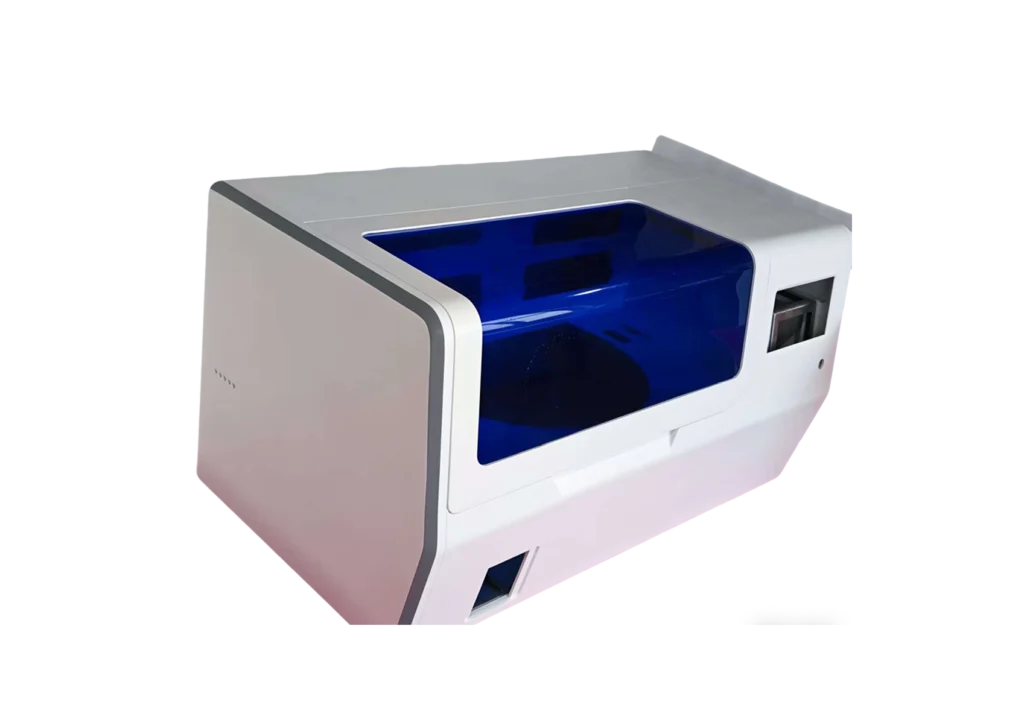
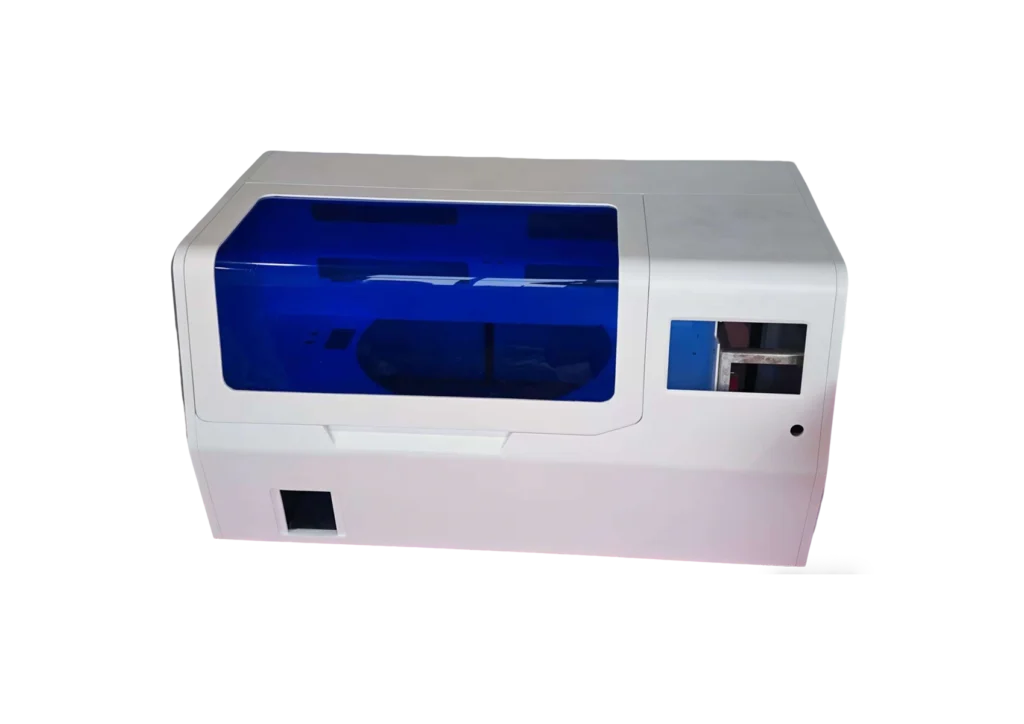
The customer needed a large ABS plastic housing with a blue transparent acrylic viewing window. The enclosure had a distinctive white matte finish, large-radius corners and multiple functional openings for sample access, ventilation, external interfaces and other equipment components.
The project was not simply about producing a large plastic shell. The main engineering challenge was keeping the long curved housing stable while maintaining accurate window dimensions, consistent upper-to-lower housing gaps and reliable alignment with the internal metal frame.
The project has now entered mass production after successful small-batch validation.
Project Overview
| Item | Project Specification |
|---|---|
| Industry | Laboratory / Medical Equipment |
| Application | Fully Automatic Laboratory Stainer |
| Country | Customer location not disclosed |
| Material | ABS plastic housing + blue acrylic viewing window |
| Dimensions | L1120 × D620 × H540 mm |
| Surface Finish | White matte baking paint |
| Tolerance | Key acrylic window mounting area ±0.2 mm |
| Manufacturing Process | Hand-built ABS assembly, machining, acrylic cutting, sanding, painting and assembly |
| Quantity | Small batch, followed by production |
| Lead Time | Confirmed according to drawing review and production schedule |
For related laboratory equipment projects, our Laboratory Equipment Enclosures capability supports custom housings designed around the equipment’s internal structure, interfaces and appearance requirements.
Customer Requirements
The customer required an enclosure capable of housing a complete automated laboratory detection mechanism while maintaining a clean and professional exterior.
The primary requirements were divided into four areas: function, appearance, assembly and surface finishing.
Functional Requirements
The enclosure needed to surround the internal transmission mechanism, circuit boards and reagent storage components while providing adequate protection from dust and accidental contact.
A large blue acrylic viewing window was required on the upper section so operators could observe the internal working area without opening the enclosure.
Several additional openings were required for:
- Sample loading and unloading
- External equipment interfaces
- Ventilation
- Display or control components
- Service access
- Locking components
The upper cover also required a flip-up structure to allow technicians to access the internal mechanism during maintenance.
Appearance Requirements
The customer wanted a modern laboratory instrument appearance rather than a conventional industrial cabinet.
The design included:
- Pure white exterior
- Matte surface finish
- Large R35 rounded corners
- Large blue transparent viewing window
- Simple rectangular overall form
- Clean and consistent assembly lines
The main viewing window measured approximately 640 × 320 mm, with a 12 mm mounting step.
The right-side sample opening measured approximately 185 × 155 mm, while the lower ventilation opening measured approximately 95 × 110 mm. A Ø18 mm locking hole was also incorporated into the enclosure.
Assembly Requirements
The acrylic window had to fit securely into the housing without looseness.
The upper and lower ABS sections needed consistent joint gaps, while the enclosure also had to assemble with the internal metal frame without interference.
These requirements made dimensional coordination particularly important.
Manufacturing Challenges
1. Large Curved ABS Housing
The enclosure was relatively large at 1120 mm in length. Large plastic structures can be more sensitive to deformation than small components, particularly when long surfaces and curved corners are combined.
The R35 corner geometry also meant that the exterior appearance depended heavily on maintaining a smooth transition across the entire housing.
Our engineering team therefore treated the large curved surfaces as a structural and appearance-control problem rather than simply a machining problem.
2. Acrylic Window Fit
The blue acrylic viewing window was one of the most critical interfaces.
The mounting area required a tolerance of approximately ±0.2 mm. If the opening was oversized, the window could move or produce an inconsistent gap. If it was undersized, assembly could become difficult or create stress around the acrylic.
The machining sequence therefore had to account for the final acrylic dimensions and the required assembly clearance.
3. Multiple Functional Openings
The enclosure contained several openings on different sides.
Their locations had to correspond with internal components and external accessories. Even a relatively small positional error could cause interference during final assembly.
For this reason, we controlled the opening locations against the enclosure reference structure rather than treating each opening independently.
4. Upper and Lower Housing Alignment
The housing was divided into upper and lower sections.
The customer required a clean, uniform joint line after assembly. Any dimensional variation along the long joint could become visually obvious on the finished white surface.
This required control of both individual components and the relationship between components during assembly.
5. Surface Appearance
White matte paint makes surface defects easier to see under laboratory lighting.
Before painting, the ABS surfaces therefore required careful sanding and preparation. The objective was not only dimensional accuracy but also a consistent visual surface after finishing.
Our Engineering Solution
At Zhongrongda, we approach enclosure projects by considering the complete manufacturing sequence before production begins.
DFM Review
Our engineering team first reviewed the enclosure structure, window mounting area, functional openings and upper/lower housing interfaces.
The key question was not simply whether the geometry could be produced, but whether it could be produced consistently in small-batch quantities and subsequently transferred into production.
The acrylic window interface and enclosure split line were treated as key inspection features.
Manufacturing Sequence Optimization
We established a controlled sequence:
- ABS material preparation
- Hand-built housing assembly
- Initial structural adjustment
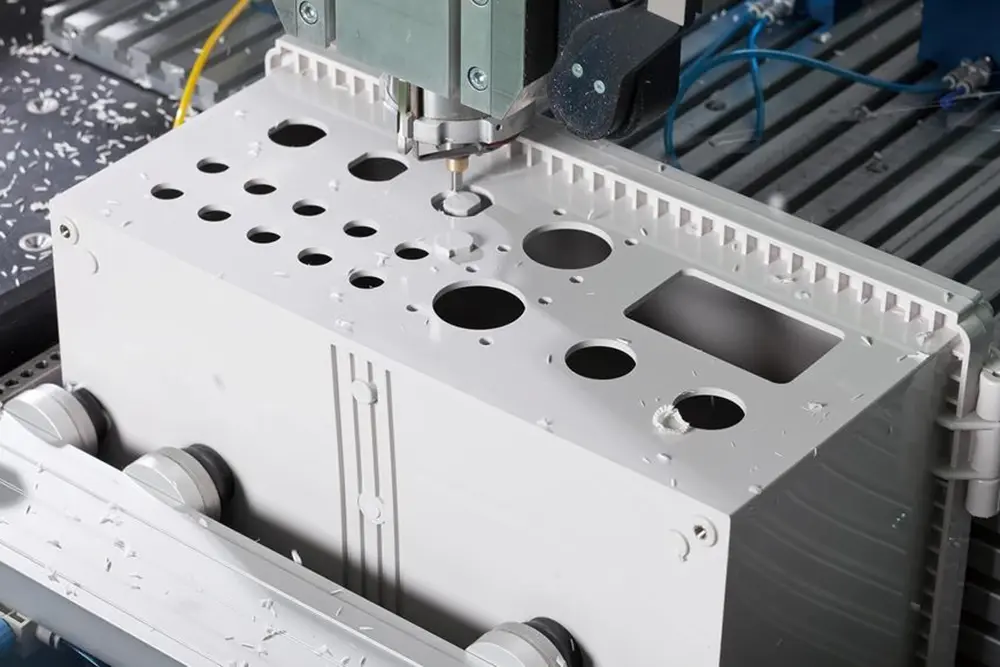
- Functional opening machining
- Acrylic window opening machining
- Acrylic cutting
- Surface preparation
- Matte white painting
- Final assembly
- Dimensional and appearance inspection
This sequence reduced the risk of completing surface finishing before critical structural adjustments had been verified.
Fixture and Reference Control
For the functional openings, reference points were established from the enclosure structure so that the sample opening, ventilation opening and other interfaces remained correctly positioned.
This was particularly important because the enclosure had multiple external openings that needed to correspond with internal components.
Acrylic Window Control
The blue acrylic panel was cut according to the verified mounting dimensions.
Before final assembly, we checked the interface between the acrylic and the housing to ensure that the window was properly seated and that the visible gap remained consistent.
Surface Preparation
After structural and dimensional work was completed, the ABS housing was carefully sanded and prepared for matte white baking paint.
The large-radius corners and long curved surfaces received particular attention because uneven preparation could become visible after painting.
For customers developing new laboratory or medical equipment, our Rapid Prototyping service can also be used to validate enclosure geometry, fit and appearance before committing to larger production quantities.
Manufacturing Process
1. DFM Review
We reviewed the 3D structure, opening locations, acrylic interface, split lines and assembly relationships.
2. Programming
Machining data was prepared for the required openings and interface features.
3. Material Preparation
ABS material and blue acrylic were prepared according to the project specifications.
4. ABS Housing Fabrication
The ABS sections were hand-built and adjusted to achieve the required overall form.
5. Opening Machining
The viewing-window opening, sample opening, ventilation opening and other required interfaces were machined.
6. Deburring and Surface Preparation
Edges were cleaned and surfaces were prepared for finishing.
7. Acrylic Cutting and Assembly
The blue acrylic viewing window was cut and fitted into the prepared mounting area.
8. Surface Finishing
The enclosure received white matte baking paint to achieve the requested laboratory-equipment appearance.
9. Final Assembly
The upper and lower housing sections were assembled with the internal metal structure and checked for interference.
10. Inspection and Packaging
Final dimensional, functional and appearance checks were completed before packaging for delivery.
Quality Inspection
For enclosure projects, inspection is not limited to checking the overall dimensions.
Our inspection approach focuses on the interfaces that determine whether the enclosure will assemble correctly.
Depending on project requirements, our quality-control process can include:
- CMM inspection for critical dimensional features
- Height gauge measurement for reference dimensions
- Micrometer measurement for precision features
- Caliper measurement for openings and general dimensions
- First Article Inspection (FAI) for initial production validation
- Final inspection for dimensional accuracy, assembly, surface finish and appearance
For this project, particular attention was paid to the acrylic window mounting area, functional openings, upper/lower housing alignment and assembly with the internal frame.
Zhongrongda operates with ISO9001 and ISO13485 quality-management capabilities, supporting customers that require controlled manufacturing processes for medical and laboratory equipment projects.
Final Results
The completed enclosure achieved the customer’s intended combination of functionality and appearance.
The finished housing provided:
- A large blue transparent viewing window
- A clean white matte exterior
- Smooth R35 rounded corners
- Functional sample and interface openings
- Accessible internal service space
- Consistent upper/lower housing assembly
- Reliable integration with the internal metal frame
The project successfully progressed from small-batch production into production manufacturing.
No public customer testimonial was provided for this project, so we do not attribute an unverified quotation to the customer. The production status itself confirms that the enclosure passed the required development and manufacturing stages.
For similar laboratory and diagnostic equipment, our Diagnostic Equipment Enclosures capability provides another suitable manufacturing route when the housing must accommodate precise interfaces, internal mechanisms and professional medical-equipment aesthetics.
Why Choose Zhongrongda
Engineering Support
Our engineering team reviews enclosure geometry, manufacturability, assembly interfaces and production risks before manufacturing.
Fast Quotation and DFM Review
Customers can provide 3D models, 2D drawings, specifications or reference samples for project evaluation. We review the manufacturing requirements before confirming the production approach.
Rapid Prototyping
Prototype manufacturing allows product teams to verify form, fit, assembly, appearance and internal component positioning before larger production commitments.
Small-Batch Manufacturing
Medical and laboratory equipment manufacturers often need small quantities during product validation and early commercialization. We support this development stage before production volumes increase.
Quality Control
Dimensional inspection, appearance inspection and assembly verification are incorporated according to project requirements.
Confidential Project Handling
We can work under an NDA when customers need confidentiality protection for drawings, 3D models, product concepts and technical information.
Medical and Laboratory Enclosure Experience
Our focus on custom equipment housings allows us to coordinate engineering, fabrication, finishing, assembly and inspection within one manufacturing workflow.
Our Case Studies section provides additional examples of custom enclosure projects and manufacturing solutions.
FAQ
1. Can Zhongrongda manufacture automatic laboratory stainer enclosures?
Yes. We manufacture custom housings for laboratory, diagnostic and medical equipment. The enclosure can be designed around the customer’s internal mechanisms, interfaces, service requirements and appearance specifications.
2. What is the MOQ for a custom medical device enclosure?
There is no universal MOQ for every enclosure project. Prototype and small-batch quantities can be evaluated according to the design, material, finishing requirements and production method.
3. What lead time is required?
Lead time depends on enclosure size, structure, quantity, finishing requirements and assembly complexity. After reviewing the drawings and specifications, our engineering team can confirm a project-specific production schedule.
4. What tolerance can you achieve?
The achievable tolerance depends on the material, feature size, manufacturing process and required inspection method. For this project, the acrylic window mounting area required approximately ±0.2 mm control.
5. Can you manufacture ABS medical equipment housings?
Yes. ABS can be used for custom equipment housings when the project requires a lightweight plastic structure, custom geometry and a finished exterior appearance.
6. What surface finishes are available?
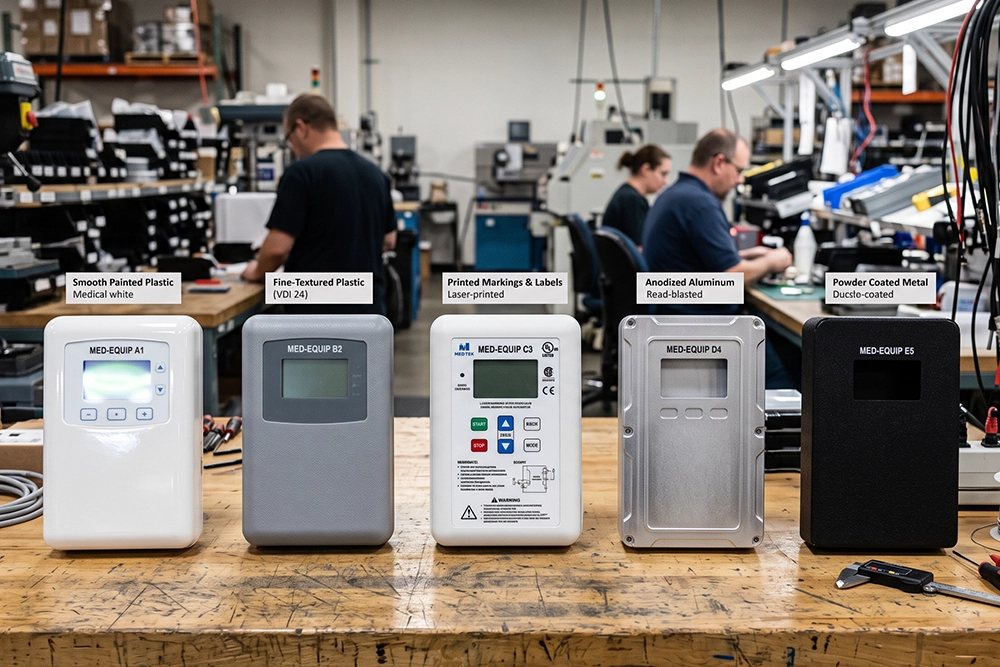
Depending on the material and application, finishing options can include sanding, matte painting, baking paint, printing and other decorative or protective treatments. The final finish is selected according to the product requirements.
7. Can Zhongrongda sign an NDA?
Yes. We can work under an NDA when confidential drawings, product concepts, specifications or other technical information need protection before manufacturing.
8. Do you support rapid prototyping before production?
Yes. Our Rapid Prototyping service supports prototype development and engineering validation before small-batch or production manufacturing.
9. Can you manufacture medical device enclosures in small batches?
Yes. Small-batch manufacturing is suitable for medical and laboratory equipment companies that need prototype validation, pilot production or early commercialization quantities.
10. Can you manufacture the complete medical device?
Our focus is custom medical and equipment enclosures and related manufacturing services. We manufacture housings, structural components, finishing and assembly according to customer-provided designs. We do not represent ourselves as the medical-device OEM or final device manufacturer.
CTA
Need a reliable CNC machining partner for your next project?
Upload your drawings today and our engineering team will provide a free DFM review and quotation within 24 hours.
Whether you are developing a laboratory instrument, diagnostic system, medical device or specialized equipment, we can help evaluate the enclosure structure, material, manufacturing process, surface finish and assembly requirements before production.
Contact Zhongrongda with your 3D files, 2D drawings, reference samples or project specifications and let our engineering team review your next enclosure project.