Large scientific and industrial equipment often requires an enclosure that does much more than cover internal components. It must provide structural protection, controlled ventilation, service access, clean visual alignment and enough flexibility for engineers to maintain different functional modules.
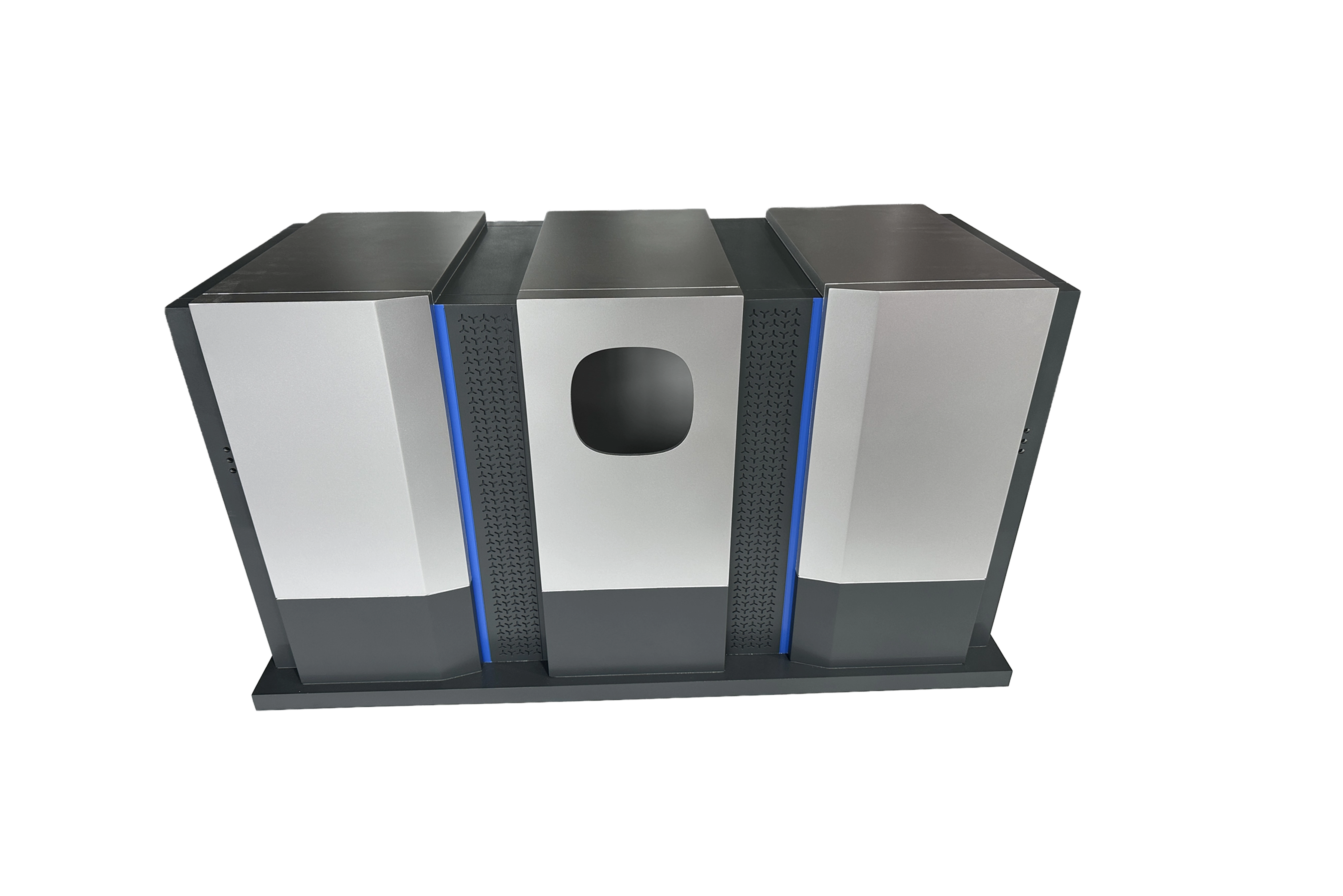
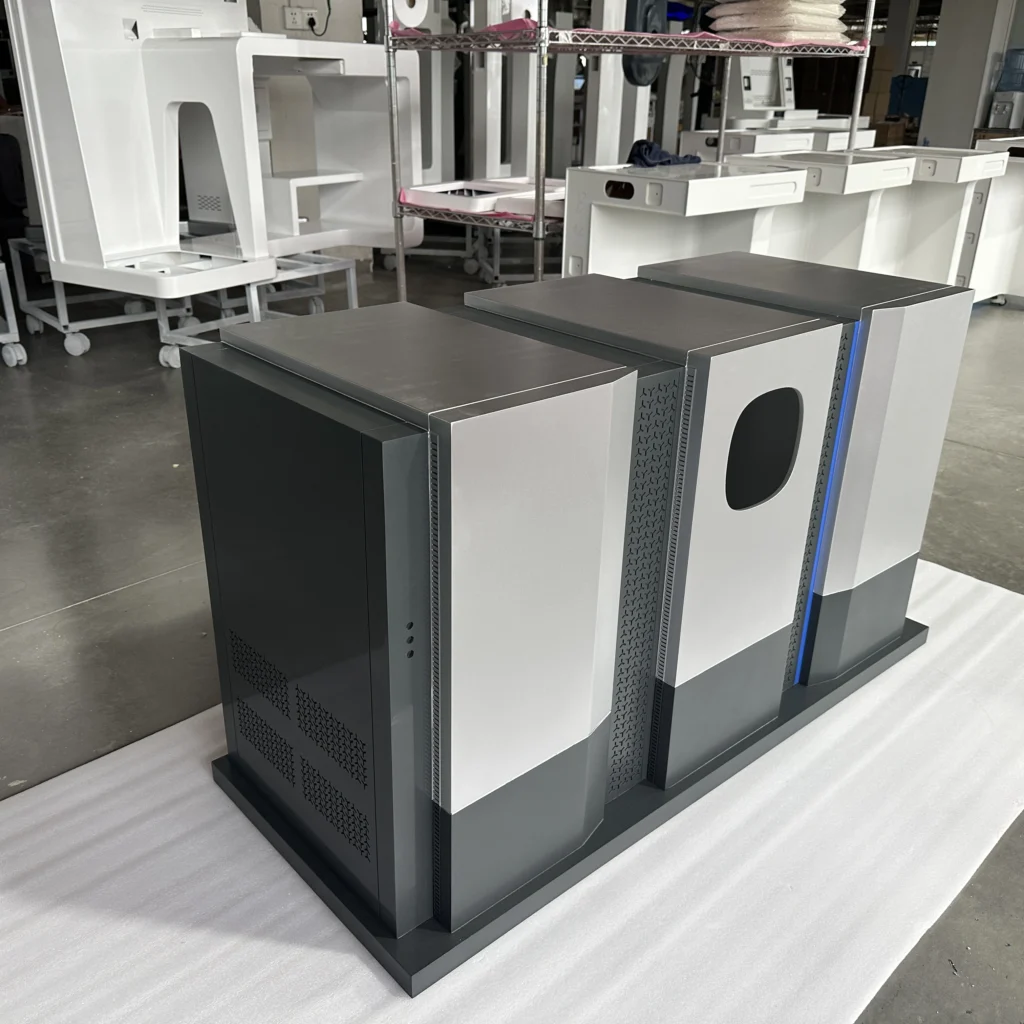
For this project, our team handled quantum computer enclosure manufacturing for a large modular equipment housing made primarily from PC-ABS plastic panels. The enclosure was designed around three independent cabinet modules mounted on a common base platform. Inside the cabinets were high-power electrical, power and inspection-related modules that required effective heat dissipation and convenient maintenance access.
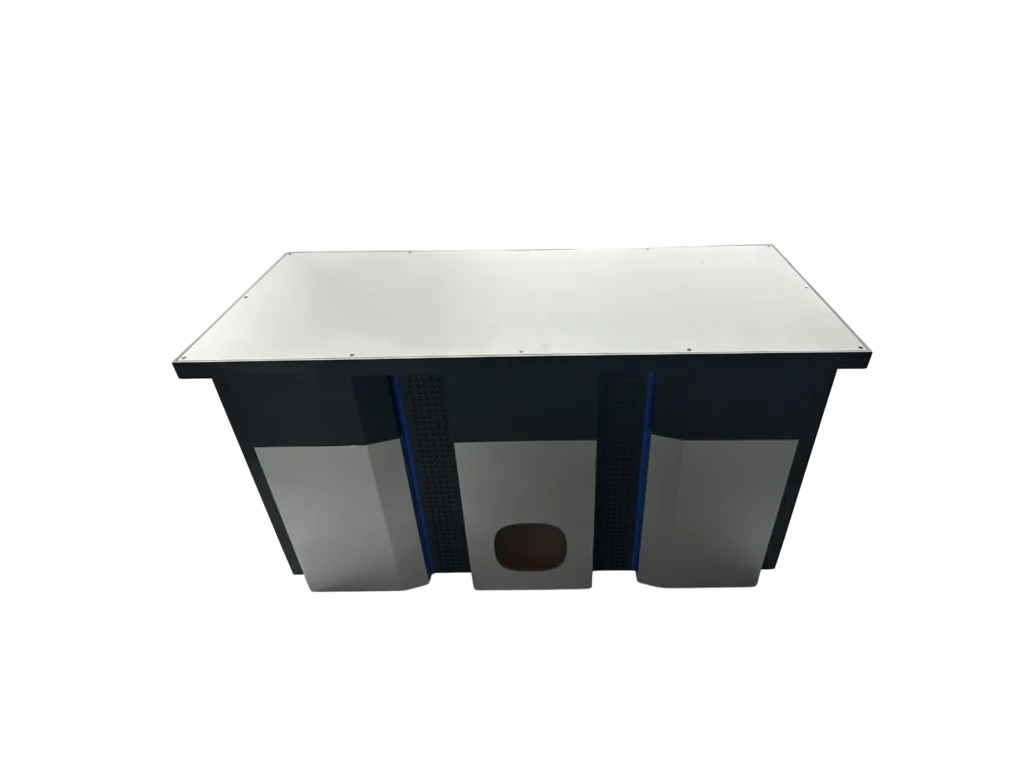
The customer also had demanding appearance requirements. The three modules needed to maintain a symmetrical appearance, consistent gaps and aligned heights, while the center cabinet required an observation window and large ventilation areas. The exterior combined matte dark gray and silver-gray panels with blue vertical decorative strips to create a technical, industrial appearance.
At Zhongrongda, we approached the project as an engineering and manufacturing problem rather than simply producing individual panels. Our engineering team reviewed the modular structure, machining requirements, assembly interfaces, ventilation openings and finishing sequence before moving into production.
The project was ultimately delivered for mass production.
Project Overview
| Item | Project Specification |
|---|---|
| Industry | Quantum Computing / Scientific Equipment |
| Application | Large modular equipment enclosure |
| Country | Not disclosed |
| Material | PC-ABS plastic panels |
| Overall Dimensions | 2200 × 950 × 1100 mm |
| Structure | Three modular cabinets + common base |
| Surface Finish | Matte baked paint |
| Key Tolerance | Observation window ±0.2 mm |
| Manufacturing Process | Plastic panel fabrication, machining, sheet-metal grille fabrication, painting and assembly |
| Quantity | Small batch initially, subsequently mass-produced |
| Lead Time | Project-specific |
This project required quantum computer enclosure manufacturing with a strong focus on dimensional consistency, modular assembly and appearance control across a large enclosure structure.
The main enclosure consisted of three cabinets arranged from left to right.
The left and right electrical cabinets were symmetrical, each measuring approximately 640 × 860 × 1020 mm. The central physical host cabinet measured approximately 600 × 860 × 1020 mm and included a 260 × 220 mm oval observation window.
The three cabinet modules were separated by controlled 25 mm gaps, while approximately 15 mm clearance was maintained between the cabinets and the base platform.
For applications where a smaller footprint is preferred, the alternative configuration can be reduced to approximately 2050 × 900 × 1050 mm, with cabinet widths of 600 / 560 / 600 mm and 20 mm module gaps.
Customer Requirements
The customer’s primary objective was to create a large equipment enclosure capable of housing different functional modules independently while maintaining a unified external appearance.
From a functional perspective, each cabinet needed to form an independent enclosure space. This allowed different electrical, power and inspection components to be separated while making future maintenance easier.
Thermal management was another important requirement. Because the equipment contained high-power components, large ventilation areas were incorporated into the design. The central section included open grille areas on both sides of the observation window to support airflow.
The customer also required the external structure to remain visually consistent across all three modules. The cabinet heights, horizontal color separation and assembly gaps needed to remain aligned.
The appearance specification included:
- Dark gray and silver-gray contrasting panels
- Blue vertical decorative strips
- 30° chamfered front-side surfaces
- 75 mm wide angled sections
- A consistent 610 mm color separation line
- A central observation window
- Open ventilation grille areas
- Matte painted surfaces
- Optional logo and model-number screen printing
For assembly, the three modules needed to align accurately with each other and with the supporting base. The enclosure also had to be removable without interfering with the internal equipment frame.
This combination of large dimensions, multiple modules, appearance-critical surfaces and functional ventilation made the project substantially more demanding than a conventional equipment cover.
Manufacturing Challenges
Controlling Large Plastic Panels
One of the first challenges in quantum computer enclosure manufacturing was controlling straightness and deformation across large PC-ABS panels.
Large plastic components can be more sensitive to dimensional variation than small machined parts. When several large panels are assembled together, even relatively small deviations can become visible as uneven gaps or misaligned surfaces.
Our engineering team therefore treated the enclosure as a complete assembly rather than independent parts. Critical interfaces were reviewed together so that individual dimensional variations would not accumulate excessively during final assembly.
Maintaining Consistent Module Alignment
The three-module structure created another important challenge.
The left and right cabinets had to appear symmetrical, while the center cabinet needed to remain visually centered. The 25 mm module gaps also needed to remain visually consistent.
The base mounting interfaces were particularly important because errors at the bottom could affect the alignment of the entire enclosure.
Observation Window Accuracy
The central observation window had a specified dimensional tolerance of ±0.2 mm.
This opening was both functional and highly visible. Its position affected the visual symmetry of the center cabinet, while its dimensions affected the installation of the associated window components.
We therefore treated the opening as a controlled feature rather than a simple cutout.
Ventilation Grille Quality
The ventilation areas required clean, consistent openings and proper fit with the enclosure.
Poorly controlled grille openings could create uneven edges, inconsistent visual appearance or restricted airflow. The sheet-metal grille components also had to fit properly against the surrounding plastic enclosure.
Multi-Color Surface Finishing
The exterior combined silver-gray, dark gray and blue elements.
For this reason, the finishing process had to control the boundaries between different colors. The blue decorative strips also needed accurate positioning so that the three modules maintained a consistent visual language.
Our Engineering Solution for Quantum Computer Enclosure Manufacturing
Our approach to quantum computer enclosure manufacturing focused on treating the three cabinets and base platform as one complete assembly rather than as unrelated individual parts.
Our engineering approach began with a DFM review of the complete enclosure assembly.
Instead of evaluating only individual drawings, our engineering team reviewed the relationships between the cabinets, base, observation window, ventilation grilles, decorative strips and internal mounting structure.
Where necessary, we optimized manufacturing references and assembly interfaces to make the final alignment easier to control.
For large plastic panels, we paid particular attention to the manufacturing sequence and handling of the parts. The goal was to reduce deformation and prevent dimensional variation from accumulating during assembly.
For machined openings, our team selected appropriate cutting parameters and tooling according to the PC-ABS material and feature geometry. The observation window received tighter dimensional attention because of its ±0.2 mm requirement.
For the ventilation areas, the machining and fabrication process was coordinated with the sheet-metal grille components. This helped ensure that the grille and surrounding enclosure surfaces remained properly matched after assembly.
We also considered the painting sequence during manufacturing. Multi-color surfaces were planned so that the transition boundaries remained clean and the blue decorative strips could be positioned consistently.
The assembly stage served as another important quality checkpoint. Rather than relying exclusively on individual part inspection, we verified the relationship between the major modules during assembly.
For projects requiring additional confidentiality, customers can also work with us under an NDA before sharing detailed product drawings and technical information.
Manufacturing Process
For this quantum computer enclosure manufacturing project, we followed a controlled workflow from DFM review through final assembly and inspection.
1. DFM Review
We reviewed the overall enclosure structure, module interfaces, openings, mounting points, gaps and finishing requirements before production.
2. Programming
Machining programs were prepared according to the approved drawings and critical dimensions.
3. Material Preparation
PC-ABS plastic panels were prepared for fabrication. Supporting sheet-metal materials were also prepared for the ventilation grille components.
4. Plastic Panel Fabrication and Machining
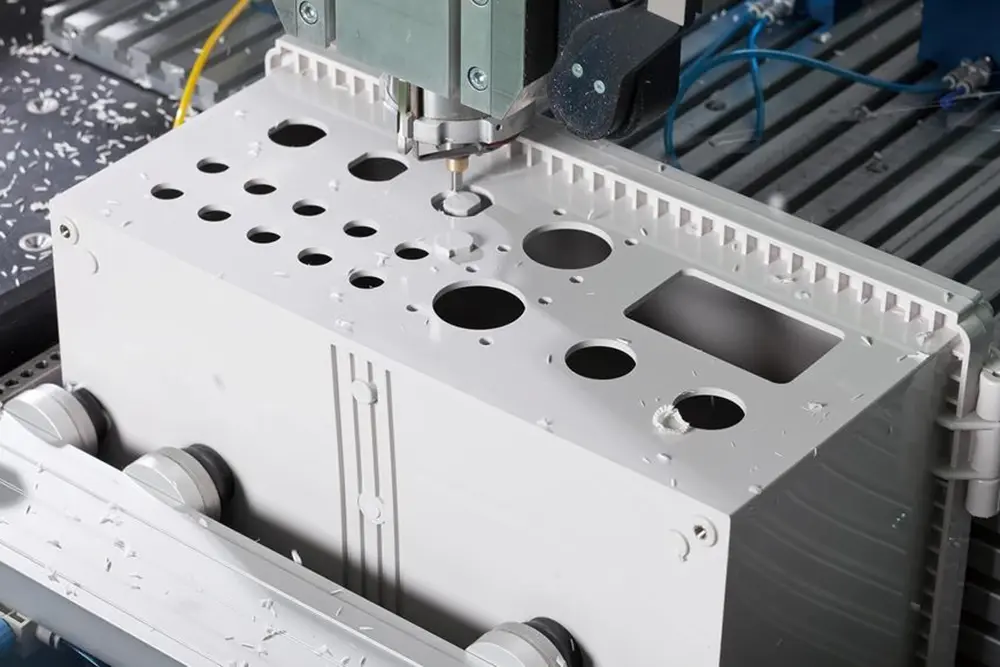
The large enclosure panels were fabricated and machined according to the approved design. Observation-window openings, ventilation areas and other required features were processed at this stage.
5. Sheet-Metal Grille Fabrication
The ventilation grille components were fabricated separately and prepared for integration with the plastic enclosure.
6. Deburring
Machined edges and openings were deburred and cleaned to improve assembly safety and surface quality.
7. Surface Finishing
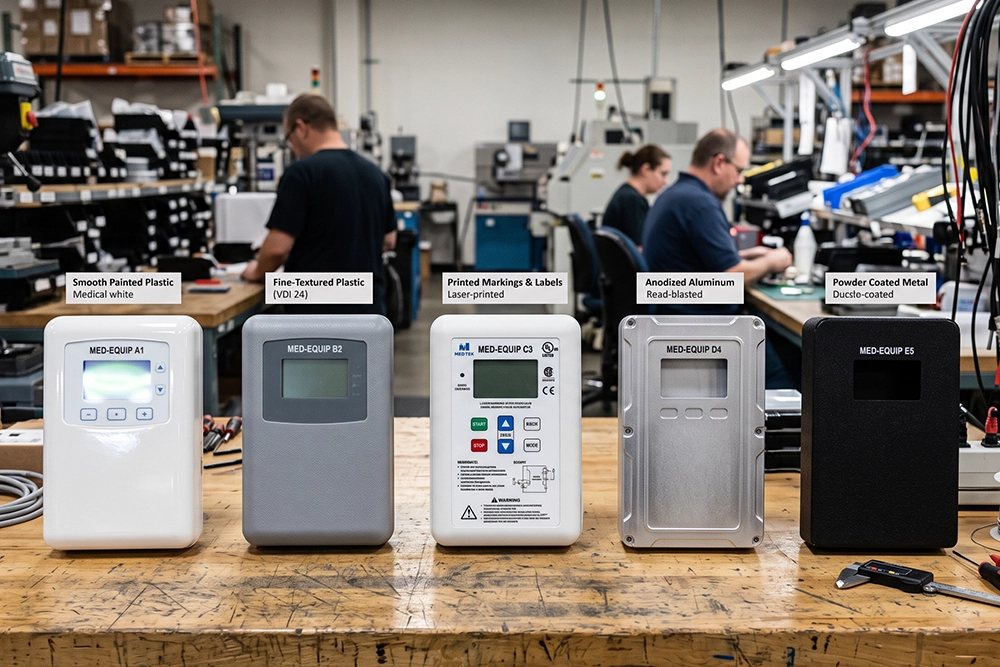
The enclosure panels received matte baked-paint finishing. The different color areas were processed according to the approved appearance requirements.
8. Decorative Strip Installation
The blue vertical decorative strips were installed and aligned with the corresponding enclosure features.
9. Assembly
The three enclosure modules were assembled onto the common base platform. Module gaps, alignment and interference conditions were checked during assembly.
10. Inspection and Packaging
Completed assemblies and critical components were inspected before packaging and delivery.
For customers evaluating similar projects, our broader Manufacturing capabilities can be integrated with the engineering and enclosure workflow rather than treated as separate processes.
Quality Inspection
Quality control was applied at both the component and assembly levels.
Depending on the feature and production stage, our inspection process can include:
- CMM inspection for critical dimensional relationships
- Height-gauge inspection for reference dimensions
- Micrometer measurement for precision features
- Caliper measurement for general dimensions
- First Article Inspection for initial production parts
- Final inspection before shipment
For this project, particular attention was given to the central observation window, module alignment, enclosure gaps, base mounting-hole positions and overall assembly consistency.
The inspection strategy is important for large modular equipment because a part can meet its individual drawing dimensions while the complete assembly still shows alignment problems. Our team therefore considers both component accuracy and system-level fit.
Final Results
The completed enclosure demonstrated the expected results of our quantum computer enclosure manufacturing approach, combining modular construction, controlled assembly gaps and a consistent industrial appearance.
The left and right electrical cabinets maintained a symmetrical arrangement around the central physical host cabinet. The observation window was positioned within the central module, while the surrounding ventilation areas provided the required open structure for heat dissipation.
The matte dark-gray and silver-gray finish, combined with the blue vertical decorative elements, produced the requested technical and industrial appearance.
From a manufacturing perspective, the most important result was not simply producing the individual panels. It was achieving consistent relationships between large components during final assembly.
The project was subsequently moved into mass production, demonstrating that the enclosure concept could be translated from a small-batch manufacturing stage into a repeatable production process.
The customer-specific feedback was not disclosed for publication, so we do not attribute an unverified testimonial to the project.
Why Choose Zhongrongda
Our experience in quantum computer enclosure manufacturing also gives us practical insight into the challenges associated with large equipment housings, including dimensional accumulation, ventilation openings, surface finishing and final assembly.
At Zhongrongda, we support enclosure projects from engineering review through prototype, small-batch production and larger-scale manufacturing.
Engineering Support
Our engineering team evaluates drawings, materials, assembly relationships, manufacturing risks and critical dimensions before production.
Fast Quotation and DFM Review
Customers can submit drawings, 3D files or project specifications for an engineering review. We identify manufacturability concerns before production rather than waiting until assembly.
Rapid Prototyping
When a new enclosure requires physical validation, our Rapid Prototyping service can be used to verify dimensions, appearance and assembly before production.
Small-Batch Manufacturing
This project demonstrates our ability to support large and complex equipment housings where relatively low initial quantities still require careful engineering and quality control.
Medical and Industrial Enclosure Experience
Our enclosure manufacturing experience also covers specialized applications such as Medical Device Enclosure, Laboratory Equipment Enclosures, Diagnostic Equipment Enclosures, Medical Robot Enclosures and Large Medical Equipment Enclosures.
The same engineering principles—dimensional control, assembly alignment, surface quality and functional ventilation—are important across many types of sophisticated equipment.
Quality and Confidentiality
Our quality management system includes ISO9001 and ISO13485 certification. For confidential development projects, we can also support NDA arrangements to protect customer drawings and technical information.
FAQ
1. What is the typical MOQ for a custom equipment enclosure?
MOQ depends on the enclosure structure, material, manufacturing process and production requirements. We can support prototype, small-batch and larger production quantities. For complex equipment enclosures, we recommend discussing the required annual or project quantity during the quotation stage.
2. Can Zhongrongda manufacture large equipment enclosures?
Yes. This project involved an overall enclosure size of approximately 2200 × 950 × 1100 mm. Large enclosures require additional attention to deformation, straightness, transportation, assembly references and dimensional accumulation.
3. What tolerance can you achieve for PC-ABS enclosure components?
Tolerance depends on the feature size, geometry, material and manufacturing process. For this project, the central observation window required a ±0.2 mm dimensional tolerance. Critical dimensions should be identified during DFM review so the appropriate manufacturing and inspection methods can be selected.
4. What materials can be used for custom equipment enclosures?
Depending on the application, enclosure projects may use engineering plastics, aluminum, steel, stainless steel or combinations of different materials. PC-ABS was selected for this project based on the customer’s structural and appearance requirements.
5. What surface finishes are available?
We can support different surface-finishing requirements depending on the material and application, including painted finishes and other specified treatments. This project used a matte baked-paint finish with multiple exterior colors and blue decorative elements.
6. Can you manufacture a custom quantum computer enclosure from customer drawings?
Yes. Customers can provide 2D drawings, 3D CAD files, dimensions or even an initial enclosure concept. Our engineering team can review the design for manufacturability, assembly and production risks before quotation.
7. Can you sign an NDA before reviewing technical drawings?
Yes. NDA arrangements can be discussed when a project contains confidential product designs, engineering information or proprietary equipment details.
8. Do you support rapid prototyping before production?
Yes. Rapid Prototyping can be used to validate important dimensions, appearance, assembly relationships and functional interfaces before committing to larger production quantities.
9. Can you support small-batch manufacturing?
Yes. Small-batch manufacturing is suitable for new equipment, engineering validation, pilot production and specialized industrial products. We can review the quantity and manufacturing process together to determine the appropriate production approach.
10. Can you manufacture enclosures for medical and laboratory equipment?
Yes. Our enclosure solutions include Medical Device Enclosure, Laboratory Equipment Enclosures, Diagnostic Equipment Enclosures, Medical Robot Enclosures and Large Medical Equipment Enclosures.
CTA
Need a reliable CNC machining partner for your next project?
Upload your drawings today and our engineering team will provide a free DFM review and quotation within 24 hours.
Whether you are developing a quantum computing enclosure, laboratory equipment housing, diagnostic system, medical device enclosure or another large industrial enclosure, we can help evaluate the design, manufacturing process and assembly requirements.
For project discussions, drawings and quotation requests, please Contact our engineering team.