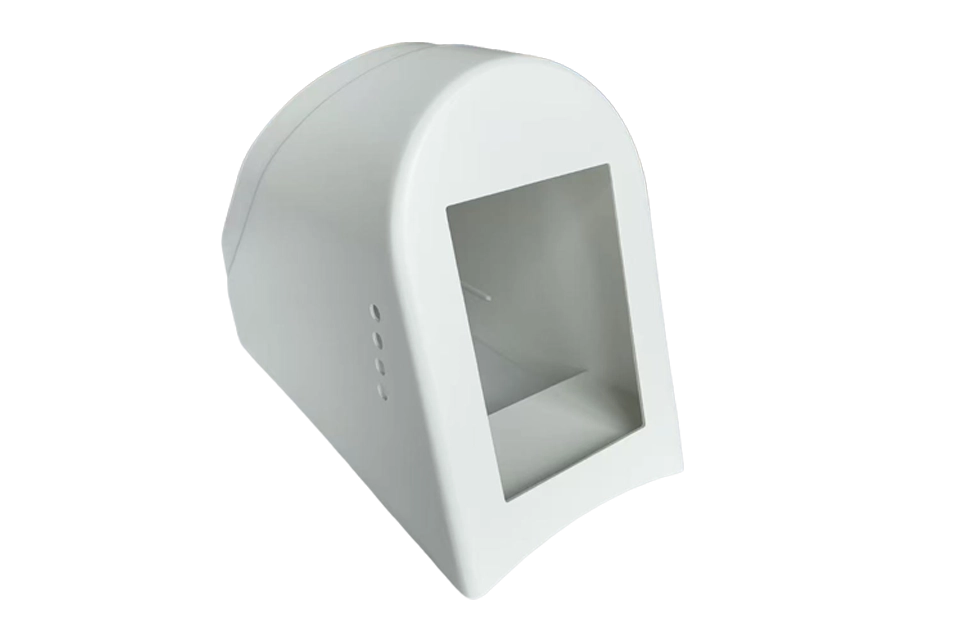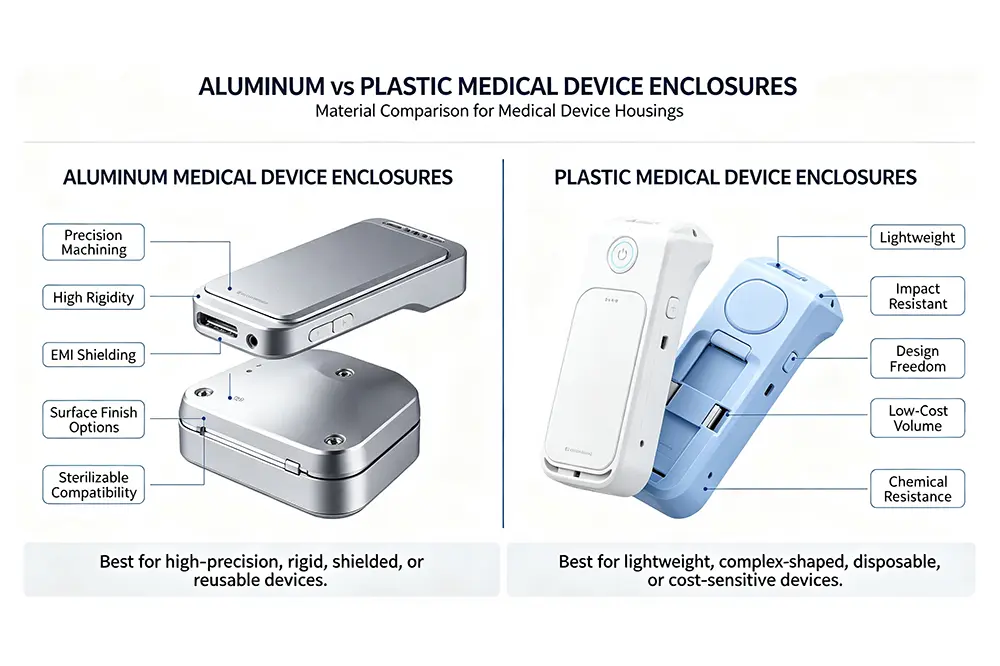
A laboratory equipment enclosure has to do more than cover the internal mechanism. For automated laboratory analyzers, the housing must protect motion systems and electronic components, provide access to critical operating areas, allow operators to observe the testing process, and maintain a clean appearance suitable for medical and laboratory environments.
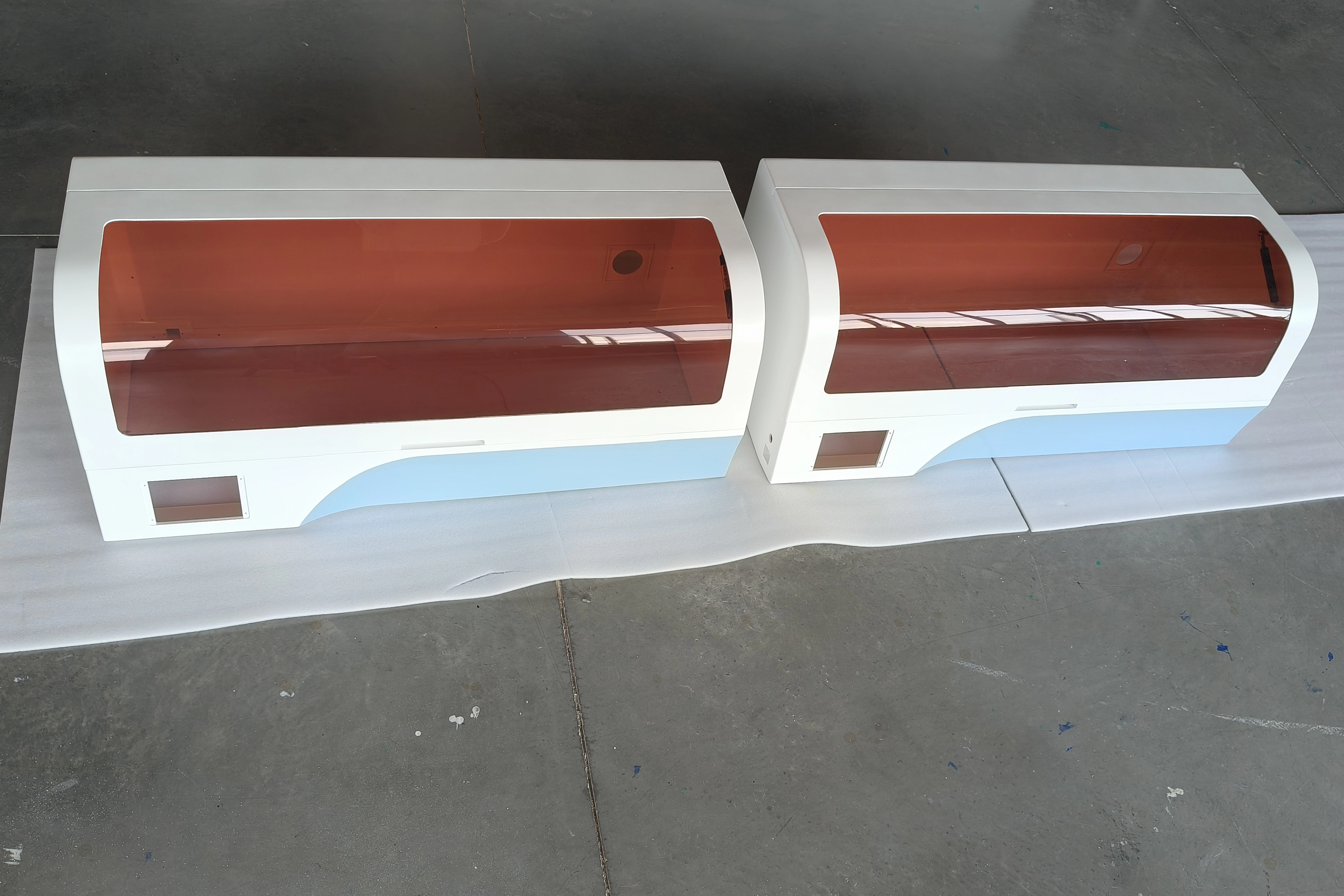
At Zhongrongda, our engineering team recently completed a production project for a large automated laboratory analyzer housing. The equipment is designed for applications such as hospital laboratory departments and professional testing laboratories. Its internal system includes motion mechanisms, electronic control components, and testing modules that require protection from dust and accidental contact while remaining accessible for maintenance.
The project required two different enclosure sizes. The larger housing measured approximately 1180 × 520 × 410 mm, while the smaller version measured approximately 980 × 480 × 385 mm.
The housings were manufactured using PC-ABS plastic construction with CNC prototype processing and thermoforming methods, combined with tinted acrylic observation windows.
The project has now moved into mass production, making it a good example of how we approach large custom plastic housings when appearance, dimensional control, structural rigidity, and assembly accuracy all need to work together.
For similar projects, our experience in [Laboratory Equipment Enclosures] allows us to evaluate the enclosure structure, manufacturing process, interfaces, and finishing requirements before production begins.
Project Overview
| Item | Project Details |
|---|---|
| Industry | Medical & Laboratory Equipment |
| Application | Automated Laboratory Analyzer |
| Country | Customer location not disclosed |
| Material | PC-ABS plastic + tinted acrylic |
| Large Housing Size | 1180 × 520 × 410 mm |
| Small Housing Size | 980 × 480 × 385 mm |
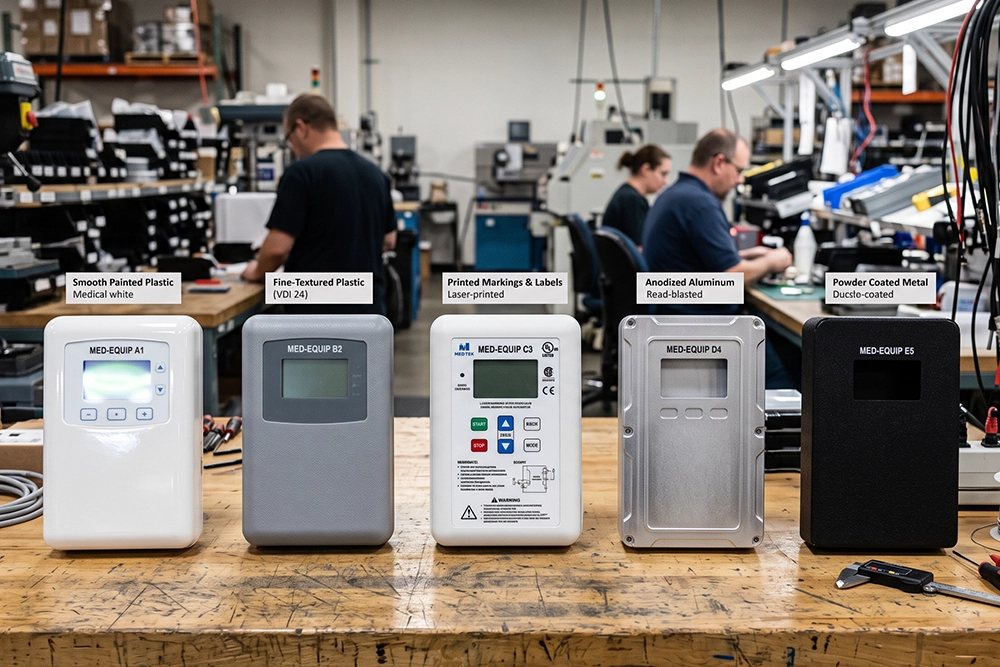
| Surface Finish | Matte two-tone painted finish |
| Key Tolerances | Display opening ±0.2 mm; controlled acrylic fit and assembly alignment |
| Manufacturing Process | Plastic sheet fabrication, CNC machining, thermoforming, acrylic cutting, sanding, painting and assembly |
| Quantity | Small batch initially; subsequently moved to production |
| Lead Time | Project-specific; not publicly disclosed |
Customer Requirements
The customer needed a large enclosure capable of protecting the internal mechanism of an automated laboratory analyzer while maintaining a clean and modern appearance.
The enclosure had four primary functions.
1. Protect Internal Components
The housing surrounds the internal motion mechanism, control boards, electrical components, and testing assemblies.
The enclosure therefore needed sufficient rigidity while providing protection against dust and accidental external contact.
2. Provide Clear Visibility
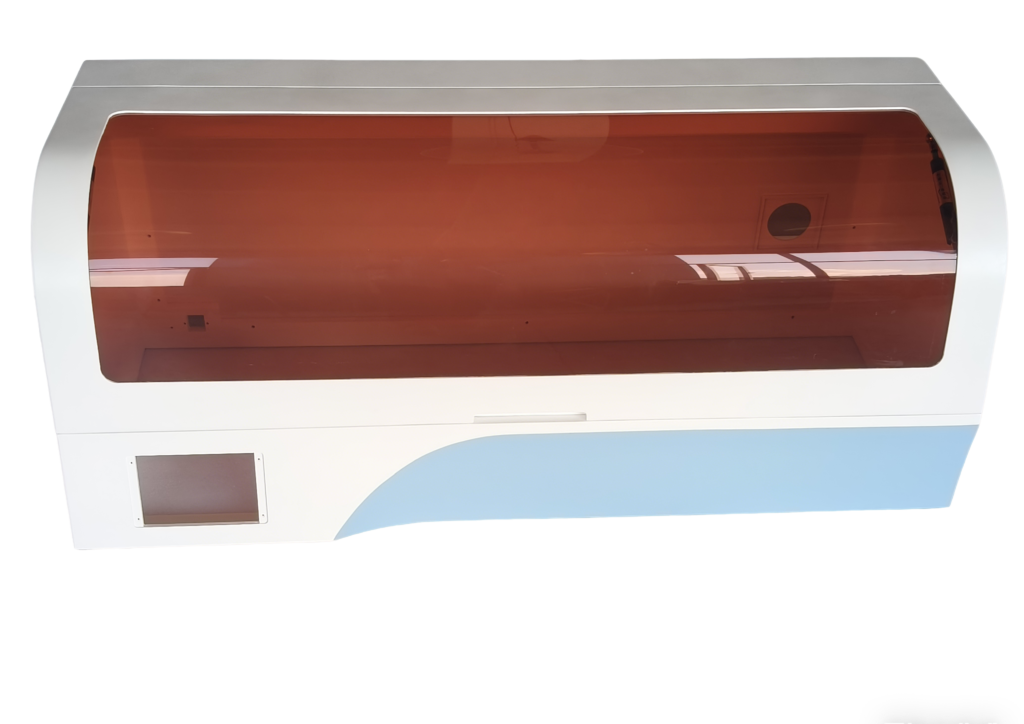
A long, curved tinted acrylic window was required across the upper section.
The operator needs to see the internal testing area during equipment operation without opening the enclosure.
For the large version, the acrylic window frame measures approximately 1040 × 265 mm.
The smaller housing uses an approximately 845 × 240 mm window.
3. Provide Functional Access
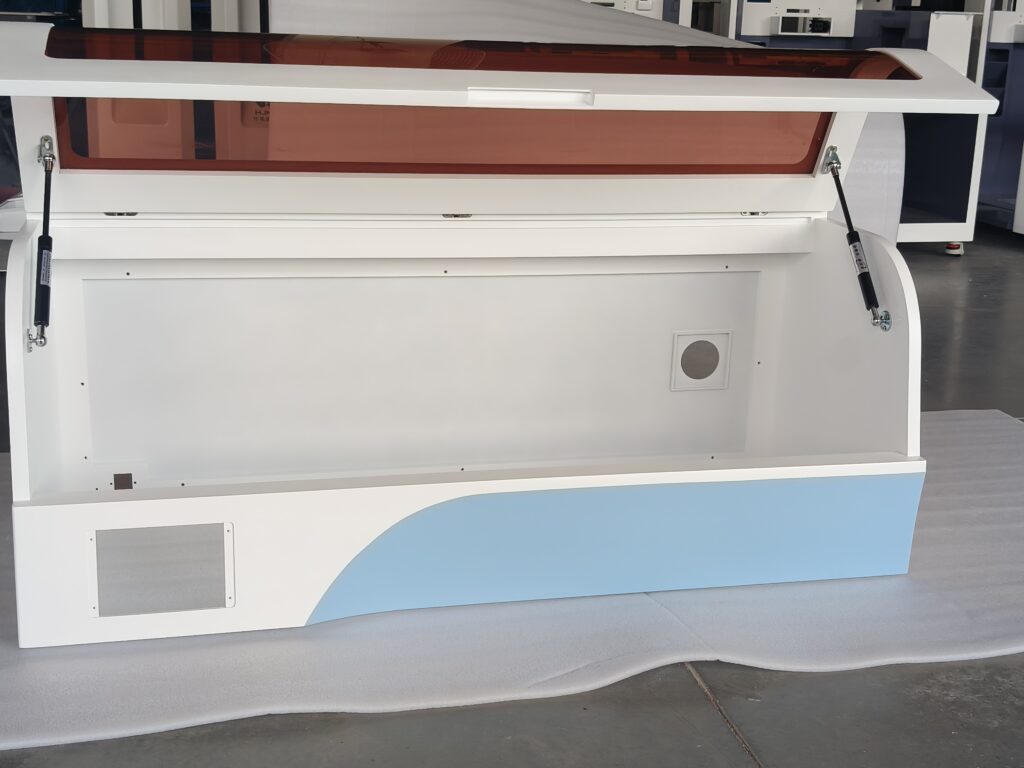
The lower section includes a dedicated square operating window for the reagent and operating area.
The larger opening measures approximately 150 × 115 mm, while the smaller version measures approximately 140 × 110 mm.
A rear Ø85 mm cable routing opening was also incorporated, with the hole center positioned approximately 95 mm from the top surface.
The upper cover needed to remain accessible so technicians could inspect and maintain the internal mechanism.
4. Maintain a Medical-Laboratory Appearance
The customer specified a clean, understated appearance rather than a heavily industrial enclosure.
The design combines:
- White curved upper housing
- White and light-blue lower sections
- Long tinted acrylic observation window
- Large-radius corners
- Matte painted surfaces
- Optional silk-screened logos and model markings
This combination gives the analyzer a cleaner appearance suitable for laboratory and healthcare environments.
Manufacturing Challenges
Large Curved Plastic Housing
The first challenge was the overall size of the enclosure.
A housing exceeding one meter in length can be difficult to keep straight and rigid, particularly when large curved surfaces are involved.
If the plastic structure is not properly supported during fabrication, deformation can become visible after assembly.
Our approach was to divide the enclosure into manageable sections and control the forming, machining, joining, and finishing processes individually before final assembly.
The objective was to achieve a smooth continuous appearance after the upper and lower sections were assembled.
Long Curved Observation Window
The tinted acrylic observation window was another critical interface.
The installation groove was designed with a depth of approximately 12 mm, while the acrylic assembly clearance was controlled to approximately 0.8–1.2 mm per side.
The challenge was to create enough clearance for practical assembly without allowing the acrylic to move excessively inside the housing.
An inconsistent gap would also be highly visible because of the long window length.
Display Opening Accuracy
The lower display opening required tighter dimensional control than the general external surfaces.
The specified display opening tolerance was approximately ±0.2 mm.
This required us to treat the display interface as a functional machining feature rather than simply an appearance feature.
The surrounding surfaces could have different dimensional requirements, but the display opening had to remain stable enough for the downstream component to fit correctly.
Two-Tone Painting
The customer required a white and light-blue two-tone finish.
Large painted housings can easily develop problems at color boundaries, particularly when masking long curved surfaces.
Our finishing process therefore focused on surface preparation, masking accuracy, paint coverage, and controlled separation between the two colors.
The objective was a clean boundary without visible overspray or color bleeding.
Upper and Lower Housing Alignment
The enclosure consists of large upper and lower sections.
After painting, even a small alignment error can become obvious along a long enclosure seam.
We therefore paid particular attention to the mating surfaces, locating features, and assembly sequence so that the two halves could be aligned consistently.
Our Engineering Solution
For this project, our engineering team focused on the interfaces that would have the greatest impact on final assembly and appearance.
DFM Review
Before manufacturing, we reviewed the enclosure from a manufacturing perspective.
The main areas of attention included:
- Large curved surfaces
- Acrylic window installation
- Display opening
- Internal mounting locations
- Upper and lower housing interfaces
- Cable routing opening
- Handle groove
- Painting and masking requirements
This allowed us to separate critical functional dimensions from cosmetic dimensions.
CNC Machining Strategy
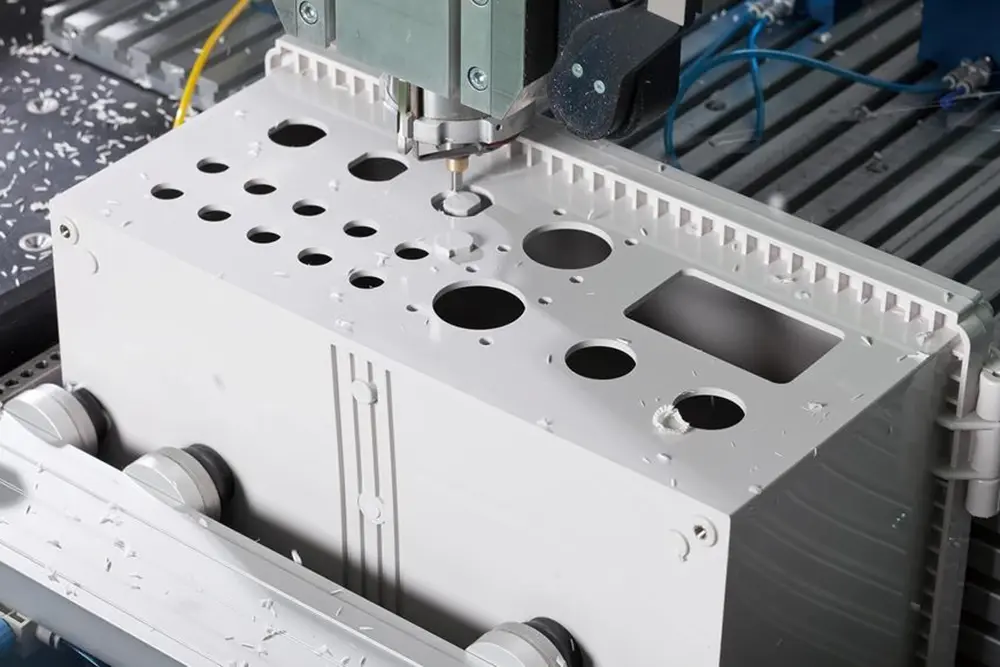
CNC machining was used where accurate openings and interfaces were required.
For example, the display opening and acrylic installation features required significantly tighter control than broad external surfaces.
The handle groove was also incorporated into the housing design, with an approximate length of 220 mm, width of 18 mm, and depth of 6 mm.
By controlling these features during machining rather than relying only on manual finishing, we could achieve more consistent production results.
Surface Preparation
After plastic fabrication and machining, the housing underwent extensive surface preparation.
The sequence included:
Plastic fabrication → CNC machining → joining → filling → sanding → leveling → primer → sanding → masking → painting
This was particularly important for the long curved surfaces.
Small scratches, joints, or uneven areas that might not be obvious on an unfinished component can become highly visible after matte painting.
Assembly Control
The acrylic window, internal structure, upper and lower housing sections, and functional openings all needed to work together.
Our engineering team therefore considered the assembly sequence rather than treating each component independently.
This helped reduce interference between the enclosure and internal equipment structure and supported more consistent housing alignment during production.
Manufacturing Process
1. DFM Review
We first reviewed the drawings and enclosure structure, identifying critical interfaces, assembly points, and high-risk cosmetic areas.
2. Programming
CNC machining programs were prepared for the required openings, profiles, grooves, and interface features.
3. Material Preparation
PC-ABS plastic material and tinted acrylic were prepared according to the project requirements.
4. Plastic Fabrication
The plastic enclosure sections were fabricated and joined to create the required large curved housing geometry.
5. CNC Machining
Critical openings, mounting features, display interfaces, cable holes, and other defined features were machined.
6. Deburring and Surface Preparation
Machined edges were cleaned and the enclosure surfaces were prepared for subsequent finishing.
7. Surface Finishing
The housing went through sanding, primer application, additional surface leveling, masking, and matte two-tone painting.
8. Acrylic Installation
The tinted acrylic observation window was cut and fitted into the dedicated installation groove.
9. Assembly
Upper and lower housing sections were assembled with the equipment structure and checked for interference and alignment.
10. Inspection and Packaging
Finished housings were inspected for dimensions, appearance, openings, assembly fit, surface quality, and overall alignment before packaging.
This manufacturing approach is part of our broader [Manufacturing] capability for custom equipment housings.
Quality Inspection
Quality control for a large plastic enclosure cannot depend on one measurement method.
We use different inspection tools according to the feature being evaluated.
Typical inspection methods include:
- Calipers for general dimensions and openings
- Micrometers for selected dimensional checks
- Height gauges for positional and height-related measurements
- CMM inspection when the project requires coordinate-based dimensional verification
- First Article Inspection for critical production features
- Visual inspection for paint, seams, scratches, color boundaries, and surface defects
- Final assembly inspection for fit, alignment, and interference
For this project, particular attention was placed on the ±0.2 mm display opening, acrylic window fit, upper and lower housing alignment, internal mounting hole positions, and overall appearance.
The inspection focus is determined by the function of each feature rather than applying the same tolerance to every surface.
Final Results
The final PC-ABS laboratory analyzer housings successfully progressed from prototype and small-batch manufacturing into production.
The finished enclosure combines:
- Large curved plastic panels
- Tinted acrylic observation windows
- Accurate functional openings
- Matte two-tone painting
- Serviceable upper cover construction
- Internal equipment protection
- Controlled upper and lower housing alignment
The long curved observation window provides visibility into the internal testing area, while the enclosed lower structure protects the analyzer’s electrical and mechanical components.
From our perspective, the most important result was not simply achieving the required appearance.
The enclosure had to remain manufacturable and repeatable after moving from an individual prototype into production.
That transition—from prototype fabrication to repeatable manufacturing—is where enclosure engineering becomes especially important.
For more examples of our custom enclosure work, see our [Case Studies].
Why Choose Zhongrongda
At Zhongrongda, we approach custom equipment housings from both the engineering and manufacturing sides.
Our team supports customers with:
Engineering Support
We review enclosure structures, critical interfaces, materials, tolerances, and manufacturing methods.
Fast Quotation & DFM Review
Customers can submit drawings or 3D files for an engineering review before production.
Rapid Prototyping
We can support prototype development before customers commit to larger production quantities. Our [Rapid Prototyping] service is particularly useful when enclosure appearance and fit need to be validated early.
Small-Batch Production
Projects can begin with small quantities before moving toward larger production requirements.
Quality Control
Our manufacturing system operates under ISO 9001 and ISO 13485 quality management certifications.
Confidential Project Support
NDA arrangements can be provided for projects involving proprietary equipment designs, drawings, or product development information.
Our focus is not simply to manufacture a plastic shell.
We work with product designers, mechanical engineers, purchasing teams, and equipment manufacturers to develop practical enclosure solutions that can move from prototype to production.
Learn more about our company and manufacturing capabilities through [About Us] and our [VR Factory Tour].
FAQ
1. What is a laboratory equipment enclosure?
A laboratory equipment enclosure is a protective housing designed around laboratory instruments or automated testing equipment. It can protect internal mechanical and electronic components while providing functional openings, operator access, ventilation, observation windows, and a finished external appearance.
2. What materials can be used for a custom laboratory equipment enclosure?
Material selection depends on the equipment structure, size, appearance, operating environment, and production requirements. Common options include PC-ABS, ABS, acrylic, sheet metal, aluminum, and other engineering plastics.
For this project, we used PC-ABS plastic with tinted acrylic for the observation window.
3. Can Zhongrongda manufacture large plastic equipment housings?
Yes. Large housings can be manufactured using a combination of plastic fabrication, CNC machining, thermoforming, joining, surface finishing, and assembly processes.
The manufacturing method depends on the enclosure geometry and required production quantity.
4. What tolerance can you achieve on a custom enclosure?
Tolerance depends on the material, feature size, manufacturing process, and functional requirement.
For this project, the display opening required approximately ±0.2 mm, while other enclosure surfaces were controlled according to their specific assembly and appearance requirements.
We recommend defining tighter tolerances only where they are functionally necessary.
5. Can you manufacture acrylic observation windows?
Yes. Acrylic panels can be cut and prepared as part of a complete enclosure project.
For this laboratory analyzer, the tinted acrylic observation window was integrated into a dedicated groove in the PC-ABS housing, with an approximately 0.8–1.2 mm clearance per side.
6. Do you support rapid prototyping for medical and laboratory equipment?
Yes. We support prototype development for custom equipment housings so customers can verify dimensions, appearance, component fit, and assembly before moving into production.
7. Can you manufacture small batches?
Yes. Small-batch manufacturing is available for customers who need prototype quantities, engineering validation units, pilot production, or an initial production run before scaling.
8. Can you sign an NDA for a laboratory equipment enclosure project?
Yes. NDA arrangements can be discussed when customers need to protect proprietary product designs, drawings, specifications, or development information.
9. Can you manufacture complete medical or laboratory equipment enclosures?
Yes. Our enclosure capabilities cover medical device enclosures, laboratory equipment enclosures, diagnostic equipment housings, medical workstations, medical carts, and other custom equipment housings.
10. How do I start a custom enclosure project with Zhongrongda?
Send us your drawings, 3D CAD files, dimensions, material requirements, quantity, and surface-finishing requirements.
Our engineering team can review the project, identify potential manufacturing issues, and provide a quotation based on the actual requirements.
CTA
Need a Reliable Partner for Your Next Laboratory Equipment Enclosure?
Whether you are developing an automated laboratory analyzer, diagnostic system, medical instrument, or other professional equipment, the enclosure needs to balance engineering accuracy, structural performance, appearance, manufacturability, and production consistency.
At Zhongrongda, our engineering team can support your project from prototype development through production.
Upload your drawings today and our engineering team will provide a free DFM review and quotation within 24 hours.
For your next custom enclosure project, [Contact] our team to discuss your requirements.