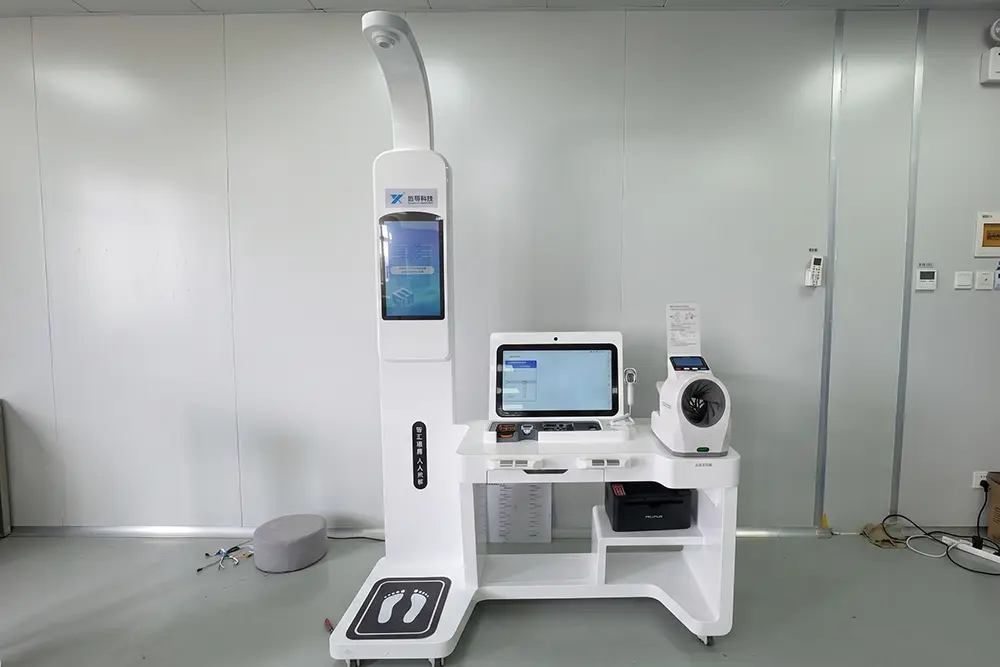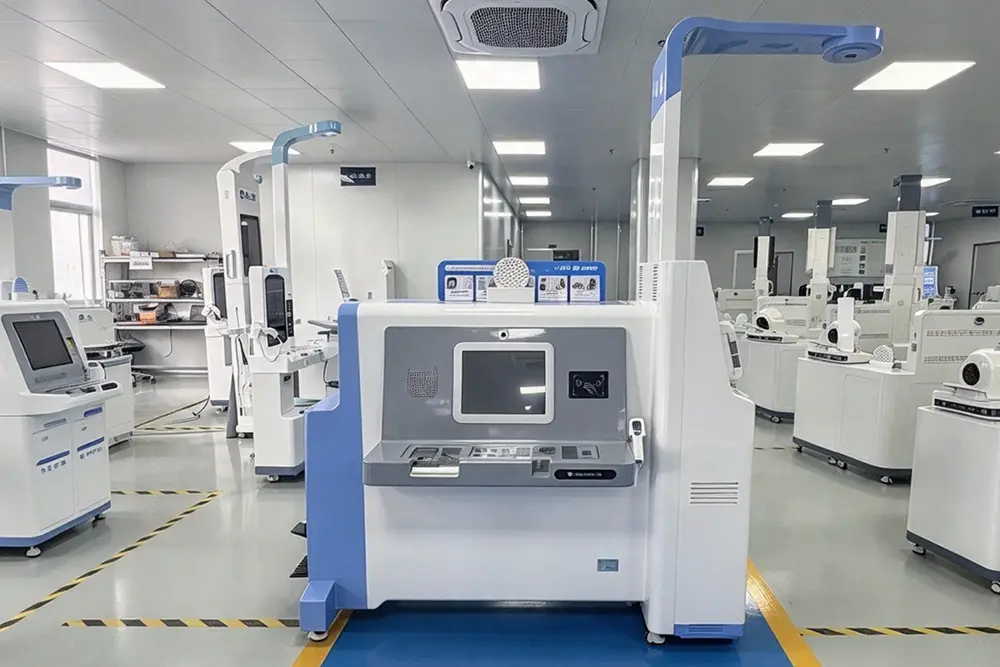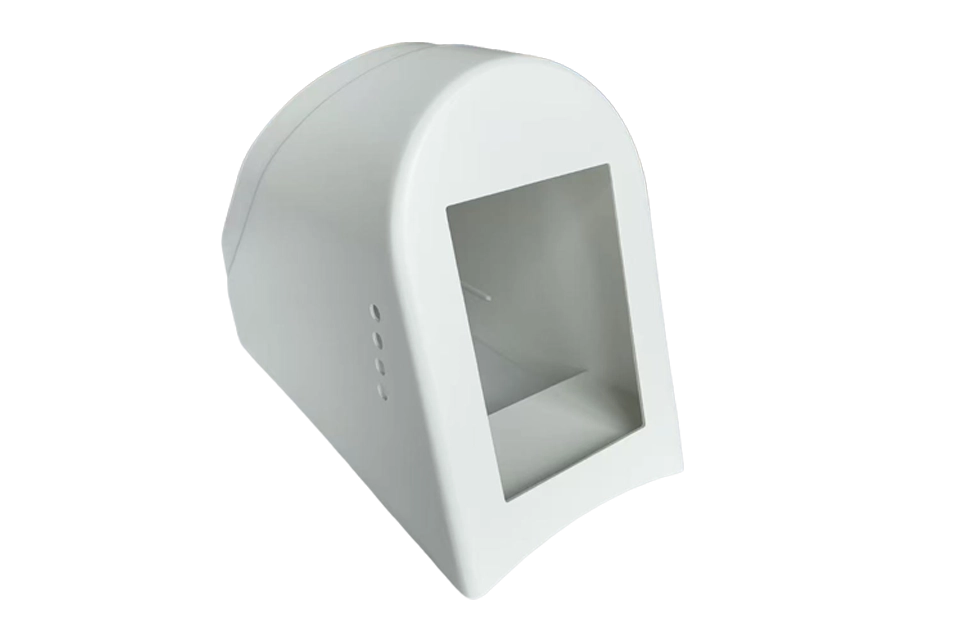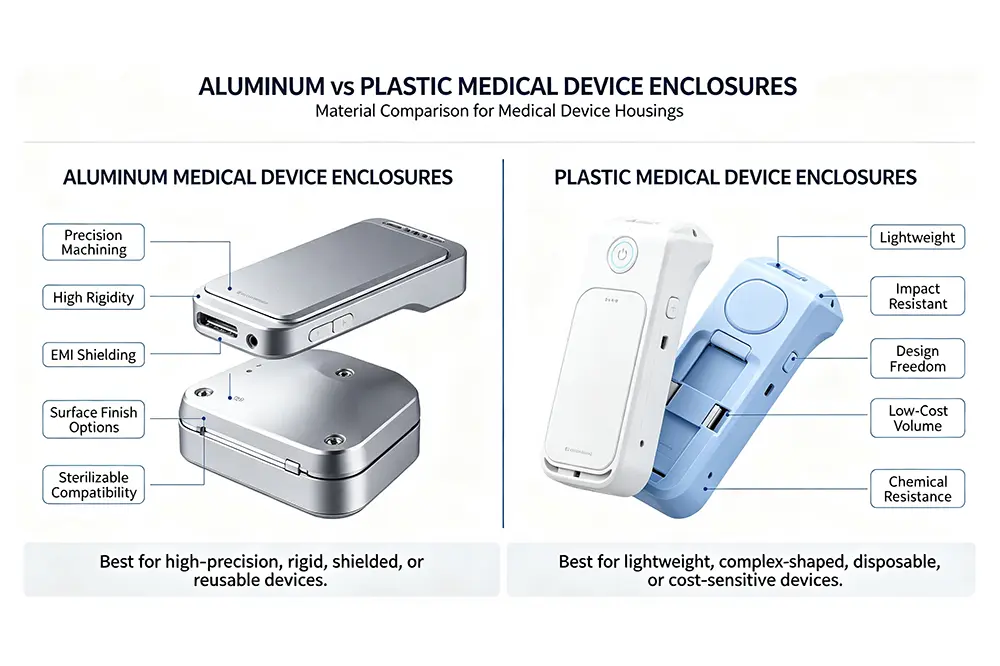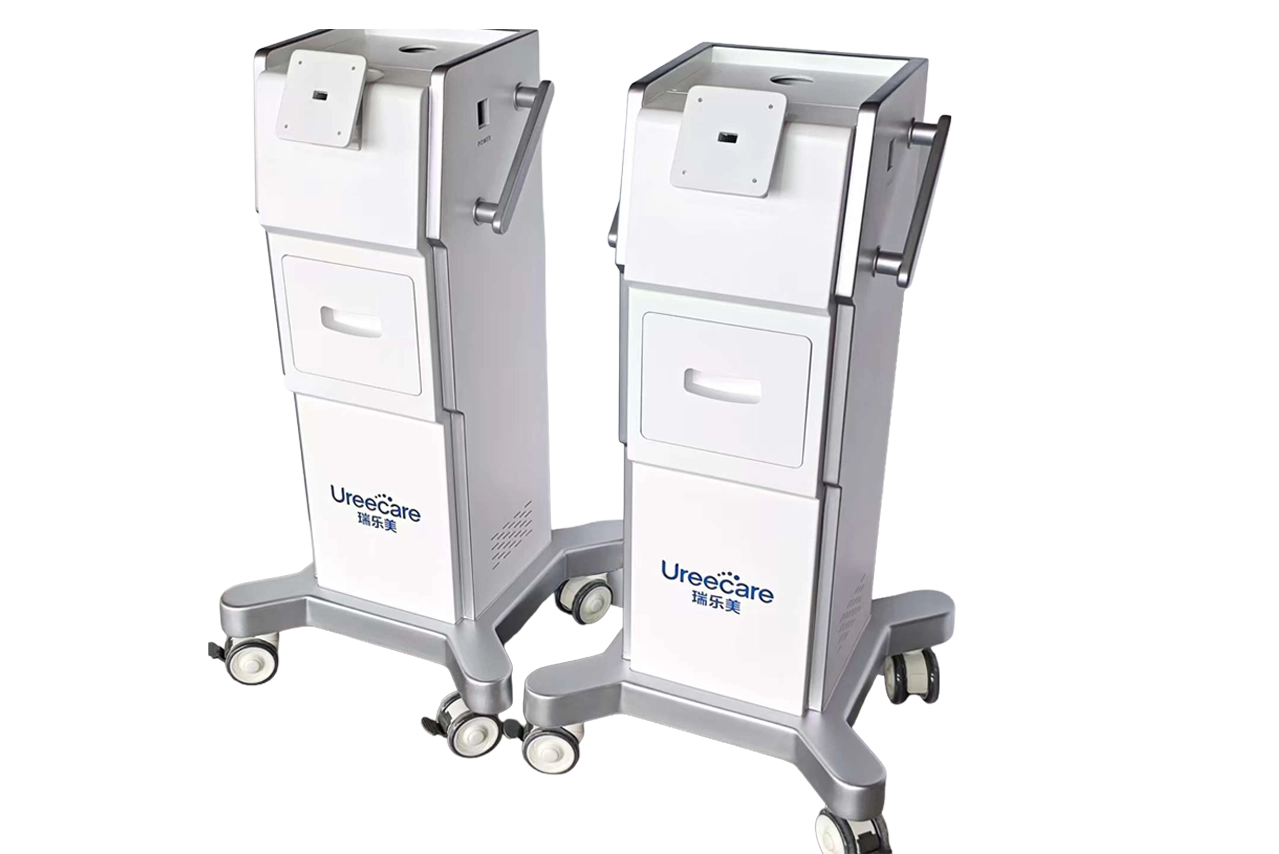
A medical device cart enclosure must do more than provide an attractive outer shell. It needs to protect internal electronics, support displays and accessories, allow convenient maintenance, and remain stable when the complete equipment is moved between treatment rooms or clinical environments.
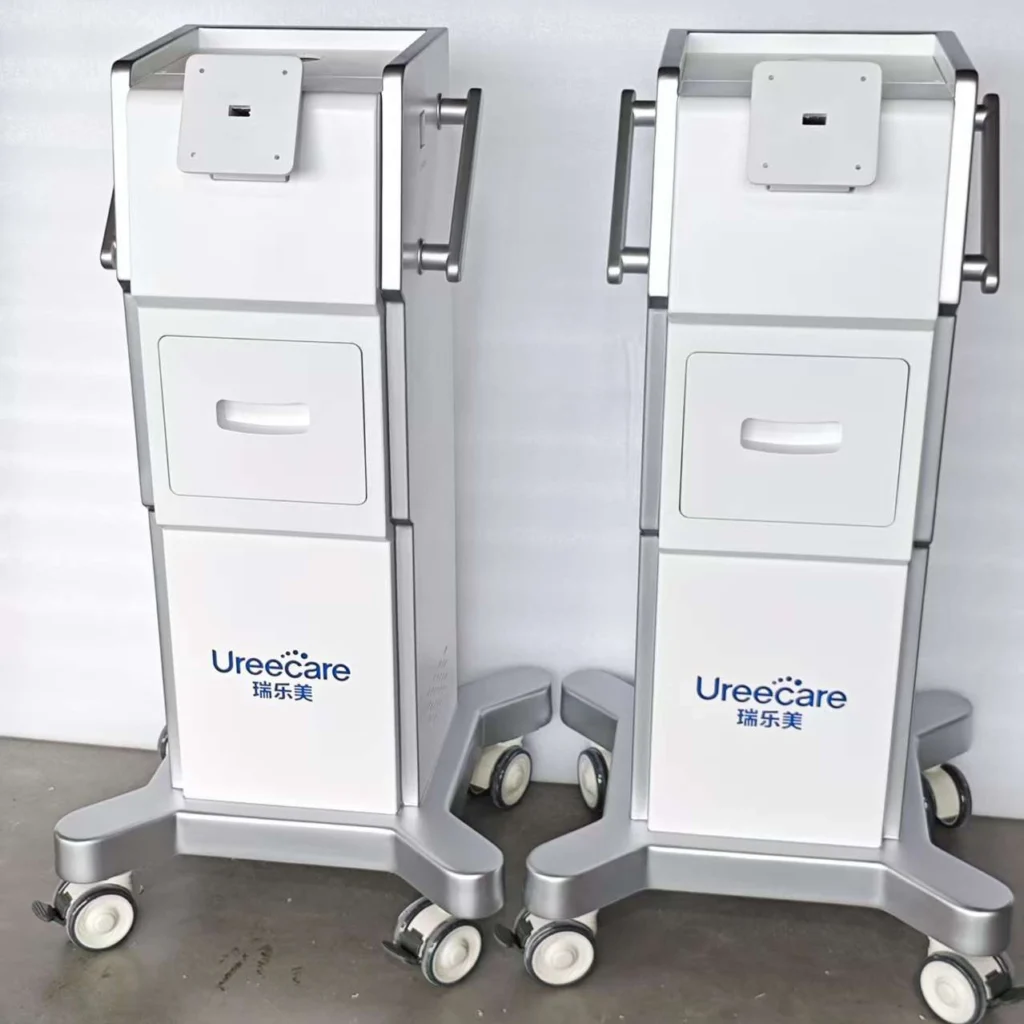
At Zhongrongda, we recently completed a mass-production project for a vertical mobile cart housing used with a rehabilitation and medical aesthetic therapy system. The enclosure had to combine a clean medical appearance with practical storage, display mounting, cable routing, service access, and stable four-wheel mobility.
The customer required a white ABS outer housing combined with a silver metal frame and base. The complete cart reached approximately 1,520 mm in height, making structural stability and center-of-gravity control important considerations during engineering.
Our engineering team worked through the enclosure structure, panel interfaces, drawer assembly, mounting-hole positioning, and production processes before moving into mass production. The project ultimately entered mass production, demonstrating how coordinated plastic, aluminum-profile, and sheet-metal manufacturing can be used to build a complete medical equipment cart.
For similar projects, our Medical Cart & Workstation Enclosures capability supports customers from enclosure development through production and assembly.
Project Overview
| Item | Project Specification |
|---|---|
| Industry | Medical / Rehabilitation / Medical Aesthetic Equipment |
| Application | Mobile therapy and rehabilitation equipment cart |
| Country | China |
| Material | ABS plastic, aluminum profile, sheet metal |
| Dimensions | Overall height: 1,520 mm; main cabinet: W420 × D360 mm |
| Surface Finish | White matte painted/plastic finish; anodized aluminum frame |
| Tolerance | Critical mounting holes: ±0.2 mm |
| Manufacturing Process | CNC machining, thermoforming/injection molding, aluminum bending/assembly, sheet-metal welding, assembly |
| Quantity | Mass production |
| Lead Time | Managed according to production schedule and customer requirements |
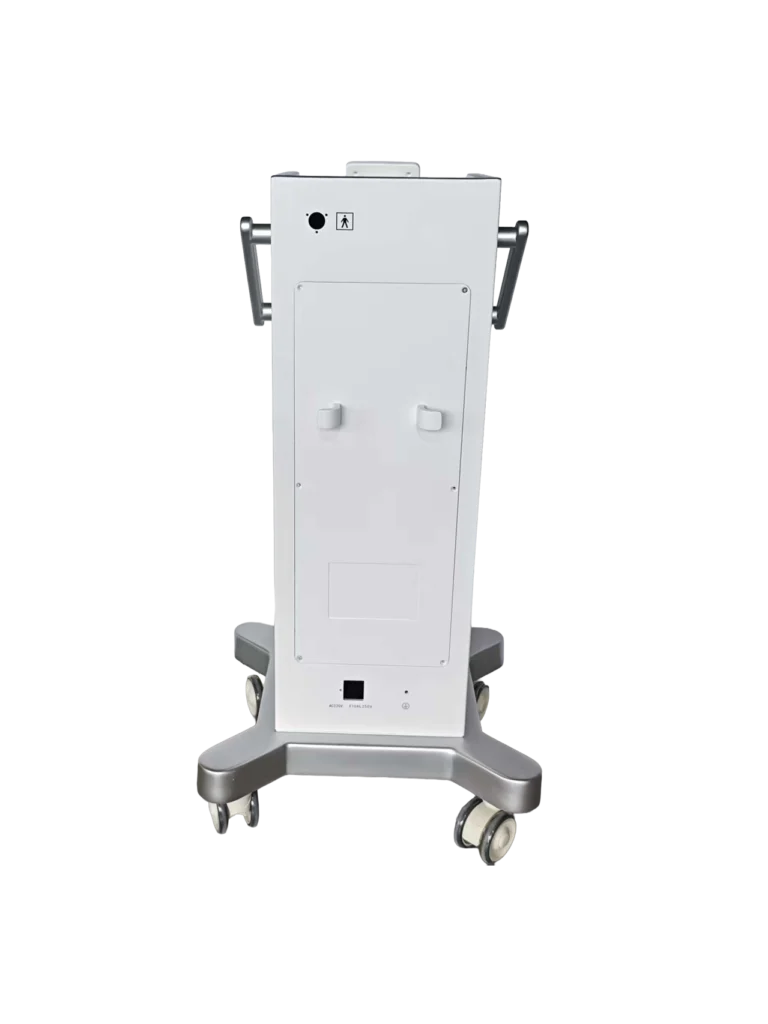
The enclosure included a 620 mm maximum-width base, a 210 × 210 mm display mounting plate, a 310 × 240 mm drawer frame, and a 330 × 440 mm lower logo panel. The handle used Ø32 mm tubing with a 95 mm extension, while Ø100 mm casters provided mobile support.
Customer Requirements
The customer needed a complete enclosure system suitable for a freestanding medical and rehabilitation device.
From a functional perspective, the cart needed to accommodate the main control electronics, display, handpiece accessories, and internal wiring. A pull-out storage drawer was required for daily-use accessories, while the top section needed a dedicated mounting area for the display.
The two side handles had to provide convenient control when moving the equipment. At the bottom, silent universal casters were required to make the equipment easier to transfer between rooms.
Appearance was equally important. The customer specified a pure white outer housing with a silver metallic frame and base, creating a clean and understated medical aesthetic. The housing also needed a designated area where the customer’s brand logo could be applied.
Assembly requirements included:
- Convenient removal and installation of individual panels
- Adequate internal service and maintenance space
- Smooth and unobstructed cable-routing channels
- Consistent panel gaps
- No visible warping after final assembly
- Smooth drawer operation
- Accurate display mounting
The key dimensional requirement was the display mounting interface, where the screw-hole positions needed to remain within ±0.2 mm.
Manufacturing Challenges
The first challenge was maintaining a consistent visual gap between the ABS housing and aluminum-profile frame. Because the materials have different structures and manufacturing characteristics, uncontrolled interfaces could create uneven gaps or visible misalignment.
The second challenge involved the drawer. A medical equipment cart is frequently used by operators, so the drawer could not simply fit dimensionally; its slide mechanism needed to operate smoothly without sticking or excessive resistance.
The third challenge was overall stability. With a total height of approximately 1,520 mm, the cart needed a stable center of gravity while being pushed on four casters. The base structure therefore had to work together with the housing and internal equipment layout.
The fourth challenge was the display mounting plate. Small positional errors in the mounting holes could affect screen installation and alignment. The specified ±0.2 mm requirement therefore became a critical inspection point.
Finally, the assembled housing needed to maintain consistent panel alignment without warping. A 3 mm assembly gap was incorporated into the design to help achieve a controlled and repeatable fit.
Our Engineering Solution
At Zhongrongda, we approached the project as a complete enclosure system rather than treating the plastic shell as an isolated component.
During the DFM review, our engineering team evaluated the relationship between the ABS panels, aluminum frame, sheet-metal base, drawer, display mounting plate, and internal service areas.
We reviewed the assembly sequence so that components could be installed and removed without creating unnecessary interference. Internal cable-routing space was also considered during the enclosure structure review.
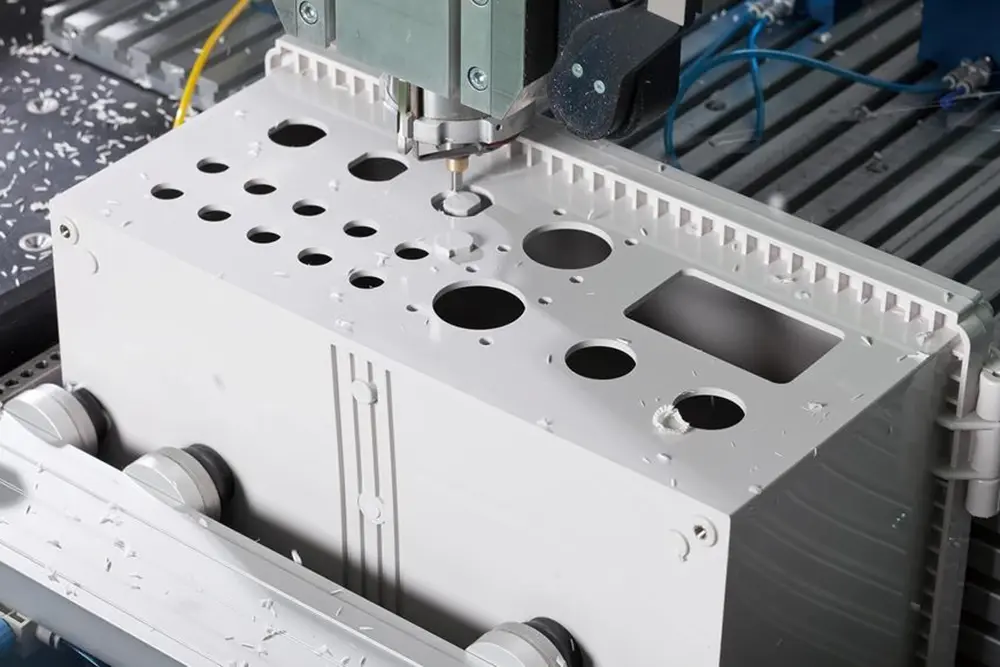
For the plastic housing, the production route incorporated CNC machining together with thermoforming/injection-molding processes according to the individual component requirements. Machined features were controlled around functional interfaces, particularly mounting and assembly areas.
For the aluminum frame, bending and assembly were coordinated to maintain the required relationship between the metal structure and ABS panels. The sheet-metal base was welded and processed as part of the overall supporting structure.
The engineering team also paid particular attention to the drawer interface and display mounting plate. Functional dimensions were separated from less critical cosmetic dimensions so that inspection resources could focus on features that directly affected assembly performance.
This approach allowed us to control the project from DFM through production and final assembly, rather than discovering fit problems after mass production had already started.
Customers looking for a complete manufacturing partner can also review our Manufacturing capabilities and Case Studies for additional project examples.
Manufacturing Process
Our production process followed a structured sequence:
1. DFM Review
We reviewed the drawings, material requirements, assembly interfaces, mounting holes, panel gaps, and production requirements before manufacturing.
2. Programming
CNC programs were prepared for the required machined plastic and metal components. Tool paths were reviewed according to the geometry and functional features.
3. Material Preparation
ABS, aluminum profiles, and sheet-metal materials were prepared according to the approved specifications.
4. CNC Machining
Required plastic and metal components were CNC machined. Critical mounting and interface features received particular attention.
5. Deburring
Edges and machined areas were deburred to eliminate sharp edges and improve assembly safety and appearance.
6. Surface Finishing
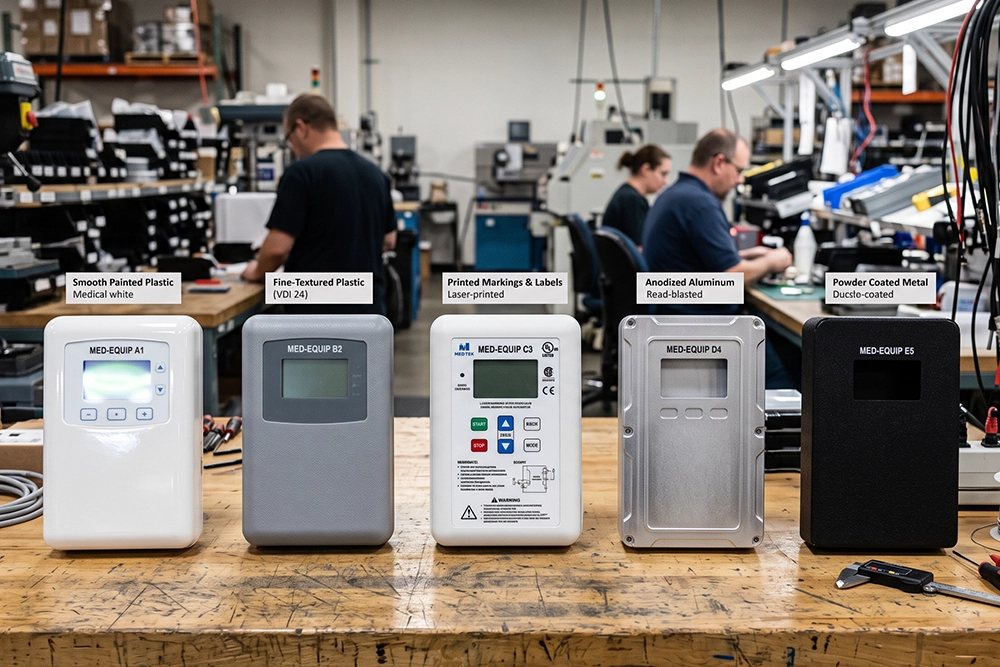
The plastic housing received the specified white finish, while the aluminum frame used anodized treatment to achieve the required silver metallic appearance.
7. Assembly
The aluminum frame, ABS housing, welded sheet-metal base, drawer, display mounting plate, handles, and casters were assembled into the completed mobile cart.
8. Inspection
Dimensional and functional inspections were performed on critical components and the finished assembly.
9. Packaging
Completed units were prepared for shipment with appropriate protection for the finished surfaces and assembled structure.
Quality Inspection
Quality control focused on both dimensional accuracy and actual assembly performance.
For critical dimensions, our inspection process can use CMM inspection, height gauges, micrometers, and calipers according to the feature and measurement requirement.
For this project, particular attention was given to:
- Display mounting-hole positions
- Panel dimensions
- Assembly gaps
- Drawer fit and movement
- Housing-to-frame alignment
- Overall assembly condition
- Visible burrs and surface defects
- Stability of the completed cart
Where required, First Article Inspection (FAI) can be used to verify the initial production sample before continuing with larger production quantities.
Final inspection then checks the completed assembly to ensure that the enclosure, drawer, display mounting area, handles, casters, and major panels meet the approved requirements.
Final Results
The project successfully moved into mass production.
The completed medical equipment cart combined a white ABS enclosure with a silver metal structural frame and base, creating the clean medical appearance required by the customer.
The final structure incorporated:
- A pull-out storage drawer
- Dedicated display mounting position
- Side handles
- Four silent universal casters
- Internal maintenance access
- Reserved cable-routing space
- Brand-logo application area
The key engineering objectives were maintaining consistent housing-to-frame gaps, achieving smooth drawer movement, supporting stable four-wheel mobility, and maintaining accurate display mounting-hole positions.
Rather than optimizing only for the appearance of the enclosure, we focused on the complete relationship between structure, function, assembly, serviceability, and production repeatability.
Why Choose Zhongrongda for Medical Device Cart Enclosures?
At Zhongrongda, we support customers who need more than a component supplier.
Engineering Support
Our engineering team can review drawings, identify manufacturing risks, and recommend practical DFM improvements before production.
Fast Quotation
Customers can send drawings, 3D models, specifications, and quantities for engineering review and quotation.
Rapid Prototyping
We support prototype development to help customers verify dimensions, appearance, assembly, and functional requirements before committing to larger production.
Our Rapid Prototyping service can be integrated into the development process when a physical sample is required.
Mass and Small-Batch Production
We support both prototype development and production quantities, allowing customers to move from engineering validation toward larger-scale manufacturing.
Quality Control
Our manufacturing system is supported by ISO9001 and ISO13485 certifications, with inspection methods selected according to product requirements.
NDA & Confidentiality
For projects involving proprietary medical equipment designs, customers can request an NDA to protect drawings, product concepts, and technical information.
For customers developing new medical equipment, our Medical Device Enclosure solutions can also be integrated with the broader enclosure development process.
FAQ
1. What is the MOQ for a medical device cart enclosure?
MOQ depends on the material, manufacturing process, tooling requirements, and project stage. Prototype quantities can be discussed separately from mass-production requirements.
2. How long does it take to manufacture a medical equipment cart enclosure?
Lead time depends on drawing complexity, material availability, tooling, surface finishing, assembly requirements, and quantity. We confirm the production schedule during quotation.
3. What tolerance can you achieve?
Tolerance depends on the material, process, and feature. For this project, the critical display mounting-hole positions were specified at ±0.2 mm.
4. What materials can be used for medical equipment enclosures?
Common options include ABS and other engineering plastics, aluminum, and sheet metal. Material selection depends on structural, appearance, weight, environmental, and production requirements.
5. What surface finishes are available?
Depending on the material, options can include painting, matte finishes, anodizing, and other specified surface treatments. This project used a white finish for the housing and anodized aluminum for the metal frame.
6. Can you sign an NDA before reviewing our drawings?
Yes. Customers can request an NDA when their project contains confidential product designs, drawings, specifications, or other proprietary information.
7. Do you support rapid prototyping?
Yes. We support rapid prototyping so customers can verify enclosure dimensions, appearance, assembly, and functional interfaces before moving into larger production.
8. Can you manufacture medical device cart enclosures in small batches?
Yes. We can discuss prototype, low-volume, and mass-production requirements based on the project’s manufacturing process and tooling requirements.
9. Can you manufacture complete medical cart assemblies?
Yes. Depending on the project, we can coordinate plastic housings, aluminum structures, sheet-metal components, drawers, mounting panels, and final assembly requirements.
10. Do you manufacture medical device enclosures for overseas customers?
Yes. Zhongrongda works with customers in international markets and supports engineering communication, manufacturing, inspection, and production requirements for medical equipment enclosure projects.
CTA
Need a reliable CNC machining partner for your next project?
Upload your drawings today and our engineering team will provide a free DFM review and quotation within 24 hours.
Whether you need a prototype, small production run, or mass-production solution, we can help evaluate your enclosure structure, material, manufacturing process, assembly requirements, and quality-control requirements.
Contact Zhongrongda today to discuss your next medical equipment enclosure project.