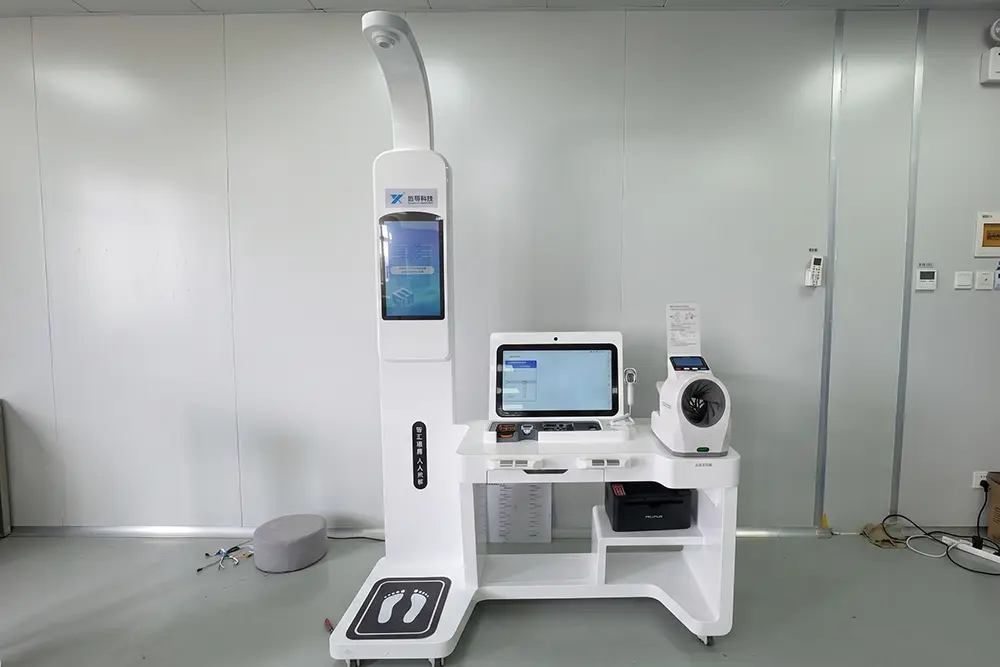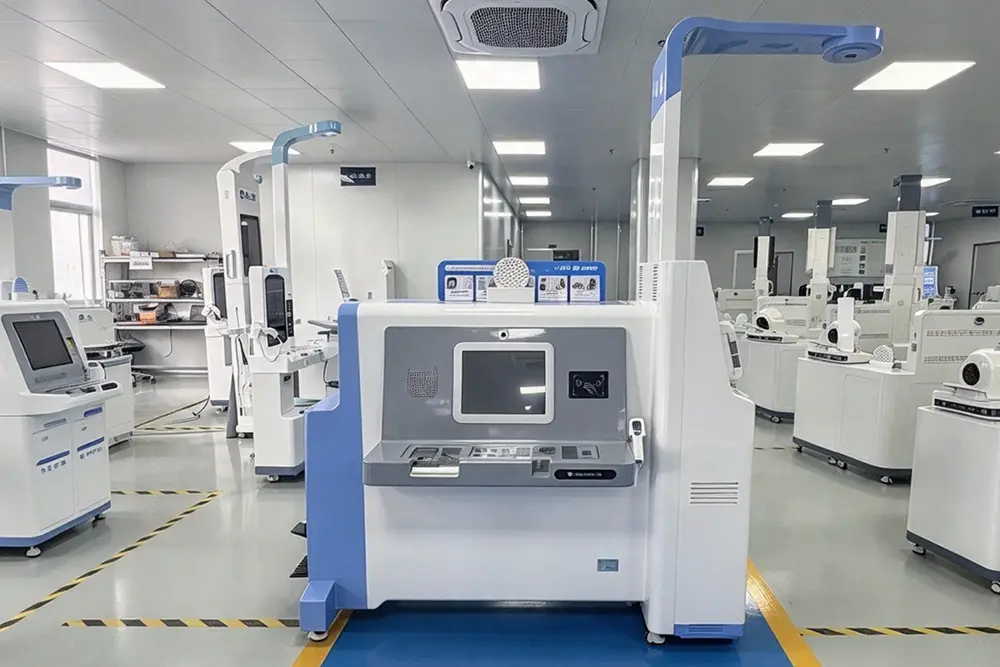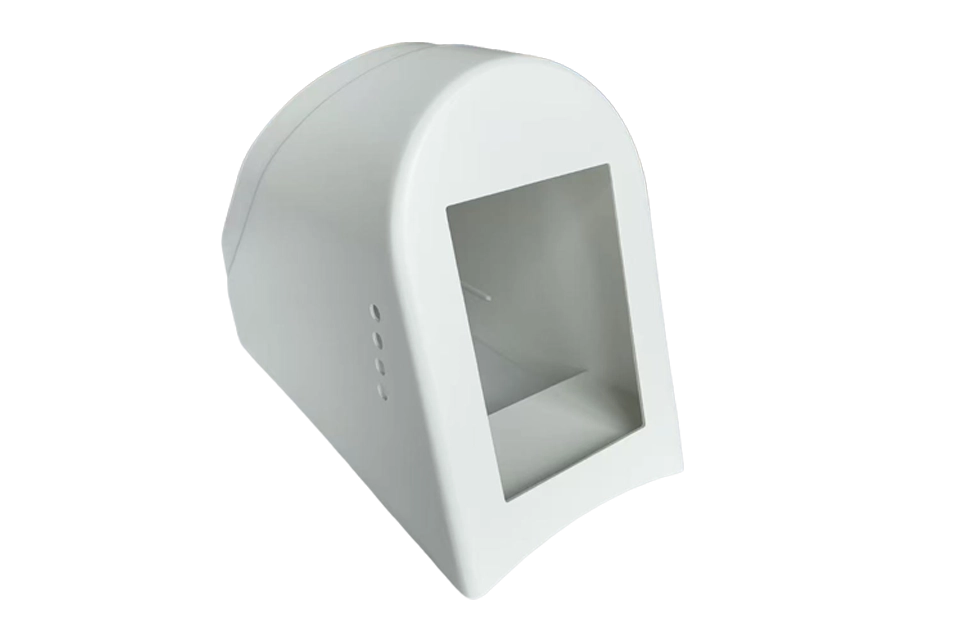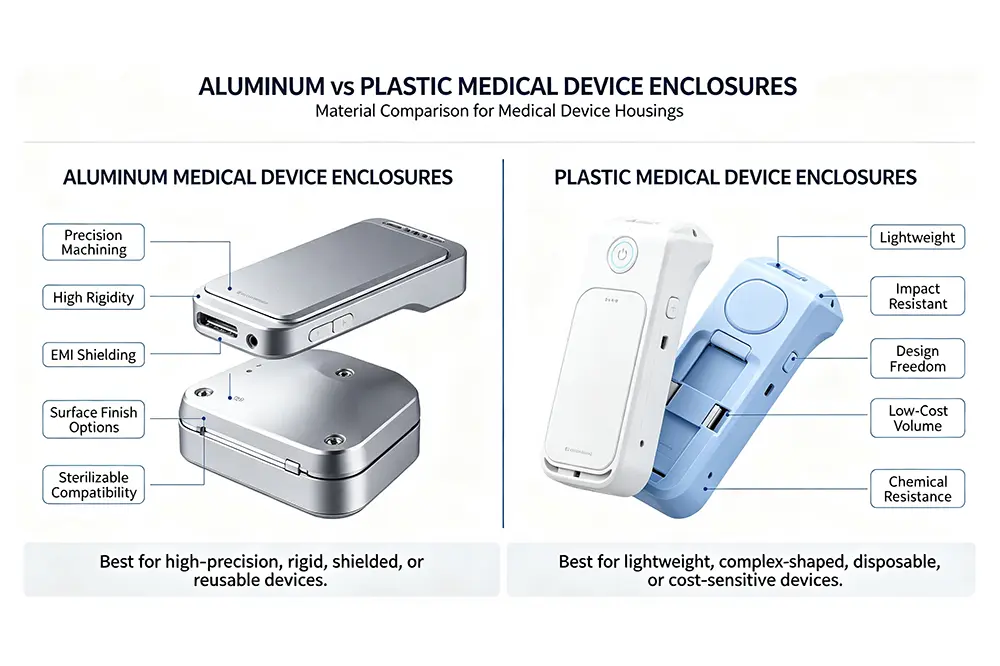
An IVD diagnostic equipment enclosure must do more than protect internal electronics. It needs to accommodate sample handling mechanisms, electrical components, ventilation, wiring, maintenance access, and external controls while maintaining accurate dimensions and a professional medical appearance.
For this project, Zhongrongda manufactured a custom enclosure for an IVD in vitro diagnostic system used in hospitals and laboratory environments. The equipment is designed to perform in-vitro diagnostic testing of human samples, so the housing needed to provide accurate component interfaces while remaining clean, durable, and easy to maintain.
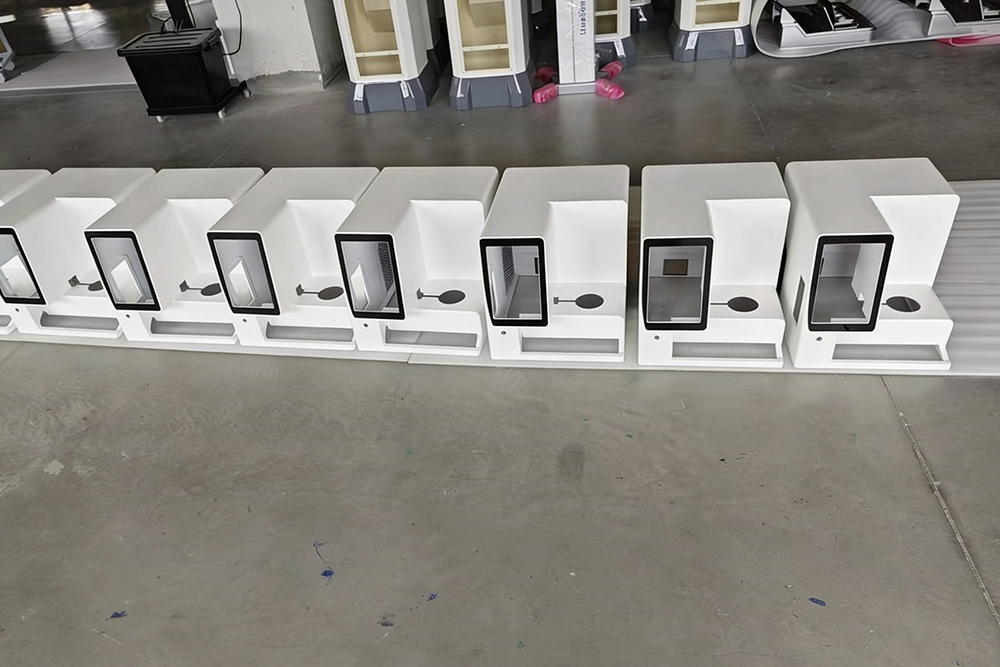
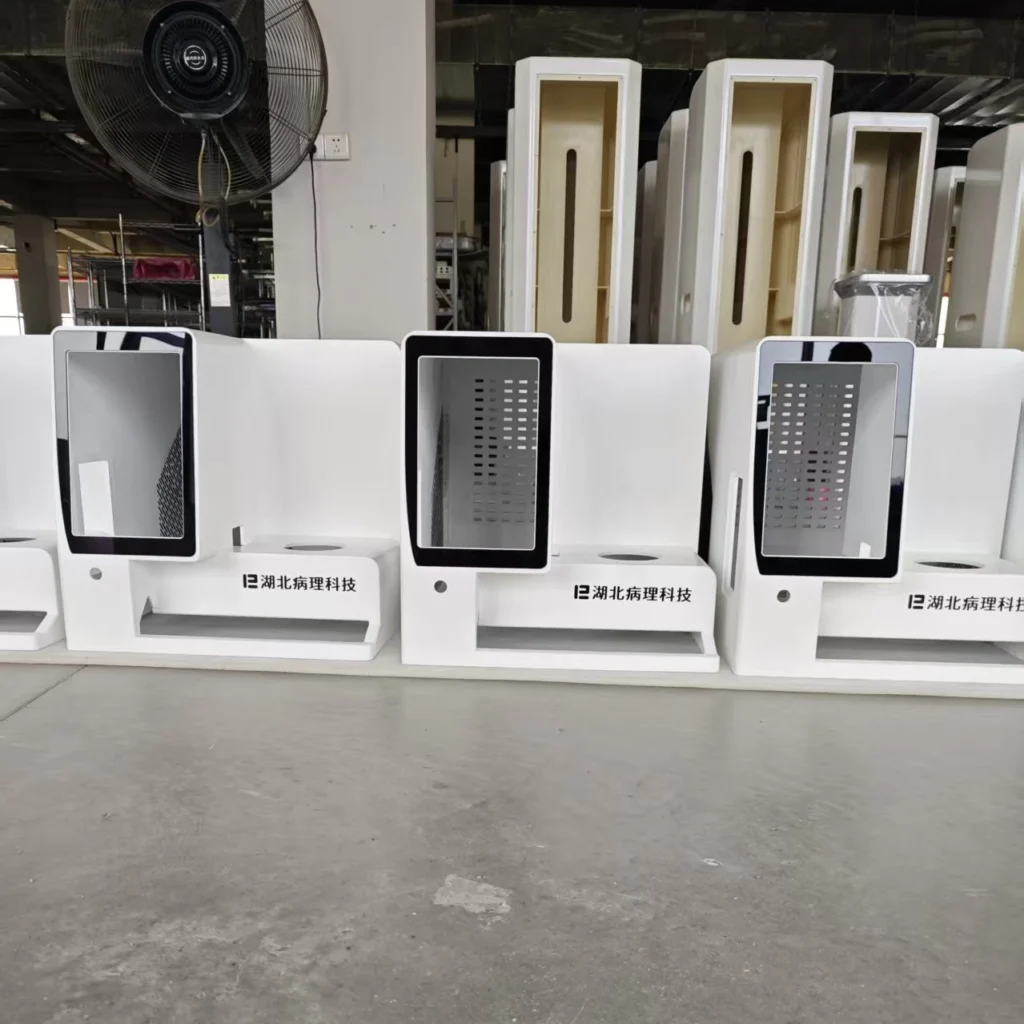
The customer required a small-batch enclosure manufactured primarily from ABS sheet. The complete housing was built from multiple CNC-machined ABS components that were bonded and assembled into the finished structure. A black acrylic frame was also manufactured for the front viewing window.
At Zhongrongda, our engineering team treated the project as a complete enclosure manufacturing task. The main challenges were controlling the dimensional chain of multiple ABS parts, maintaining flatness during bonding and painting, accurately positioning internal ribs and mounting posts, and achieving a clean interface between the white ABS housing and black acrylic window frame.
The completed enclosure went through CNC machining, ABS bonding, surface preparation, painting, acrylic processing, assembly, silk-screen marking, and final inspection before being delivered to the equipment manufacturer for small-batch IVD equipment assembly.
Project Overview
| Project | Specification |
|---|---|
| Industry | IVD / Medical Laboratory Equipment |
| Application | In-vitro diagnostic equipment for human sample testing |
| Country | China |
| Quantity | Small batch |
| Main Material | ABS sheet |
| Secondary Material | Acrylic for black front viewing-window decorative frame |
| Overall Dimensions | 420 × 360 × 440 mm |
| Wall Thickness | 3.0 ±0.3 mm |
| Main Body Finish | White fine-textured painted finish |
| Acrylic Finish | Black, unpainted |
| Overall Dimension Tolerance | ±0.8 mm for dimensions over 100 mm |
| Medium Feature Tolerance | ±0.5 mm |
| Small Hole Tolerance | +0.2 / -0.1 mm |
| Manufacturing Process | ABS CNC machining + bonding + acrylic CNC processing + assembly + painting + inspection |
Customer Requirements
The customer required the entire main enclosure to be manufactured from ABS sheet and assembled from multiple hand-built components.
Unlike a housing that relies on a separate metal frame, this enclosure used the ABS structure itself to incorporate internal ribs and mounting posts. These features needed to support the internal IVD diagnostic module, mainboard, power components, and related equipment.
The overall enclosure size was approximately 420 × 360 × 440 mm, with an overall dimensional tolerance of ±0.8 mm for dimensions greater than 100 mm.
Several functional areas required controlled dimensions:
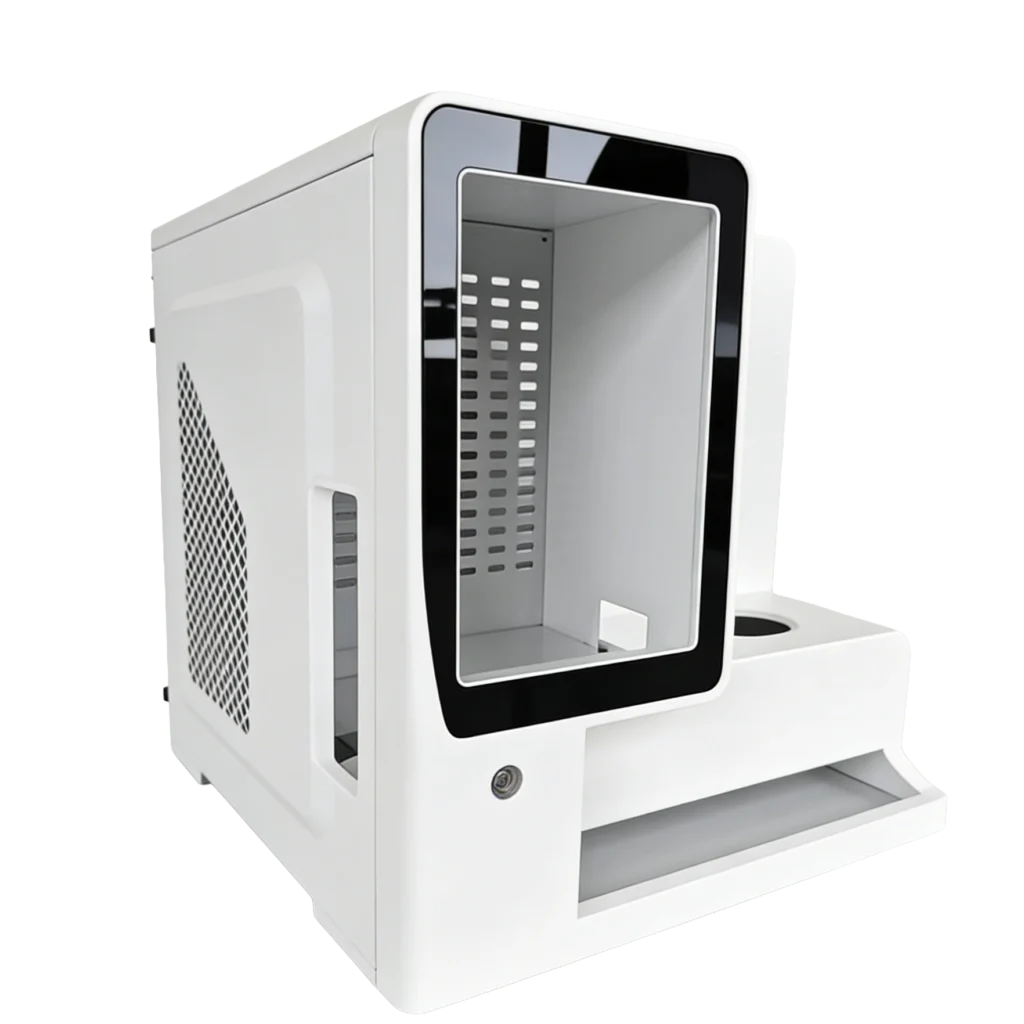
- Front viewing-window outer frame: 240 × 320 mm
- Window inner opening: 180 × 260 mm
- Side ventilation area: 140 × 220 mm
- Bottom front platform extension: 120 mm
- Power-button mounting hole: Ø16 mm
The enclosure also required reserved positions for the viewing window, sample compartment, paper outlet, mechanical lock, ventilation grille, cable-routing holes, and internal maintenance space.
The sample compartment and paper outlet had to align with the internal mechanisms without structural interference. Mounting posts and hole positions also needed to match the customer’s internal components accurately.
Appearance was another important requirement. The main housing needed a clean white finish, while the front acrylic decorative frame was black. The color boundary had to remain sharp without overspray, bleeding, or paint contamination.
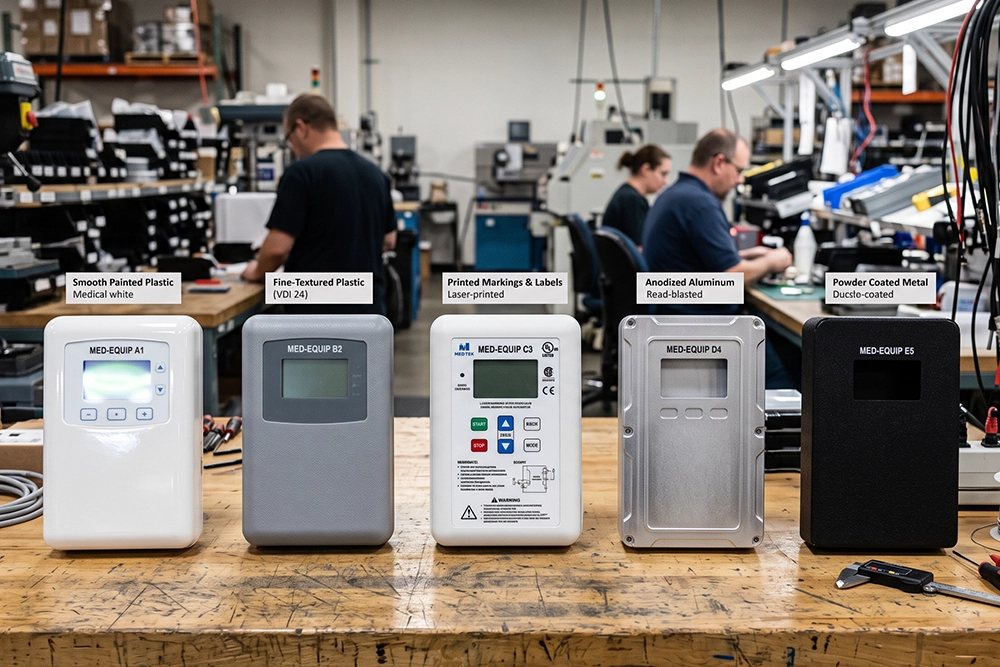
The customer also required large-radius corners, smooth transitions, consistent joints, clean bonding seams, and a fine-textured painted surface suitable for a medical laboratory environment.
Manufacturing Challenges
Multi-Part ABS Enclosure Construction
The enclosure was manufactured from multiple ABS sheet components rather than a single molded housing.
This created a long dimensional chain. Each individual component could affect the final dimensions and alignment of the assembled enclosure.
Our engineering team therefore focused not only on individual CNC dimensions but also on how every component would locate against adjacent parts during bonding.
The bonding process needed to avoid forced assembly because excessive assembly stress could cause cracking or later separation of the bonded joints.
ABS Warpage Control
Large ABS components can deform during machining, bonding, sanding, and painting if the process is not properly controlled.
For this project, the specified geometric requirements included:
- Flatness: ≤0.6 mm
- Adjacent surface perpendicularity: 0.5 mm / 100 mm
- Window frame profile tolerance: ±0.4 mm
The overall enclosure geometry had to remain stable throughout the manufacturing process, particularly during surface preparation and low-temperature oven curing.
Internal Structural Support
The ABS enclosure itself contained structural ribs and mounting posts.
These features had to provide sufficient support for the internal IVD diagnostic module and electronic components while leaving adequate clearance for the internal mechanisms.
The structure also had to avoid interference with the sample compartment, paper outlet, wiring, and maintenance areas.
Acrylic Window Frame
The front viewing window included a black acrylic decorative frame.
The acrylic required separate CNC cutting and precision milling for its internal and external contours and edge chamfers. The finished frame needed to fit closely against the ABS enclosure without visible gaps, warpage, bubbles, or bonding defects.
Surface Finishing
The customer required a fine-textured white painted surface without visible CNC marks, scratches, dents, bonding seams, particles, runs, accumulated paint, or exposed substrate.
The ABS panels therefore required extensive filling, sanding, cleaning, and primer preparation before painting.
Our Engineering Solution
DFM Review
At Zhongrongda, our engineering team first considered the enclosure as an assembled system rather than a collection of independent parts.
The ABS components were divided according to their manufacturability, bonding interfaces, internal structural requirements, and final assembly sequence.
Critical areas such as the viewing window, sample compartment, paper outlet, ventilation grille, power-button hole, and cable-routing openings were considered in relation to the internal equipment.
This approach is particularly important for Diagnostic Equipment Enclosures, where enclosure geometry must follow the internal equipment rather than being designed only for external appearance.
CNC Machining Strategy
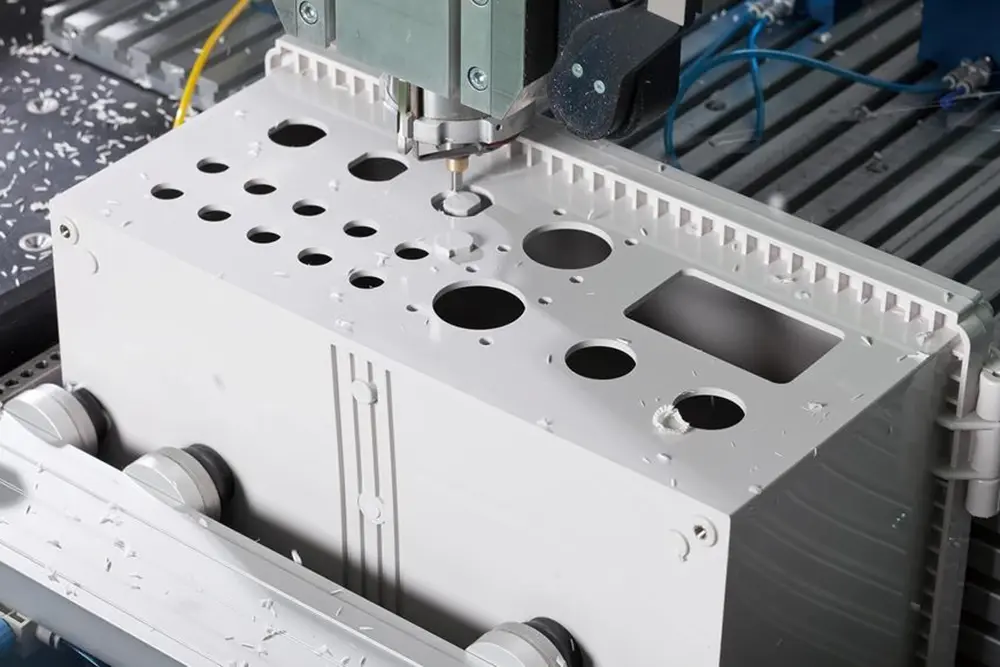
ABS sheet was cut into the required component sizes before CNC machining.
The machining operations included:
- External enclosure profiles
- Large-radius corners
- Sample compartment cavity
- Paper outlet
- Lock hole
- Ventilation grille
- Cable-routing openings
- Mounting posts
- Internal reinforcing ribs
- Other equipment interfaces
The larger openings required careful machining to prevent burrs, chipped edges, or inconsistent profiles.
For the Ø16 mm power-button hole, the specified diameter tolerance was +0.2 / -0.1 mm, giving a controlled range of 15.9–16.2 mm.
Bonding and Structural Assembly
After CNC machining, the individual ABS components were positioned and solvent-bonded.
The bonding sequence was controlled to maintain the overall enclosure geometry. Joints were filled and repaired before multi-stage sanding.
This process removed visible machining marks and reduced the appearance of bonding lines before painting.
Internal ribs and mounting posts were also incorporated into the enclosure structure to provide support for the internal IVD components.
Acrylic Processing
The black acrylic decorative frame was manufactured separately.
The acrylic sheet was cut and CNC machined to establish the inner and outer frame geometry and edge chamfers. Edges were then cleaned and prepared for bonding.
The acrylic was not painted. It was bonded to the finished ABS enclosure at the front viewing-window position, keeping the black appearance of the decorative frame.
Controlled Painting
The ABS housing received an ABS-specific primer followed by a white fine-textured coating.
Painting was carried out in a controlled spray environment. Low-temperature oven curing was used to reduce the risk of heat-related deformation of the ABS housing.
After cooling, the surface was checked for defects including bubbles, pinholes, orange peel, runs, particles, and exposed substrate.
Manufacturing Process
The project followed a structured ABS enclosure manufacturing workflow.
1. DFM Review
Our engineering team reviewed the 3D enclosure design, individual ABS components, internal ribs, mounting posts, functional openings, acrylic interface, and assembly relationships.
2. Programming
CNC machining programs were prepared for the ABS enclosure components and acrylic viewing-window frame.
3. Material Preparation
ABS sheet and acrylic sheet were prepared and cut according to the required component dimensions.
4. CNC Machining
ABS components were CNC machined for external profiles, corners, sample compartment features, ventilation openings, cable-routing holes, mounting posts, and internal reinforcing structures.
The acrylic frame was separately CNC machined for its inner contour, outer contour, and chamfered edges.
5. Deburring and Preparation
ABS components were deburred and prepared for bonding. Acrylic edges were cleaned and finished to remove unwanted chips and burrs.
6. ABS Bonding
The separated ABS components were accurately positioned and solvent-bonded into the complete enclosure structure.
7. Filling and Sanding
Bonding seams were filled and repaired. Multiple sanding stages were used to remove CNC marks and create a uniform surface.
8. Surface Finishing
ABS primer and white fine-textured coating were applied. Controlled low-temperature curing was used to minimize the risk of secondary deformation.
9. Acrylic Assembly and Printing
The black acrylic viewing-window frame was bonded into position. The housing was also prepared for customer logo and equipment identification markings.
10. Final Assembly and Inspection
The enclosure was assembled and checked for overall dimensions, openings, structural features, acrylic bonding, surface quality, and assembly condition.
This type of integrated workflow is also part of our broader Manufacturing capability for custom equipment housings.
Quality Inspection
Quality inspection focused on the dimensional and visual features that directly affected equipment assembly and final appearance.
For this project, dimensional requirements included:
- Overall dimensions: ±0.8 mm for features over 100 mm
- Medium structural features: ±0.5 mm
- Small hole diameter: +0.2 / -0.1 mm
- Bending/forming dimensions: ±0.4 mm
- Internal guide-rail hole center distance: ±0.3 mm
- Adjacent surface perpendicularity: 0.5 mm / 100 mm
- Large-plane flatness: ≤0.6 mm
- Window frame profile: ±0.4 mm
Depending on the feature and required accuracy, dimensional inspection can be performed using CMM inspection, height gauges, micrometers, and calipers. Critical dimensions are checked against the approved drawings and project specifications.
Inspection focused on:
- Overall enclosure dimensions
- Window frame dimensions
- Sample compartment opening
- Paper outlet alignment
- Ventilation grille dimensions
- Power-button hole
- Mounting-post positions
- Internal structural features
- ABS bonding seams
- Acrylic frame alignment
- Surface finish
- Paint adhesion and appearance
- Scratches, dents, bubbles, pinholes, and orange peel
- Overall assembly condition
First-article inspection principles can be applied during prototype and small-batch projects to verify the initial manufactured configuration before proceeding with the remaining production quantity.
Final Results
The complete IVD diagnostic equipment enclosure was manufactured from CNC-machined ABS components with a black acrylic front viewing-window frame.
The ABS housing was successfully bonded, structurally assembled, surface prepared, painted, and inspected. The acrylic frame was separately CNC processed and accurately bonded to the front viewing-window area.
Particular attention was given to the dimensional chain created by multiple ABS components, internal structural support, sample compartment clearance, ventilation openings, cable routing, ABS warpage, and the acrylic-to-ABS interface.
The finished enclosure achieved the customer’s required structural, functional, dimensional, and appearance requirements.
The complete housing passed structural and appearance acceptance and was delivered to the equipment manufacturer for small-batch assembly of IVD in-vitro diagnostic equipment.
This project demonstrates how CNC-machined ABS sheet and precision-machined acrylic can be combined to create a customized medical equipment housing without requiring a traditional injection-molding tool.
For similar projects, our Medical Device Enclosure capability can support custom housings for medical, laboratory, and diagnostic equipment.
Why Choose Zhongrongda
This project required coordination across CNC machining, ABS bonding, structural design, acrylic processing, surface finishing, assembly, and inspection.
At Zhongrongda, our engineering team can support customers with:
- Engineering support and DFM review
- Fast project evaluation and quotation
- CNC-machined ABS enclosure manufacturing
- Rapid Prototyping
- Small-batch production
- ABS bonding and hand-built enclosure assembly
- Acrylic CNC processing
- Surface finishing and silk-screen printing
- Dimensional and appearance inspection
- NDA and confidential project handling
- Medical and diagnostic equipment enclosure manufacturing
Our quality management capabilities include ISO9001 and ISO13485 requirements for applicable medical and manufacturing projects.
For product designers, mechanical engineers, purchasing managers, and medical equipment manufacturers, we can coordinate multiple processes through one manufacturing workflow instead of requiring customers to manage separate machining, finishing, and assembly suppliers.
FAQ
1. What is the MOQ for a custom IVD diagnostic equipment enclosure?
The MOQ depends on the project structure, manufacturing process, and development stage. Zhongrongda supports prototype, validation, and small-batch enclosure manufacturing, allowing customers to develop and validate equipment before higher-volume production.
2. What material was used for this IVD diagnostic equipment enclosure?
The main enclosure was manufactured from ABS sheet. A black acrylic frame was used for the front viewing-window decorative area. The acrylic frame does not carry the main structural load.
3. What are the overall dimensions of the enclosure?
The overall enclosure dimensions are approximately 420 mm in depth, 360 mm in width, and 440 mm in height. The specified tolerance for dimensions over 100 mm is ±0.8 mm.
4. What tolerance can you achieve on ABS medical equipment housings?
Tolerance depends on the feature size, geometry, material, and manufacturing method. For this project, overall dimensions over 100 mm were specified at ±0.8 mm, medium features at ±0.5 mm, and selected small holes at +0.2 / -0.1 mm.
5. Can you manufacture complex ABS diagnostic equipment housings?
Yes. CNC machining can produce ABS external profiles, large-radius corners, internal cavities, ventilation openings, cable-routing holes, mounting posts, reinforcing ribs, and other custom interfaces.
6. How do you control ABS enclosure warpage?
Warpage needs to be controlled throughout CNC machining, bonding, sanding, painting, and curing. For this project, the specified large-plane flatness was ≤0.6 mm, with adjacent surface perpendicularity controlled to 0.5 mm / 100 mm. Low-temperature curing was used to reduce heat-related deformation.
7. Can you manufacture acrylic parts together with an ABS enclosure?
Yes. Acrylic can be cut and CNC machined separately, including inner and outer contours and edge chamfers. It can then be bonded to the ABS enclosure during final assembly.
8. Can you manufacture small-batch diagnostic equipment enclosures?
Yes. This IVD enclosure was manufactured specifically for small-batch assembly. Zhongrongda can support prototype and small-batch projects involving CNC machining, bonding, painting, acrylic processing, assembly, and inspection.
9. Can you provide painted ABS medical equipment enclosures?
Yes. ABS components can be prepared with ABS-specific primer and finished with a specified coating. This project used a white fine-textured finish with controlled low-temperature curing.
10. Can you sign an NDA for an IVD equipment project?
Yes. NDA and confidential project handling can be discussed before technical drawings and product information are shared with our engineering team.
CTA
Need a reliable CNC machining partner for your next project?
Upload your drawings today and our engineering team will provide a free DFM review and quotation within 24 hours.
Whether you need a CNC-machined ABS prototype, a custom IVD diagnostic equipment enclosure, or small-batch medical equipment production, Zhongrongda can help evaluate the enclosure structure, material, machining process, bonding method, surface finishing, and assembly requirements.
Contact our engineering team to discuss your next enclosure project.