Introduction
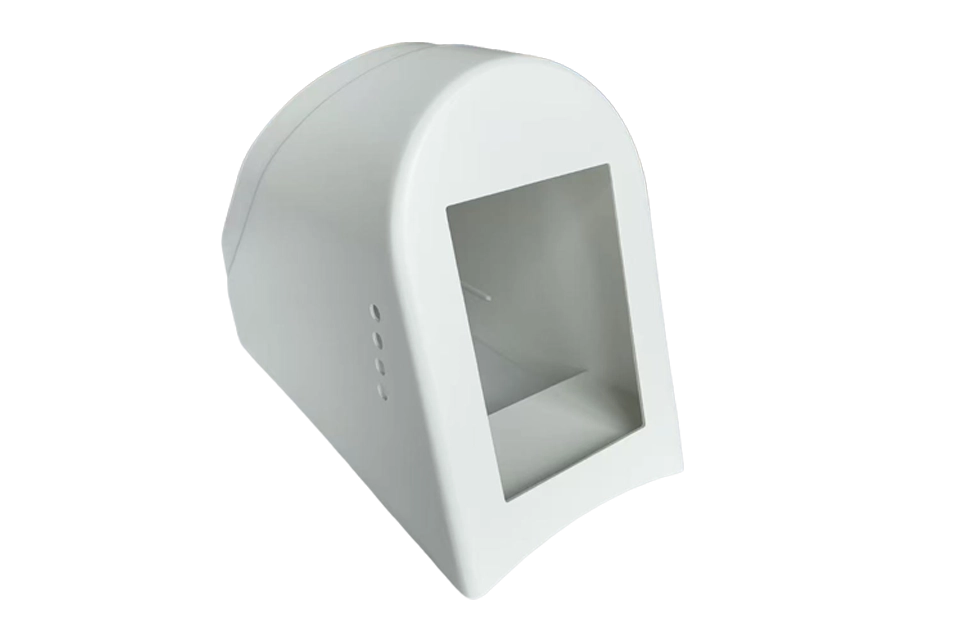
A pathology equipment enclosure has to do more than provide an attractive exterior. It must accommodate internal mechanisms, protect electronic and optical components, provide access for maintenance, and maintain accurate interfaces between multiple enclosure parts. For this project, Zhongrongda worked on a custom enclosure for a pathology analysis system used for pathological tissue slide analysis.
The equipment is designed for hospitals and third-party medical laboratories, where it supports slide loading, sample scanning, image acquisition, and pathology image analysis. The customer required a small-batch enclosure for prototyping, validation, and initial production.
At Zhongrongda, our engineering team approached the project as a complete enclosure manufacturing task rather than simply machining individual panels. The design combined a load-bearing SPCC cold-rolled steel frame with CNC-machined ABS outer panels and acrylic viewing windows.
The finished enclosure was processed, assembled, painted, inspected, and delivered to the equipment manufacturer. After final acceptance, the completed housing was put into use.
Project Overview
| Project | Specification |
|---|---|
| Industry | Medical / Pathology Equipment |
| Application | Pathology tissue slide analysis equipment |
| Country | China |
| Main Materials | ABS + SPCC cold-rolled steel + acrylic |
| Overall Size | 420 × 380 × 520 mm |
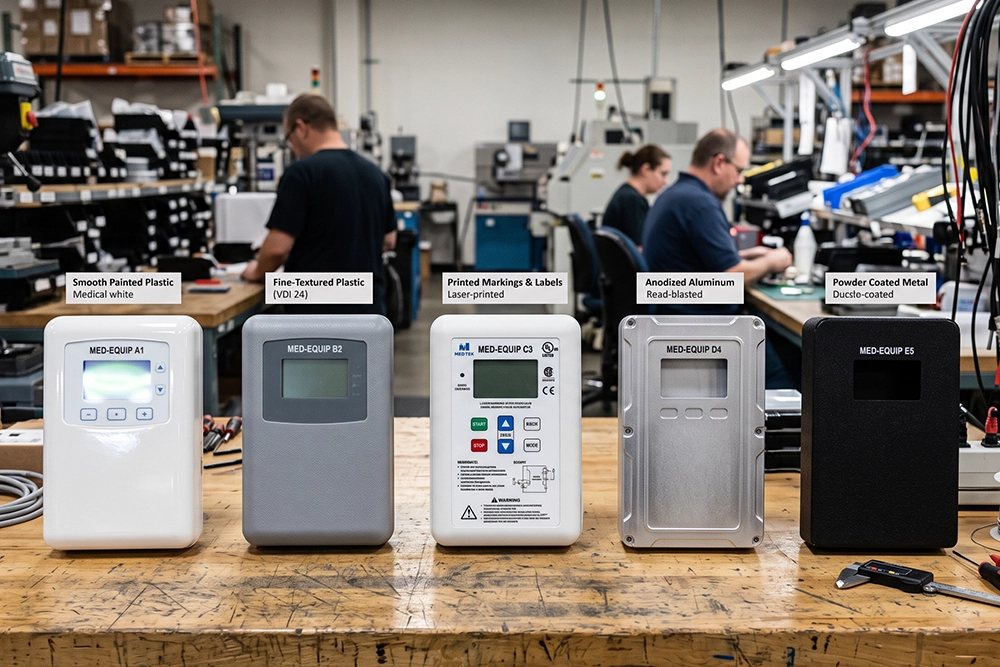
| Surface Finish | White + light gray, semi-matte painted finish |
| Main Tolerances | Overall dimensions up to ±1.2 mm; critical interfaces down to ±0.3–0.5 mm |
| Manufacturing Process | Sheet metal fabrication + CNC machining + hand-built ABS assembly + acrylic machining + painting + assembly |
| Quantity | Small batch |
| Lead Time | Prototype / validation / small-batch project; specific lead time was project-dependent |
Customer Requirements
The customer had several requirements that affected both the mechanical structure and manufacturing process.
First, the internal SPCC steel frame needed sufficient strength and rigidity to support the pathology scanning module, slide transport mechanism, touchscreen display, lighting components, mainboard, and power system. The ABS enclosure was designed primarily as the external housing and was not intended to carry the main equipment load.
The enclosure also required multiple functional openings. These included a display opening, slide loading and unloading opening, ventilation grilles, cable routing holes, and service access areas. Their locations had to match the customer’s internal components while leaving sufficient space for wiring and maintenance.
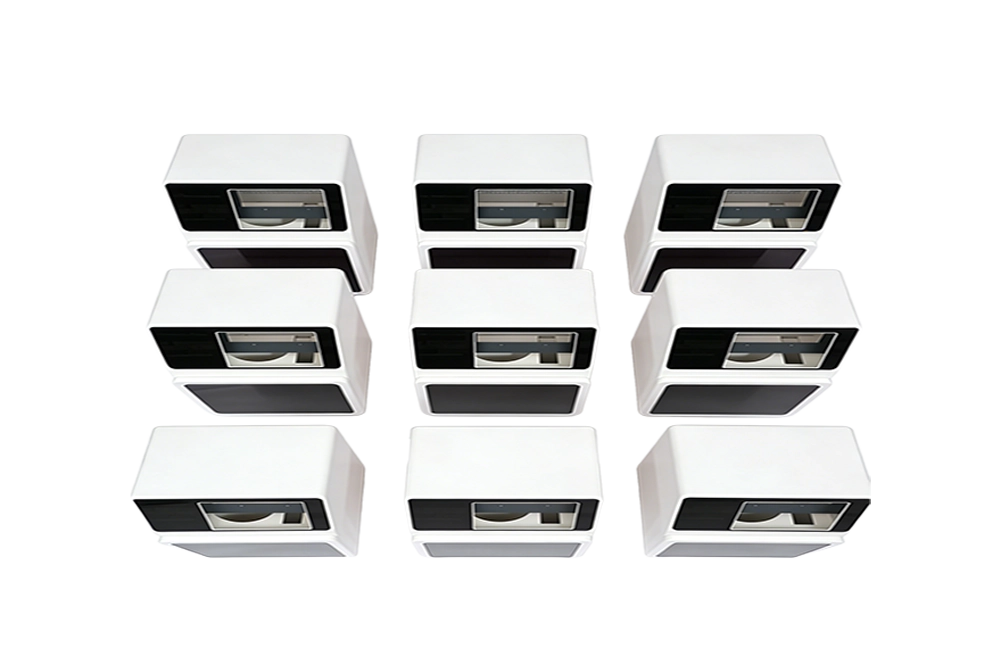
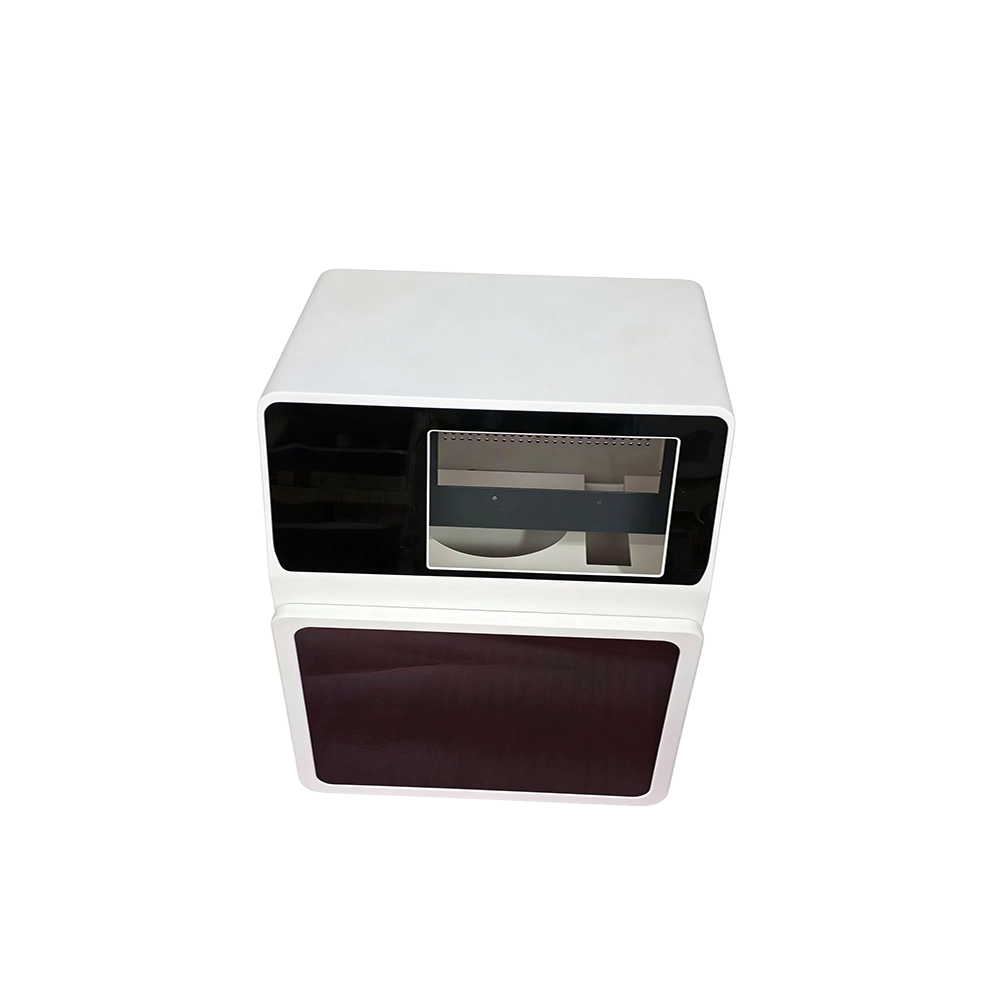
The housing measured approximately 420 × 380 × 520 mm overall. The upper and lower enclosure sections were each approximately 260 mm high, with dimensional requirements specified separately for critical areas.
A large black acrylic viewing window measured approximately 390 × 180 mm with a ±0.5 mm requirement. The central sample access opening was approximately 220 × 130 mm with a ±0.4 mm requirement. The lower black viewing area measured approximately 360 × 240 mm, also requiring controlled dimensional accuracy.
The appearance requirements were equally important. The customer specified a white main body with light-gray sections, large-radius corners, smooth curved transitions, uniform panel gaps, and a semi-matte painted surface.
Manufacturing Challenges
Complex Multi-Part Enclosure Structure
The enclosure contained numerous parts, creating a long dimensional chain during assembly. Even when individual components were within their specified dimensions, accumulated variation could affect panel alignment and visible gaps.
Our engineering team therefore treated the enclosure as an assembled system. Critical interfaces, acrylic slots, openings, mounting locations, and panel joints were considered together rather than independently.
ABS Machining and Finishing
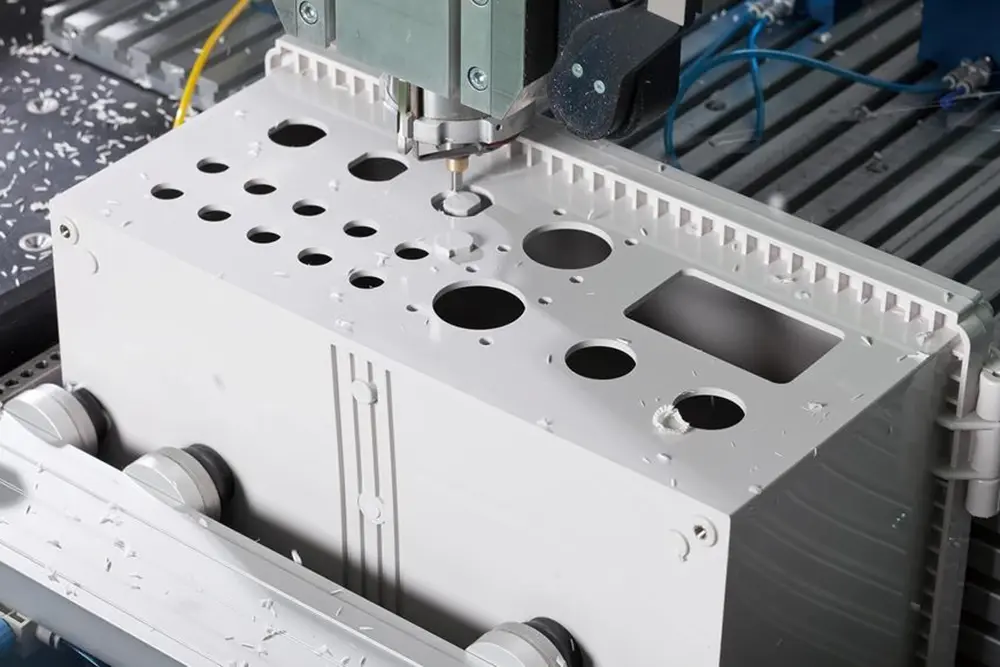
The large ABS panels required CNC machining for the outer contours, large-radius corners, display opening, sample opening, acrylic mounting groove, ventilation holes, and cable routing holes.
After machining, the panels required hand-built joining, filling, and multi-stage sanding. This was necessary to reduce visible machining marks and joint lines before painting.
Acrylic Window Fit
The acrylic viewing panels required controlled machining because the window needed to sit flush with the surrounding enclosure.
The mounting groove was therefore treated as a critical interface. Excessive clearance could result in movement or uneven installation, while insufficient clearance could make assembly difficult or create stress on the acrylic.
Painting and Heat Control
The large ABS enclosure presented another challenge during painting and curing. Excessive heat could cause deformation of the plastic panels.
The project therefore used an ABS-specific primer system and low-temperature oven curing. The white and light-gray sections were separately masked and painted to create a clean two-color boundary.
Our Engineering Solution
Our engineering approach focused on maintaining the relationship between the internal structure, external housing, and functional openings.
DFM and Structural Planning
The first priority was separating structural load from cosmetic enclosure functions. The SPCC steel frame carried the main equipment components, while the ABS panels provided the external housing.
This reduced the structural demands placed on the plastic panels and allowed the enclosure to be assembled without relying on ABS for the main equipment load.
The internal frame was produced through laser cutting, CNC bending, welding, grinding, and correction. After fabrication, the steel structure received surface preparation and an epoxy primer.
CNC Machining Strategy
For the ABS panels, CNC machining was used to establish the major external geometry and critical openings.
Machining operations included:
- External contours and large-radius corners
- Display opening
- Sample loading opening
- Acrylic window groove
- Ventilation openings
- Cable routing holes
- Other component clearance areas
Our team also paid particular attention to the locations of the openings around the internal slide transport mechanism to prevent mechanical interference.
Assembly and Surface Preparation
After CNC machining, multiple ABS sections were joined into the required enclosure geometry. Filling and multi-stage sanding were then used to reduce machining marks and visible joining lines.
The acrylic panel was machined separately. Its edges were chamfered and polished to remove chips and burrs, while a protective film was retained during the manufacturing process to reduce the risk of surface damage.
The acrylic was not painted together with the enclosure. It was installed after painting to protect the transparent viewing surface from paint contamination.
Manufacturing Process
The project followed a controlled sequence from structural fabrication through final inspection.
1. DFM Review
The enclosure structure, openings, mounting relationships, acrylic interface, and internal component clearances were reviewed before manufacturing.
2. Programming
CNC machining programs were prepared for the ABS housing components and acrylic panel features.
3. Material Preparation
SPCC sheet, ABS panels, and acrylic materials were prepared according to the required components.
4. CNC Machining
ABS panels were CNC machined to create the external geometry, openings, grooves, ventilation features, and cable routing features.
5. Deburring and Surface Preparation
Machined components were deburred, sanded, and prepared for subsequent assembly and finishing.
6. Surface Finishing
The steel frame received cleaning, rust removal treatment, epoxy primer, and finishing preparation. ABS panels received ABS-specific primer and surface leveling.
7. Assembly
The ABS enclosure was mounted to the steel frame. Panel joints were adjusted, casters were installed, and the acrylic viewing panel was fitted.
8. Inspection
Dimensions, openings, panel gaps, acrylic fit, surface quality, and assembly condition were checked.
9. Packaging
After completion and acceptance, the enclosure was prepared for delivery to the equipment manufacturer.
For projects requiring an earlier validation stage, our Rapid Prototyping capability can also be integrated into the development process before moving toward repeat small-batch manufacturing.
Quality Inspection
Quality control was applied to both individual components and the assembled enclosure.
The inspection process focused on the dimensions and interfaces that directly affected equipment assembly and appearance.
Depending on the feature, measurement methods can include CMM inspection, height gauges, micrometers, and calipers. For this project, dimensional checks covered the overall enclosure dimensions, viewing windows, sample opening, panel interfaces, and other specified features.
First Article Inspection principles were applied to verify the initial manufactured configuration before final assembly.
Final inspection covered:
- Overall dimensions
- Opening positions and dimensions
- Acrylic window fit
- Panel alignment
- Surface finish
- Paint condition
- Visible gaps and joints
- Structural assembly
- Functional clearance around internal mechanisms
This approach is consistent with our broader Manufacturing workflow, where dimensional accuracy, appearance, and assembly requirements are considered together.
Final Results
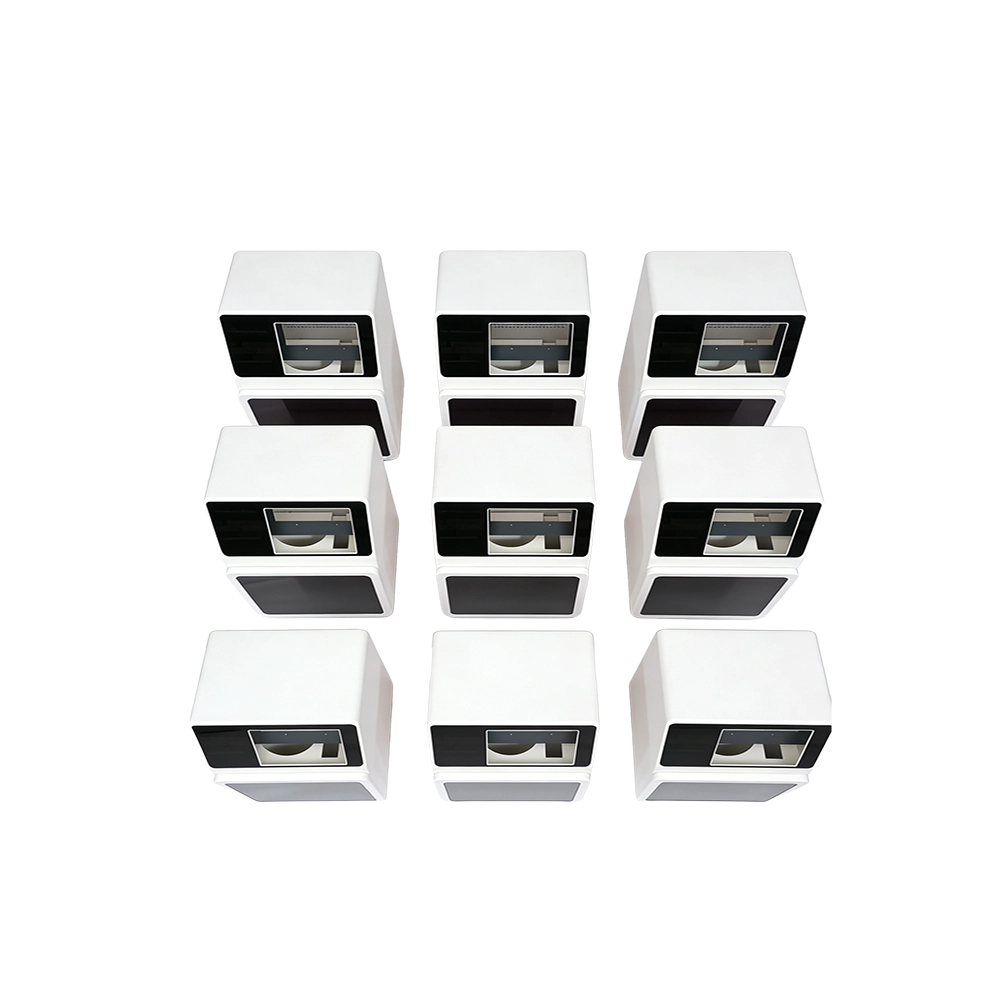
The complete pathology equipment enclosure was manufactured from SPCC steel, ABS, and acrylic according to the customer’s structural, functional, appearance, and assembly requirements.
The steel frame provided the required structural support for the internal equipment, while the CNC-machined ABS housing provided the external form and protective enclosure.
The final unit completed CNC machining, hand-built panel assembly, surface preparation, two-color painting, acrylic installation, final assembly, and inspection.
Particular attention was given to the uniformity of enclosure joints, acrylic window alignment, two-color paint boundaries, ABS deformation control, and clearance around the slide transport mechanism.
The complete enclosure passed the required structural and appearance acceptance process and was delivered to the equipment manufacturer. The finished equipment has since been put into use.
For similar medical equipment projects, our Medical Device Enclosure and Diagnostic Equipment Enclosures capabilities can support prototype development, enclosure manufacturing, and small-batch production.
Why Choose Zhongrongda
Medical equipment enclosure projects often require coordination between mechanical design, material selection, machining, finishing, and final assembly. This project demonstrates our ability to manage those requirements as one manufacturing process.
At Zhongrongda, customers can work with our engineering team for:
- Engineering support and DFM review
- Fast quotation and project evaluation
- Rapid prototyping
- Small-batch manufacturing
- CNC machining and enclosure fabrication
- Surface finishing and assembly
- Dimensional and appearance inspection
- NDA / confidential project handling
- Medical enclosure manufacturing support
Our company also operates with quality management requirements associated with ISO9001 and ISO13485, supporting projects where consistent manufacturing processes and quality control are important.
For customers developing medical, laboratory, diagnostic, or robotic equipment, our broader Enclosure Solutions cover different enclosure requirements from prototype development through production.
FAQ
1. What is the MOQ for a custom pathology equipment enclosure?
MOQ depends on the enclosure structure, materials, manufacturing process, and project stage. Zhongrongda supports prototype, validation, and small-batch manufacturing rather than requiring every project to begin with large-volume production.
2. What materials can be used for a pathology equipment enclosure?
This project used a combination of ABS for the external housing, SPCC cold-rolled steel for the internal structural frame, and acrylic for the viewing windows. Other material combinations can be evaluated according to structural, functional, appearance, and manufacturing requirements.
3. What tolerance can you achieve?
Tolerance depends on the material, feature size, manufacturing process, and functional requirement. In this project, specified dimensions ranged from ±0.3 mm for selected features to ±1.2 mm for the overall height.
4. Can you manufacture CNC-machined ABS medical equipment housings?
Yes. CNC machining can be used to produce ABS enclosure contours, openings, mounting grooves, ventilation features, and cable routing holes. Additional sanding, filling, and painting can be used when a finished appearance is required.
5. Can you produce acrylic viewing windows together with the enclosure?
Yes. Acrylic panels can be cut and CNC machined separately, including edge finishing and engraved markings. For painted enclosures, the acrylic can be installed after painting to protect the transparent surface.
6. Can Zhongrongda support rapid prototyping?
Yes. Prototype and validation projects are part of our manufacturing workflow. Rapid Prototyping can be combined with CNC machining, enclosure assembly, finishing, and inspection.
7. Can you manufacture medical device enclosures in small batches?
Yes. This pathology equipment project itself was produced for prototyping, validation, and small-batch requirements. Production quantities can be discussed according to the project stage and manufacturing complexity.
8. Can you sign an NDA for a medical equipment enclosure project?
NDA and confidential project handling can be discussed before technical drawings and project information are shared. Customers can communicate their confidentiality requirements with our engineering and sales teams.
9. Can you manufacture other diagnostic equipment housings?
Yes. Zhongrongda provides Diagnostic Equipment Enclosures and other medical equipment housing solutions. Project requirements such as internal component layout, access openings, structural support, materials, finishing, and assembly can be reviewed during the DFM stage.
10. Can you handle both enclosure manufacturing and final assembly?
Yes. Depending on the project, we can coordinate CNC machining, sheet metal fabrication, finishing, acrylic processing, enclosure assembly, and final inspection as part of an integrated manufacturing workflow.
CTA
Need a reliable CNC machining partner for your next project?
Upload your drawings today and our engineering team will provide a free DFM review and quotation within 24 hours.
Whether you need a prototype, custom medical equipment enclosure, or small-batch production, Zhongrongda can help evaluate the structure, materials, machining requirements, surface finishing, and assembly process.
Contact our engineering team to discuss your next enclosure project.